Thank you for visiting SNEWPapers!
Sign up free
Editorial
December 24, 1803
Alexandria Daily Advertiser
Alexandria, Virginia
What is this article about?
Editorial from Charleston Courier criticizes anti-federalists for hypocrisy in opposing high government salaries under Federalists but supporting them now under Republicans, highlighting inconsistency and praising the measure itself.
Clipping
OCR Quality
95%
Excellent
Full Text
From the Charleston Courier.
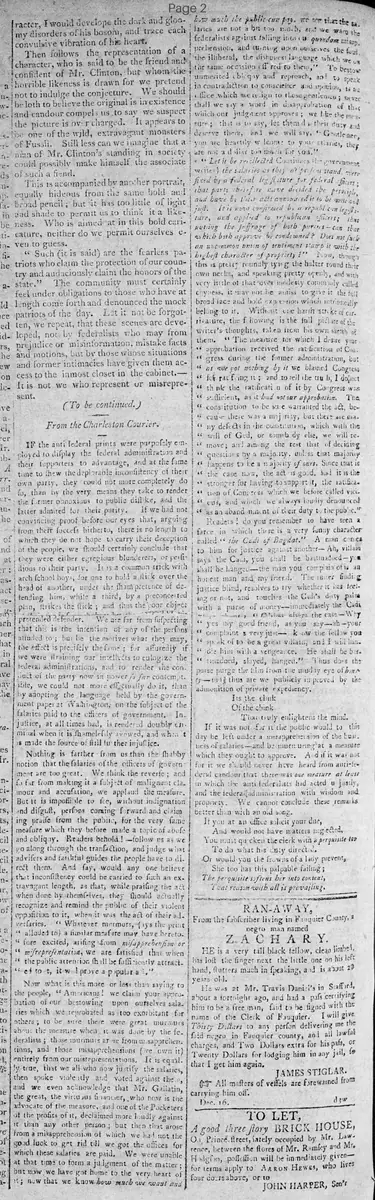
IF the anti federal prints were purposely employed to display the federal administration and their supporters to advantage, and at the same time to show the deplorable inconsistency of their own party, they could not more completely do so, than by the very means they take to render the former obnoxious to public dislike, and the latter admired for their purity. If we had not convincing proof before our eyes that, arguing from their success hitherto, there is no length to which they do not hope to carry their deception of the people, we should certainly conclude that they were either egregious blunderers, or perfidious to their party. It is a common trick with arch school boys, for one to hold a stick over the head of another, under the sham pretence of defending him, while a third, by a preconcerted plan, strikes the stick ; and thus the poor object is punished by his pretended defender. We are far from suspecting that this is the intention of any of the persons alluded to ; but be the motives what they may, the effect is precisely the same : for assuredly if we were straining our intellects to eulogize the federal administrations, and to render the conduct of the party now in power so far contemptible, we could not more effectually do it, than by adopting the language held by the government paper at Washington; on the subject of the salaries paid to the officers of government. Injustice, at all times bad, is rendered doubly criminal when it is shamelessly avowed, and when it is made the source of still further injustice.
Nothing is farther from us than the shabby notion that the salaries of the officers of government are too great. We think the reverse : and so far from making it a subject of malignant clamor and accusation, we applaud the measure.
But it is impossible to see, without indignation and disgust, persons coming forward and claiming praise from the public, for the very same measure which they before made a topic of abuse and obloquy. Readers behold! —follow us as we go along through the transaction, and judge what advisers and faithful guides the people have to direct them. And say, would any one believe that inconsistency could be carried to such an extravagant length, as that, while praising the act when done by themselves, they should actually recognize and remind the public of their violent opposition to it, when it was the act of their adversaries. "Whatever murmurs (says the print alluded to) a similar measure may have heretofore excited, arising from misapprehension or misrepresentation, we are satisfied that when the public attention shall be sufficiently attracted to it, it will prove as popular as ."
Now what is this more or less than saying to the people, "Americans! we claim your approbation of our bestowing upon ourselves salaries which we reprobated as too exorbitant for others; to be sure there were great murmurs about the measure when it was done by the federalists ; those murmurs arose from misapprehensions, and those misapprehensions (we own it) entirely from our misrepresentations. It is equally true, that we all—who now justify the salaries, then spoke violently and voted against them, and we even acknowledge that Mr. Gallatin, the great, the virtuous financier, who now is the advocate of the measure, and one of the Pocketters of the profits of it, declaimed more loudly against it than any other person; but then that arose from a misapprehension of which we had not the good luck to get rid till we got the offices for which these salaries are paid. We were unable at that time to form a judgment of the matter : but now we have got home to the very heart of it: now that we know how much we want and how much the public can pay, we see that the salaries are not a bit too much, and we were the federalists against tainting into quoddam misapprehension, and turning upon ourselves the foul, the illiberal, the dishonest language which we used the same occasion to redound to them."
To bestow unmerited blame and reproach, and to speak in contradiction to conscience and opinion, is an office which we resign to those gentlemen; never shall we say a word in disapprobation of that which our judgment approves ; we like the measure; that is to say, let them do their duty and deserve them, and we will say, "Gentlemen, you are heartily welcome to your salaries, they are not a bit too much for you."
Let it be remembered Committees of government writer the salaries as they at present stand. were fixed by a federal legislature for federal officers; that party therefore have decided the principle, and have by their oaths announced it to be wise and just. It is now confirmed by a republican legislature, and applied to republican officers; thus uniting the suffrage of both parties—can that which both approve: he condemned? Does not such an uncommon union of sentiment stamp it with the highest character of propriety? Now, though this is pretty roundly tying the halter round their own necks, and speaking pretty openly, and with very little of that over modesty commonly called coyness, it may not be amiss to give it the full broad face and bold expression which intrinsically belong to it. Without too harsh stroke of caricature, the following is the full picture of the writer's thoughts, taken from his own sketch of them. "The measure for which I desire your apprebation received the ratification of Congress during the former administration, but as we got nothing by it we blamed Congress for ratifying it ; and to tell the truth, I do not think the ratification of it by Congress was sufficient, as it had not our approbation. The constitution to be sure warranted the act, because there was a majority, but there are many defects in the constitution, which with the will of God, or somebody else. we will remove: and among the rest that of deciding questions by a majority. unless that majority happens to be a majority of ours. Since that is the case now, the act is good, and it is the stronger for having to support it, the ratification of Congress which we before called vicious, and which we always loudly denounced as an abandonment of their duty to the public."
Readers ! do you remember to have seen a farce in which there is a very funny character called "the Cadi of Bagdat." A man comes to him for justice against another—Ah, villain says the Cadi, you shall be bastinadoed—you shall be hanged—the man you complain of is an honest man and my friend. The suitor seeing justice blind, resolves to try whether it has feeling or not, and touches the Cadi's dirty palm with a purse of money—immediately the Cadi "Li-hane, " says he alters the case—Why "yes my good friend, as you say—ah—your complaint is very just— I know the fellow you speak of to be a great villain, and I will handle him with a vengeance. He shall be bastinadoed, slayed, hanged." Thus does the purse purge the film from the muddy eye of honesty—paid thus are we publicly improved by the admonition of private expediency.
'Tis the clank
Of the chink
That truly enlightens the mind.
If it was not for it the public would to this day be left under a misapprehension of the business of salaries—and be murmuring at a measure which they ought to approve. And if it was not for it we should never have heard from anti-federal candour that there was one measure at least in which the anti federalists had acted unjustly, and the federal administration with wisdom and propriety. We cannot conclude these remarks better than with an old song.
If you at an office solicit your due,
And would not have matters neglected,
You must quicken the clerk with a perquisite fee
To do what his duty directs.
Or would you the frowns of a lady prevent,
She too has this palpable failing;
The perquisite softens her into consent,
That reason with all is prevailing.
IF the anti federal prints were purposely employed to display the federal administration and their supporters to advantage, and at the same time to show the deplorable inconsistency of their own party, they could not more completely do so, than by the very means they take to render the former obnoxious to public dislike, and the latter admired for their purity. If we had not convincing proof before our eyes that, arguing from their success hitherto, there is no length to which they do not hope to carry their deception of the people, we should certainly conclude that they were either egregious blunderers, or perfidious to their party. It is a common trick with arch school boys, for one to hold a stick over the head of another, under the sham pretence of defending him, while a third, by a preconcerted plan, strikes the stick ; and thus the poor object is punished by his pretended defender. We are far from suspecting that this is the intention of any of the persons alluded to ; but be the motives what they may, the effect is precisely the same : for assuredly if we were straining our intellects to eulogize the federal administrations, and to render the conduct of the party now in power so far contemptible, we could not more effectually do it, than by adopting the language held by the government paper at Washington; on the subject of the salaries paid to the officers of government. Injustice, at all times bad, is rendered doubly criminal when it is shamelessly avowed, and when it is made the source of still further injustice.
Nothing is farther from us than the shabby notion that the salaries of the officers of government are too great. We think the reverse : and so far from making it a subject of malignant clamor and accusation, we applaud the measure.
But it is impossible to see, without indignation and disgust, persons coming forward and claiming praise from the public, for the very same measure which they before made a topic of abuse and obloquy. Readers behold! —follow us as we go along through the transaction, and judge what advisers and faithful guides the people have to direct them. And say, would any one believe that inconsistency could be carried to such an extravagant length, as that, while praising the act when done by themselves, they should actually recognize and remind the public of their violent opposition to it, when it was the act of their adversaries. "Whatever murmurs (says the print alluded to) a similar measure may have heretofore excited, arising from misapprehension or misrepresentation, we are satisfied that when the public attention shall be sufficiently attracted to it, it will prove as popular as ."
Now what is this more or less than saying to the people, "Americans! we claim your approbation of our bestowing upon ourselves salaries which we reprobated as too exorbitant for others; to be sure there were great murmurs about the measure when it was done by the federalists ; those murmurs arose from misapprehensions, and those misapprehensions (we own it) entirely from our misrepresentations. It is equally true, that we all—who now justify the salaries, then spoke violently and voted against them, and we even acknowledge that Mr. Gallatin, the great, the virtuous financier, who now is the advocate of the measure, and one of the Pocketters of the profits of it, declaimed more loudly against it than any other person; but then that arose from a misapprehension of which we had not the good luck to get rid till we got the offices for which these salaries are paid. We were unable at that time to form a judgment of the matter : but now we have got home to the very heart of it: now that we know how much we want and how much the public can pay, we see that the salaries are not a bit too much, and we were the federalists against tainting into quoddam misapprehension, and turning upon ourselves the foul, the illiberal, the dishonest language which we used the same occasion to redound to them."
To bestow unmerited blame and reproach, and to speak in contradiction to conscience and opinion, is an office which we resign to those gentlemen; never shall we say a word in disapprobation of that which our judgment approves ; we like the measure; that is to say, let them do their duty and deserve them, and we will say, "Gentlemen, you are heartily welcome to your salaries, they are not a bit too much for you."
Let it be remembered Committees of government writer the salaries as they at present stand. were fixed by a federal legislature for federal officers; that party therefore have decided the principle, and have by their oaths announced it to be wise and just. It is now confirmed by a republican legislature, and applied to republican officers; thus uniting the suffrage of both parties—can that which both approve: he condemned? Does not such an uncommon union of sentiment stamp it with the highest character of propriety? Now, though this is pretty roundly tying the halter round their own necks, and speaking pretty openly, and with very little of that over modesty commonly called coyness, it may not be amiss to give it the full broad face and bold expression which intrinsically belong to it. Without too harsh stroke of caricature, the following is the full picture of the writer's thoughts, taken from his own sketch of them. "The measure for which I desire your apprebation received the ratification of Congress during the former administration, but as we got nothing by it we blamed Congress for ratifying it ; and to tell the truth, I do not think the ratification of it by Congress was sufficient, as it had not our approbation. The constitution to be sure warranted the act, because there was a majority, but there are many defects in the constitution, which with the will of God, or somebody else. we will remove: and among the rest that of deciding questions by a majority. unless that majority happens to be a majority of ours. Since that is the case now, the act is good, and it is the stronger for having to support it, the ratification of Congress which we before called vicious, and which we always loudly denounced as an abandonment of their duty to the public."
Readers ! do you remember to have seen a farce in which there is a very funny character called "the Cadi of Bagdat." A man comes to him for justice against another—Ah, villain says the Cadi, you shall be bastinadoed—you shall be hanged—the man you complain of is an honest man and my friend. The suitor seeing justice blind, resolves to try whether it has feeling or not, and touches the Cadi's dirty palm with a purse of money—immediately the Cadi "Li-hane, " says he alters the case—Why "yes my good friend, as you say—ah—your complaint is very just— I know the fellow you speak of to be a great villain, and I will handle him with a vengeance. He shall be bastinadoed, slayed, hanged." Thus does the purse purge the film from the muddy eye of honesty—paid thus are we publicly improved by the admonition of private expediency.
'Tis the clank
Of the chink
That truly enlightens the mind.
If it was not for it the public would to this day be left under a misapprehension of the business of salaries—and be murmuring at a measure which they ought to approve. And if it was not for it we should never have heard from anti-federal candour that there was one measure at least in which the anti federalists had acted unjustly, and the federal administration with wisdom and propriety. We cannot conclude these remarks better than with an old song.
If you at an office solicit your due,
And would not have matters neglected,
You must quicken the clerk with a perquisite fee
To do what his duty directs.
Or would you the frowns of a lady prevent,
She too has this palpable failing;
The perquisite softens her into consent,
That reason with all is prevailing.
What sub-type of article is it?
Partisan Politics
Economic Policy
What keywords are associated?
Government Salaries
Political Hypocrisy
Federalists
Anti Federalists
Gallatin
Partisan Inconsistency
What entities or persons were involved?
Anti Federal Prints
Federal Administration
Government Paper At Washington
Mr. Gallatin
Federalists
Republicans
Editorial Details
Primary Topic
Hypocrisy Of Anti Federalists On Government Salaries
Stance / Tone
Critical Of Anti Federalist Inconsistency, Supportive Of Salary Measure
Key Figures
Anti Federal Prints
Federal Administration
Government Paper At Washington
Mr. Gallatin
Federalists
Republicans
Key Arguments
Anti Federalists Opposed High Salaries Under Federalists But Now Praise Them For Themselves
Previous Opposition Stemmed From Misrepresentation And Misapprehension
Salaries Fixed By Federal Legislature, Confirmed By Republican One, Uniting Both Parties
Hypocrisy Likened To Schoolboy Tricks And Corrupt Justice In Farce
Measure Is Just And Applauded Regardless Of Party In Power