Thank you for visiting SNEWPapers!
Sign up free
Smyrna Times
Smyrna, Kent County, Delaware
What is this article about?
Delaware agricultural agent George Vapaa advises farmers to cull low-producing cows and maintain production records to boost efficiency, profits, and reduce labor, highlighting benefits seen in state and national dairy statistics.
Clipping
OCR Quality
Full Text
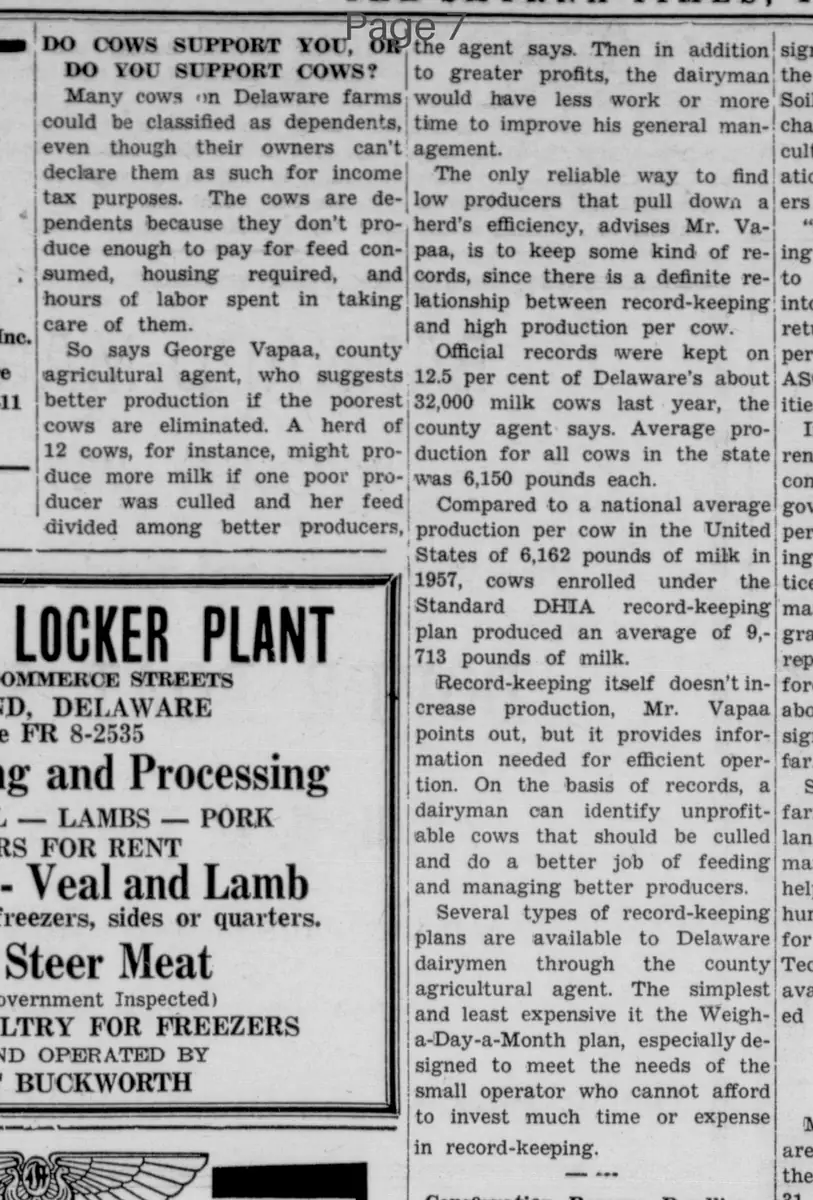
Many cows on Delaware farms could be classified as dependents, even though their owners can't declare them as such for income tax purposes.
The cows are dependents because they don't produce enough to pay for feed consumed, housing required, and hours of labor spent in taking care of them.
So says George Vapaa, county agricultural agent, who suggests better production if the poorest cows are eliminated.
A herd of 12 cows, for instance, might produce more milk if one poor producer was culled and her feed divided among better producers, the agent says.
Then in addition to greater profits, the dairyman would have less work or more time to improve his general management.
The only reliable way to find low producers that pull down a herd's efficiency, advises Mr. Vapaa, is to keep some kind of records, since there is a definite relationship between record-keeping and high production per cow.
Official records were kept on 12.5 per cent of Delaware's about 32,000 milk cows last year, the county agent says.
Average production for all cows in the state was 6,150 pounds each.
Compared to a national average production per cow in the United States of 6,162 pounds of milk in 1957, cows enrolled under the Standard DHIA record-keeping plan produced an average of 9,713 pounds of milk.
Record-keeping itself doesn't increase production, Mr. Vapaa points out, but it provides information needed for efficient operation.
On the basis of records, a dairyman can identify unprofitable cows that should be culled and do a better job of feeding and managing better producers.
Several types of record-keeping plans are available to Delaware dairymen through the county agricultural agent.
The simplest and least expensive is the Weigh-a-Day-a-Month plan, especially designed to meet the needs of the small operator who cannot afford to invest much time or expense in record-keeping.
What sub-type of article is it?
What keywords are associated?
What entities or persons were involved?
Where did it happen?
Domestic News Details
Primary Location
Delaware
Key Persons
Outcome
greater profits and less work through culling poor producers and record-keeping
Event Details
George Vapaa, county agricultural agent, suggests eliminating poorest cows to improve production, as they don't produce enough to cover feed, housing, and labor. Recommends keeping records to identify low producers, noting that record-keeping correlates with higher production. Official records kept on 12.5% of Delaware's 32,000 milk cows last year, with state average 6,150 pounds, national 6,162 pounds in 1957, and DHIA plan cows at 9,713 pounds. Several record-keeping plans available, including Weigh-a-Day-a-Month for small operators.