Thank you for visiting SNEWPapers!
Sign up free
Literary
March 29, 1928
The Milwaukee Leader
Milwaukee, Milwaukee County, Wisconsin
What is this article about?
Dr. Frank Thone's essay explores the fascination with newly discovered animals, citing the gorilla's public debut, a scaly rhinoceros in Java, the okapi in Africa, and potential undiscovered beasts in unexplored regions like Brazil's Matto Grosso, questioning if more unknown species exist.
Clipping
OCR Quality
98%
Excellent
Full Text
. Nature's Notebook
BY DR. FRANK THONE.
Science Service Staff Writer.
There went a thrill, half fascination, half horror, that went over Europe and America when the gorilla ceased to be merely a roaring shadow in the books of DuChaillu and became an actual thing of the flesh in a highly advertised circus cage.
And it is only about a year ago that authentic news came out of the swamps of southern Java of the existence of a new species of rhinoceros hitherto unknown to white men—a huge, two-horned beast encased in an armor of horny scales. The natives have known it for a long time, under the name of "tanggiling," which means "scaly beast," but their reports were received incredulously, until a few good photographs proved them right.
There are still wide areas in the world that have not been really explored, and some, like the Matto Grosse in Brazil, that have not even been entered by white men. The Indians tell tales of enormous beasts, like the giant sloths and armadillos whose bones are found in Ice Age deposits. Who knows but that a few survivors may have remained hidden away in this, the country of Conan Doyle's Lost World?
In all likelihood, yes. Most of the grownup readers of this article will remember the discovery of the Okapi in Africa, luring the early years of the century.
At least a few of the older ones will recall the thrill, half fascination, half horror, that went over Europe and America when the gorilla ceased to be merely a roaring shadow in the books of DuChaillu and became an actual thing of the flesh in a highly advertised circus cage.
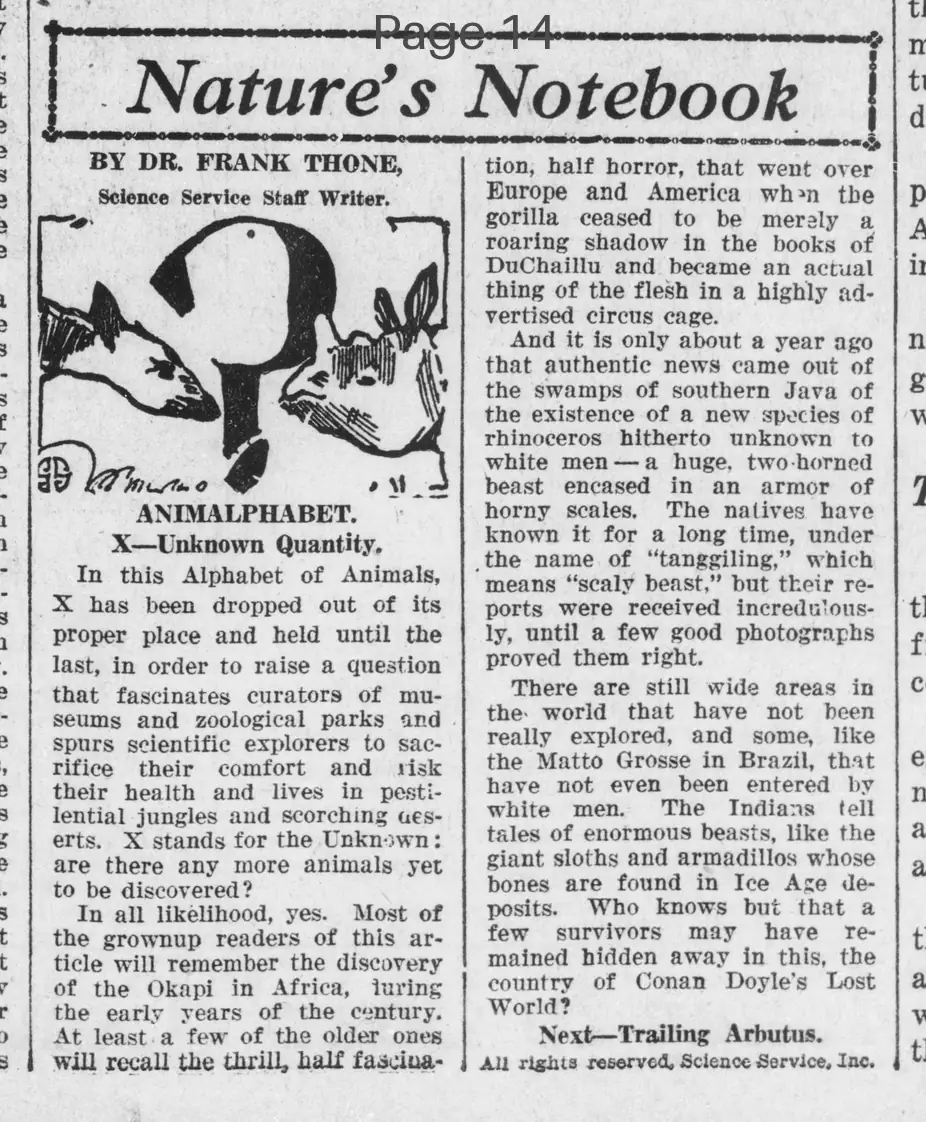
In this Alphabet of Animals, X has been dropped out of its proper place and held until the last, in order to raise a question that fascinates curators of museums and zoological parks and spurs scientific explorers to sacrifice their comfort and risk their health and lives in pestilential jungles and scorching deserts. X stands for the Unknown: are there any more animals yet to be discovered?
Next—Trailing Arbutus.
All rights reserved, Science Service, Inc.
BY DR. FRANK THONE.
Science Service Staff Writer.
There went a thrill, half fascination, half horror, that went over Europe and America when the gorilla ceased to be merely a roaring shadow in the books of DuChaillu and became an actual thing of the flesh in a highly advertised circus cage.
And it is only about a year ago that authentic news came out of the swamps of southern Java of the existence of a new species of rhinoceros hitherto unknown to white men—a huge, two-horned beast encased in an armor of horny scales. The natives have known it for a long time, under the name of "tanggiling," which means "scaly beast," but their reports were received incredulously, until a few good photographs proved them right.
There are still wide areas in the world that have not been really explored, and some, like the Matto Grosse in Brazil, that have not even been entered by white men. The Indians tell tales of enormous beasts, like the giant sloths and armadillos whose bones are found in Ice Age deposits. Who knows but that a few survivors may have remained hidden away in this, the country of Conan Doyle's Lost World?
In all likelihood, yes. Most of the grownup readers of this article will remember the discovery of the Okapi in Africa, luring the early years of the century.
At least a few of the older ones will recall the thrill, half fascination, half horror, that went over Europe and America when the gorilla ceased to be merely a roaring shadow in the books of DuChaillu and became an actual thing of the flesh in a highly advertised circus cage.
In this Alphabet of Animals, X has been dropped out of its proper place and held until the last, in order to raise a question that fascinates curators of museums and zoological parks and spurs scientific explorers to sacrifice their comfort and risk their health and lives in pestilential jungles and scorching deserts. X stands for the Unknown: are there any more animals yet to be discovered?
Next—Trailing Arbutus.
All rights reserved, Science Service, Inc.
What sub-type of article is it?
Essay
What themes does it cover?
Nature
What keywords are associated?
Animal Discovery
Unknown Species
Gorilla
Rhinoceros
Okapi
Exploration
Matto Grosso
What entities or persons were involved?
By Dr. Frank Thone. Science Service Staff Writer.
Literary Details
Title
Nature's Notebook
Author
By Dr. Frank Thone. Science Service Staff Writer.
Subject
Discovery Of Unknown Animal Species
Form / Style
Prose Reflection On Zoological Exploration
Key Lines
There Went A Thrill, Half Fascination, Half Horror, That Went Over Europe And America When The Gorilla Ceased To Be Merely A Roaring Shadow In The Books Of Duchaillu And Became An Actual Thing Of The Flesh In A Highly Advertised Circus Cage.
X Stands For The Unknown: Are There Any More Animals Yet To Be Discovered?
Who Knows But That A Few Survivors May Have Remained Hidden Away In This, The Country Of Conan Doyle's Lost World?