Thank you for visiting SNEWPapers!
Sign up free
The Liberator
Boston, Suffolk County, Massachusetts
What is this article about?
In early February 1837, the U.S. House debated censuring Rep. John Quincy Adams for inquiring about a petition from slaves, sparking heated exchanges on petition rights, slavery, and free speech. Southern members pushed for censure amid threats of legal action, but resolutions were rejected, affirming Adams' position.
Merged-components note: Merged sequential components detailing the Congressional debate on censuring Mr. Adams, including continuation across pages and related short commentary items under the Journal of the Times section.
Clippings
1 of 2
OCR Quality
Full Text
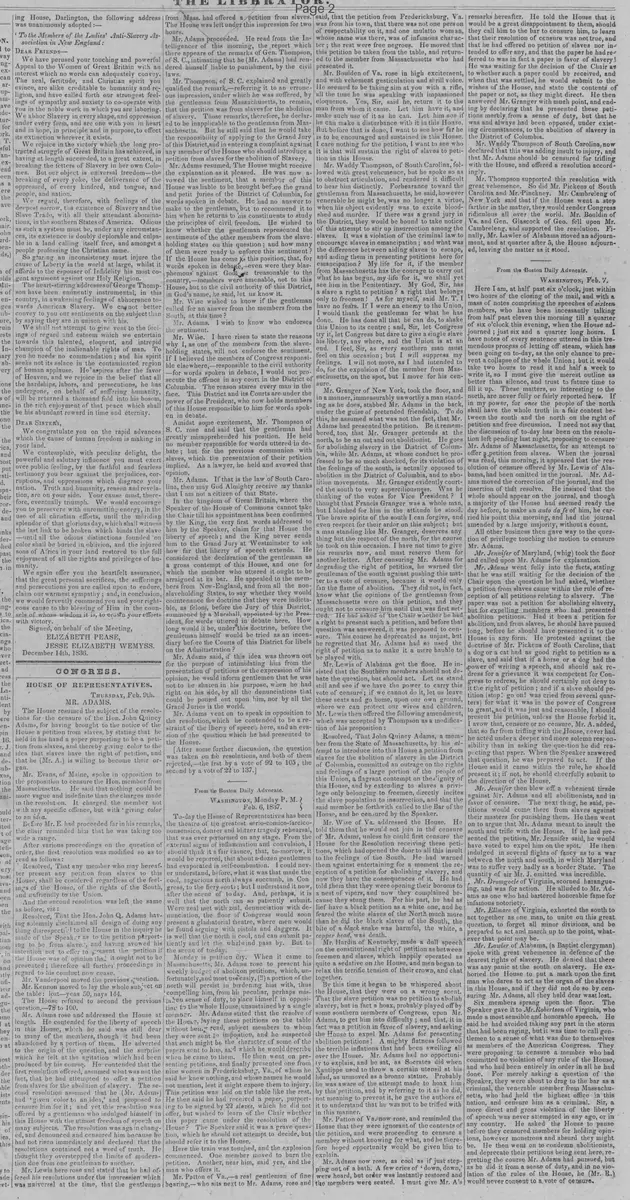
HOUSE OF REPRESENTATIVES.
THURSDAY, Feb. 9th.
MR. ADAMS.
The House resumed the subject of the resolutions for the censure of the Hon. John Quincy Adams, for having brought to the notice of the House a petition from slaves, by stating that he held in his hand a paper purporting to be a petition from slaves, and thereby giving color to the idea that slaves have the right of petition, and that he (Mr. A.) is willing to become their organ.
Mr. Evans, of Maine, spoke in opposition to the proposition to censure the Hon. member from Massachusetts. He said that nothing could be more vague and indefinite than the charges made in the resolution. It charged the member not with any specific offence, but with giving color to an idea.
Before Mr. E. had proceeded far in his remarks, the chair reminded him that he was taking too wide a range.
After various proceedings on the question of order, the first resolution was modified so as to read as follows:
Resolved, That any member who may hereafter present any petition from slaves to this House, shall be considered regardless of the feelings of the House, of the rights of the South, and unfriendly to the Union.
And the second resolution was left the same as before, viz:
Resolved, That the Hon. John Q. Adams having solemnly disclaimed all design of doing any thing disrespectful to the House in the inquiry he made of the Speaker as to the petition purporting to be from slaves, and having avowed his intention not to offer to present the petition if the House was of opinion that it ought not to be presented; therefore all further proceedings in regard to his conduct now cease.
Mr. Vanderpool moved the previous question.
Mr. Kennon moved to lay the whole subject on the table: lost—yeas 50, nays 144.
The House refused to second the previous question,—78 to 100.
Mr. Adams rose and addressed the House at length. He contended for the liberty of speech in this House, which he said was still dear to many of the members, though it had been abandoned by a portion of them. He adverted to the origin of the question, and the surprise which he felt at the agitation which had been produced by his course. He contended that the first resolution offered, assumed what was not the fact, that he had attempted to offer a petition from slaves for the abolition of slavery. The second resolution assumed that he (Mr. Adams) had 'given color to an idea,' and proposed to censure him for it; and yet this resolution was offered by a gentleman who indulged himself in this House with the utmost freedom of speech on many subjects. The resolution was again changed, and denounced and censured him because he had not risen immediately and declared that the resolutions contained not a word of truth. He thought they overstepped the limits of moderation due from one gentleman to another.
Mr. Lewis here rose and stated that he had offered his resolutions under the impression which was universal at the time, that the gentleman from Mass. had offered a petition from slaves. The House was left under this impression for two hours.
Mr. Adams proceeded. He read from the Intelligencer of this morning, the report which there appears of the remarks of Gen. Thompson, of S. C., intimating that he (Mr. Adams) had rendered himself liable to punishment, by the civil laws.
Mr. Thompson, of S. C. explained and greatly qualified the remark,—referring it to an erroneous impression, under which he was suffered, by the gentleman from Massachusetts, to remain, that the petition was from slaves for the abolition of slavery. Those remarks, therefore, he declared to be inapplicable to the gentleman from Massachusetts. But he still said that he would take the responsibility of applying to the Grand Jury of this District, and in entering a complaint against any member of the House who should introduce a petition from slaves for the abolition of Slavery.
Mr. Adams resumed. The House might receive the explanation as it pleased. He was now avowed the sentiment, that a member of this House was liable to be brought before the grand and petit juries of the District of Columbia, for words spoken in debate. He had no answer to make to the gentleman, but to recommend it to him when he returns to his constituents to study the principles of civil freedom. He wished to know whether the gentleman represented the sentiments of the other members from the slave-holding states on this question; and how many of them were ready to enforce this sentiment? If the House has come to this position, that, for words spoken in debate.—even were they blasphemous against God or treasonable to the country,—members were amenable, not to this House, but to the civil authority of this District. in God's name, he said, let us know it.
Mr. Wise wished to know if the gentleman called for an answer from the members from the South, at this time?
Mr. Adams. I wish to know who endorses the sentiment.
Mr. Wise. I have risen to state the reasons why I, as one of the members from the slave-holding states, will not endorse the sentiment If I believed the members of Congress responsible elsewhere,—responsible to the civil authority —for words spoken in debate, I would not prosecute the offence in any court in the District of Columbia. The reason stares every man in the face. This District and its Courts are under the power of the President, who now holds members of this House responsible to him for words spoken in debate.
Amidst some excitement, Mr. Thompson of S. C. rose and said that the gentleman had greatly misapprehended his position. He held no member responsible for words uttered in debate; but for the previous communion with slaves. which the presentation of their petition implied. As a lawyer, he held and avowed that opinion.
Mr. Adams. If that is the law of South Carolina, then may God Almighty receive my thanks that I am not a citizen of that State.
In the kingdom of Great Britain, where the Speaker of the House of Commons cannot take the Chair till his appointment has been confirmed by the King, the very first words addressed to him by the Speaker, claim for that House the liberty of speech; and the King never sends him to the Grand Jury at Westminster to ask how far that liberty of speech extends. He considered the declaration of the gentleman as a gross contempt of this House. and one for which the member who uttered it ought to be arraigned at its bar. He appealed to the members from New-England, and from all the non-slaveholding States, to say whether they would countenance the doctrine that they were indictable, as felons, before the Jury of this District. summoned by a Marshall, appointed by the President, for words uttered in debate here. How long would it be, under this doctrine, before the gentleman himself would be tried as an incendiary before the Courts of this District for libels on the Administration ?
Mr. Adams said. if this idea was thrown out for the purpose of intimidating him from the presentation of petitions or the expression of his opinion, he would inform gentlemen that he was not to be shaken in his purpose, when he had right on his side, by all the denunciations that could be poured out upon him, nor by all the Grand Juries in the world.
Mr. Adams went on to speak in opposition to the resolution, which he contended to be a restraint of the liberty of speech here, and an evasion of the question which he had presented to the House.
[After some further discussion, the question was taken on the resolutions, and both of them rejected,—the first by a vote of 92 to 105, the second by a vote of 22 to 137.]
From the Boston Daily Advocate.
WASHINGTON, Monday P. M. Feb. 6, 1837.
To-day the House of Representatives has been the theatre of the greatest serio-comico-farcico-nonsensico, donnybrook and blitzer tragedy rehearsal, that was ever performed on any stage. From the external signs of inflammation and convulsion, I should think it a fair chance, that, to-morrow, it would be reported, that about a-dozen gentlemen had evaporated in self-combustion. I could never understand, before, what it was that made the cool, sagacious north always succumb, in Congress, to the fiery south ; but I understand it now after the scene of to day. And, perhaps, it is well that the north can so patiently submit Were zeal met with zeal, denunciation with denunciation, the floor of Congress would soon present a gladiatorial theatre, where men would be found arguing with pistols and daggers. It is well that the north is cool, and can submit patiently and let the whirlwind pass by. But to the scene of to-day.
Monday is petition day. When it came to Massachusetts. Mr. Adams rose to present his weekly budget of abolition petitions, which, unfortunately, and most uselessly, (!!) a portion of the north will persist in burdening him with, thus compelling him, from his peculiar, perhaps mistaken sense of duty, to place himself in opposition to the whole House, unsustained by a single member. Mr. Adams stated that the resolve of the House, laying these petitions on the table without being read, subject members to whom they were sent to imposition, and he suspected that such might be the character of some of the papers sent to him, and which he would describe when he came to them. He then went on presenting petitions, and finally presented one from nine women in Fredericksburg, Va., of whom he said he knew nothing, and whose names he would not mention, lest it might expose them to injury. This petition was laid on the table like the rest.
He then said he had received a paper, purporting to be signed by 22 slaves, which he did not offer, but wished to learn of the Chair whether this paper came under the resolution of the House? The Speaker said it was a grave question, which he should not attempt to decide, but should refer it to the House.
Here the train was touched, and the explosion commenced. One member moved to burn the petition. Another, near him, said yes, and the man who offers it.
Mr. Patton of Va.,—a real gentleman of fine bearing,—who sits next to Mr. Adams, rose and said. that the petition from Fredericksburg, Va. was from his town, that there was not one person of respectability on it, and one mulatto woman. whose name was there, was of infamous character; the rest were free negroes. He moved that this petition be taken from the table, and returned to the member from Massachusetts who had presented it.
Mr. Boulden of Va. rose in high excitement and with vehement gesticulation and shrill voice He seemed to be taking aim at you with a rifle. all the time he was speaking with impassioned eloquence. Yes, Sir, said he, return it to the man from whom it came. Let him have it, and make such use of it as he can. Let him see if he can make a disturbance with it in this House. But before that is done, I want to see how far he is to be encouraged and sustained in this House. I care nothing for the petition, I want to see who it is that will sustain the right of slaves to petition in this House.
Mr. Waddy Thompson, of South Carolina, followed with great vehemence, but he spoke so as to obstruct articulation, and rendered it difficult to hear him distinctly. Forbearance toward the gentleman from Massachusetts, he said, however venerable he might be, was no longer a virtue when his object evidently was to excite bloodshed and murder. If there was a grand jury in the District, they would be bound to take notice of this attempt to stir up insurrection among the slaves. It was a violation of the criminal law to encourage slaves in emancipation; and what was the difference between aiding slaves to escape, and aiding them in presenting petitions here for emancipation? My life for it, if the member from Massachusetts has the courage to carry out what he has begun, my life for it, we shall yet see him in the Penitentiary. My God, Sir, has a slave a right to petition ? a right that belongs only to freemen! As for myself, said Mr. T. I have no fears. If I were an enemy to the Union. I would thank the gentleman for what he has done. He has done all that he can do, to shake this Union to its centre; and, Sir, let Congress try it, let Congress but dare to give a single slave his liberty, any where, and the Union is at an end. I feel, Sir, as every southern man must feel on this occasion; but I will suppress my feelings. I will not move, as I had intended to do, for the expulsion of the member from Massachusetts, on the spot, but I move for his censure.
Mr. Granger of New York, took the floor, and in a manner, immeasurably unworthy a man standing as he does, stabbed Mr. Adams in the back. under the guise of pretended friendship. To do this. he assumed what was not the fact, that Mr. Adams had presented the petition. Be it remembered, too. that Mr. Granger pretends at the north, to be an out and out abolitionist. He goes for abolishing slavery in the District of Columbia, while Mr. Adams, at whose conduct he professed to be so much shocked. for its violation of the feelings of the south, is actually opposed to abolition in the District of Columbia, and to abolition movements. Mr. Granger evidently courted the south to very superciliousness. Was he thinking of the votes for Vice President ? I thought that Francis Granger was a whole man, but I blushed for him in the attitude he stood. The brave spirits of the south I can forgive, and even respect for their ardor on this subject; but a man standing like Mr. Granger, deserves anything but the respect of the north, for the course he took on this occasion. I have not time to give his remarks now, and must reserve them for another letter. After censuring Mr. Adams for degrading the right of petition, he warned the gentleman of the south against pushing this matter to a vote of censure, because it would only fan the flame of abolition. They did not, in fact know what the opinions of the gentleman from Massachusetts were on this petition, and they ought not to censure him until that was first settled. He had asked of the Chair whether he had a right to present such a petition, and before that question was answered, it was proposed to censure. This course he deprecated as unjust, but he regretted that Mr. Adams had so used the right of petition as to make it a mere bauble to be played with.
Mr. Lewis of Alabama got the floor. He insisted that the Southern members should not debate the question. but should act. Let us stand still and see if we have the power to carry this vote of censure; if we cannot do it, let us leave these seats and go home, upon our own ground, where we can protect our wives and children.
Mr. Lewis then offered the following amendment, which was accepted by Thompson as a modification of his proposition:
Resolved, That John Quincy Adams. a member from the State of Massachusetts, by his attempt to introduce into this House a petition from slaves for the abolition of slavery in the District of Columbia, committed an outrage on the rights and feelings of a large portion of the people of this Union, a flagrant contempt on the dignity of this House, and by extending to slaves a privilege only belonging to freemen, directly incites the slave population to insurrection, and that the said member be forthwith called to the Bar of the House, and be censured by the Speaker.
Mr. Wise of Va. addressed the House. He told them that he would not join in the censure of Mr. Adams, unless he could first censure the House for the Resolution receiving these petitions, which had opened the door to all this insult to the feelings of the South. He had warned them against entertaining for a moment the reception of a petition for abolishing slavery. and now they have the consequences of it. He had told them that they were opening their bosoms to a nest of vipers, and now they complained because they stung them. For his part, he had as lief have a black petition as a white one, and he feared the white slaves of the North much more than he did the black slaves of the South, the bite of a black snake was harmful, the white, a copper head, was death.
Mr. Hardin of Kentucky, made a dull speech on the constitutional right of petition as between freemen and slaves, which happily operated as quite a sedative on the House, and men began to relax the terrific tension of their brows, and chat together.
By this time it began to be whispered about the House, that they were on a wrong scent. That the slave petition was no petition to abolish slavery, but in fact a hoax, probably played off by some southern members of Congress, upon Mr. Adams, to get him into difficulty ; and that, it in fact was a petition in favor of slavery, and asking the House to expel Mr. Adams for presenting abolition petitions! A mighty flatness followed the terrible inflations that had been swelling all over the House. Mr. Adams had no opportunity to explain, and he sat, as Socrates did when Xantippe used to throw a certain utensil at his head, as unmoved as a bronze statue. Probably he was aware of the attempt made to hoax him by this' petition, and by referring to it as he did, not meaning to present it, he gave the authors of it to understand that he was not to be trifled with in this manner.
Mr. Patton of Va. now rose, and reminded the House that they were ignorant of the contents of the petition, and were proceeding to censure a member without knowing for what, and he therefore hoped opportunity would be given him to explain.
Mr. Adams now rose, as cool as if just stepping out of a bath. A few cries of 'down, down,' were heard, but order was instantly restored and the members were seated. I must give Mr. A's remarks hereafter. He told the House that it would be a great disappointment to them, should they call him to the bar to censure him, to learn that their resolution of censure was not true, and that he had offered no petition of slaves nor intended to offer any, and that the paper he had referred to was in fact a paper in favor of slavery! He was waiting for the decision of the Chair as to whether such a paper could be received, and when that was settled, he would submit to the wishes of the House, and state the contents of the paper or not, as they might direct. He then answered Mr. Granger with much point, and ending by declaring that he presented these petitions merely from a sense of duty, but that he was and always had been opposed, under existing circumstances, to the abolition of slavery in the District of Columbia.
Mr. Waddy Thompson of South Carolina. now declared that this was adding insult to injury, and that Mr. Adams should be censured for trifling with the House, and offered a resolution accordingly.
Mr. Thompson supported this resolution with great vehemence. So did Mr. Pickens of South Carolina and Mr. Pinckney. Mr. Cambreleng of New York said that if the House went a step farther in the matter, they would render Congress ridiculous all over the world. Mr. Bouldin of Va. and Gen. Glascock of Geo. fell upon Mr. Cambreleng, and supported the resolution. Finally, Mr. Lawler of Alabama moved an adjournment, and at quarter after 5, the House adjourned, leaving the matter as it stood.
From the Boston Daily Advocate.
WASHINGTON, Feb.7.
Here I am, at half past six o'clock, just within two hours of the closing of the mail, and with a mass of notes comprising the speeches of sixteen members, who have been incessantly talking from half past eleven this morning till a quarter of six o'clock this evening, when the House adjourned; just six and a quarter long hours. I have notes of every sentence uttered in this tremendous process of letting off steam, which has been going on to-day, as the only chance to prevent a collapse of the whole Union: but it would take two hours to read it and half a week to write it, so I must give the merest outline as better than silence, and trust to future time to fill it up. These matters, so interesting to the north, are never fully or fairly reported here. If in my power, for once the people of the north shall have the whole truth in a fair contest between the south and the north on the right of petition and free discussion. I need not say that the discussion of to-day has been on the resolution left pending last night, proposing to censure Mr. Adams of Massachusetts, for an attempt to offer a petition from slaves. When the journal was read, this morning, it appeared that the resolution of censure offered by Mr. Lewis of Alabama, had been omitted in the journal. Mr. Adams moved the correction of the journal, and the insertion of that resolve. He insisted that the whole should appear on the journal, and though a majority of the House had seemed ready the day before, to make an auto da fe of him, he carried his point this morning, and had the journal amended by a large majority, without a count.
All other business then gave way to the question of privilege touching the motion to censure Mr. Adams.
Mr. Jennifer of Maryland, (whig) took the floor and called upon Mr. Adams for explanation.
Mr. Adams went fully into the facts, stating that he was still waiting for the decision of the Chair upon the question he had asked, whether a petition from slaves came within the rule of reception of all petitions relating to slavery. The paper was not a petition for abolishing slavery. but for expelling members who had presented abolition petitions. Had it been a petition for abolition, and from slaves, he should have paused long, before he should have presented it to the House in any form. He protested against the doctrine of Mr. Pickens of South Carolina, that a dog or a cat had as good right to petition as a slave. and said that if a horse or a dog had the power of writing a speech, and should ask redress for a grievance it was competent for Congress to redress, he should certainly not deny to it the right of petition ; and if a slave should petition (stop! go on! was cried from several quarters) for what it was in the power of Congress to grant, and it was just and reasonable, I should present his petition, unless the House forbid it, I avow that, censure or no censure, Mr. A. added, that so far from trifling with the House, never had he acted under a deeper and more solemn responsibility than in asking the question he did respecting that paper. When the Speaker answered that question, he was prepared to act. If the House said it came within the rule, he should present it; if not, he should cheerfully submit to the direction of the House.
Mr. Jennifer then blew off a vehement tirade against Mr. Adams and all abolitionists, and in favor of censure. The next thing, he said, petitions would come there from slaves against their masters for punishing them. He then went on to argue that Mr. Adams meant to insult the south and trifle with the House. If he had presented the petition, Mr. Jennifer said, he would have voted to expel him on the spot. He then indulged in several flights of fancy as to a war between the north and south, in which Maryland was to suffer very badly as a border State. The quantity of air Mr. J. emitted was incredible.
Mr. Dromgoole of Virginia, scorned haranguing, and was for action. He alluded to Mr. Adams as one who had bartered honorable fame for infamous notoriety.
Mr. Elmore of Virginia, exhorted the south to act together as one man, to unite on this great question, to forget all minor divisions, and be prepared to act and march up to the point, whatever that point may be.
Mr. Lawler of Alabama, (a Baptist clergyman) spoke with great vehemence in defence of the dearest rights of slavery. He denied that there was any panic at the south on slavery. He exhorted the House to put a mark upon the first man who dares to act as the organ of the slaves in this House, and if they did not do so by censuring Mr. Adams, all they held dear was lost.
Six members sprang upon the floor. The Speaker gave it to Mr. Robertson of Virginia, who made a most sensible and honorable speech. He said he had avoided taking any part in the storm that had been raging, but it was time to call gentlemen to a sense of what was due to themselves as members of the American Congress. They were proposing to censure a member who had committed no violation of any rule of the House, and who had been entirely in order in all he had done. For merely asking a question of the Speaker, they were about to drag to the bar as a criminal, the venerable member from Massachusetts, who had held the highest office in this nation, and censure him as a criminal. Sir, a more direct and gross violation of the liberty of speech was never attempted in any age, or in any country. He asked the House to pause before they censured members for holding opinions, however monstrous and absurd they might be. He then went on to condemn abolitionists. and deprecate their petitions being sent here, regretting the course Mr. Adams had pursued, but as he did it from a sense of duty, and in no violation of the rules of the House, he (Mr. R.) would never consent to a vote of censure.
This boldness of Mr. Robertson, a Southern member, began to turn the current, and gentlemen commenced looking round to see how they could back out. It was apparent that the cooler portion of the South could not be brought up to the sticking point of censure. Up to this time, had the vote at any moment been taken, it was plain that the censure would have been carried into effect, as many Northern members would have voted with the South. Mr. Robertson broke the phalanx.
Mr. Alford, the new whig member from Georgia, attempted a rally of the South. Never did I hear such a speech; full of sound and fury, signifying nothing. He spoke so loud, he could not be heard, fairly drowning himself with his own voice. His speech was so ludicrously furious, that he set half the House in a giggle at his sophomoric flourishes. At the close of every other sentence, rap, rap, rap, would go his fist, like a trip hammer, on his desk, making the very dome echo again. He said that the South had been too tame, and had never spoken on this subject in language strong enough. It should come, said he, like a tornado, and sweep all before it—and then he gave a specimen of the sort of tornado he wanted to raise. It was, in truth, a tempest in a tea-pot. If the gentleman dares to offer the petition, said he, so help me God, I will vote for his expulsion. To his mind, it was worse to present the petition of a free negro or mulatto than a slave, for in his opinion the slave was the best of the three. He invoked the banner of liberty once more to wave over the gallant sons of the South. The deep damnation, the utter indignation of the South against these abolition petitions, must be heard, in more emphatic language. The pious, the godly, the Christians of the South, had sworn, in their eternal wrath, vengeance against these savage fanatics, the abolitionists; and then he concluded, with a clap of thunder, in the following terrific sentence, which set the House in a half suppressed roar. He (Mr. Adams) may get up a monstrous crusade against the South, he may carry fire and sword into our dwellings, but, sir, we will stand in a firm phalanx on our border, and we will never yield until this city shall become a Waterloo, and the Potomac an ocean of blood!!!
[I move, said Mr. Lawrence of Boston, in an under tone, to strike out Potomac, and insert Tiber, alias Goose Creek, a little dirty puddle that oozes through the city! I second the motion, said Dr. Sutherland of Pennsylvania. I can't afford them any more blood than will fill Goose Creek!]
Mr. Lincoln of Massachusetts now got the floor, and most honorably did he acquit himself. In a dispassionate, manly, dignified, conciliating manner, he vindicated his venerable colleague, and defended the abolitionists from the abusive epithets that had been cast upon them. He described them as ministers, pious men, intellectual and amiable women, persons who were not only incapable of doing but of thinking wrong, and though he did not agree with their views nor approve of their course, he contended, in the broadest sense, for the right of petition and free discussion. He tested the allegation against Mr. Adams, and the facts, by rules of law and evidence, and exposed the utter absurdity of this attempt to punish a man for a supposed intention to do what he had not done. The speech was of considerable length, and placed Mr. Lincoln higher than he ever stood before. I honor him for it, and as a son of Massachusetts, I could not refrain, on meeting him at the close of it, from thanking him in the name of my State, for the able manner in which he had defended her citizens.
After Mr. Lincoln, Mr. Bynum of North Carolina followed, and worked himself up into a foaming passion in denouncing the incendiary priests and silly women, who constituted the abolitionists of the North. His rage was greater than that of any gentleman who had preceded him, and his speech should be written out with aqua fortis. Having none, I shall pass it by for the present.
Mr. Graves of Kentucky (whig) now took the floor, and supported Mr. Adams. He contended he had done nothing wrong, and that if he stood all alone from the slaveholding States, he would resist this monstrous attempt to put down freedom of speech in this House. He appealed to the whigs, and asked them why they might not as well be censured by the majority for holding that the President exercised the power of a monarch. He told the 16 members from the South, who voted against Mr. Pinckney's resolution, and who now denounced that resolution as contemptible, that they were more deserving censure than Mr. Adams was, who had only indirectly brought into contempt a Resolution they had openly denounced! This was a home thrust.
Mr. Waddy Thompson of S. Carolina next got up, and went at New England and Massachusetts pell mell. He raked up old Indian histories, brought in James D'Wolf, a slave-dealer, being sent to Congress from R. Island, and went on pell mell, till the speaker called him to order.
Mr. Calhoun of Kentucky made a dull speech for censure, and against his colleague, Mr. Graves.
Mr. Cushing of Massachusetts, then got the floor. Never did I hear a more eloquent, more modest, more manly, more thrilling speech. It was beautiful, forcible, pungent, and irresistible. He defended Massachusetts in a noble strain, and demolished Waddy Thompson, until not so much as a speck of him was left. He vindicated the opinions of Massachusetts on slavery and the right of petition, and protested that not so much as a shadow of a shade of censure should fall on his venerable colleague, Mr. Adams. The speech did him great credit, and from my soul I thank him for it. All were delighted with it, and Mr. Dawson of Georgia, complimented him on the spot. At the close of his speech, a quarter of six, the House adjourned, having taken no question.
JOHN QUINCY ADAMS.
By reference to our Congressional proceedings, it will be seen that Mr. Adams has signally triumphed over all his blustering, insane and guilty assailants, and covered his brow with imperishable laurels. Much credit is also due to Hon. Mr. Cushing and Hon. Mr. Lincoln of this State, and Hon. Mr. Evans of Maine, for their eloquent defence of the North and the right of petition.
CONGRESS. Waddy Thompson, in one of his flourishes last Tuesday, went out of his way to assail James D'Wolf of Rhode Island, late of the U. S. Senate, and pronounced him a thief, a cut-throat, and a murderer; and charged him with having murdered a negro on the high seas. For this the Speaker called him to order, as an unruly member.
The above shows what opinion one slaveholder entertains of another!
The same Waddy Thompson spoke of William Ellery Channing in the following terms:
'Dr. Channing, once one of the greatest men of the country—once the pride of the South, but now the most infamous in the ranks of abolition.'
The above shows what is to be gained by using soft language relating to southern robbers and men-stealers, and attempting to please all parties!
What sub-type of article is it?
What keywords are associated?
What entities or persons were involved?
Where did it happen?
Domestic News Details
Primary Location
Washington
Event Date
February 6 9, 1837
Key Persons
Outcome
resolutions to censure john quincy adams rejected: first 92-105, second 22-137. debate upheld freedom of speech and right of petition without formal censure or legal action.
Event Details
The U.S. House of Representatives engaged in intense debate over censuring Rep. John Quincy Adams for inquiring about presenting a petition purportedly from 22 slaves, which turned out to be a hoax favoring slavery. Southern members accused him of inciting insurrection and violating House rules, proposing resolutions for censure and expulsion. Adams defended his actions, emphasizing liberty of speech and petition rights. Multiple speeches from both sides ensued, with threats of grand jury complaints, but ultimately the resolutions failed.