Thank you for visiting SNEWPapers!
Sign up free
Story
April 14, 1945
The Sub
Groton, New London County, Connecticut
What is this article about?
The NLRB, in Washington D.C., reversed its stance to allow foremen and supervisory employees to unionize under the Wagner Act, following strikes and AFL advocacy, with member Gerald Reilly dissenting.
Clipping
OCR Quality
100%
Excellent
Full Text
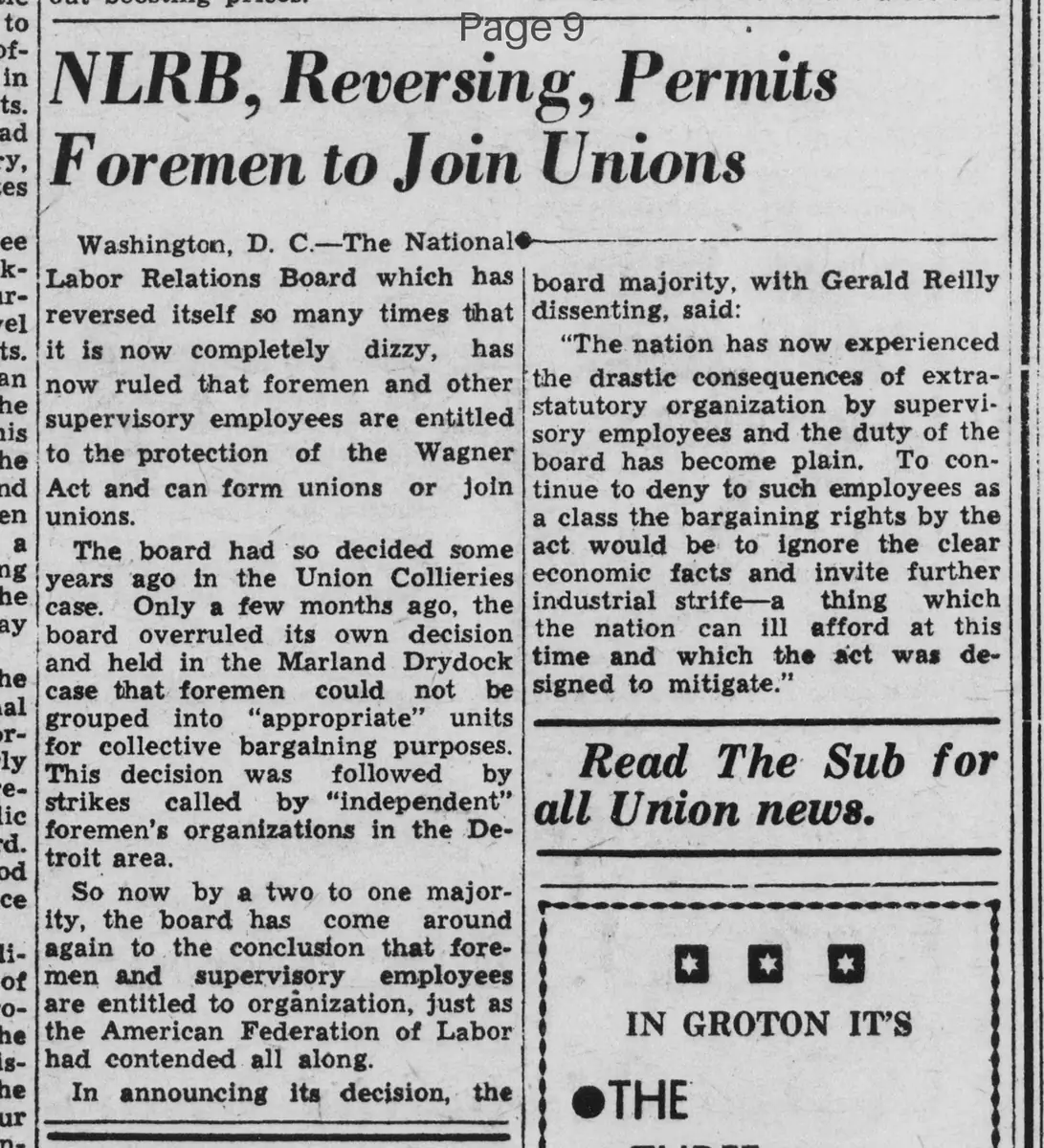
NLRB, Reversing, Permits Foremen to Join Unions
Washington, D.C.--The National Labor Relations Board which has reversed itself so many times that it is now completely dizzy, has now ruled that foremen and other supervisory employees are entitled to the protection of the Wagner Act and can form unions or join unions.
The board had so decided some years ago in the Union Collieries case. Only a few months ago, the board overruled its own decision and held in the Marland Drydock case that foremen could not be grouped into "appropriate" units for collective bargaining purposes.
This decision was followed by strikes called by "independent" foremen's organizations in the Detroit area.
So now by a two to one majority, the board has come around again to the conclusion that foremen and supervisory employees are entitled to organization, just as the American Federation of Labor had contended all along.
In announcing its decision, the board majority, with Gerald Reilly dissenting, said:
"The nation has now experienced the drastic consequences of extra-statutory organization by supervisory employees and the duty of the board has become plain. To continue to deny to such employees as a class the bargaining rights by the act would be to ignore the clear economic facts and invite further industrial strife--a thing which the nation can ill afford at this time and which the act was designed to mitigate."
Washington, D.C.--The National Labor Relations Board which has reversed itself so many times that it is now completely dizzy, has now ruled that foremen and other supervisory employees are entitled to the protection of the Wagner Act and can form unions or join unions.
The board had so decided some years ago in the Union Collieries case. Only a few months ago, the board overruled its own decision and held in the Marland Drydock case that foremen could not be grouped into "appropriate" units for collective bargaining purposes.
This decision was followed by strikes called by "independent" foremen's organizations in the Detroit area.
So now by a two to one majority, the board has come around again to the conclusion that foremen and supervisory employees are entitled to organization, just as the American Federation of Labor had contended all along.
In announcing its decision, the board majority, with Gerald Reilly dissenting, said:
"The nation has now experienced the drastic consequences of extra-statutory organization by supervisory employees and the duty of the board has become plain. To continue to deny to such employees as a class the bargaining rights by the act would be to ignore the clear economic facts and invite further industrial strife--a thing which the nation can ill afford at this time and which the act was designed to mitigate."
What sub-type of article is it?
Historical Event
What themes does it cover?
Justice
What keywords are associated?
Nlrb Reversal
Foremen Unions
Wagner Act
Supervisory Employees
Labor Rights
What entities or persons were involved?
National Labor Relations Board
Gerald Reilly
American Federation Of Labor
Where did it happen?
Washington, D.C.
Story Details
Key Persons
National Labor Relations Board
Gerald Reilly
American Federation Of Labor
Location
Washington, D.C.
Story Details
The National Labor Relations Board reversed its recent decision in the Marland Drydock case, overruling its prior stance from the Union Collieries case, to rule that foremen and supervisory employees are entitled to Wagner Act protections and can form or join unions, as contended by the American Federation of Labor, amid strikes by foremen's organizations.