Thank you for visiting SNEWPapers!
Sign up free
Editorial
January 4, 1821
Richmond Enquirer
Richmond, Richmond County, Virginia
What is this article about?
Editorial clarifies that the Bank of the United States' statement to Congress is a balance sheet of assets and debts, not a profit/loss report for dividend decisions, addressing critics' misinterpretations of losses and charges like the U.S. bonus and building costs.
Clipping
OCR Quality
95%
Excellent
Full Text
BANK OF THE UNITED STATES.
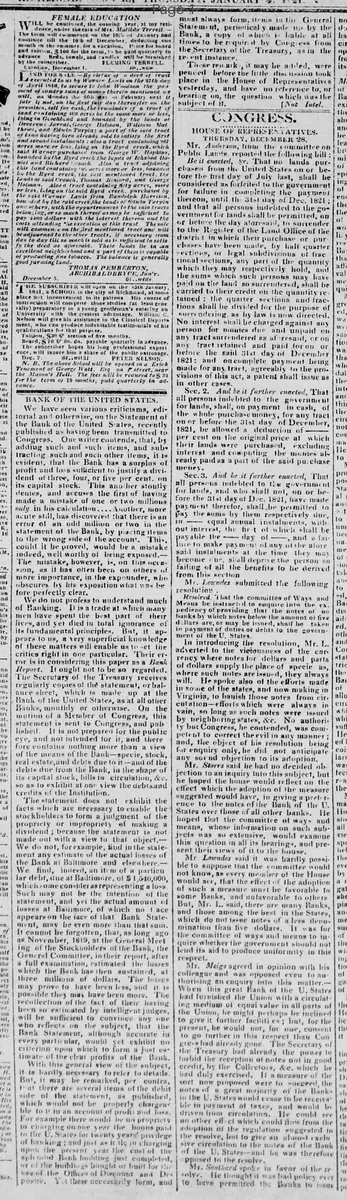
We have seen various criticisms, editorial and otherwise, on the Statement of the Bank of the United States, recently published as having been transmitted to Congress. One writer contends, that, by adding such and such items, and subtracting such and such other items, it is evident, that the Bank has a surplus of profit and loss sufficient to justify a dividend of three, four, or five per cent. on its capital stock. This another stoutly denies, and accuses the first of having made a mistake of one or two millions only in his calculation....Another, more acute still, has discovered that there is an error of an odd million or two in the statement of the Bank, by placing items to the wrong side of the account. This, could it be proved, would be a mistake indeed, well worthy of being exposed. The mistake, however, is, on this occasion, as it has often been on others of more importance, in the expounder, who obscures by his exposition what was before perfectly clear.
We do not profess to understand much of Banking. It is a trade at which many men have spent the best part of their lives, and yet died in total ignorance of its fundamental principles. But, it appears to us, every superficial knowledge of these matters will enable us to set the critics right in one particular. Their error is in considering this paper as a Bank Report. It ought not to be so regarded. The Secretary of the Treasury receives regularly copies of the statement, or balance sheet, which is made up at the Bank of the United States, as at all other Banks, monthly or otherwise. On the motion of a Member of Congress, this statement is sent to Congress, and published. It is not prepared for the public eye, and not intended for it, and therefore contains nothing more than a view of the means of the Bank—specie, stock, real estate, and debts due to it—and of the debts due from the Bank, in the shape of its capital stock, bills in circulation, &c. so as to exhibit at one view the debts and credits of the Institution.
The statement does not exhibit the facts which are necessary to enable the stockholders to form a judgment of the propriety or impropriety of making a dividend; because the statement is not made out with a view to that object. We do not, for example, find in the statement any estimate of the actual losses of the Bank at Baltimore and elsewhere. We find, indeed, an item of a particular debt, due at Baltimore, of $1,640,000, which some consider as representing a loss. Such may not be the intention of the statement, and yet the actual amount of losses at Baltimore, of which no trace appears on the face of that Bank Statement, may be even more than that sum.
It cannot be forgotten, that, as long ago as November, 1819, at the General Meeting of the Stockholders of the Bank, the General Committee, in their report, after a full examination, estimated the losses which the Bank has then sustained, at three millions of dollars. The losses may prove to have been less, and it is possible they may have been more. The recollection of the fact of their having been so estimated by intelligent judges, will be sufficient to convince any one who reflects on the subject, that the Bank Statement, although accurate in every particular, would yet exhibit no criterion upon which to form a just estimate of the clear profits of the Bank.
With this general view of the subject, it is hardly necessary to refer to details. But, it may be remarked, per contra, that there are several items of the debit side of the statement, as published, which would not be properly chargeable to it in an account of profit and loss. For example there would be no propriety in charging on one year the bonus paid to the U. States for twenty years' privilege of banking; and just as little in charging upon the present year the cost of the splendid Bank building just completed, or of the buildings bought or built for the use of the Offices of Discount and Deposit. Yet these necessarily form, and must always form, items in the General Statement, periodical made up by the Bank, a copy of which is liable at all times to be required by Congress from the Secretary of the Treasury, as in the recent instance.
These remarks, it may be added, were penned before the late discussion took place in the House of Representatives yesterday, and have no reference to, or bearing on, the question which was the subject of it.
[Nat Intel.
We have seen various criticisms, editorial and otherwise, on the Statement of the Bank of the United States, recently published as having been transmitted to Congress. One writer contends, that, by adding such and such items, and subtracting such and such other items, it is evident, that the Bank has a surplus of profit and loss sufficient to justify a dividend of three, four, or five per cent. on its capital stock. This another stoutly denies, and accuses the first of having made a mistake of one or two millions only in his calculation....Another, more acute still, has discovered that there is an error of an odd million or two in the statement of the Bank, by placing items to the wrong side of the account. This, could it be proved, would be a mistake indeed, well worthy of being exposed. The mistake, however, is, on this occasion, as it has often been on others of more importance, in the expounder, who obscures by his exposition what was before perfectly clear.
We do not profess to understand much of Banking. It is a trade at which many men have spent the best part of their lives, and yet died in total ignorance of its fundamental principles. But, it appears to us, every superficial knowledge of these matters will enable us to set the critics right in one particular. Their error is in considering this paper as a Bank Report. It ought not to be so regarded. The Secretary of the Treasury receives regularly copies of the statement, or balance sheet, which is made up at the Bank of the United States, as at all other Banks, monthly or otherwise. On the motion of a Member of Congress, this statement is sent to Congress, and published. It is not prepared for the public eye, and not intended for it, and therefore contains nothing more than a view of the means of the Bank—specie, stock, real estate, and debts due to it—and of the debts due from the Bank, in the shape of its capital stock, bills in circulation, &c. so as to exhibit at one view the debts and credits of the Institution.
The statement does not exhibit the facts which are necessary to enable the stockholders to form a judgment of the propriety or impropriety of making a dividend; because the statement is not made out with a view to that object. We do not, for example, find in the statement any estimate of the actual losses of the Bank at Baltimore and elsewhere. We find, indeed, an item of a particular debt, due at Baltimore, of $1,640,000, which some consider as representing a loss. Such may not be the intention of the statement, and yet the actual amount of losses at Baltimore, of which no trace appears on the face of that Bank Statement, may be even more than that sum.
It cannot be forgotten, that, as long ago as November, 1819, at the General Meeting of the Stockholders of the Bank, the General Committee, in their report, after a full examination, estimated the losses which the Bank has then sustained, at three millions of dollars. The losses may prove to have been less, and it is possible they may have been more. The recollection of the fact of their having been so estimated by intelligent judges, will be sufficient to convince any one who reflects on the subject, that the Bank Statement, although accurate in every particular, would yet exhibit no criterion upon which to form a just estimate of the clear profits of the Bank.
With this general view of the subject, it is hardly necessary to refer to details. But, it may be remarked, per contra, that there are several items of the debit side of the statement, as published, which would not be properly chargeable to it in an account of profit and loss. For example there would be no propriety in charging on one year the bonus paid to the U. States for twenty years' privilege of banking; and just as little in charging upon the present year the cost of the splendid Bank building just completed, or of the buildings bought or built for the use of the Offices of Discount and Deposit. Yet these necessarily form, and must always form, items in the General Statement, periodical made up by the Bank, a copy of which is liable at all times to be required by Congress from the Secretary of the Treasury, as in the recent instance.
These remarks, it may be added, were penned before the late discussion took place in the House of Representatives yesterday, and have no reference to, or bearing on, the question which was the subject of it.
[Nat Intel.
What sub-type of article is it?
Economic Policy
What keywords are associated?
Bank Of The United States
Bank Statement
Profits And Losses
Dividends
Banking Principles
Stockholders
Congressional Report
What entities or persons were involved?
Bank Of The United States
Congress
Secretary Of The Treasury
Stockholders
Editorial Details
Primary Topic
Defense Of Bank Of The United States Statement Clarity
Stance / Tone
Explanatory And Corrective
Key Figures
Bank Of The United States
Congress
Secretary Of The Treasury
Stockholders
Key Arguments
The Statement Is A Balance Sheet Of Assets And Liabilities, Not A Profit And Loss Report For Dividends.
It Lacks Estimates Of Actual Losses, Such As Those At Baltimore Estimated At Three Million Dollars In 1819.
Certain Debit Items Like The Bonus To The U.S. And Building Costs Should Not Be Charged To Current Profits.
Critics Err By Treating It As A Full Financial Report For Profit Assessment.