Thank you for visiting SNEWPapers!
Sign up free
Columbia Democrat And Bloomsburg General Advertiser
Bloomsburg, Columbia County, Pennsylvania
What is this article about?
Letter from an artillerist near Slaughter's Hill, Va., dated August 12, 1862, detailing Gen. Ricketts' Division's march to Culpepper C.H., rumors of Jackson's advance, and the August 9 battle with Confederate forces, resulting in about 1500 Union losses including wounded officers like Gen. Geary and Col. Knipc.
Clipping
OCR Quality
Full Text
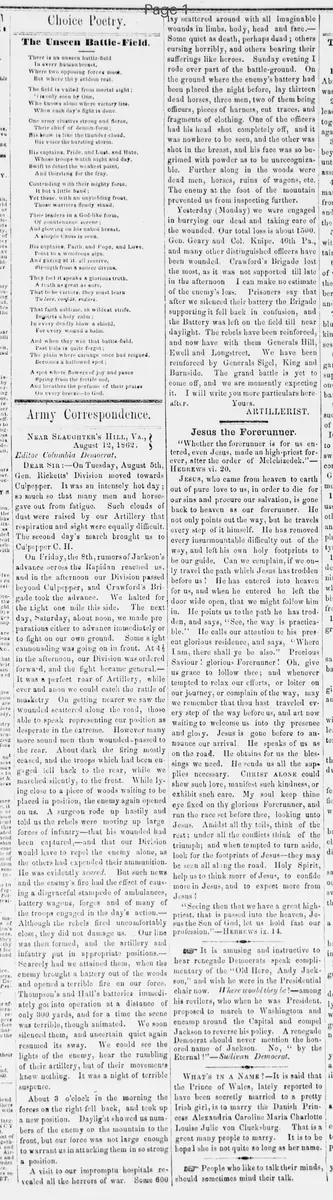
Near Slaughter's Hill, Va.,
August 12, 1862.
Editor Columbia Democrat:
DEAR SIR:—On Tuesday, August 5th.
Gen. Ricketts' Division moved towards
Culpepper. It was an intensely hot day:
so much so that many men and horses
gave out from fatigue. Such clouds of
dust were raised by our Artillery that
respiration and sight were equally difficult.
The second day's march brought us to
Culpepper C. H.
On Friday, the 8th, rumors of Jackson's
advance across the Rapidan reached us,
and in the afternoon our Division passed
beyond Culpepper, and Crawford's Brigade took the advance. We halted for
the night one mile this side. The next
day, Saturday, about noon, we made preparations either to advance immediately or
to fight on our own ground. Some slight
cannonading was going on in front. At 4
in the afternoon, our Division was ordered
forward, and the fight became general.—
It was a perfect roar of Artillery, while
ever and anon we could catch the rattle of
musketry. On getting nearer we saw the
wounded scattered along the road, those
able to speak representing our position as
desperate in the extreme. However many
more sound men than wounded—passed to
the rear. About dark the firing mostly
ceased, and the troops which had been engaged fell back to the rear, while we
marched silently, to the front. While lying close to a piece of woods waiting to be
placed in position, the enemy again opened
on us. A surgeon rode up hastily and
told us the rebels were moving up large
forces of infantry—that his wounded had
been captured,—and that our Division
would have to repel the enemy alone, as
the others had expended their ammunition.
He was evidently scared. But such news
and the enemy's fire had the effect of causing a disgraceful stampede of ambulances,
battery wagons, forges and of many of
the troops engaged in the day's action.—
Although the rebels fired uncomfortably
close, they did not damage us. Our line
was then formed, and the artillery and
infantry put in appropriate positions.—
Scarcely had we attained them, when the
enemy brought a battery out of the woods
and opened a terrible fire on our force.
Thompson's and Hall's batteries immediately got into operation at a distance of
only 300 yards, and for a time the scene
was terrible, though animated. We soon
silenced them, and uncertain quiet again
resumed its sway. We could see the
lights of the enemy, hear the rumbling
of their artillery, but of their movements
knew nothing. It was a night of terrible
suspense.
About 3 o'clock in the morning the
forces on the right fell back, and took up
a new position. Daylight showed us numbers of the enemy on the mountain to the
front, but our force was not large enough
to warrant us in attacking them in so strong
a position.
A visit to our impromptu hospitals revealed all the horrors of war. Some 600
lay scattered around with all imaginable
wounds in limbs, body, head and face.—
Some quiet as death, perhaps dead; others
cursing horribly, and others bearing their
sufferings like heroes. Sunday evening I
rode over part of the battle-ground. On
the ground where the enemy's battery had
been placed the night before, lay thirteen
dead horses, three men, two of them being
officers, pieces of harness, cut traces, and
fragments of clothing. One of the officers
had his head shot completely off, and it
was nowhere to be seen, and the other was
shot in the breast, and his face was so be-
grined with powder as to be unrecognizable. Further along in the woods were
dead men, horses, ruins of wagons, etc.
The enemy at the foot of the mountain
prevented us from inspecting further.
Yesterday (Monday) we were engaged
in burying our dead and taking care of
the wounded. Our total loss is about 1500.
Gen. Geary and Col. Knipc, 46th Pa.,
and many other distinguished officers have
been wounded. Crawford's Brigade lost
the most, as it was not supported till late
in the afternoon. I can make no estimate
of the enemy's loss. Prisoners say that
after we silenced their battery the Brigade
supporting it fell back in confusion, and
the Battery was left on the field till near
daylight. The rebels have been reinforced.
and now have with them Generals Hill,
Ewell and Longstreet. We have been
reinforced by Generals Sigel, King and
Burnside.
The grand battle is yet to
come off, and we are momently expecting
it. I will write you more particulars hereafter.
Yours,
ARTILLERIST.
What sub-type of article is it?
What keywords are associated?
What entities or persons were involved?
Where did it happen?
Domestic News Details
Primary Location
Near Slaughter's Hill, Va.
Event Date
August 5 12, 1862
Key Persons
Outcome
union loss about 1500; gen. geary and col. knipc wounded; enemy battery silenced but reinforcements on both sides; battle inconclusive with horrors of war described.
Event Details
Gen. Ricketts' Division marched to Culpepper C.H. amid heat and dust on August 5-6; rumors of Jackson's advance on August 8 led to positioning; on August 9, advanced into general battle with artillery and musketry; faced enemy fire, formed lines, silenced battery; night suspense, morning repositioning; visited hospitals and battlefield showing dead and wounded.