Thank you for visiting SNEWPapers!
Sign up free
Editorial
October 9, 1880
The Republican
Oakland, Garrett County, Maryland
What is this article about?
Editorial criticizes British efforts, via figures like Thomas Bayley Potter and the Cobden Club, to influence the 1880 US presidential election toward free trade and low tariffs, questioning American acceptance of such foreign meddling.
Clipping
OCR Quality
98%
Excellent
Full Text
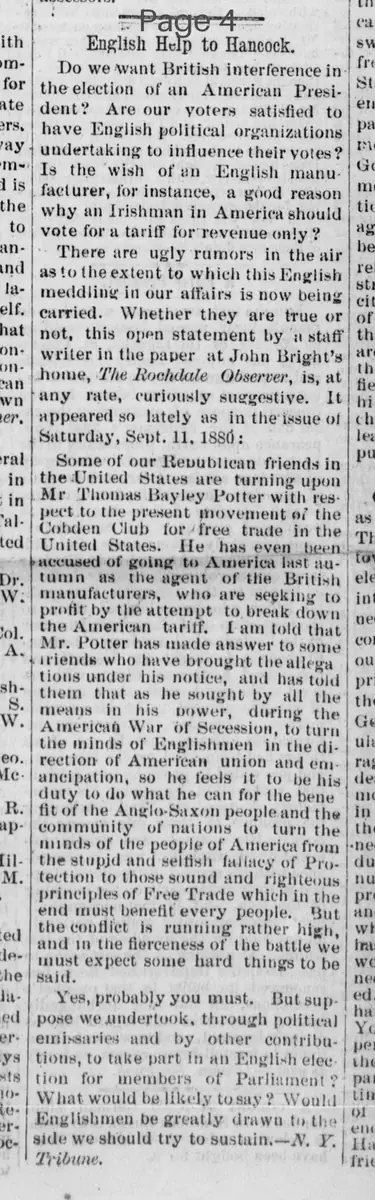
English Help to Hancock.
Do we want British interference in the election of an American President? Are our voters satisfied to have English political organizations undertaking to influence their votes? Is the wish of an English manufacturer, for instance, a good reason why an Irishman in America should vote for a tariff for revenue only?
There are ugly rumors in the air as to the extent to which this English meddling in our affairs is now being carried. Whether they are true or not, this open statement by a staff writer in the paper at John Bright's home, The Rochdale Observer, is, at any rate, curiously suggestive. It appeared so lately as in the issue of Saturday, Sept. 11, 1880:
Some of our Republican friends in the United States are turning upon Mr. Thomas Bayley Potter with respect to the present movement of the Cobden Club for free trade in the United States. He has even been accused of going to America last autumn as the agent of the British manufacturers, who are seeking to profit by the attempt to break down the American tariff. I am told that Mr. Potter has made answer to some friends who have brought the allegations under his notice, and has told them that as he sought by all the means in his power, during the American War of Secession, to turn the minds of Englishmen in the direction of American union and emancipation, so he feels it to be his duty to do what he can for the benefit of the Anglo-Saxon people and the community of nations to turn the minds of the people of America from the stupid and selfish fallacy of Protection to those sound and righteous principles of Free Trade which in the end must benefit every people. But the conflict is running rather high, and in the fierceness of the battle we must expect some hard things to be said.
Yes, probably you must. But suppose we undertook, through political emissaries and by other contributions, to take part in an English election for members of Parliament? What would be likely to say? Would Englishmen be greatly drawn to the side we should try to sustain.—N. Y. Tribune.
Do we want British interference in the election of an American President? Are our voters satisfied to have English political organizations undertaking to influence their votes? Is the wish of an English manufacturer, for instance, a good reason why an Irishman in America should vote for a tariff for revenue only?
There are ugly rumors in the air as to the extent to which this English meddling in our affairs is now being carried. Whether they are true or not, this open statement by a staff writer in the paper at John Bright's home, The Rochdale Observer, is, at any rate, curiously suggestive. It appeared so lately as in the issue of Saturday, Sept. 11, 1880:
Some of our Republican friends in the United States are turning upon Mr. Thomas Bayley Potter with respect to the present movement of the Cobden Club for free trade in the United States. He has even been accused of going to America last autumn as the agent of the British manufacturers, who are seeking to profit by the attempt to break down the American tariff. I am told that Mr. Potter has made answer to some friends who have brought the allegations under his notice, and has told them that as he sought by all the means in his power, during the American War of Secession, to turn the minds of Englishmen in the direction of American union and emancipation, so he feels it to be his duty to do what he can for the benefit of the Anglo-Saxon people and the community of nations to turn the minds of the people of America from the stupid and selfish fallacy of Protection to those sound and righteous principles of Free Trade which in the end must benefit every people. But the conflict is running rather high, and in the fierceness of the battle we must expect some hard things to be said.
Yes, probably you must. But suppose we undertook, through political emissaries and by other contributions, to take part in an English election for members of Parliament? What would be likely to say? Would Englishmen be greatly drawn to the side we should try to sustain.—N. Y. Tribune.
What sub-type of article is it?
Foreign Affairs
Economic Policy
Partisan Politics
What keywords are associated?
British Interference
Us Election
Tariffs
Free Trade
Cobden Club
Potter
Hancock
What entities or persons were involved?
John Bright
Thomas Bayley Potter
Cobden Club
Hancock
British Manufacturers
Rochdale Observer
N.Y. Tribune
Editorial Details
Primary Topic
British Interference In Us Presidential Election On Tariffs
Stance / Tone
Critical Of English Meddling In American Politics
Key Figures
John Bright
Thomas Bayley Potter
Cobden Club
Hancock
British Manufacturers
Rochdale Observer
N.Y. Tribune
Key Arguments
Do Americans Want British Interference In Presidential Election?
English Organizations Influencing Us Votes On Tariffs
Rumors Of Extensive English Meddling
Quote From Rochdale Observer On Potter's Free Trade Advocacy
Potter's Past Support For American Union During Civil War
Hypothetical: Us Interference In English Elections Would Provoke Backlash