Thank you for visiting SNEWPapers!
Sign up free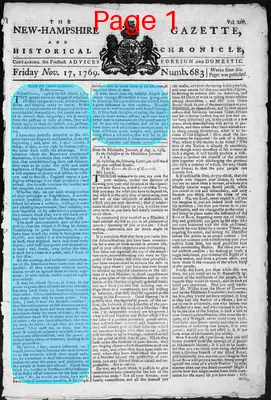
The New Hampshire Gazette And Historical Chronicle
Portsmouth, Greenland, Rockingham County, New Hampshire
What is this article about?
An anonymous letter dated August 14, 1769, addressed to King George III, urges him to redress American colonial grievances stemming from the Stamp Act to avert rebellion and economic hardship in England. It highlights mutual benefits of empire, respectful American remonstrances, and suggests consulting preacher George Whitefield for reconciliation.
Clipping
OCR Quality
Full Text
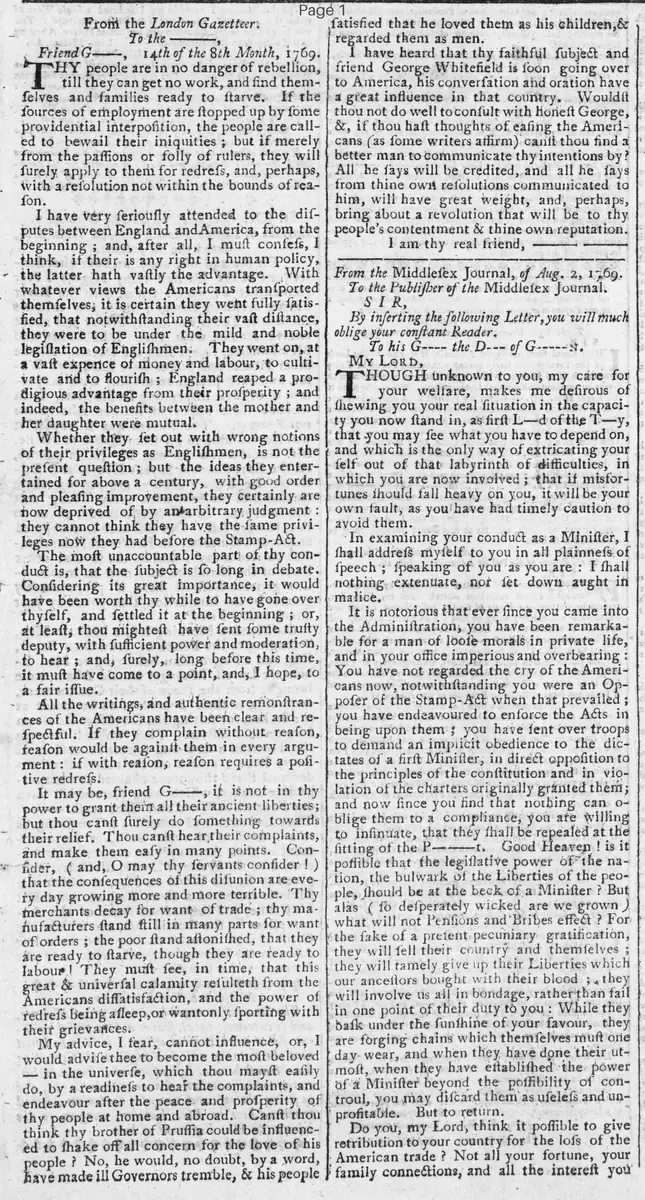
To the Friend G-s, 14th of the 8th Month, 1769.
My people are in no danger of rebellion, till they can get no work, and find themselves and families ready to starve. If the sources of employment are stopped up by some providential interposition, the people are called to bewail their iniquities: but if merely from the passions or folly of rulers, they will surely apply to them for redress, and, perhaps, with a resolution not within the bounds of reason.
I have very seriously attended to the disputes between England and America, from the beginning; and, after all, I must confess, I think, if there is any right in human policy, the latter hath vastly the advantage. With whatever views the Americans transported themselves: it is certain they went fully satisfied, that notwithstanding their vast distance, they were to be under the mild and noble legislation of Englishmen: They went on, at a vast expense of money and labour, to cultivate and to flourish: England reaped a prodigious advantage from their prosperity; and indeed, the benefits between the mother and her daughter were mutual.
Whether they set out with wrong notions of their privileges as Englishmen, is not the present question; but the ideas they entertained for above a century, with good order and pleasing improvement, they certainly are now deprived of by an arbitrary judgment: they cannot think they have the same privileges now they had before the Stamp-Act.
The most unaccountable part of thy conduct is, that the subject is so long in debate. Considering its great importance, it would have been worth thy while to have gone over thyself, and settled it at the beginning; or, at least: thou mightest have sent some trusty deputy, with sufficient power and moderation, to hear; and surely, long before this time, it must have come to a point, and I hope, to a fair issue.
All the writings, and authentic remonstrances of the Americans have been clear and respectful: If they complain without reason, reason would be against them in every argument: if with reason, reason requires a positive redress.
It may be, friend G-ie -, it is not in thy power to grant them all their ancient liberties; but thou canst surely do something towards their relief. Thou canst hear their complaints, and make them easy in many points. Consider, (and, O may thy servants consider!) that the consequences of this disunion are every day growing more and more terrible. Thy merchants decay for want of trade; thy manufacturers stand still in many parts for want of orders; the poor stand astonished, that they are ready to starve, though they are ready to labour! They must see, in time, that this great & universal calamity resulteth from the Americans dissatisfaction, and the power of redress being asleep, or wantonly sporting with their grievances.
My advice, I fear, cannot influence, or I would advise thee to become the most beloved — in the universe, which thou mayst easily do, by a readiness to hear the complaints, and endeavour after the peace and prosperity of thy people at home and abroad. Canst thou think thy brother of Prussia could be influenced to shake off all concern for the love of his people? No, he would, no doubt, by a word, have made ill Governors tremble, & his people satisfied that he loved them as his children; & regarded them as men.
I have heard that thy faithful subject and friend George Whitefield is soon going over to America. his conversation and oration have a great influence in that country. Wouldst thou not do well to consult with honest George, & if thou hast thoughts of easing the Americans (as some writers affirm) canst thou find a better man to communicate thy intentions by? All he says will be credited, and all he says from thine own resolutions communicated to him, will have great weight, and, perhaps, bring about a revolution that will be to thy people's contentment & thine own reputation.
I am thy real friend,
What sub-type of article is it?
What themes does it cover?
What keywords are associated?
What entities or persons were involved?
Letter to Editor Details
Recipient
Friend G S
Main Argument
the king should promptly address american grievances over lost privileges from the stamp act era by hearing complaints, providing redress, and consulting george whitefield to restore peace, prevent rebellion, and revive english economy dependent on colonial trade.
Notable Details