Thank you for visiting SNEWPapers!
Sign up free
Morning Star
Limerick, York County, Maine
What is this article about?
Cassius M. Clay delivers an anti-slavery speech at White Sulphur Springs, Kentucky, on December 30, 1843, opposing Texas annexation as it would extend slavery, violate treaties with Mexico, and risk Union dissolution. He defends abolitionism and urges constitutional fidelity.
Merged-components note: Merged introductory text about Cassius M. Clay's speech with the full speech text, as they form a single logical story unit spanning pages.
Clippings
1 of 2
OCR Quality
Full Text
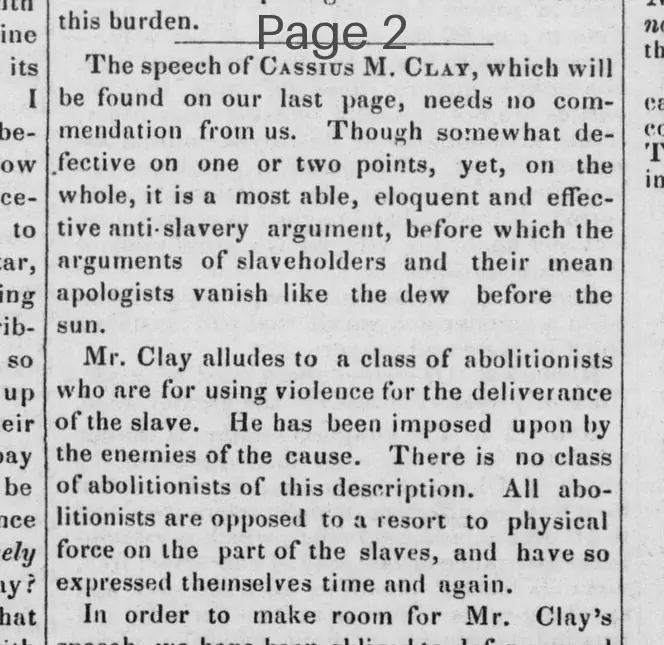
Mr. Clay alludes to a class of abolitionists who are for using violence for the deliverance of the slave. He has been imposed upon by the enemies of the cause. There is no class of abolitionists of this description. All abolitionists are opposed to a resort to physical force on the part of the slaves, and have so expressed themselves time and again.
ANTI-SLAVERY SPEECH OF CASSIUS M. CLAY.
Delivered in a mass meeting of a portion of the citizens of the 5th Congressional District, on Saturday the 30th of December, 1843, at the White Sulphur Springs, in Scott County, Ky., in reply to Col. R. M. Johnson, and others.
MR. President and Fellow-Citizens:
In presenting the resolutions which I have offered as a substitute for those reported by a majority of your committee, I do not hope to be more successful here, than I have been in the committee itself. This place of meeting, the presiding officer, (Col. R. M. Johnson, and the audience who favor me with a hearing, all forbid any expectation on my part, of carrying the substitute. But I rejoice, humble as I may be in ability, unknown to fame, and of no consideration among men, that association with your name, in this day's deliberations, will give me a factitious importance, which will recommend what I shall say to a hearing from the people of the United States.
My opinions, tho' of little intrinsic value, may excite the minds of my countrymen to reflection, and then after mature consideration, I dare venture the assertion, that the position I have this day taken will be maintained in practice, and vindicated at last by a recognition of those principles, which it is the province of history to enforce and consecrate in the affections of mankind.
Regarding the question at issue as second only to those which have forever illustrated the year 1776, I shall speak with that freedom which I inherit as my birthright, and which I so much desire to transmit unimpaired to posterity. Though yet young, I am old enough to know, from sad experience, what history in such melancholy strains has uttered in vain into the deaf ears of men: that the best counsel is far from being always the most acceptable. When the storm-cast vessel is threatened with wreck, the man who would save her by throwing overboard the boxes of gold and other things of more cherished endearment, is hardly heard, whilst he who maintains that all is safe, is too often trusted till both life and treasure are irrecoverably lost. He who from good motives gives even bad advice, is entitled at least to just forbearance: whilst the man who advances the best of counsel for selfish purposes deserves no consideration for his services.
Those gentlemen who would annex Texas to the Union, and hurry us blindfold down this precipice of ruin and dishonor, have here in these slave States at least, popular prejudice in their favor. On one side are honor, power, wealth, and easy access to fame: on the other side, denunciation, banishment, poverty, and obscurity threaten. If I then speak freely the truth, when you, my countrymen, are to reap all the fruits of the sacrifice, no man can say I ask too much, when I pray you to hear me with a patience becoming the solemnity of the occasion.
First of all, then, I protest against this appeal to our sympathies in behalf of Texas, and these unjust denunciations of Mexico, as foreign to the true issue, and eminently calculated to lead us into error. Though truly, and with sorrow be it said, of Anglo-Saxon blood, bone of our bone, and flesh of our flesh, in the language of gentlemen, I ask you, what claims of sympathy has Texas on the people of the United States? Enjoying all the blessings which the Constitution guarantees to her people, with all the offices of honor and profit open to the humblest citizen; with an unoccupied domain extending to the distant Pacific, like our first parents going out from Eden, with the world before them where to choose a home-they voluntarily banished themselves from their native country, disavowed the glorious principles of the American Declaration of the rights of man, renounced the inestimable privileges of the Federal Constitution which was their inheritance, and forgetful of all the ties of common blood, language, and home, they became the fellow subjects, with a half barbarian people, of a distant Spanish Prince.
Yes, without becoming the advocates of Santa Anna, whom we have heard denounced as a tyrant and traitor, for the purpose of prejudicing the cause which I vindicate: trusting to indestructible truth and avenging history, I challenge a comparison between Texas and Mexico. The Mexican people, inspired by that Declaration of American Independence, which recently Texas had renounced, in 1821, vindicated, by a glorious revolution, her title to independence of the Spanish monarchy: and illustrated in act, the postulate taught by our revolutionary heroes, that a people cannot of right be governed without their own consent. In 1824, Mexico, following the example of the United States and Great Britain, who in 1807 had declared the slave trade piracy and punishable with death, prohibited, in the language of Judge Story, this 'infernal traffic.' In 1826, once more unlike Texas, she made it part of her Constitution that no person born after the promulgation of the same, in the several provinces, should be held a slave. Again in 1829, this much abused Mexico declared slavery was extinguished in the republic, and elevating the dread standard of 'God and liberty,' she called upon the sons of freedom by arms to vindicate this immortal decree. And where now, throughout this vast empire, did this glad note of liberty fail to receive a willing response? Alas! for the recreant Saxons of Texas,-the descendants of Washington, and Jefferson, and Adams, and Franklin,-Texas, who had received from a paternal government a gratuitous fee simple in the finest soil on earth, exempt from taxation for ten years, and without other sacrifice, save allegiance to the government and to the Catholic religion, which she had most solemnly sworn to yield; Texas, was the first to raise the black flag of 'slavery and no emancipation'-aye, Texas was the only people who dared to brave the indignation of mankind, by resisting that liberty which has made the nineteenth century forever memorable in the annals of the world. And yet, Santa Anna is a most horrible despot, and much injured and oppressed Texas is the defender of liberty! Santa Anna, who has civilized the barbarian and revolutionary spirit of his people -who has suppressed the daring bands of robbers who infested the high ways, making life unsafe, property insecure, and commerce impracticable-who has encouraged education and the useful arts-who has caused to be recognized the principles of equal rights and representative government-who, in the midst of the embarrassments of the world, and the exhaustion, arising from revolutionary and civil wars, which have especially harassed his own country, has preserved the Mexican faith inviolate; whose many gallant deeds in war and peace I have, by the almost unanimous acclamation of the people, again and again elevated him to the presidency of the republic. Santa Anna, who has often liberated American citizens, under circumstances which induced England to send them into hopeless exile-Santa Anna is an odious tyrant, and Texas, renegade from the land and religion of its fathers-Texas, the ingrate to its adopted and fostering country-Texas, the propagators of slavery-Texas, the repadiator of its debts, the violator of public faith
Texas is so lovely in the eyes of gentlemen, that we must take it to our embrace, although we fall with it into one common grave! But in truth we have nothing to do with the republics of Texas and Mexico; whether they be the same or two independent nations, is to us a matter of no concern. We have no evidence that she seeks alliance, even if we were disposed to grant it. I am no propagandist-I am satisfied to maintain the principles, the independence and the honor of my own country.
The same impulse which moves me to repel foreign interference and to defend my own rights, constrains me also, to keep aloof from, and respect the peculiar organization which other nations have deemed most suitable to secure their rights.
I contend, then, in the language of the first resolution, that the annexation of Texas to the United States is contrary to the laws of nations, and just cause of war on the part of Mexico. The recognition of the independence of Texas by the United States, may or may not have been a sufficient cause of war: it remained with Mexico to vindicate her injured honor, or to pocket the injury or insult, as to her seemed best, relying upon her own capability of maintaining the integrity of her empire. But when the United States; not confining herself to just, or it may be unjust sympathy, not restrained to an opinion that Texas is or ought of right to be an independent people, makes herself an active and principal party, by taking hold of the province in controversy, thus forever making it impossible for Mexico to recover the country which up to that time was but partially or temporarily in her view alienated from her: then I say that Mexico has not only just cause of war, but that she would be disgraced in the eyes of all gallant nations, if she did not use her every power for the vindication of her injured honor and violated territory. Learned authority has been quoted here, with the vain expectation of persuading us that Mexico has no cause of grievance in the event supposed. I dare not insult common sense by acquiescence in such mysterious jurisprudential jargon as this. I appeal to the reason, to the instincts, the consciences of men, for the establishment of the law of nature, upon which the laws of nations are, or ought to be, forever based. What, sir! Have we a solemn treaty of amity with Mexico, to say nothing at present of the natural right, and is it the part of friendship to seize with a rapacious hand, a portion of the territory which she still claims, and appropriate it to ourselves? Do not these learned jurists know that a breach of treaty is contrary to the laws of nations, as laid down by all the writers upon that most obscure science, and, without reparation, just cause of war? And what reparation could we make whilst we continue to hold the price of blood and violated faith? What war was more unjust than that carried on by the United States against the Florida Indians? Suppose at some time after its commencement, Mexico had agreed with the Indians, that they declared themselves to be free and independent; and suppose Mexico had subsequently thereto, thus addressed us, 'You have expended forty millions of dollars, you have lost a white man for every Indian slain in battle, you have called to your aid blood-hounds in vain, to the horror of all Christendom; for eight years you have with the whole force of the empire carried on a hopeless war of recovery; it is time hostilities should cease: we will take the Floridas ourselves, peaceably if we can, forcibly if we must.' I shall not stop to ask whether we should have deemed this a just cause of war, or to say what would have been our laconic reply. Cases have arisen, and will doubtless again arise, which, when a people are struggling to throw off an unjust and tyrannical rule, have and will again justify a virtuous nation, even when in alliance with the tyrant, in sympathising with, and recognizing the independence of the oppressed. Here the rectitude of the motive and just cause of the injured cure and sanctify the breach of the treaty of amity. But when Texas is the wrong doer, and Mexico the injured party; here, where, not even studiously disguised motives, wearing the resemblance of virtue, but shameless and openly avowed rapacity, impels us to the breach of faith and the disregard of natural right; she will not only declare war against us, but she will justly claim the universal sympathy and aid of nations, to enable her to vindicate her desecrated soil and insulted sovereignty.
The wrongs of Mexico, the wishes of Texas, the armed arbitrament of other nations aside, the case is still far from being stripped of its embarrassments. It matters not so much what other men may think of us, as that we may think well of ourselves—happy, happy indeed are they who condemn not themselves. If we had our own consent, and that of the North, to this annexation, still, I deem it questionable whether Texas, a free State, could constitutionally be admitted into this Union. I do not deny that the necessity of the case, the dread alternatives of war, might not, under the treaty-making power, compel us to cede away, or to acquire territory. Whether the provinces of Louisiana and Florida were acquired constitutionally or not, I shall not, at this late day, undertake to question. They were admitted, however, by the sovereign proprietor's consent. One of them lying around the mouth of the Mississippi river, threatened with eternal embarrassment the trade of the whole of the great valley of the west : no breach of violated national faith was insinuated, no disastrous wars threatened, and yet able jurists and patriotic statesmen denied the constitutionality of the acquisition, and threatened its ratification with resistance and dissolution.
But where is the necessity for the annexation of Texas-even if she desired it-even if Mexico did not denounce war-even if there was no violation of faith-even if she was not a slave State-where, I ask, is that overwhelming necessity which generates a power not given by the Constitution, nor anticipated by its authors ? It is not territory that we want; our wide unoccupied domain stretches from the Mississippi to the far Pacific : we have already more land than we are able to defend from savage incursion or British usurpation. We want more slave States to offset the fanatical free States.'
Let the world hear it: you admit, sir, that we want Texas to extend slavery among men. Unutterable emotions agitate my bosom. I ask the charter of my liberty-of your liberty: I call upon the Declaration of American Independence, upon which it is founded : I invoke the spirit of freedom, which in the days of suffering and threatened despair inspired its utterance, as solemn protests against this most unholy scheme. Shall we not blush to draw the veil, which has hardly shielded us from the contempt and loathing of mankind, for proclaiming liberty and practising servitude? Shall we longer gull them by the hypocritical plea of necessity, the sole defence of tyrants ? Anew, we incur the guilt of slavery, and are ready to do battle even unto death for its extension. Then expunge from your annals the declaration of rights—repeal the law of '20 which makes the slave trade piracy-down with the gibbet, and bind the laurel upon the brow of the suspended culprit-withdraw your fleet from the coast of Africa—tell Great Britain and the world, that you have been en-
acting a solemn farce, when you talked so loudly of liberty ; that tyranny is the best government, and slavery is the truest liberty—that now, at last, you begin to be in earnest—fifty years' constraint wearies the impassive muscles of the most wooden face—you give it up-now you hold slavery sacred at home, and, like the oriental prophet of Medina, you are ready to propagate your faith by fire and sword throughout the world—that henceforth and forever your watchword shall be, 'slavery or death.' I care not for the precedents of the past : I declare that there is no power in the federal Constitution by which a slave State can be admitted into the Union. Slavery cannot exist by the law of nature : it cannot exist by act of Congress. Slavery did exist by the laws of the sovereign States, in the formation of the Constitution ; they thus far retained their sovereignty, denying it to that extent to the creature of their united will. If they vested in Congress the power to make a slave, then they at the same yielded the power to unmake him. If then the Congress can make a slave State, they can unmake a slave State ; and if she has that power, it is her bounden duty not to add new slave States to the Union, but to purge it immediately of this fatal disease which threatens death to the liberties of the whole country.
They who contend, then, for the admission of the slave State of Texas, are handling a two edged sword ; it cuts both ways ; the assumption of such a power must, therefore, be abandoned at once and forever. The contemptible jargon that slavery already existing in Texas or other territory, acquired by conquest, purchase, or voluntary cession, by municipal law, Congress may form them into slave States, and admit them into the Union, is unworthy of consideration : it involves the absurdity of having the power to do through an agent or indirectly, that which they cannot do directly or of themselves. Nothing but sovereign power can make a slave : the moment a State, once having been independent, unites itself with this Union, at that moment its sovereignty is lost, and with it falls slavery at the same time. If the State about to be admitted was originally a part of the territory of the U. States, it never had any sovereignty, and, of course, never could have made a slave.
I repeat once more, that independent of Art. 5th, of the amendment of the Constitution, slavery cannot exist by act of Congress-but when we there find the express language, 'No person shall be deprived of life, liberty, or property, without due process of law,' all subterfuge is at an end-and the learned and unlearned must unite in one voice, there is no power under heaven whilst the Constitution remains inviolate, by which Texas, as a slave State, can be admitted into this Union. When gentlemen are driven from all their strong holds, having no ground to stand upon in making out a case of necessity, they at last come out with the old bugbear, which has been so often paraded up and down with tin pans beating, and cow's horns blowing, whenever any party ends are to be achieved, that it has ceased to attract even passing boys, who are accustomed to shout after such unfamiliar shows-yes, England is the monster they would get at-and they are surprised when this old enemy is in the field, that a military man like myself should be the last to come to the rescue.
Although in the eyes of some it may be treason to say a kind or just thing about this haughty power, the brave cannot at last but honor the brave. I scorn to compliment myself indirectly, when I say that the greatest warriors are in the main the staunchest friends of peace. The man who intends to run away, cares not how soon the battle may come on; but he who has determined to die or conquer, will be slow in seeking the fight. Soult and Wellington are said to resist the warlike spirit of their people ; and the correspondence of Scott and the Governor General of New-Brunswick, during the difficulties on the Maine border, is an honor to them, and to their respective nations. In a bad cause, a woman may put me to flight ; but plant me upon the right, and I am proud to say that the man does not live whom I dare not look in the face.
If we conquered in the war of independence, it was not because of our physical strength. With Lord Chatham I say, that in a good cause, England could have crushed America to atoms. It was the consciousness of justice which nerved our people in the hour of trial. Yes, it was the right in which we conquered : it was the right that called the gallant of all lands to our standard : it was the right which made the veteran British Lion, who had traversed the world unscathed, crouch in dishonor before the unfledged bird of Jove. It was the glorious principles of life, liberty, and the pursuit of happiness inscribed on our banners, like which the letters of fire on the Babylonian wall, struck terror into the enemies of our country.
But in this war which you are madly projecting, this inspiring banner will not be borne alas by us, but by them. Go tell the six hundred thousand free laborers of my gallant State, before they leave home, wife, children and friends, before they shoulder their musket and march afar to shed on the plains of Texas, their blood for the extension of slavery, to ask themselves, what they are to gain? When they lie bleeding and dying on the burning sands of a foreign country, or writhing in the deadly grasp of the terrible epidemics of the swamps of Florida and Louisiana, what maddening reflections will then await them! The blood of our sires has been spent in vain, the Constitution has been violated, the Union has been dissolved, our wives and children have become outcasts and beggars, our country is lost; all lovely nature fades fast from our dim reluctant eyes, we sink unwep t into dishonored graves, accursed of God and man. If our cause triumphs, the sighs and tears of millions enslaved will mar the fruits of victory; but if it fail, as seemingly it must, then have the chains which we have forged for others, become the heritage of our posterity forever.
No. Mr. President, it cannot be. If the worst comes to the worst, and the Union shall be dissolved, I, for one, will join my destiny with the North. Here in Kentucky, my mother earth, I shall stand unawed by danger, unmoved by denunciation, a living sacrifice for her best prosperity: I shall not fear death itself, if she may but live. But if mad counsels shall press her on to ruin, and she shall prefer destruction to the relinquishment of her idols, then, and not till then, taking up my household gods, an unwilling exile, I shall, in other lands, seek that liberty which was hopeless in my native home. I would to God, that my voice could this day reach every log cabin in this wide and lovely land; then, indeed, would I feel assured that this dread alternative could never happen; but my words are feebly echoed from these walls, and the press is sealed like the apocalyptic books, which human power cannot open, and darkness broods over the land once more, till God himself shall say, Let there be light.
Gentlemen, I know, flatter themselves that there will be no dissolution of the Union.- In 1803 and 1820, we are told there was the same loud talk that there is now, about separation-that it will wear away once more as it did then. It is natural for man to indulge in the illusions of hope; we are apt to shut our
eyes to the painful truth and to listen to the voice of that syren, till she has transformed us into beasts. Alas! that these lines of other days, made familiar by school-boy declamations, should rush back upon the memory with their primitive awful energy. I know the North; at last, they are in earnest.- Twenty of her leading minds, her ablest, most patriotic citizens, have most solemnly declared in the face of men, that in the event of the annexation of Texas to this country, the Union shall be no more. Yes, sir, they have said it-depend upon it, they will do what they say they will do. Since the time, when in the vindication of the law of 1833, I found it necessary to prevent the flood of Southern blacks from desolating our State, to appeal to the first great principles of natural and American law, to sustain my policy against blind and maddened avarice, I have received from all parts of the Union, letters and papers upon the vital subject of slavery, and I think I know as much about the true feelings of Northern men as any other man in Kentucky.
They are divided into three parties upon the subject of slavery. First, there is the small band of abolitionists, who are, for violence, if necessary, in the extermination of slavery. They are few indeed, and deserve, as they receive, the execration of good men both in the North, and in the South. Then come the Liberty party, embracing a large portion of the virtue, intelligence, and legal knowledge, the Christianity and patriotism of the North. Taking the ground first occupied by Washington himself, that slavery was the creature of the law, and should be abolished by law, they appeal to the ballot-box, not the bayonet; like the great Irish reformer, having faith in the power of reason, truth and virtue, they expect to achieve a bloodless revolution, more glorious than any yet arising from force and arms. This party, a few years ago, numbered but seven thousand voters; now, in 1843, they poll sixty-five thousand men at the ballot-box; having doubled themselves every year from the time of their organization. At such a continued rate of increase, I leave it to the reflecting to determine how long it will be before they absorb the whole political power of the North.- Lastly, there is the great mass of Northern men, who are opposed to slavery in principle, but who forbear to take any active part for its removal: not because they do not feel many of its evils, but because they fear the consequences of entering upon untried scenes; preferring, according to the oft-repeated maxim, to bear the evils they have, rather than fly to others they know not of. Then there remains a fragment of men, who are the shameless advocates of slavery, with a perverse nature, such as inspires the unworthy bosoms of convicts; they pride themselves upon their pre-eminence in guilt, and challenge the abhorrence of mankind to elevate them to that notoriety which they have despaired of obtaining by virtuous deeds. In estimating Northern feeling, I shall pass them over entirely, as in speaking of the morals of Kentuckians, I would not enter the penitentiary for illustration. So, in speaking of the North, I mention not these men, regarding them rather as those outcasts, whom God in his vengeance has inflicted upon all nations, and who are peculiar to none.
Then, sir, these twenty men of whom I have before spoken, are the true exponents of the sentiments of the great mass of Northern freemen, and of course, also to the extent of the two fragmentary parties which I have enumerated. You know the opinions of those men-they have avowed them in Congress-they are before the world. They say that slavery, not content with the immunities allowed it in the original compact, has transcended its assigned limits, and recklessly trenched upon the liberties of the North, through a violated Constitution. They complain that the right of petition is denied-that the freedom of speech and the press is suppressed-that members of Congress are censured for opinion's sake-that the Post-office is wrested by violence from the purposes of its creation: they are outraged, that their colored citizens, cooks, sailors, and others, contrary to the express language of the Constitution, instead of being allowed the privileges of citizenship, are thrown into prison and deprived of their rights without any just cause; they are indignant that their free white citizens are horribly murdered in the South for opinion's sake, without having violated any State or national law, or without having been tried by a jury of their peers, which is their inalienable right. They are dissatisfied, that the most solemn treaties of the United States should be nullified by the extension of the laws of Georgia, over the Cherokee nation, and by which the missionaries, free citizens of the North, were thrown into prison, and there kept, contrary to law, and in disregard of the Supreme Court of the Union. They are aggrieved at the cause and the progress of the Florida war by which forty millions of dollars have been taken from the hard earnings of the people, by which many thousand valuable lives have been sacrificed by disease and the Indian rifle, by which our national honor was tarnished in the employment of blood-hounds, to drive the unoffending savages from the homes of their fathers, which were their rightful inheritance-all of which they attribute to the sole cause of saving runaway slaves from fleeing into those impassable swamps. They are solemnly of opinion, that of right, no new State could have been admitted into this Union.
They believe that there is no good reason why slaves, held as property, should be represented in Congress, to the exclusion of all other property, and that justice, as well as their own interest, calls for a change in the Constitution, so as to destroy this inequality. They are opposed to the continuance of slavery in the District of Columbia, in the territories and at the impunity of the coasting, and domestic slave trade. Annex Texas, say they, 'and slavery will acquire such strength as to destroy the remnant of liberty that yet lingers in the North and in the South.' All these grievances they have reluctantly borne, for the peace, harmony, and permanency of the Union, bought by the common blood of our ancestors. Should the South, now, anew, violate the Constitution for the sole purpose of extending slavery, they are not the true descendants of the men of Lexington and Bunker Hill, if they do not part from slavery and its ruinous consequences, at once and forever. And because I will not shut my eyes to the danger that seems to threaten us with immediate dissolution-because I dare to speak fearlessly the truth, holding, with Jefferson, that there is no error so dangerous that it may not be combatted with reason and argument-because I will not, for popular favor, prove a renegade from the faith of my ancestors—because I will not, for the sake of office and political promotion, prostitute myself to the basest and most dishonorable purposes, by avowing in public what, in private, every one who is not a madman daily acknowledges to be utterly false, that 'slavery is a blessing,'-because I am willing to allow that the six hundred thousand free white citizens of this Commonwealth have some rights as well as the slaveholders —I am to be run down as an abolitionist, and the ban of the empire is to be denounced a-
gainst me. I cannot write an answer to the complimentary letter of Mr. Giddings, of Ohio, but I am published throughout the land as an enemy to my country. And when, in the New-York Tribune, I set forth my true position, and in defence of which I challenge both North and South to shake me, my letter is denied publication in the presses of both political parties; and yet still goes on the eternal prating about the freedom of the press; sycophantic speeches are daily poured into the ears of the dear people, whilst that same people are barred by despotic intolerance from receiving any light by which they know their rights, and free themselves from the competition of slave labor, which brings ignorance and beggary to their doors. I appeal to mankind against such fiendish injustice.— If public opinion be indeed omnipotent, then let its thunders strike terror into the faithless sentinels on the watch-tower of liberty-the false prophets who have basely usurped the tripods of the press.* To say that I am an abolitionist, in the sense in which the enemies of all moral progress would have you believe, that I would sanction insurrection and massacre-my wife, children, mother, brothers and sisters, and relations and friends, are all hostages for my sincerity, when, restraining myself to the use of courteous terms, I repel the unjust and dishonoring imputation. That I am an abolitionist in the sense that I would take away, without just compensation, the rights of property in slaves, which the laws secure to me and some thirty or forty thousand citizens of Kentucky, my letter to the Tribune, which is before the world, disproves.
Still, sir, I am an abolitionist. Such an abolitionist as I have been from my boyhood- such an abolitionist as I was in 1836, when I declared in my place in the House of Representatives to which I was just then elected, that if the Constitution did not give us power to protect ourselves against the infernal slave-trade, that I renounced it, and would appeal to a Convention for a new one. Such an abolitionist as I was again in 1840, when I declared in the same House of Representatives, that I wished to place the State of Kentucky in such a position by sustaining the law of 1833, that she could move at any time she thought it conducive to her highest interest, to free herself from slavery. Such an abolitionist as I have ever avowed myself in public speeches and writings to the people of this district, that if Kentucky was wise enough to free herself from the counsels of pro-slavery men, that slavery would perish of itself, by the voluntary action of masters and the irresistible force of circumstances, which would compel the people to the use of free instead of slave labor, as every way most advantageous. Such an abolitionist as was the band of immortal men who formed the Federal Constitution, who would not have the word 'slave' in that sacred instrument, am I. Such an abolitionist as Washington, who, so far from lending countenance to the propagation of slavery, as you are now doing, declared that on all proper occasions his influence and his vote should be cast for the extinguishment of slavery among men, am I also. Such an abolitionist as was Jefferson, the great father of Democracy, whom you all profess to follow, who foretold what has since partially come to pass, that slavery, if not destroyed, would jeopard and finally extinguish the liberties of the whites themselves, that the slavery of the black race, if not remedied by the whites, would at last remedy itself-such an abolitionist am I also. And being such, I take issue with the opinion that has been here to-day, as it has been often elsewhere most dogmatically advanced, that the question is, whether the whites shall rule the blacks, or the blacks rule the whites.' Such an issue is false in theory, false in practice, and so proven to be false by all experience. It is derogatory to human nature, and blasphemy against God himself.
All America, except Brazil and the United States, have freed their slaves: and are all the whites slaves in consequence? At the Revolution, on the day of the Declaration of Independence, all the States held slaves, not excepting Massachusetts. Now there are thirteen non-slaveholding States: are those ten millions of Northerners slaves? Great Britain, in conjunction with all Europe, except the miserable anarchies of Spain and Portugal, have long since emancipated many slaves, and now, in the year 1843, to her honor be it spoken, having liberated 30,000,000 of her East India serfs, in all her wide domains which touch on every sea, and embrace every clime under the whole heavens, there is not, nor indeed can be a single slave: and is she enslaved? No; she has sense enough to know, and heart enough to feel, that it is justice, honor and glory, which secure the liberties of a people and make them invincible and immortal.
Do gentlemen take the absurd position, that one hundred and eighty thousand freed men could enslave Kentucky? West India emancipation proves that the great majority of freed men could be employed economically in the same offices at small wages, which they now fill; with perhaps more ease and safety than now exist. But should they prove turbulent, for which there would be no cause, and which no man in his senses believes would happen, and were I disposed to indulge in that vaunting spirit which to day has so powerfully infected us— with five thousand such troops as those I have the honor to command, to whom gentlemen have been pleased to allude in a manner so complimentary, at my expense, I would undertake to drive from the State the assembled one hundred and eighty thousand in arms. They further tell us, with most reverential gravity, that 'God has designed some men for slaves, and man need not attempt to reverse the decree : it is better that the blacks should be slaves than the whites.' This proposition, which I denounce as utterly false, passes away before the glance of reason, as the dew before a summer's sun.
I shall admit, merely for the sake of argument, that some men always have, and possibly will, perform menial offices for the more fortunate. Let the law of nature or of God have its undisturbed action-let the performance of those offices be voluntary on the part of servants, and that beautiful harmony by which the highest intellect is united, by successive inferior links to the lowest mind, will never be disturbed. The sensitive, and highly organized, and intellectual, will gradually rise from service to command : the stolid, the profligate, the insensible and coarsely organized, will sink into their places; the law of God and enlightened freedom will still be preserved, and the greatest good to the greatest number be secured forever. But when by municipal law, and not by the law of fitness, which is the law of nature, not regarding the distinctions of morals, mind or body, whole classes are doomed to servitude; when the intellectual, the sensitive, the foolish, the rude, the good, the bad, the refined, the degraded, are all depressed to one level, never more to rise forever ; then comes evil, nothing but evil-like as from dammed up waters or pent up streams, floods and explosions come slowly, but come at last-so nature mocks with temporary desolation at the obstacles man would oppose to her progress, and at length moves on once more in all the untramelled vigor and unfading loveliness which from eternity was decreed. That the black is inferior to the white, I readily allow ; but that vice may depress the one, and virtue by successive generations elevate the other, till the two races meet on one common level, I am also firmly convinced. Modern science, in the breeding and culture of other animals than man, has most fully proved this fact, while the ablest observers of man himself, all allow that mental, and moral, and physical developments transmit their several properties to the descendants—corroborating by experience the divine decree, that the virtues and the vices of the father shall be visited on the children, to the third and fourth generation. In the capitals of Europe, blacks have attained to the highest places of social and literary eminence. That they are capable of a high degree of civilization, Hayti daily illustrates. There we have lately seen a revolution conducted in a manner that would do honor to the first people on earth, one of the avowed grounds of which was, that President Boyer neglected to secure general education to the people, a consideration that should make some vaunted States blush in comparison. After the expulsion of the tyrant, they set about forming a more republican Constitution, admitting the whites who had participated in their dangers and success, to all the rights of citizenship.
If history be true, we owe to the Egyptians, said to be of the modern Moorish race, the arts and sciences, and our early seeds of civilization. How many centuries did it take to bring them to perfection ! When we reflect how little time the negro race has been under the influence of another civilized nation, and the rapid progress they have made in an upward direction, we have no reason to treat them with that absurd contempt, which in both the eye of reason and religion stands equally condemned. Why, then, am I taunted by both pro-slavery and anti-slavery men ? Do I hold slaves ? Uninfluenced by the opinions of the world, I intend, in my own good time, to act or not to act, as to me seems best in view of all the premises. Yet, I thus far pledge myself, that whenever Kentucky will join me in freeing ourselves from this curse, which weighs us down even unto death, the slaves I own she shall dispose of as to her seems best. I shall ask nothing in return but the enhanced value of my land, which must ensue gradually from the day that we become indeed a free State I will go yet further-give me free labor, and I will not only give up my slaves, but I will agree to be taxed to buy the remainder from those who are unwilling or unable, consistently with regard to pecuniary interest, to present them to the State, and then I shall deem myself and my posterity richer in dollars and cents even, than we were before.
But to return from this digression. We are told that England almost surrounds us, and that if we do not break away from her frightful grasp, our days are numbered ; and to excite our patriotic indignation, we hear the taunt, that by our very last treaty, territory was lost, and the country betrayed ! Indeed ! and where then were the swords which to-day are so restless in their scabbards—where were your indignation meetings, your chivalric defiance, your patriotic ardor ? If we must fight England, let us meet her in defence of our western border-there let us vindicate our sullied honor; there battling in the name of liberty and the right, let us not doubt for a moment on whose standard victory will perch. But no ! you don't want to fight England. In Oregon are no titles in lands to be confirmed, no bonds to be redeemed, no plunder to be indulged, no slavery to be perpetuated. When miserable Mexico, exhausted by revolutionary and civil wars, was inundated by armed troops from the United States, marching from our very cities in open day, with colors flying, led on by land-mongers and bond-speculators, to violate the neutrality of a country at peace with us ; whilst she protested and implored us, by the ties of republican sisterhood, to spare her-we answered her entreaties and just complaints by sending General Gaines into (if necessary) her very borders, under pretence of guarding our own country, but, in fact, to aid in the rescue of Texas from the invading foe. But when the Canadians, inspired by sentiments of true liberty, invoked the God of battles and the sympathies of nations to her rescue from the British crown ; that Britain who we are now told is about to seal us up hermetically-that Britain with whom we have had two exasperating wars; that Britain whom the gentlemen so much denounce, dared to come into the borders of the United States, and to cut out an American vessel lying in our own town, and to destroy the lives of American citizens, resting under the folds of the broad banner of the stars and stripes ; and when McLeod, one of the perpetrators of the deed, was taken in our border, where he had tauntingly intruded himself, and held to answer for the murder, this same haughty Britain defyingly assumed the responsibility, demanded his unconditional release, and denounced war as the consequence of refusal.
Where then-where, I ask once more, was that military fervor which to-day would hurry us to battle? You heard not then the blood of our brother crying to us from the ground for vengeance ! Silent and placid as the still waters which had forever closed over our murdered countrymen, you opened not your mouth ! Aye, more yet-your Maj r General was sent in hot haste to the northern border, not like Gaines, to enter the enemy's country, but to keep the peace at home, lest England might not still bear with your pitiable humility. Your Attorney General was hurried off to New-York to guard with all the inviolability of a great national officer, McLeod, from harm. Your Secretary of State continued to write frequent and explanatory letters to the British Minister, anxiously protesting that the laws of New-York would no doubt release the prisoner after trial, which the general government, if they had the power, would immediately do. All this we had to bear, not because we were not indignant, not because we regarded ourselves in the wrong, not because whether right or wrong, at other times, we would not have hung McLeod as Haman. No—it was because we were unprepared for war that, although England stood single handed against us, we pocketed the insult and the injury, and at last released the prisoner. And now, when these ten millions of northerners- they who cast our cannons, build and man our navy—who make our swords and munitions of war-who are capable of inventing more infernal machines than the demon of war has yet dreamed of, and who have the iron nerve to use them—now when they are not only not for us but against us-now when we are opposed not to England single handed, but to a Christendom united with Mexico-now when we are in a worse state of defence than before-now in a manifestly bad cause, where we are losers, whether we stand or fall-now we are to be hurried into the miserable policy only worthy of madmen, of seizing on Texas and waging a general war ! For one, I dare not, I will not do it. I pray you to consider this matter yet a little while longer: sleep on it a few nights, if sleep you can-scrutinize the admonitions of an unerring conscience-see if it be a cause that you can pray for-a cause upon the justice of which you dare invoke the dread arbitrament of the God of battles. If it be not, desert it now and forever-renew your vows upon the desecrated altars of an injured country —spurning all party trammels, trample into dust the black banner of war, slavery and dissolution, and from every house top throughout this boundless empire let there be thrown out once more the soul-cheering banner-'Liberty and Union, one and inseparable, now and forever.'
What sub-type of article is it?
What themes does it cover?
What keywords are associated?
What entities or persons were involved?
Where did it happen?
Story Details
Key Persons
Location
White Sulphur Springs, In Scott County, Ky.
Event Date
Saturday The 30th Of December, 1843
Story Details
Cassius M. Clay argues against annexing Texas as a slave state, claiming it violates U.S.-Mexico treaties, extends slavery contrary to the Constitution, risks war, and threatens Union dissolution. He defends non-violent abolitionism, praises Mexico's anti-slavery history, and pledges to free his slaves if Kentucky does so.