Thank you for visiting SNEWPapers!
Sign up free
Story
January 19, 1825
Massachusetts Spy And Worcester Advertiser
Worcester, Worcester County, Massachusetts
What is this article about?
George Houston of New-York describes the use of pyroligneous acid for curing and preserving meat, as an economical alternative to smoking. He details experiments confirming its effectiveness in maintaining flavor, weight, and freshness, with samples from 1819 still good in 1821.
Clipping
OCR Quality
98%
Excellent
Full Text
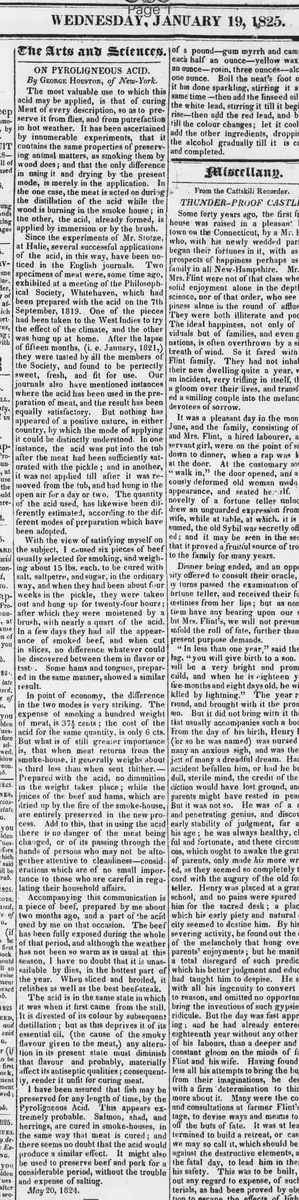
WEDNESDAY, JANUARY 19, 1825.
The Arts and Sciences.
ON PYROLIGNEOUS ACID.
By George Houston, of New-York.
The most valuable use to which this acid may be applied, is that of curing Meat of every description, so as to preserve it from flies, and from putrefaction in hot weather. It has been ascertained by innumerable experiments, that it contains the same properties of preserving animal matters, as smoking them by wood does; and that the only difference in using it and drying by the present mode, is merely in the application. In the one case, the meat is acted on during the distillation of the acid while the wood is burning in the smoke house; in the other, the acid, already formed, is applied by immersion or by the brush.
Since the experiments of Mr. Stotze, at Halle, several successful applications of the acid, in this way, have been noticed in the English journals. Two specimens of meat were, some time ago, exhibited at a meeting of the Philosophical Society, Whitehaven, which had been prepared with the acid on the 7th September, 1819. One of the pieces had been taken to the West Indies to try the effect of the climate, and the other was hung up at home. After the lapse of fifteen months. (i. e. January, 1821,) they were tasted by all the members of the Society, and found to be perfectly sweet, fresh, and fit for use. Our journals also have mentioned instances where the acid has been used in the preparation of meat, and the result has been equally satisfactory. But nothing has appeared of a positive nature, in either country, by which the mode of applying it could be distinctly understood. In one instance, the acid was put into the tub after the meat had been sufficiently saturated with the pickle; and in another, it was not applied till after it was removed from the tub, and had hung in the open air for a day or two. The quantity of the acid used, has likewise been differently estimated, according to the different modes of preparation which have been adopted.
With the view of satisfying myself on the subject, I caused six pieces of beef usually selected for smoking, and weighing about 15 lbs. each, to be cured with salt, saltpetre, and sugar, in the ordinary way, and when they had been about four weeks in the pickle, they were taken out and hung up for twenty-four hours; after which they were moistened by a brush, with nearly a quart of the acid. In a few days they had all the appearance of smoked beef, and when cut in slices, no difference whatever could be discovered between them in flavor or taste. Some hams and tongues, prepared in the same manner, showed a similar result.
In point of economy, the difference in the two modes is very striking. The expense of smoking a hundred weight of meat, is 37 cents; the cost of the acid for the same quantity, is only 6 cts. But what is of still greater importance is, that when meat returns from the smoke-house, it generally weighs about a third less than when sent thither. Prepared with the acid, no diminution in the weight takes place; while the juices of the beef and hams, which are dried up by the fire of the smoke-house, are entirely preserved in the new process. Add to this, that in using the acid there is no danger of the meat being changed, or of its passing through the hands of persons who may not be altogether attentive to cleanliness--considerations which are of no small importance to those who are careful in regulating their household affairs.
Accompanying this communication is a piece of beef, prepared by me about two months ago, and a part of the acid used by me on that occasion. The beef has been fully exposed during the whole of that period, and although the weather has not been so warm as is usual at this season, I have no doubt that it is unassailable by flies, in the hottest part of the year. When sliced and broiled, it relishes as well as the best beef-steak.
The acid is in the same state in which it was when it first came from the still. It is divested of its colour by subsequent distillation; but as this deprives it of its essential oil, (the cause of the smoky flavour given to the meat,) any alteration in its present state must diminish that flavour and probably, materially affect its antiseptic qualities; consequently, render it unfit for curing meat.
I have been assured that fish may be preserved for any length of time, by the Pyroligneous Acid. This appears extremely probable. Salmon, shad, and herrings, are cured in smoke-houses, in the same way that meat is cured; and there seems no doubt that the acid would produce a similar effect. It might also be used to preserve beef and pork for a considerable period, without the trouble and expense of salting.
The Arts and Sciences.
ON PYROLIGNEOUS ACID.
By George Houston, of New-York.
The most valuable use to which this acid may be applied, is that of curing Meat of every description, so as to preserve it from flies, and from putrefaction in hot weather. It has been ascertained by innumerable experiments, that it contains the same properties of preserving animal matters, as smoking them by wood does; and that the only difference in using it and drying by the present mode, is merely in the application. In the one case, the meat is acted on during the distillation of the acid while the wood is burning in the smoke house; in the other, the acid, already formed, is applied by immersion or by the brush.
Since the experiments of Mr. Stotze, at Halle, several successful applications of the acid, in this way, have been noticed in the English journals. Two specimens of meat were, some time ago, exhibited at a meeting of the Philosophical Society, Whitehaven, which had been prepared with the acid on the 7th September, 1819. One of the pieces had been taken to the West Indies to try the effect of the climate, and the other was hung up at home. After the lapse of fifteen months. (i. e. January, 1821,) they were tasted by all the members of the Society, and found to be perfectly sweet, fresh, and fit for use. Our journals also have mentioned instances where the acid has been used in the preparation of meat, and the result has been equally satisfactory. But nothing has appeared of a positive nature, in either country, by which the mode of applying it could be distinctly understood. In one instance, the acid was put into the tub after the meat had been sufficiently saturated with the pickle; and in another, it was not applied till after it was removed from the tub, and had hung in the open air for a day or two. The quantity of the acid used, has likewise been differently estimated, according to the different modes of preparation which have been adopted.
With the view of satisfying myself on the subject, I caused six pieces of beef usually selected for smoking, and weighing about 15 lbs. each, to be cured with salt, saltpetre, and sugar, in the ordinary way, and when they had been about four weeks in the pickle, they were taken out and hung up for twenty-four hours; after which they were moistened by a brush, with nearly a quart of the acid. In a few days they had all the appearance of smoked beef, and when cut in slices, no difference whatever could be discovered between them in flavor or taste. Some hams and tongues, prepared in the same manner, showed a similar result.
In point of economy, the difference in the two modes is very striking. The expense of smoking a hundred weight of meat, is 37 cents; the cost of the acid for the same quantity, is only 6 cts. But what is of still greater importance is, that when meat returns from the smoke-house, it generally weighs about a third less than when sent thither. Prepared with the acid, no diminution in the weight takes place; while the juices of the beef and hams, which are dried up by the fire of the smoke-house, are entirely preserved in the new process. Add to this, that in using the acid there is no danger of the meat being changed, or of its passing through the hands of persons who may not be altogether attentive to cleanliness--considerations which are of no small importance to those who are careful in regulating their household affairs.
Accompanying this communication is a piece of beef, prepared by me about two months ago, and a part of the acid used by me on that occasion. The beef has been fully exposed during the whole of that period, and although the weather has not been so warm as is usual at this season, I have no doubt that it is unassailable by flies, in the hottest part of the year. When sliced and broiled, it relishes as well as the best beef-steak.
The acid is in the same state in which it was when it first came from the still. It is divested of its colour by subsequent distillation; but as this deprives it of its essential oil, (the cause of the smoky flavour given to the meat,) any alteration in its present state must diminish that flavour and probably, materially affect its antiseptic qualities; consequently, render it unfit for curing meat.
I have been assured that fish may be preserved for any length of time, by the Pyroligneous Acid. This appears extremely probable. Salmon, shad, and herrings, are cured in smoke-houses, in the same way that meat is cured; and there seems no doubt that the acid would produce a similar effect. It might also be used to preserve beef and pork for a considerable period, without the trouble and expense of salting.
What sub-type of article is it?
Curiosity
What themes does it cover?
Triumph
What keywords are associated?
Pyroligneous Acid
Meat Curing
Preservation
Smoking Alternative
Experiments
What entities or persons were involved?
George Houston
Mr. Stotze
Where did it happen?
New York
Story Details
Key Persons
George Houston
Mr. Stotze
Location
New York
Event Date
1825 01 19
Story Details
George Houston explains the application of pyroligneous acid for curing meat to prevent spoilage, detailing experiments and economic benefits over traditional smoking methods.