Thank you for visiting SNEWPapers!
Sign up free
Story
December 22, 1847
Morning Star
Limerick, York County, Maine
What is this article about?
A Christian critique of Universalism's doctrines, tracing its 'triangular' theories from Winchester's restorationism, Chauncey's successive probations, to Huntington's improved Calvinism, arguing they undermine true atonement and agency. Written by L. G. Gardner from southern Central New York.
Clipping
OCR Quality
95%
Excellent
Full Text
In the southern part of Central New York.
For the Morning Star.
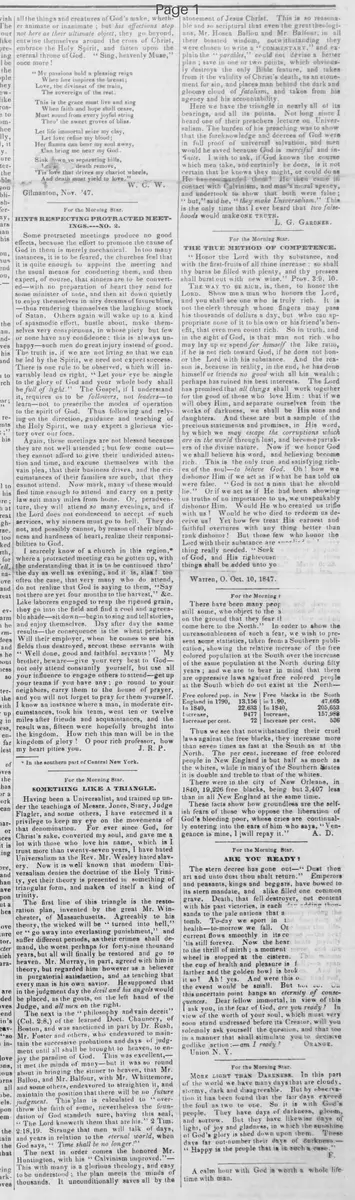
SOMETHING LIKE A TRIANGLE.
Having been a Universalist, and trained up under the teachings of Messrs. Jones, Stacy, Judge Flagler, and some others, I have esteemed it a privilege to keep my eye on the movements of that denomination. For ever since God, for Christ's sake, converted my soul, and gave me a lot with those who love his name, which is, I trust more than twenty-seven years, I have hated Universalism as the Rev. Mr. Wesley hated slavery. Now it is well known that modern Universalism denies the doctrine of the Holy Trinity, yet their theory is presented in something of triangular form, and makes of itself a kind of trinity.
The first line of this triangle is the restoration plan, invented by the great Mr. Winchester, of Massachusetts. Agreeably to his theory, the wicked will be "turned into hell," or "go away into everlasting punishment," and suffer different periods, as their crimes shall demand, the worst perhaps for forty-nine thousand years, but all will finally be restored and go to heaven. Mr. Murray, in part, agreed with him in theory, but regarded him however as a believer in purgatorial satisfaction, and as teaching that every man is his own savior. He supposed that in the judgment day the devil and his angels would be placed, as the goats, on the left hand of the Judge, and all men on the right.
The next is the "philosophy and vain deceit" (Col. 2:8,) of the learned Doct. Chauncey, of Boston, and was sanctioned in part by Dr. Rush, Mr. Foster and others, who endeavored to maintain the successive probations and days of judgment until all shall be brought to heaven, to enjoy the paradise of God. This was excellent,—it met the minds of many—but it was so round about in bringing the sinner to heaven, that Mr. Ballou, and Mr. Balfour, with Mr. Whittemore, and some others, endeavored to straighten it, and maintain the position that there will be no future judgment. This plan is calculated to "overthrow the faith of some, nevertheless the foundation of God standeth sure, having this seal, "The Lord knoweth them that are his." 2 Tim. 2:18,19. Strange that men will talk of days, and years in relation to the eternal world, when God says, "Time shall be no longer!"
The next in order comes the honored Mr. Huntington, with his "Calvinism improved." This with many is a glorious theology, and easy to be understood; the plan meets the minds of thousands. It unconditionally saves all by the atonement of Jesus Christ. This is so reasonable and so scriptural that even the great theologians, Mr. Hosea Ballou and Mr. Balfour, in all their boasted wisdom, notwithstanding they were chosen to write a "COMMENTARY," and explain the "parables," could not devise a better plan: save in one or two points, which obviously destroys the only Bible feature, and takes from it the validity of Christ's death, as an atonement for sin, and places man behind the dark and gloomy cloud of fatalism, and takes from his agency and his accountability.
Here we have the triangle in nearly all of its bearings, and all its points. Not long since I heard one of their preachers lecture on Universalism. The burden of his preaching was to show that the foreknowledge and decrees of God were in full proof of universal salvation, and men would be saved because God is merciful and infinite. I wish to ask, if God knows the course which men take, and certainly he does, is it not certain that he knows they might, or could do as He has commanded! He then came in contact with Calvinism, and man's moral agency, and undertook to show that both were false; "but," said he, "they make Universalism." This is the only time that I ever heard that two falsehoods would make ONE TRUTH.
L. G. GARDNER.
For the Morning Star.
SOMETHING LIKE A TRIANGLE.
Having been a Universalist, and trained up under the teachings of Messrs. Jones, Stacy, Judge Flagler, and some others, I have esteemed it a privilege to keep my eye on the movements of that denomination. For ever since God, for Christ's sake, converted my soul, and gave me a lot with those who love his name, which is, I trust more than twenty-seven years, I have hated Universalism as the Rev. Mr. Wesley hated slavery. Now it is well known that modern Universalism denies the doctrine of the Holy Trinity, yet their theory is presented in something of triangular form, and makes of itself a kind of trinity.
The first line of this triangle is the restoration plan, invented by the great Mr. Winchester, of Massachusetts. Agreeably to his theory, the wicked will be "turned into hell," or "go away into everlasting punishment," and suffer different periods, as their crimes shall demand, the worst perhaps for forty-nine thousand years, but all will finally be restored and go to heaven. Mr. Murray, in part, agreed with him in theory, but regarded him however as a believer in purgatorial satisfaction, and as teaching that every man is his own savior. He supposed that in the judgment day the devil and his angels would be placed, as the goats, on the left hand of the Judge, and all men on the right.
The next is the "philosophy and vain deceit" (Col. 2:8,) of the learned Doct. Chauncey, of Boston, and was sanctioned in part by Dr. Rush, Mr. Foster and others, who endeavored to maintain the successive probations and days of judgment until all shall be brought to heaven, to enjoy the paradise of God. This was excellent,—it met the minds of many—but it was so round about in bringing the sinner to heaven, that Mr. Ballou, and Mr. Balfour, with Mr. Whittemore, and some others, endeavored to straighten it, and maintain the position that there will be no future judgment. This plan is calculated to "overthrow the faith of some, nevertheless the foundation of God standeth sure, having this seal, "The Lord knoweth them that are his." 2 Tim. 2:18,19. Strange that men will talk of days, and years in relation to the eternal world, when God says, "Time shall be no longer!"
The next in order comes the honored Mr. Huntington, with his "Calvinism improved." This with many is a glorious theology, and easy to be understood; the plan meets the minds of thousands. It unconditionally saves all by the atonement of Jesus Christ. This is so reasonable and so scriptural that even the great theologians, Mr. Hosea Ballou and Mr. Balfour, in all their boasted wisdom, notwithstanding they were chosen to write a "COMMENTARY," and explain the "parables," could not devise a better plan: save in one or two points, which obviously destroys the only Bible feature, and takes from it the validity of Christ's death, as an atonement for sin, and places man behind the dark and gloomy cloud of fatalism, and takes from his agency and his accountability.
Here we have the triangle in nearly all of its bearings, and all its points. Not long since I heard one of their preachers lecture on Universalism. The burden of his preaching was to show that the foreknowledge and decrees of God were in full proof of universal salvation, and men would be saved because God is merciful and infinite. I wish to ask, if God knows the course which men take, and certainly he does, is it not certain that he knows they might, or could do as He has commanded! He then came in contact with Calvinism, and man's moral agency, and undertook to show that both were false; "but," said he, "they make Universalism." This is the only time that I ever heard that two falsehoods would make ONE TRUTH.
L. G. GARDNER.
What sub-type of article is it?
Historical Event
Curiosity
What themes does it cover?
Moral Virtue
Deception
What keywords are associated?
Universalism Critique
Restoration Plan
Successive Probations
Calvinism Improved
Theological Triangle
Moral Agency
Divine Foreknowledge
What entities or persons were involved?
L. G. Gardner
Mr. Winchester
Mr. Murray
Doct. Chauncey
Dr. Rush
Mr. Foster
Mr. Ballou
Mr. Balfour
Mr. Whittemore
Mr. Huntington
Hosea Ballou
Messrs. Jones
Stacy
Judge Flagler
Where did it happen?
Southern Part Of Central New York
Story Details
Key Persons
L. G. Gardner
Mr. Winchester
Mr. Murray
Doct. Chauncey
Dr. Rush
Mr. Foster
Mr. Ballou
Mr. Balfour
Mr. Whittemore
Mr. Huntington
Hosea Ballou
Messrs. Jones
Stacy
Judge Flagler
Location
Southern Part Of Central New York
Story Details
The author, a former Universalist, critiques the denomination's evolving doctrines as a flawed 'triangle': Winchester's restoration after punishment, Chauncey's successive probations refined to no future judgment, and Huntington's universal atonement, arguing they deny true Trinity, atonement, and human agency.