Thank you for visiting SNEWPapers!
Sign up free
Story
October 23, 1930
The Daily Worker
Chicago, Cook County, Illinois
What is this article about?
Political analysis by Max Salzman exposing the 1920s Pennsylvania gubernatorial election as a capitalist power struggle between Mellon-backed Republican Pinchot and utilities/railroad-backed Democrat Hemphill, using demagogy to deceive workers amid party splits and Hoover administration ties.
Clipping
OCR Quality
95%
Excellent
Full Text
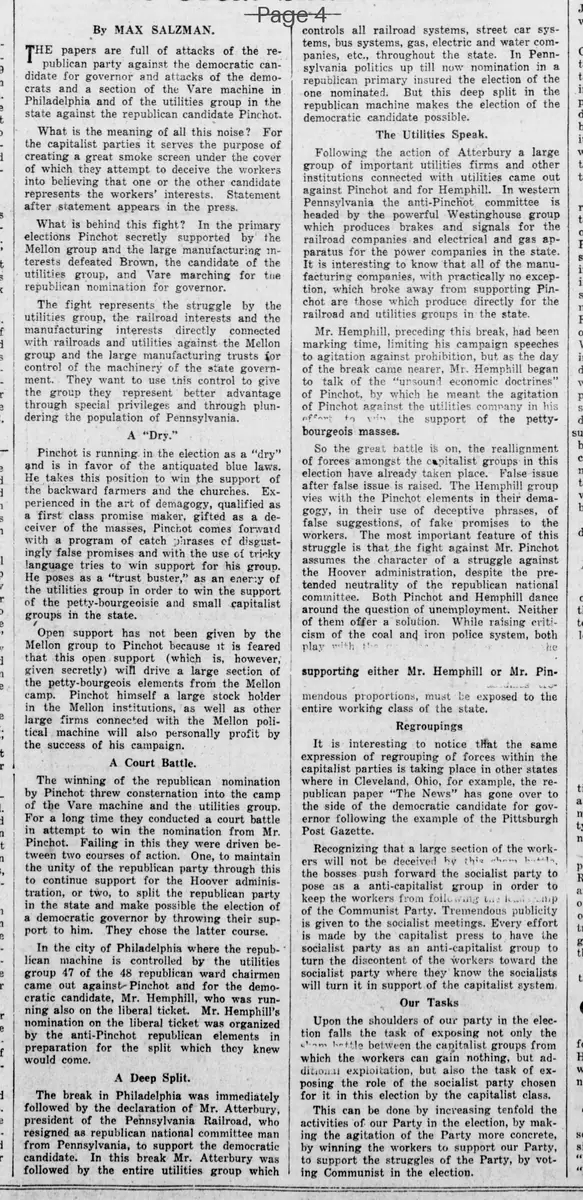
By MAX SALZMAN.
The papers are full of attacks of the republican party against the democratic candidate for governor and attacks of the democrats and a section of the Vare machine in Philadelphia and of the utilities group in the state against the republican candidate Pinchot.
What is the meaning of all this noise? For the capitalist parties it serves the purpose of creating a great smoke screen under the cover of which they attempt to deceive the workers into believing that one or the other candidate represents the workers' interests. Statement after statement appears in the press.
What is behind this fight? In the primary elections Pinchot secretly supported by' the Mellon group and the large manufacturing interests defeated Brown, the candidate of the utilities group, and Vare marching for the republican nomination for governor.
The fight represents the struggle by the utilities group, the railroad interests and the manufacturing interests directly connected with railroads and utilities against the Mellon group and the large manufacturing trusts for control of the machinery of the state government. They want to use this control to give the group they represent better advantage through special privileges and through plundering the population of Pennsylvania.
A "Dry."
Pinchot is running in the election as a "dry" and is in favor of the antiquated blue laws. He takes this position to win the support of the backward farmers and the churches. Experienced in the art of demagogy, qualified as a first class promise maker, gifted as a deceiver of the masses, Pinchot comes forward with a program of catch phrases disgustingly false promises and with the use of tricky language tries to win support for his group.
He poses as a "trust buster," as an enemy of the utilities group in order to win the support of the petty-bourgeoisie and small capitalist groups in the state.
Open support has not been given by the Mellon group to Pinchot because it is feared that this open support (which is, however, given secretly wil drive a large section of the petty-bourgeois elements from the Mellon camp. Pinchot himself a large stock holder in the Mellon institutions, as well as other large firms connected with the Mellon political machine will also personally profit by the success of his campaign.
A Court Battle.
The winning of the republican nomination by Pinchot threw consternation into the camp of the Vare machine and the utilities group. For a long time they conducted a court battle in attempt to win the nomination from Mr. Pinchot. Failing in this they were driven between two courses of action. One, to maintain the unity of the republican party through this to continue support for the Hoover administration, or two, to split the republican party in the state and make possible the election of a democratic governor by throwing their support to him. They chose the latter course.
In the city of Philadelphia where the republican machine is controlled by the utilities group 47 of the 48 republican ward chairmen came out against-Pinchot and for the democratic candidate, Mr. Hemphill, who was running also on the liberal ticket. Mr. Hemphill's nomination on the liberal ticket was organized by the anti-Pinchot republican elements in preparation for the split which they knew would come.
A Deep Split.
The break in Philadelphia was immediately followed by the declaration of Mr. Atterbury, president of the Pennsylvania Railroad, who resigned as republican national committee man from Pennsylvania, to support the democratic candidate. In this break Mr. Atterbury was followed by the entire utilities group which controls all railroad systems, street car systems, bus systems, gas, electric and water companies, etc., throughout the state. In Pennsylvania politics up till now nomination in a republican primary insured the election of the one nominated. But this deep split in the republican machine makes the election of the democratic candidate possible.
The Utilities Speak.
Following the action of Atterbury a large group of important utilities firms and other institutions connected with utilities came out against Pinchot and for Hemphill. In western Pennsylvania the anti-Pinchot committee is headed by the powerful Westinghouse group which produces brakes and signals for the railroad companies and electrical and gas apparatus for the power companies in the state.
It is interesting to know that all of the manufacturing companies, with practically no exception, which broke away from supporting Pinchot are those which produce directly for the railroad and utilities groups in the state.
Mr. Hemphill. preceding this break, had been marking time, limiting his campaign speeches to agitation against prohibition, but as the day of the break came nearer. Mr. Hemphill began to talk of the "unsound economic doctrines" of Pinchot, by which he meant the agitation of Pinchot against the utilities company in his effort to win the support of the petty- bourgeois masses.
So the great battle is on, the realignment of forces amongst the capitalist groups in this election have already taken place. False issue after false issue is raised. The Hemphill group vies with the Pinchot elements in their demagogy. in their use of deceptive phrases, of false suggestions, of fake promises to the workers. The most important feature of this struggle is that the fight against Mr. Pinchot assumes the character of a struggle against the Hoover administration, despite the pretended neutrality of the republican national committee. Both Pinchot and Hemphill dance around the question of unemployment. Neither of them offer a solution. While raising criticism of the coal and iron police system, both play with the idea of supporting either Mr. Hemphill or Mr. Pinchot.
This sham battle of tremendous proportions, must be exposed to the entire working class of the state.
Regroupings
It is interesting to notice that the same expression of regrouping of forces within the capitalist parties is taking place in other states where in Cleveland, Ohio, for example, the republican paper "The News" has gone over to the side of the democratic candidate for governor following the example of the Pittsburgh Post Gazette.
Recognizing that a large section of the workers will not be deceived by this sham battle- the bosses push forward the socialist party to pose as a anti-capitalist group in order to keep the workers from following the lead of the Communist Party. Tremendous publicity is given to the socialist meetings. Every effort is made by the capitalist press to have the socialist party as an anti-capitalist group to turn the discontent of the workers toward the socialist party where they know the socialists will turn it in support of the capitalist system.
Our Tasks
Upon the shoulders of our party in the election falls the task of exposing not only the sham battle between the capitalist groups from which the workers can gain nothing. but additional exploitation, but also the task of exposing the role of the socialist party chosen for it in this election by the capitalist class.
This can be done by increasing tenfold the activities of our Party in the election, by making the agitation of the Party more concrete, by winning the workers to support our Party, to support the struggles of the Party, by voting Communist in the election.
The papers are full of attacks of the republican party against the democratic candidate for governor and attacks of the democrats and a section of the Vare machine in Philadelphia and of the utilities group in the state against the republican candidate Pinchot.
What is the meaning of all this noise? For the capitalist parties it serves the purpose of creating a great smoke screen under the cover of which they attempt to deceive the workers into believing that one or the other candidate represents the workers' interests. Statement after statement appears in the press.
What is behind this fight? In the primary elections Pinchot secretly supported by' the Mellon group and the large manufacturing interests defeated Brown, the candidate of the utilities group, and Vare marching for the republican nomination for governor.
The fight represents the struggle by the utilities group, the railroad interests and the manufacturing interests directly connected with railroads and utilities against the Mellon group and the large manufacturing trusts for control of the machinery of the state government. They want to use this control to give the group they represent better advantage through special privileges and through plundering the population of Pennsylvania.
A "Dry."
Pinchot is running in the election as a "dry" and is in favor of the antiquated blue laws. He takes this position to win the support of the backward farmers and the churches. Experienced in the art of demagogy, qualified as a first class promise maker, gifted as a deceiver of the masses, Pinchot comes forward with a program of catch phrases disgustingly false promises and with the use of tricky language tries to win support for his group.
He poses as a "trust buster," as an enemy of the utilities group in order to win the support of the petty-bourgeoisie and small capitalist groups in the state.
Open support has not been given by the Mellon group to Pinchot because it is feared that this open support (which is, however, given secretly wil drive a large section of the petty-bourgeois elements from the Mellon camp. Pinchot himself a large stock holder in the Mellon institutions, as well as other large firms connected with the Mellon political machine will also personally profit by the success of his campaign.
A Court Battle.
The winning of the republican nomination by Pinchot threw consternation into the camp of the Vare machine and the utilities group. For a long time they conducted a court battle in attempt to win the nomination from Mr. Pinchot. Failing in this they were driven between two courses of action. One, to maintain the unity of the republican party through this to continue support for the Hoover administration, or two, to split the republican party in the state and make possible the election of a democratic governor by throwing their support to him. They chose the latter course.
In the city of Philadelphia where the republican machine is controlled by the utilities group 47 of the 48 republican ward chairmen came out against-Pinchot and for the democratic candidate, Mr. Hemphill, who was running also on the liberal ticket. Mr. Hemphill's nomination on the liberal ticket was organized by the anti-Pinchot republican elements in preparation for the split which they knew would come.
A Deep Split.
The break in Philadelphia was immediately followed by the declaration of Mr. Atterbury, president of the Pennsylvania Railroad, who resigned as republican national committee man from Pennsylvania, to support the democratic candidate. In this break Mr. Atterbury was followed by the entire utilities group which controls all railroad systems, street car systems, bus systems, gas, electric and water companies, etc., throughout the state. In Pennsylvania politics up till now nomination in a republican primary insured the election of the one nominated. But this deep split in the republican machine makes the election of the democratic candidate possible.
The Utilities Speak.
Following the action of Atterbury a large group of important utilities firms and other institutions connected with utilities came out against Pinchot and for Hemphill. In western Pennsylvania the anti-Pinchot committee is headed by the powerful Westinghouse group which produces brakes and signals for the railroad companies and electrical and gas apparatus for the power companies in the state.
It is interesting to know that all of the manufacturing companies, with practically no exception, which broke away from supporting Pinchot are those which produce directly for the railroad and utilities groups in the state.
Mr. Hemphill. preceding this break, had been marking time, limiting his campaign speeches to agitation against prohibition, but as the day of the break came nearer. Mr. Hemphill began to talk of the "unsound economic doctrines" of Pinchot, by which he meant the agitation of Pinchot against the utilities company in his effort to win the support of the petty- bourgeois masses.
So the great battle is on, the realignment of forces amongst the capitalist groups in this election have already taken place. False issue after false issue is raised. The Hemphill group vies with the Pinchot elements in their demagogy. in their use of deceptive phrases, of false suggestions, of fake promises to the workers. The most important feature of this struggle is that the fight against Mr. Pinchot assumes the character of a struggle against the Hoover administration, despite the pretended neutrality of the republican national committee. Both Pinchot and Hemphill dance around the question of unemployment. Neither of them offer a solution. While raising criticism of the coal and iron police system, both play with the idea of supporting either Mr. Hemphill or Mr. Pinchot.
This sham battle of tremendous proportions, must be exposed to the entire working class of the state.
Regroupings
It is interesting to notice that the same expression of regrouping of forces within the capitalist parties is taking place in other states where in Cleveland, Ohio, for example, the republican paper "The News" has gone over to the side of the democratic candidate for governor following the example of the Pittsburgh Post Gazette.
Recognizing that a large section of the workers will not be deceived by this sham battle- the bosses push forward the socialist party to pose as a anti-capitalist group in order to keep the workers from following the lead of the Communist Party. Tremendous publicity is given to the socialist meetings. Every effort is made by the capitalist press to have the socialist party as an anti-capitalist group to turn the discontent of the workers toward the socialist party where they know the socialists will turn it in support of the capitalist system.
Our Tasks
Upon the shoulders of our party in the election falls the task of exposing not only the sham battle between the capitalist groups from which the workers can gain nothing. but additional exploitation, but also the task of exposing the role of the socialist party chosen for it in this election by the capitalist class.
This can be done by increasing tenfold the activities of our Party in the election, by making the agitation of the Party more concrete, by winning the workers to support our Party, to support the struggles of the Party, by voting Communist in the election.
What sub-type of article is it?
Historical Event
Deception Fraud
What themes does it cover?
Deception
Social Manners
What keywords are associated?
Pennsylvania Election
Gifford Pinchot
Hemphill
Mellon Group
Utilities Group
Political Demagogy
Republican Split
Communist Agitation
What entities or persons were involved?
Pinchot
Hemphill
Vare
Atterbury
Mellon Group
Hoover
Where did it happen?
Pennsylvania, Philadelphia
Story Details
Key Persons
Pinchot
Hemphill
Vare
Atterbury
Mellon Group
Hoover
Location
Pennsylvania, Philadelphia
Story Details
Analysis of Pennsylvania gubernatorial election as capitalist factions' struggle for state control, with Pinchot backed by Mellon interests posing as reformer, opposed by utilities and railroads supporting Democrat Hemphill after Republican split, using demagogy to mislead workers; calls for Communist exposure.