Thank you for visiting SNEWPapers!
Sign up free
Richmond Enquirer
Richmond, Richmond County, Virginia
What is this article about?
An anonymous author defends his proposed State and District funding plan for the James River and Kanawha canal improvements against Joseph C. Cabell's advocacy for a joint stock company, highlighting advantages in speed, scale, toll reduction, and public control while critiquing the joint stock approach's risks and perpetual high tolls.
Merged-components note: This is a single continuous letter to the editor spanning across the two components, with text directly continuing from one to the next.
Clippings
1 of 2
OCR Quality
Full Text
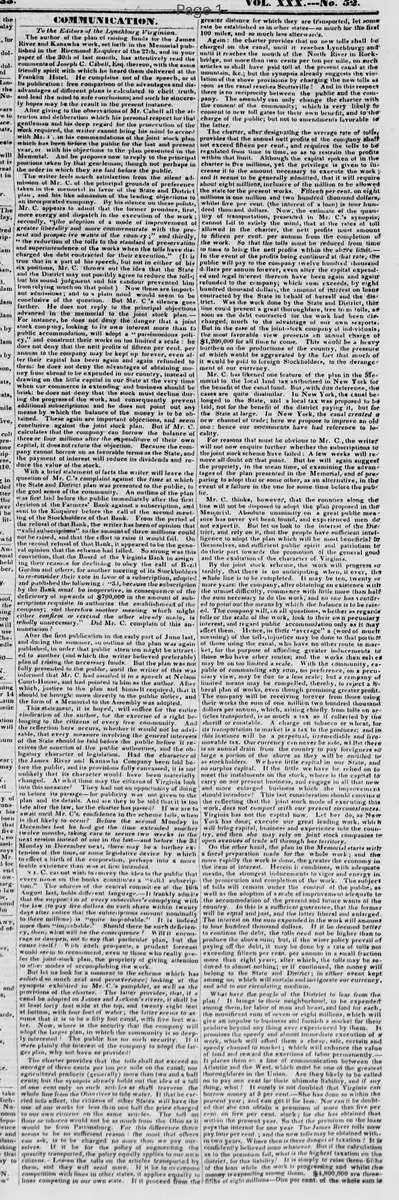
To the Editors of the Lynchburg Virginian.
The author of the plan of raising funds for the James River and Kanawha work, set forth in the Memorial published in the Richmond Enquirer of the 27th, and in your paper of the 30th of last month, has attentively read the comments of Joseph C. Cabell, Esq. thereon, with the same friendly spirit with which he heard them delivered at the Franklin Hotel. He complains not of the speech, or of its publication: free comparison of the advantages and disadvantages of different plans is calculated to elicit truth, and lead the mind to safe conclusions; and such he sincerely hopes may be the result in the present instance.
After giving to the observations of Mr. Cabell all the attention and deliberation which his personal respect for that gentleman and his deep regard for the prosecution of the work required, the writer cannot bring his mind to accord with Mr. C. in his commendations of the joint stock plan which has been before the public for the last and present year, or with his objections to the plan presented in the Memorial. And he proposes now to reply to the principal positions taken by that gentleman; though not perhaps in the order in which they are laid before the public.
The writer feels much satisfaction from the silent admission of Mr. C. of the principal grounds of preference taken in the memorial in favor of the State and District plan, and his like admission of the leading objections to an incorporated company. By his silence on these points, Mr. C. appears to admit that the former promises, first, more energy and dispatch in the execution of the work; secondly, "the adoption of a mode of improvement of greater liberality and more commensurate with the present and prospective wants of the country;" and thirdly, "the reduction of the tolls to the standard of preservation and superintendence of the works when the tolls have discharged the debt contracted for their execution." (It is true that in a part of his speech, but not in either of his six positions, Mr. C. throws out the idea that the State and the District may not possibly agree to reduce the toll; but his sound judgment and his candor prevented him from relying much on that point. Now these are important admissions; and to a plain mind would seem to be conclusive of the question. But Mr. C's silence goes farther. He does not reply to the principal objections advanced in the memorial to the joint stock plan.—
For instance, he does not deny the danger that a joint stock company, looking to its own interest more than to public accommodation, will adopt a "parsimonious policy," and construct their works on too limited a scale: he does not deny that the nett profits of fifteen per cent. per annum to the company may be kept up forever, even after their capital has been again and again refunded to them: he does not deny the advantages of obtaining money from abroad to be expended in our country, instead of drawing on the little capital in our State at the very time when our commerce is extending and business should be brisk: he does not deny that the stock must decline during the progress of the work, and consequently prevent additional subscriptions: and he does not point out any means by which the balance of the money is to be obtained. These again are important objections, and seem conclusive against the joint stock plan. But if Mr. C. calculates that the company can borrow the balance of three or four millions after the expenditure of their own capital, it does not refute the objection. Because the company cannot borrow on as favorable terms as the State, and the payment of interest will reduce its dividends and reduce the value of the stock.
With a brief statement of facts the writer will leave the question of Mr. C.'s complaint against the time at which the State and District plan was presented to the public, to the good sense of the community. An outline of the plan was first laid before the public immediately after the first decision of the Farmers' Bank against a subscription, and sent to the Enquirer before the call of the second meeting of the Stockholders of that Bank. From the period of the refusal of that Bank, the writer has been of opinion that "valid subscriptions" to the amount of three millions could not be raised, and that the effort to raise it would fail. On the second refusal of that Bank, it appeared to be the general opinion that the scheme had failed. So strong was this conviction, that the Board of the Virginia Bank in assigning their reasons for declining to obey the call of Bazil Gordon and others, for another meeting of its Stockholders to re-consider their vote in favor of a subscription, adopted and published the following: "3d, because the subscription by the Bank must be inoperative, in consequence of the deficiency of upwards of $700,000 in the amount of subscriptions requisite to authorize the establishment of the company; and therefore another meeting which might either confirm or rescind the vote already made, is wholly unnecessary."
Did Mr. C. complain of this annunciation?
After the first publication in the early part of June last, and during the summer, an outline of the plan was again published, in order that public attention might be attracted to another (and which the writer believed preferable) plan of raising the necessary funds. But the plan was not fully presented to the public, until the writer of this was informed that Mr. C. had assailed it in a speech at Nelson Court-House, and had pointed to him as the author. After which, justice to the plan and himself required, that it should be brought more directly to the public notice, and the form of a Memorial to the Assembly was adopted.
This statement, it is hoped, will suffice for the entire vindication of the author, for the exercise of a right belonging to the citizens of every free community. And the reflection here occurs, whether it would not be advisable, that every measure involving the general interests of the State should be laid before the public before it receives the sanction of the public authorities, and the obligatory character of legislation. Had the character of the James River and Kanawha Company been laid before the public, and its provisions fully canvassed, it is not unlikely that its character would have been materially changed. At what time may the citizens of Virginia look into this measure? They had not an opportunity of doing so before its passage—for publicity was not given to the plan and its details. And are they to be told that it is too late after the law, for the charter has passed? If we are to await until Mr. C's. confidence in the scheme fails, when is that likely to occur? Before the second Monday in December last he had got the time extended another twelve months, taking care to secure two weeks in the next session instead of one in the last—and before the 31 Monday in December next, there may be a further extension of the time, or some legislative device by which to effect a birth of the corporation, perhaps into a more feeble existence than was at first intended.
Mr. C. cannot wish to convey the idea to the public that every name on the books constitutes a "valid subscription." The address of the central committee of the 16th August last, holds different language.—It frankly admits that the supposition of every subscriber's complying with the law (to pay five dollars on each share within twenty days after notice that the subscriptions amount nominally to three millions) is "quite improbable."
It is indeed more than "improbable."' Should there be such deficiency, then, what will be the consequence? will it encourage or dampen, not to say that particular plan, but the cause itself? With such prospects, a prudent forecast would seem to recommend, even to those who really prefer the joint-stock plan, the propriety of giving attention to other modes of accomplishing the work.
But let us look for a moment to the scheme which has enlisted so much zeal and perseverance; looking at the synopsis exhibited in Mr. C.'s pamphlet, as well as the provisions of the charter. The latter provides, that, if a canal be adopted on James and Jackson's rivers, it shall be at least forty feet wide at the top, and twenty-eight feet at bottom, with four feet of water; the latter seems to assume that it is to be a fifty foot canal, with five feet water. Now, where is the security that the company will adopt the larger plan, in which the community is so deeply interested? The public has no such security. If it were plainly the interest of the company to adopt the larger plan, why not have so provided?
The charter provides that the tolls shall not exceed an average of three cents per ton per mile on the canal; nor agricultural products (generally) more than two and a half cents; but the synopsis already holds out the idea of a toll of one cent only on such articles as shall traverse the whole line from the Ohio river to tide water. If that be carried into effect, the citizens of other States will have the use of our works for less than one half the price charged to our own citizens on the same articles. The toll on flour or tobacco would not be as much from the Ohio as it would be from Pattonsburg. For this difference there seems to be no sufficient reason : the most that others can ask, is to be charged no more than we pay ourselves. If it be for the policy of augmenting the quantity transported, the policy equally applies to our own citizens. — Lessen the tolls on the articles transported by them, and they will send more. If it be to overcome competition with lines in other states, it applies equally to lines competing in our own state. If it proceed from the greater distance for which they are transported, let some rate be established as in other states— so much for the first 100 miles, and so much less afterwards,
Again : the charter provides that no new tolls shall be charged on the canal, until it reaches Lynchburg; and until it reaches the mouth of the North River in Rockbridge, not more than two cents per ton per mile, on such articles as shall have paid toll at the present canal at the mountain, &c.; but the synopsis already suggests the violation of the above provisions by charging the new tolls as soon as the canal reaches Scottsville! And in this respect there is no reciprocity between the public and the company. The assembly can only change the charter with the consent of the community; which is very likely to consent to new toll gates for their own benefit, and to the charge of the public; but not to amendments favorable to the latter.
The charter, after designating the average rate of tolls, provides that the annual nett profits of the company shall not exceed fifteen per cent., and requires the tolls to be regulated from time to time, so as to restrain the profits within that limit. Although the capital spoken of in the charter is five millions, yet the privilege is given to increase it to the amount necessary to execute the work; and it seems to be generally admitted, that it will require about eight millions, inclusive of the million to be allowed the state for the present works. Fifteen per cent. on eight millions is one million and two hundred thousand dollars, whilst five per cent. (the interest of a loan) is four hundred thousand dollars. Now, the estimate of the quantity of transportation, presented in Mr. C.'s synopsis; cannot fail to satisfy the mind, that at the rates of toll allowed in the charter, the nett profits must amount to fifteen per cent. per annum from the completion of the work. So that the tolls must be reduced from time to time to bring the nett profits within the above limit.—
In the event of the profits being continued at that rate; the public will pay to the company twelve hundred thousand dollars per annum forever, even after the capital expended and legal interest thereon have been again and again refunded to the company; which sum exceeds, by eight hundred thousand dollars, the amount of interest on loans contracted by the State in behalf of herself and the district. Was the work done by the State and District, this line could present a great thoroughfare, free from tolls, as soon as the debt contracted for the work had been discharged; much to the advantage of our own seaports.
But in the case of the joint-stock company of individuals, the most favorable view presents an annual charge of $1,200,000 for all time to come. This would be a heavy burthen on the productions of the country, the pressure of which would be aggravated by the fact that much of it would be paid to foreign Stockholders, to the derangement of our currency.
Mr. C. has likened one feature of the plan in the Memorial to the local land tax authorized in New York for the benefit of the canal fund. But, with due deference, the cases are quite dissimilar. In New York, the canal belonged to the State, and a local tax was proposed to be laid, not for the benefit of the district paying it, but for the State at large. In New York, the canal created a new channel of trade; here we propose to improve an old one: hence our assessments have had reference to locality.
For reasons that must be obvious to Mr. C., the writer will not now enquire further whether the subscriptions to the joint stock scheme have failed: A few weeks will remove all doubt on' that point. But he will again suggest the propriety, in the mean time, of examining the advantages of the plan presented in the Memorial, and of preparing to adopt that or some other, as an alternative, in the event of a failure in the one for some time before the public.
Mr. C. thinks, however, that the counties along the line will not be disposed to adopt the plan proposed in the Memorial. Absolute unanimity on a great public measure has never yet been found, and experienced men do not expect it. But let us look to the interest of the District, and rely on it, that the people have sufficient intelligence to adopt the plan which will be most beneficial to themselves, and sufficient public spirit and patriotism to do their part towards the promotion of the general good and the exaltation of the character of Virginia.
By the joint stock scheme, the work will progress so tardily, that there is no anticipating when, if ever, the whole line is to be completed. It may be ten, twenty or more years: the company, after obtaining an existence with the utmost difficulty, commence with little more than half the sum necessary to do the work; and no one has yet endeavored to point out the means by which the balance is to be raised. The company will, on all questions, whether as regards tolls or the scale of the work, look to their own pecuniary interest, and regard public accommodation only as it may affect them. Hence, in their "average" a (word of much meaning) of the tolls, injustice may be done to that portion of those using the canal, who have no other route to market, for the purpose of affording greater inducements to those who have other routes; and the works themselves may be on too limited a scale.
With the community, capable of commanding any sum, no preference, on a pecuniary view, may be due to a less scale; but a company of limited means may be compelled, thereby, to reject a liberal plan of works, even though promising greater profit.
The company will be receiving forever from those using their works the sum of one million two hundred thousand dollars per annum, which, arising chiefly from tolls on articles transported, is as much a tax as if collected by the sheriff or constable. A charge on tobacco or wheat, for its transportation to market is a tax to the producer: and in this instance will be a perpetual, irremediable and immovable tax. Our currency can never be safe, whilst there is an annual drain from the country to pay foreigners so large a portion of the above as they will be entitled to as stockholders. We have little capital in our State, and no surplus capital. If the little we have be relied on to meet the instalments on the stock, where is the capital to carry on our present business, and engage in all that new and more enlarged business which the improvement should introduce? This last consideration should convince the reflecting that the joint stock mode of executing this work, does not comport with our present circumstances.
Virginia has not the capital now. Let her do, as New York has done; execute our great leading work, which will bring capital, business and experience into the country, and then she may rely on joint stock companies to open avenues of trade all through her territory.
On the other hand, the plan in the Memorial starts with a fiscal preparation made for the whole work; and the more rapidly the work is done, the greater the economy in the item of interest. Herein it combines, with adequate means, the strongest inducements to vigor and energy in the prosecution and completion of the work. The subject of tolls will remain under the control of the public, as well as the adoption of a scale of improvement adequate to the accommodation of the present and future wants of the country. In this is a sufficient guarantee, that the former will be equal and just, and the latter liberal and enlarged.
The interest on the sum expended in the work will amount to four hundred thousand dollars. If it be deemed better to continue the debt, the tolls need not be higher than to produce the above sum; but, if the wiser policy prevail of paying off the debt, it may be done by a rate of tolls not exceeding fifteen per cent. per annum in a small fraction more than eight years; after which, the tolls may be reduced to almost nothing; or if continued, the money will belong to the State and District; in either event kept among us; which will sustain and invigorate our currency, and add to our circulating medium.
What have the people of the District to fear from the plan? It brings to their neighborhood, to be expended among them, for labor of man and beast, and food for each. the munificent sum of seven or eight millions, which will give an impulse to business and furnish a market for their produce beyond any thing ever experienced by them. It promises the speedy and almost immediate execution of work, which will afford them a cheap, safe, certain and speedy channel to market; which will enhance the value of land and reward the exertions of labor permanently.—
It places them on a line of communication between the Atlantic and the West, which must be one of the greatest thoroughfares in the Union. Are they likely to be called on to pay one cent for their ultimate liability, and if any thing, what? It surely is not doubted that "Virginia can borrow money at 5 per cent.—She has done so within the present year; and can get it for less. Nor can it be doubted that she can obtain a premium of more than five per cent. on five per cent. stock; for she has obtained that within the present year. So that the premium on the loan pays the interest for one year. The James River tolls now pay four per cent ; and the new tolls may be obtained within two years. Where then is there danger of taxation ? It is confidently believed none whatever. But if the calculation as to the premium fail, what is the highest taxation on the district, for this liability? It is simply to raise three-fifths of the loan while the work is progressing and whilst the money is expending among them. $1,800,000 are three-fifths of eight millions—One per cent. of the whole sum is
forty-eight thousand dollars.
But it will take several years to do the work, only a portion of the money will be borrowed at a time, and may be wanting. If one million be expended annually, one year's rent of three-fifths thereof— of $1,500,000—will be $90,000, which may be the tax the first year; $120,000 for the second, $150,000 for the third, &c. So that twenty-seven thousand dollars in the average of this rate, which is about one-fifteenth part of one cent in the dollar of the average value of the real estate in the District. This requires the entire to pay in a share of $100,000 by stock and $100,000 money—a just proportion. Will it not make such a bargain? If this be not all, 'I the true unwisely' that for the work to 'to stock compu. ny, there being their extent toll, rail road will be twrirt chaigrd'ni h qur mition n. ino budeed ih.uraind dol. iara prr yanr,, or right huutirdt tlu'tiail do laus a )rar omoin thon ta r iutrrast on the caperal eaprualed. . Now the n tole capital auud tive prr crpt. sntrorni theiri n is, 't ra'r of 'urlt pioti,' wl'oned iu she char'er, sriurued lo .he *ischluhlos rvrry tleht y: ars wiut abut wu wotth-; sot thn tolle go on waul the dety in sev y. to dr dist hargrd! ihe: luud nser to he conrrfr.! Wta' nrticl n nu I son tibute mo-t 'to thuy ro moe yrd n vrr e tiug polit! 'I ho rgricul'uat aut muinerst puent: c'n of our Jainde - Iein In wuly an 'imilrtiut'r talu uy.' wtnl-t the u he r it tol' t.muiled aud 'rm yrary' aud when the d-bt w paid cit, (hn worko nitl bu l sog 'o ua— t, long o :he S ate niut J-i iri, aud they Inay tlo ni i tlao tulla as way bo nise mul j-l.
Mr. C. likewise, with commendable liberality of spirit, objects to what he is pleased to consider a 'compulsory' tenure in the plan presented in the Memorial. But he may dismiss his alarms on that point. It is hoped that the Memorial will be circulated among the people and the plan it recommends discussed by them, before their members start for the Assembly; so as to enable the latter to carry with them the opinions and wishes of their constituents. If the people be against the plan, then their representatives will not sanction it. If they favor it, it is to be hoped that the Honorable Assembly will carry it into effect. In this case, at least, the people will not be taken by surprise. The subject is laid fairly before them, to be freely discussed and fully understood; and there is a confident reliance on their intelligence, public spirit and patriotism. Should it be found that the most remote parts of some counties are unwilling to be included, they might be left out, without detriment to the scheme; and their loss may probably be made up by the admittance of others not immediately on the line. But if the objection means that nothing is to be done without entire unanimity, it does not come with much force from those who sought to obtain a subscription from the Banks on the vote of a mere majority of stockholders, whose interests were quite variant. One portion of them having an interest as proprietors, on the line as well as stockholders, whilst others had the latter interest only. In the present case, all are proprietors; and if some are nearer the line than others, the circumstance is no doubt considered in the assessment.
It is difficult to comprehend the meaning or force of Mr. C.'s objection, that this plan 'combines the incongruous features of public management and private responsibility.'
The writer does not deem it very material as to the mode of management; it is a matter of detail which does not affect the principle. The examples of New York and Ohio, where that mode was found most salutary and efficient, may incline us to the appointment of commissioners to contract for and superintend the execution of the work. If these successful examples be followed here, the commissioners may be appointed by the General Assembly, by the Executive or by the Board of Public Works. And if it be desirable that the District should have the appointment of a portion, in proportion to her part of the liability, then the members representing the District may be authorized to appoint for it. And the 'private responsibility' is not believed to apply. We shall be responsible as citizens and as proprietors of land in the District, not personally and individually. If we authorize our representatives to adopt this plan, we shall be unquestionably bound to obey this law, as we would another.
If, however, the objection means to revive the almost exploded doctrine, that the public cannot have this work executed with as much economy and skill, as a joint stock company, it may be again refuted by reason and example. It is an objection often and pertinaciously urged from anti-improvement sources, but it is believed to be unsupported by a single reason. If it apply in any case, it is to one of an entirely local nature, where all interested in it may, in proper person, unite in contracting and superintending the execution of the work. But as regards the James and Kanawha works, agents must be employed and have authority to act, whether the work be undertaken on the Joint Stock or State and District plan. In the case of the James and Kanawha Company the charter provides for conducting the business by a President and Directors; who must of necessity have their sub agents, engineers and superintendents, contractors and laborers. On the other plan, commissioners will have the same powers as the directory; the same alone being different. Each will be removable alike; and if it be said that the Stockholders can make a more judicious choice of their directory than the public bodies can of commissioners, (which is denied,) it is respectfully asked how many Stockholders will probably attend the election in person? Probably not more than one-fourth—the balance or a sufficient number to constitute a quorum, being represented by proxies. What motive of interest, character or patriotism can prompt the directory, that will not equally apply to the commissioners; especially if the latter are proprietors on the line as well as citizens? But the commissioners will have a higher moral impulse to stimulate them. They are more before the public eye—occupy a more elevated position—have received their appointment from a more dignified body—and will have more reputation for good conduct, and be rendered more infamous for bad conduct. Hence, reason does not support the objection. 'The world owes much to New York,' said the Legislature of Ohio, 'for their practical refutation of the doctrine, that the public could not accomplish works of this kind so cheap as a corporation.' And it may now be said, with like justice that Ohio presents equal claims to the admiration of the patriotic and public-spirited, for her brilliant and conclusive example to the same effect.
The writer cannot think, with Mr. C. that the State's contingent subscription to the joint stock company materially affects the question of the eligibility of the two plans. There may have been difficulty in procuring that subscription originally; because it was in advance, was committing the State in an association before knowing who would be the other partners, and was contrary to the general course of the State as to joint stock companies. But the District is now proposed for the only other partner, and its real estate is probably worth fifty millions of dollars; the sufficiency of its guarantee is unquestioned and unquestionable; and the State can control not only the money part, but all questions regarding the superintendence, expenditure, tolls and sale of the work. It must be with much reluctance that the State parts with the control of this great line; its value is daily better understood and more justly and highly appreciated. Besides that, Virginia is not now unmindful of her geographical advantages, or the immense benefits of improving them. She no longer plays the sluggard. She does not now struggle for self-abasement. She has awoke to the true conception of her interests; and is, practically and unequivocally, in a rapid progress of improvement, in various respects. Let us glance at the evidences of this gratifying fact. Those astonishing labor-saving machines, (Canals, Rail roads and Turnpikes,) are actually constructing and multiplying in every section of our territory. Until the last session of Assembly, she had granted no pecuniary aid to the canal destined to connect the tide-water of Chesapeake bay with the Ohio river, a work that has advanced greatly, is advancing steadily, and seems likely now to afford almost unhoped-for advantages to her North Western counties and her seaports. The Petersburg Rail-road is completed to Roanoke; a perpetual monument to their public spirit, and to the material benefit of their town and the Roanoke country. The seaports of Norfolk and Portsmouth, alive to the extent and value of the same trade, and actuated by an enlightened spirit of forecast, have projected and commenced a railway to the same point; and though temporarily defeated in their application for the State's subscription of two fifths by the unseemly opposition of the Roanoke representatives, (with perhaps three exceptions,) yet they are not discouraged, but by their manly exertions and perseverance, will achieve the success which they justly merit. The railway from Winchester to the Potomac, patronized by the people and Legislature, is fairly commenced and its completion may be joyfully anticipated in the shortest practicable time. But before even a blow had been struck in its construction, means were taken for its extension up the valley. And before the completion of a turnpike between Richmond and Fredericksburg, (in lieu of an ordinary public road) measures are adopting for a Railway between the same points. Of the numerous turnpikes, completed, constructing and contemplated, it is needless as tedious to particularize. It may rather be asked where are they not? And there is in the works projected in the present day these marked distinctions, they do not depend alone on the exertions of one or a few individuals, who, having seen, read or reflected more on their benefits, are alive to their importance; whilst the public are listless and indifferent about them and ready to be influenced by the senseless cry of 'visionary,' 'chimerical,' &c.; but the body of the people are now deeply convinced of their utility, and public sympathy responds to calls for the construction of any valuable channel of trade. Another distinction is, that make-shifts, expedients and temporary contrivances are not now the order of the day; public intelligence approves, and approving, demands, the higher order of improvement, which may be permanent, and that it be in the most durable mode, as being in the end most economical.
Nor are the improvements in Virginia confined to channels of trade—they pervade the business of society, and the wealth and character of individuals. Her Agriculture is improving steadily and rapidly—factories are springing up wherever capital can be raised—and seminaries of learning, public and private, more numerous and more attended. These are gratifying and encouraging facts, they speak well for the present, and promise more for the future.
In such a state of things, shall we doubt the decision of the Legislature? And from gloomy forebodings and unmanly fears, reject a plan which promises speed and vigor in the construction, and on an adequate scale, reasonable tolls for a few years, and ultimately a channel of conveyance of the highest order, free from toll, together with the control of the line? And this, too, for the sake of the prospects of a joint stock company, allowed to commence, if it reach that point, with little more than half the sum necessary to do the work—without information how and whence the balance is to be raised—with a slow and snail-like progress of the work—the certainty of perpetual tolls, higher than a fair compensation for the capital—and above all, to part for ever with the control of the line.
All seem now awake to the value of this work, and alive to the importance of its immediate execution. All admit that the best interests of our country are at stake; that henceforth we advance with gigantic strides to prosperity, wealth and character, or place it out of our power to attain them. Let us then arouse to the crisis, adopt an open, fair and manly course, and pursue it with energy and vigor. Adopt the plan which promises most permanent good and general accommodation. Make the fiscal preparations at the start, and not send the Mariner on a voyage around Cape Horn with half his stock of provisions laid in, and no arrangements for supplies on the way.
What sub-type of article is it?
What themes does it cover?
What keywords are associated?
What entities or persons were involved?
Letter to Editor Details
Recipient
To The Editors Of The Lynchburg Virginian
Main Argument
the state and district plan for funding the james river and kanawha improvements is superior to the joint stock company approach, offering greater energy in execution, more liberal improvements, lower and temporary tolls, public control, and avoidance of perpetual high profits to private interests.
Notable Details