Thank you for visiting SNEWPapers!
Sign up free
Atlanta Daily World
Atlanta, Fulton County, Georgia
What is this article about?
The Local Education Commission released an interim report on merging Atlanta and Fulton County schools, noting minimal legal hurdles but potential costs of hundreds of thousands in expenses and $300,000 annual fund losses, with comparisons of systems and no final recommendations yet.
Clipping
OCR Quality
Full Text
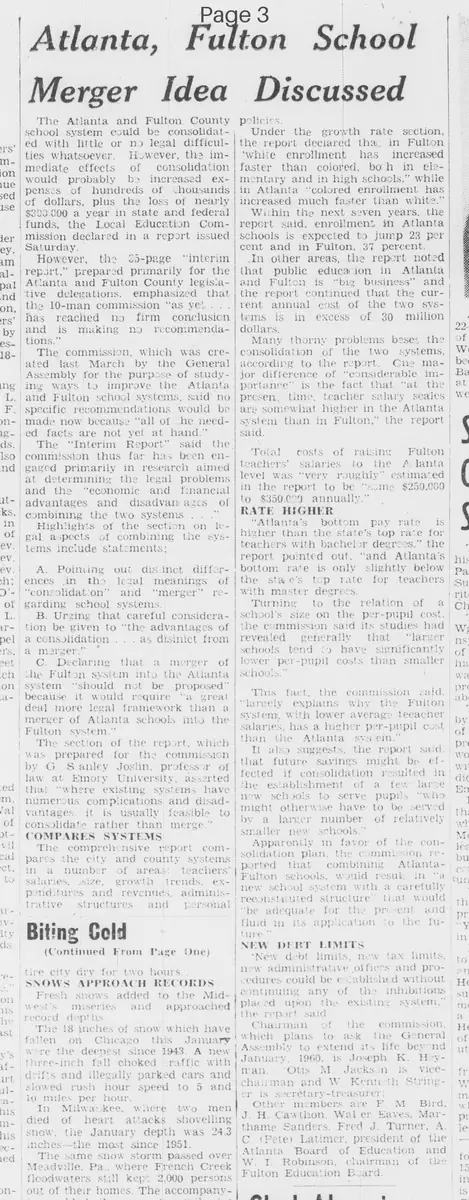
The Atlanta and Fulton County school system could be consolidated with little or no legal difficulties whatsoever. However, the immediate effects of consolidation would probably be increased expenses of hundreds of thousands of dollars, plus the loss of nearly $300,000 a year in state and federal funds, the Local Education Commission declared in a report issued Saturday.
However, the 35-page "interim report," prepared primarily for the Atlanta and Fulton County legislative delegations, emphasized that this 10-man commission "as yet . . . has reached no firm conclusion and is making no recommendations."
The commission, which was created last March by the General Assembly for the purpose of studying ways to improve the Atlanta and Fulton school systems, said no specific recommendations would be made now because "all of the needed facts are not yet at hand."
The "Interim Report" said the commission thus far has been engaged primarily in research aimed at determining the legal problems and the "economic and financial advantages and disadvantages of combining the two systems."
Highlights of the section on legal aspects of combining the systems include statements:
A. Pointing out distinct differences in the legal meanings of "consolidation" and "merger" regarding school systems.
B. Urging that careful consideration be given to "the advantages of a consolidation as distinct from a merger."
C. Declaring that a merger of the Fulton system into the Atlanta system "should not be proposed" because it would require a great deal more legal framework than a merger of Atlanta schools into the Fulton system.
The section of the report, which was prepared for the commission by G. Stanley Joslin, professor of law at Emory University, stated that "where existing systems have numerous complications and disadvantages, it is usually feasible to consolidate rather than merge."
COMPARES SYSTEMS
The comprehensive report compares the city and county systems in a number of areas teachers salaries, size, growth trends, expenditures and revenues administrative structures and personnel.
Under the growth rate section, the report declared that in Fulton 'white enrollment has increased faster than colored, both in elementary and in high schools." while in Atlanta "colored enrollment has increased much faster than white."
Within the next seven years, the report said, enrollment in Atlanta schools is expected to jump 23 per cent and in Fulton, 37 percent.
In other areas, the report noted that public education in Atlanta and Fulton is "big business" and the report continued that the current annual cost of the two systems is in excess of 30 million dollars.
Many thorny problems beset the consolidation of the two systems, according to the report. One major difference of "considerable importance" is the fact that "at the present time, teacher salary scales are somewhat higher in the Atlanta system than in Fulton," the report said.
Total costs of raising Fulton teachers' salaries to the Atlanta level was "very roughly" estimated in the report to be "some $250,000 to $350,000 annually."
RATE HIGHER
"Atlanta's bottom pay rate is higher than the state's top rate for teachers with bachelor degrees," the report pointed out. "and Atlanta's bottom rate is only slightly below the state's top rate for teachers with master degrees."
Turning to the relation of a school's size on the per-pupil cost, the commission said its studies had revealed generally that "larger schools tend to have significantly lower per-pupil costs than smaller schools."
This fact, the commission said "largely explains why the Fulton system, with lower average teacher salaries, has a higher per-pupil cost than the Atlanta system."
It also suggests, the report said that future savings might be effected if consolidation resulted in the establishment of a few large new schools to serve pupils who might otherwise have to be very expensively served by a larger number of relatively smaller new schools.
Apparently in favor of the consolidation plan the commission reported that combining Atlanta-Fulton schools, would result in a new school system with a carefully reconstituted structure that would be adequate for the present and fluid in its application to the future.
New debt limits, new tax limits new administrative offices and procedures could be established without continuing any of the inhibitions placed upon the existing system, the report said.
Chairman of the commission which plans to ask the General Assembly to extend its life beyond January, 1960, is Joseph K. Heyman. Otis M. Jackson is vice-chairman and W. Kenneth Stringer is secretary-treasurer.
Other members are F.M. Bird, J.H. Cawthon, Walter Eaves, Martha Sanders, Fred J. Turner, A.C. (Pete) Latimer, president of the Atlanta Board of Education and W.I. Robinson, chairman of the Fulton Education Board.
What sub-type of article is it?
What keywords are associated?
What entities or persons were involved?
Where did it happen?
Story Details
Key Persons
Location
Atlanta, Fulton County
Event Date
Last March; Issued Saturday; Extend Beyond January, 1960
Story Details
The Local Education Commission issued an interim report on consolidating Atlanta and Fulton County school systems, highlighting legal differences between consolidation and merger, potential increased expenses and loss of funds, comparisons of systems including salaries and enrollment trends, and suggesting possible future savings.