Thank you for visiting SNEWPapers!
Sign up free
Phenix Gazette
Alexandria, Virginia
What is this article about?
Appendix to Henry Clay's address featuring letters and statements from 1827 defending his conduct in the 1824-1825 U.S. Presidential election, denying accusations of a corrupt bargain with John Quincy Adams against Andrew Jackson, and affirming his independent preference for Adams based on merit.
Clipping
OCR Quality
Full Text
DAILY,
BY SNOWDEN & THORNTON,
TUESDAYS, THURSDAYS AND SATURDAYS.
Country Paper, $5 per annum.
MONDAY, JANUARY 7, 1828.
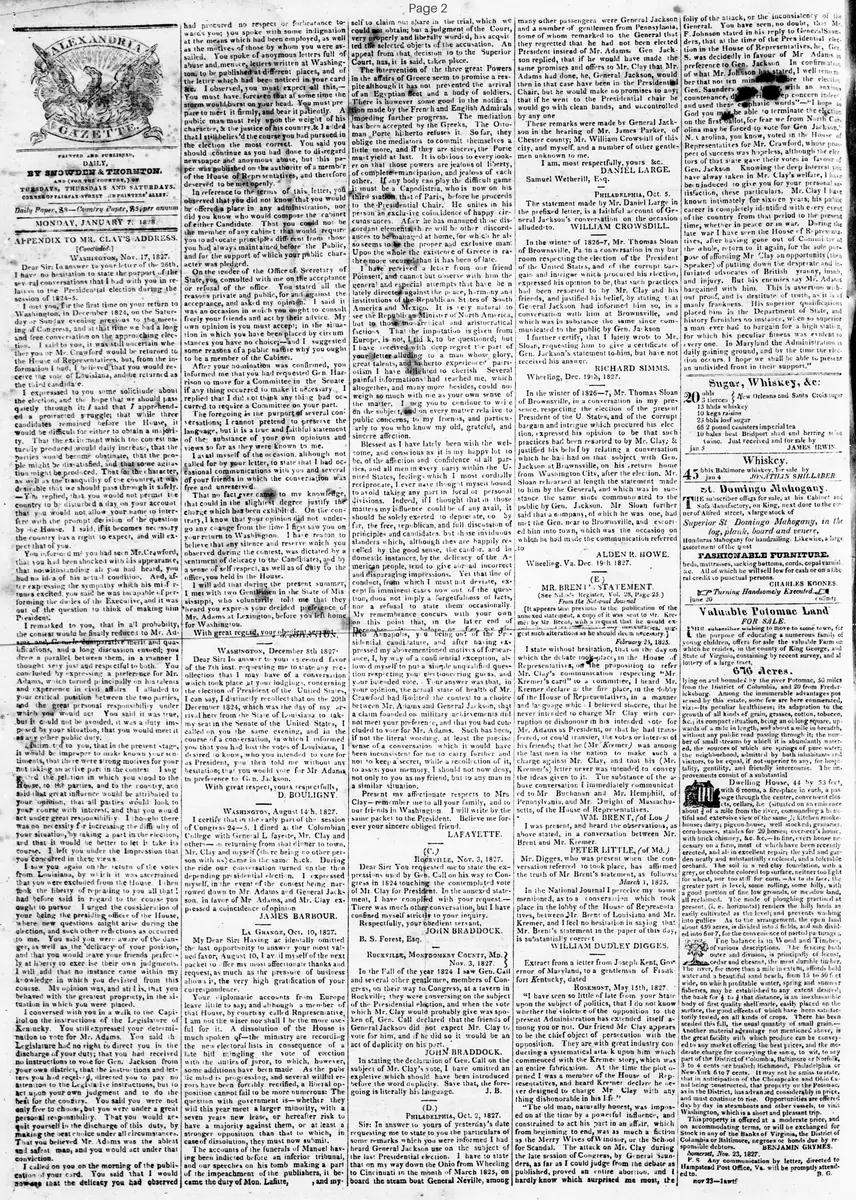
APPENDIX TO MR. CLAY'S ADDRESS.
[Concluded.]
Washington, Nov. 17, 1827.
Dear Sir: In answer to your letter of the 26th, I have no hesitation to state the purport of the several conversations that I had with you in relation to the Presidential election during the session of 1824-5.
I met you, for the first time on your return to Washington, in December 1824, on the Saturday or Sunday evening previous to the meeting of Congress, and at that time we had a long and free conversation on the approaching election. I said to you, it was still uncertain whether you or Mr. Crawford would be returned to the House of Representatives, but, from the information I had, I believed that you would receive the vote of Louisiana, and be returned as the third candidate.
I expressed to you some solicitude about the election, and the hope that we should pass quietly through it: I said that I apprehended a protracted struggle; that while three candidates remained before the House, it would be difficult for either to obtain a majority. That the excitement which the contest naturally produced would daily increase, that the parties would become obstinate, that the people might be dissatisfied, and that some agitation might be produced. That for the character, as well as the tranquility of the country, it was desirable that we should pass through it safely.
You replied, that you would not permit the country to be disturbed a day on your account; that you would not allow your name to interfere with the prompt decision of the question by the House. I said, if it becomes necessary the country has a right to expect, and will expect that of you.
You informed me you had seen Mr. Crawford, that you had been shocked with his appearance, that notwithstanding all you had heard, you had no idea of his actual condition. And, after expressing the sympathy which his misfortunes excited, you said he was incapable of performing the duties of the Executive, and it was out of the question to think of making him President.
I remarked to you, that in all probability, the contest would be finally reduced to Mr. Adams and General Jackson, on comparative merit and qualifications, and a long discussion ensued; you drew a parallel between them, in a manner I thought very just and respectful to both. You concluded by expressing a preference for Mr. Adams, which turned principally on his talents and experience in civil affairs. I alluded to your critical position between the two parties, and the great personal responsibility under which you would act. You said it was true, but it could not be avoided, it was a duty imposed by your situation, that you would meet it as any other public duty.
I intimated to you, that in the present stage, it would be improper to make known your sentiments, that there were strong motives for your not taking an active part in the contest. I suggested the relation in which you stood to the House, to the parties, and to the country, and said that great influence would be attributed to your opinion, that all parties would look to your course with interest, and that you would act under great responsibility. I thought there was no necessity for increasing the difficulty of your situation, by taking a part in the election, and that it would be better to let it take its course. I left you under the impression that you concurred in these views.
I saw you again on the return of the votes from Louisiana, by which it was ascertained that you were excluded from the House. I then took the liberty of repeating to you all that I had before said in regard to the course you ought to pursue. I urged the consideration of your being the presiding officer of the House, where new questions might arise during the election, and such other reflections as occurred to me. You said you were aware of the danger, as well as the delicacy of your position, and that you would leave your friends perfectly at liberty to exercise their own judgments.
I will add that no instance came within my knowledge in which you deviated from this course. My opinion was, and still is, that you behaved with the greatest propriety, in the situation in which you were placed.
I conversed with you in a walk to the Capitol on the instructions of the Legislature of Kentucky. You still expressed your determination to vote for Mr. Adams. You said the Legislature had no right to direct you in the discharge of your duty; that you had received no instructions to vote for Gen. Jackson from your own district, that the instructions and letters you had received, directed you to pay no attention to the Legislative instructions, but to act upon your own judgment and to do the best for the country. You said you were not only free to choose, but you were under a great personal responsibility. That you would acquit yourself in the discharge of this duty, by making the best choice under all circumstances. That you believed Mr. Adams was the ablest and safest man, and you would act under that conviction.
I called on you on the morning of the publication of your card. You said that I would now see that the delicacy you had observed had procured no respect or forbearance towards you; you spoke with some indignation as to the means which had been employed, as well as the motives of those by whom you were assailed. You spoke of anonymous letters full of abuse and menace, letters written at Washington, to be published at different places, and of the letter which had been noticed in your card, &c. I observed, you must expect all this,-- You must have foreseen that at some time the storm would burst on your head. You must prepare to meet it firmly, and bear it patiently. A public man must rely upon the weight of his character, & the justice of his country, & I added that I still believed the course you had pursued in the election the most correct. You said you should continue as you had done to disregard newspaper and anonymous abuse, but this paper was published on the authority of a member of the House of Representatives, and therefore deserved to be met openly.
In reference to the terms of this letter, you observed that you did not know that you would be offered a place in any administration, nor did you know who would compose the cabinet of either Candidate. That you could not be the member of any cabinet that would require you to advocate principles different from those you had always maintained before the Public, and for the support of which your public character was pledged.
On the tender of the Office of Secretary of State, you consulted with me on the acceptance or refusal of the office. You stated all the reasons private and public, for and against the acceptance, and asked my opinion. I said it was an occasion in which you ought to consult freely your friends and act by their advice. My own opinion is you must accept: in the situation in which you have been placed by circumstances you have no choice; and I suggested some reasons of a public nature why you ought to be a member of the Cabinet.
After your nomination was confirmed, you informed me that you had requested Gen. Harrison to move for a Committee in the Senate if any thing occurred to make it necessary. I replied that I did not think any thing had occurred to require a Committee on your part.
The foregoing is the purport of several conversations; I cannot pretend to preserve the language, but it is a true and faithful statement of the substance of your own opinions and views so far as they were known to me.
I avail myself of the occasion, although not called for by your letter, to state that I had occasional communications with you and several of your friends in which the conversation was free and unreserved.
That no fact ever came to my knowledge, that could in the slightest degree justify the charge which has been exhibited. On the contrary, I know that your opinion did not undergo any change from the time I first saw you on your return to Washington. I have reason to believe that any silence and reserve which you observed during the contest, was dictated by a sentiment of delicacy to the Candidates, and by a sense of self respect, as well as of duty to the office, you held in the House.
I will add that during the present summer, I met with two Gentlemen in the State of Mississippi, who voluntarily told me that they heard you express your decided preference of Mr. Adams at Lexington, before you left home for Washington.
With great regard, your obedient servant.
Washington, December 8th 1827.
Dear Sir: In answer to your esteemed favor of the 7th inst. requesting me to state any recollection that I may have of a conversation which took place at your lodgings, concerning the election of President of the United States, I can say, I distinctly recollect that on the 20th December 1824, which was the day of my arrival here from the State of Louisiana to take my seat in the Senate of the United States, I called on you the same evening, and in the course of a conversation, in which I informed you that you had lost the votes of Louisiana, I desired to know, who you intended to vote for as President, you then told me without any hesitation; that you would vote for Mr Adams in preference to Gen. Jackson.
With great respect, yours respectfully,
D. BOULIGNY.
Washington, August 14th, 1827.
I certify that in the early part of the session of Congress 24-5, I dined at the Columbian College with General Lafayette, Mr. Clay and others- in returning from that dinner to town, Mr. Clay and myself (there being no other person with us) came in the same hack. During the ride our conversation turned on the then depending presidential election. I expressed myself, in the event of the contest being narrowed down to Mr. Adams and General Jackson, in favor of Mr Adams, and Mr. Clay expressed a coincidence of opinion.
JAMES BARBOUR.
La Grange, Oct. 10, 1827.
My Dear Sir: Having accidentally omitted the last opportunity to answer your most valued favor, August 10, I avail myself of the next packet to offer my most affectionate thanks and request, as much as the pressure of business allows it, the very high gratification of your correspondence.
Your diplomatic accounts from Europe leave little to say; and although a member of that House, by courtesy called Representative I am not the wiser nor shall I be the more useful for it. A dissolution of the House is much spoken of-the ministry are recording the new electoral lists in consequence of a late bill mingling, the vote of election with the duties of juror, to which, however, some additions have been made. As the public mind is progressing, and several willful errors have been forcibly rectified, a liberal opposition cannot fail to be more numerous: The question with government is-whether they will this year meet a larger minority, with a seven years new lease, or hereafter risk to have a majority against them, or at least a stronger opposition than that to which, in case of dissolution, they must now submit.
The accounts of the funerals of Manuel having been indicted before an inferior tribunal, and our speeches on his tomb making a part of the impeachment of the publishers, it became the duty of Mr. Lafitte, self to claim our share in the trial, which we could not obtain; but a judgment of the Court, very properly and liberally worded, has acquitted the selected objects of the accusation. An appeal from that decision to the Superior Court, has, it is said, taken place.
The intervention of the three great Powers in the affairs of Greece seem to promise a respite although it has not prevented the arrival of an Egyptian Fleet and a body of soldiers. There is however some good in the notification made by the French and English Admirals impeding further progress. The mediation has been accepted by the Greeks, The Ottoman Porte hitherto refuses it. So far, they oblige the mediators to commit themselves a little more, and if they are sincere, the Porte must yield at last. It is obvious to every looker on that those powers are jealous of liberty, of complete emancipation, and jealous of each other. If any body can play the difficult game it must be a Capodistria, who is now on his third station, that of Paris, before he proceeds to the Presidential Chair. He unites in his person an exclusive coincidence of happy circumstances. After he has managed those discordant elements, there will be other discordances to be managed at home, for which he also seems to be the proper and exclusive man.
Upon the whole the existence of Greece is rather more secured than it has been of late.
I have received a letter from our friend Poinsett, and cannot but observe with him the general and especial attempts that have been lately directed against the peace, harmony and institutions of the Republican States of South America and Mexico. It is very natural to see the Republican Minister of North America, but to those monarchical and aristocratical factions That the imputation is given from Europe, is not, I think, to be questioned; but I have received with deep regret the part of your letter alluding to a man whose glory, great talents, and hitherto experienced patriotism I have delighted to cherish Several painful informations had reached me, which altogether, and many more besides, could not weigh so much with me as your own sense of the matter. I urge you to continue to write on the subject, and on every matter relative to public concerns, to my friends, and particularly to you who know my old, grateful, and sincere affection.
Blessed as I have lately been with the welcome, and conscious as it is my happy lot to be, of the affection and confidence of all parties, and all men in every party within the United States, feelings which I most cordially reciprocate, I ever have thought myself bound to avoid taking any part in local or personal divisions. Indeed, if I thought that in those matters my influence could be of any avail, it should be solely exerted to deprecate, not by far, the free, republican, and full discussion of principles and candidates. but those invidious slanders which, although they are happily repelled by the good sense, the candor. and in domestic instances, by the delicacy of the American people, tend to give abroad incorrect and disparaging impressions. Yet that line of conduct, from which I must not deviate, except in imminent cases now out of the question, does not imply a forgetfulness of facts, nor a refusal to state them occasionally.
My remembrance concurs with your own on this point that, in the latter end of December fore prior to my leaving it to Annapolis, being out of the Presidential candidature, and after having expressed my abovementioned motives of forbearance, I, by way of a confidential exception, allowed myself to put a simple unqualified question respecting your electioneering guess, and your intended vote. Your answer was that, in your opinion, the actual state of health of Mr. Crawford had limited the contest to a choice between Mr. Adams and General Jackson, that a claim founded on military achievements did not meet your preference, and that you had concluded to vote for Mr. Adams. Such has been, if not the literal wording. at least the precise sense of a conversation which it would have been inconsistent for me to carry further and not to keep a secret, while a recollection of it, to assist your memory, I should not now deny. not only to you as my friend, but to any man in a similar situation.
Present my affectionate respects to Mrs Clay-remember me to all your family, and to our friends in Washington. I will write by the same packet to the President. Believe me for- ever your sincere obliged friend.
LAFAYETTE.
(C.)
Rockville, Nov. 3, 1827.
Dear Sir: You requested me to state the expressions used by Gen. Call on his way to Congress in 1824 touching the contemplated vote of Mr. Clay for President. In the annexed statement, I have complied with your request.- There was much other conversation, but I have confined myself strictly to your inquiry.
Respectfully, your obedient servant,
JOHN BRADDOCK.
B. S. Forest, Esq.
Rockville, Montgomery County, Md.
Nov. 3, 1827.
In the Fall of the year 1824 I saw Gen. Call and several other gentlemen, members of Congress, on their way to Congress, at a tavern in Rockville; they were conversing on the subject of the Presidential election, and when the vote which Mr. Clay would probably give was spoken of, Gen. Call declared that the friends of General Jackson did not expect Mr. Clay to vote for him, and if he did so it would be an act of duplicity on his part.
JOHN BRADDOCK.
In stating the declaration of Gen. Call on the subject of Mr. Clay's vote, I have omitted an expletive which should have been introduced before the word duplicity. Save that, the foregoing is literally his language.
J. B.
(D.)
PHILADELPHIA, Oct. 2, 1827.
Sir: In answer to yours of yesterday's date requesting me to state to you the particulars of some remarks which you were informed I had heard General Jackson use on the subject of the last Presidential election. I have to state that on my way down the Ohio from Wheeling to Cincinnati in the month of March 1825, on board the steam boat General Neville, among many other passengers were General Jackson and a number of gentlemen from Pennsylvania, some of whom remarked to the General that they regretted that he had not been elected President instead of Mr. Adams Gen Jackson replied, that if he would have made the same promises and offers to Mr. Clay that Mr. Adams had done, he, General Jackson, would then in that case have been in the Presidential Chair, but he would make no promises to any; that if he went to the Presidential chair he would go with clean hands, and uncontrolled by any one
These remarks were made by General Jackson in the hearing of Mr. James Parker, of Chester county; Mr. William Crowsdill of this city, and myself, and a number of other gentlemen unknown to me.
I am, most respectfully, yours &c.
DANIEL LARGE.
Samuel Wetherill, Esq.
PHILADELPHIA, Oct. 5.
The statement made by Mr. Daniel Large in the prefixed letter, is a faithful account of General Jackson's conversation on the occasion alluded-to.
WILLIAM CROWSDILL
In the winter of 1826-7, Mr. Thomas Sloan of Brownsville, Pa in a conversation in my bar room respecting the election of the President of the United States, and of the corrupt bargain and intrigue which procured his election, expressed his opinion to be, that such practices had been resorted to by Mr. Clay and his friends, and justified his belief, by stating that General Jackson had informed him so, in a Conversation with him at Brownsville, and which was in substance the same since communicated to the public by Gen. Jackson
I further certify, that I lately wrote to Mr. Sloan, requesting him to give a certificate of Gen. Jackson's statement to him, but have not received his answer.
RICHARD SIMMS.
Wheeling, Dec. 19th, 1827.
In the winter of 1826-7, Mr. Thomas Sloan of Brownsville, in a conversation in my presence, respecting the election of the present President of the U. States, and of the corrupt bargain and intrigue which procured his election. expressed his opinion to be that such practices had been resorted to by Mr. Clay;& justified his belief by relating a conversation which he had had on that subject with Gen. Jackson at Brownsville, on his return home from Washington City, after the election. Mr. Sloan rehearsed at length the statement made to him by the General, and which was in substance the same since communicated to the public by Gen. Jackson. Mr Sloan further said that a Company, of which he was one, had met the Gen. near to Brownsville, and escorted him into town, which was the occasion on which he had made the communication referred to
ALDEN R. HOWVE.
Wheeling, Va. Dec. 19th 1827.
(E)
MR. BRENT'S STATEMENT.
(See Niles's Register, Vol. 28, Page 25.)
From the National Journal
[It appears that previous to the publication of the annexed statement, a copy of it was sent to Mr. Kremer: by Mr. Brent, with a request that he would examine it, and suggest such alterations as he should deem necessary.]
February 25, 1825.
I state without hesitation, that on the day on which the debate took place, in the House of Representatives, on the proposition to refer Mr. Clay's communication respecting "Mr Kremer's card" to a committee, I heard Mr. Kremer declare at the fire place, in the lobby of the House of Representatives, in a manner and language which I believed sincere, that he never intended to charge Mr Clay with corruption or dishonour in his intended vote for Mr. Adams as President, or that he had transferred, or could transfer, the votes or interest of his friends; that he (Mr Kremer) was among the last men in the nation to make such a charge against Mr. Clay, and that his (Mr. Kremer's) letter never was intended to convey the ideas given to it. The substance of the above conversation I immediately communicated to Mr Buchanan and Mr. Hemphill, of Pennsylvania. and Mr. Dwight of Massachusetts, of the House of Representatives.
WM. BRENT, (of Lou )
I was present, and heard the observations, as above stated, in a conversation between Mr. Brent and Mr. Kremer.
PETER LITTLE, (of Md.)
Mr. Digges, who was present when the conversation referred to took place, has affirmed the truth of Mr Brent's statement, as follows:
March 1, 1825.
In the National Journal I perceive my name mentioned, as to a conversation which took place in the lobby of the House of Representatives. between Mr. Brent of Louisiana and Mr. Kremer, and I feel no hesitation in saying that Mr. Brent's statement in the paper of this day, is substantially correct
WILLIAM DUDLEY DIGGES.
Extract from a letter from Joseph Kent, Governor of Maryland, to a gentleman of Frankfort Kentucky, dated
ROSEMONT, May 15th. 1827.
"I have seen so little of late from your State upon the subject of politics, that I do not know whether the violence of the opposition to the present Administration has extended itself among you or not. Our friend Mr Clay appears to be the chief object of persecution with the opposition. They are with great industry conducting a systematical attack upon him which commenced with the Kremer story, which was an entire fabrication. At the time the plot opened I was a member of the House of Representatives, and heard Kremer declare he never designed to charge Mr Clay with any thing dishonorable in his vote."
"The old man, naturally honest, was imposed on at the time by a powerful influence, and constrained to act his part in an affair, which from beginning to end, was as much a fiction as the Merry Wives of Windsor, or the School for Scandal. The attack on Mr. Clay during the late session of Congress, by General Saunders, as far as I could judge from the debate as published, proved an entire abortion, and I hardly know which surprised me most, the folly of the attack, or the inconsistency of the General. You have seen, no doubt, that Mr F. Johnson stated in his reply to General Saunders, that at the time of the Presidential election in the House of Representatives, he, Gen. S. was decidedly in favour of Mr Adams in preference to Gen. Jackson In confirmation of what Mr. Johnson has stated, I well remember that not ten minutes before the election Gen. Saunders with an anxious and used these emphatic words "I hope to God you may be able to terminate the election on the first ballot, for fear we from North Carolina may be forced to vote for Gen Jackson." North Carolina, you know, voted in the House of Representatives for Mr. Crawford, whose prospect of success was hopeless, although the electors of that state gave their votes in favour of Gen. Jackson Knowing the deep interest you have always taken in Mr. Clay's welfare, I have been induced to give you or your personal satisfaction, these particulars. Mr. Clay I have known intimately for sixteen years; his public career is completely identified with every event of the country from that period to the present time, whether in peace or in war. During the late war I have seen the House of Representatives, after having gone out of Committee of the whole, return to it again, for the sole purpose of affording Mr Clay an opportunity (then Speaker) of putting down the desperate and infuriated advocates of British tyranny, insult, and injury. But his enemies say Mr. Adams bargained with him. This is assertion without proof, and is destitute of truth, as it is of manly frankness. His superior qualifications placed him in the Department of State, and history furnishes no instance, when so superior a man ever had to bargain for a high station, for which his peculiar fitness was evident to every one. In Maryland the Administration is daily gaining ground, and by the time the election occurs. I hope we shall be able to present an undivided front in their support.'
What sub-type of article is it?
What themes does it cover?
What keywords are associated?
What entities or persons were involved?
Where did it happen?
Story Details
Key Persons
Location
Washington, D.C.
Event Date
1824 1825
Story Details
Collection of letters and affidavits from 1827 detailing conversations where Henry Clay expressed his independent preference for John Quincy Adams over Andrew Jackson in the 1824 Presidential election, denying any prior bargain or corruption, and countering Jacksonian accusations of a 'corrupt bargain' for Clay's appointment as Secretary of State.