Thank you for visiting SNEWPapers!
Sign up free
Richmond Enquirer
Richmond, Richmond County, Virginia
What is this article about?
In the House of Commons on February 5, Lord Ormelie moved an address responding to the King's Speech, emphasizing government efforts to address lawless violence in Ireland. Mr. O'Connell opposed it vehemently, accusing ministers of misgovernment causing Irish disorders, defending agitation, and calling for repeal of the Union and justice instead of force. Debate included interventions by Lord J. Russell, the Speaker, and Mr. Stanley.
Merged-components note: Continuation of the same article on Imperial Parliament proceedings across adjacent pages and sequential reading orders.
Clippings
1 of 2
OCR Quality
Full Text
HOUSE OF COMMONS—FEB. 5.
THE ADDRESS—MEASURES ON IRELAND.
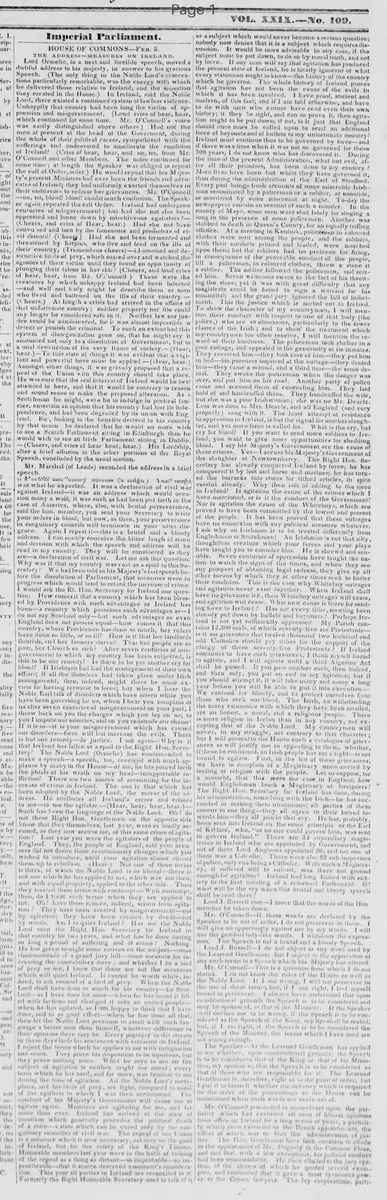
Lord Ormelie, in a neat and forcible speech, moved a dutiful address to his majesty, in answer to his gracious Speech. (The only thing in the Noble Lord's observations particularly remarkable, was the energy with which he delivered those relative to Ireland, and the sensation they created in the House.) In Ireland, said the Noble Lord, there existed a continued system of lawless violence. Unhappily that country had been long the victim of oppression and misgovernment. (Loud cries of hear, hear, which continued for some time. Mr. O'Connell's voice was easily distinguished above others) Had not the men at present at the head of the Government, during the whole of their political career, sympathized with the sufferings and endeavored to ameliorate the condition of Ireland? (Cries of hear, hear, and no, no, from Mr. O'Connell and other Members. The noise continued for some time; at length the Speaker was obliged to repeat the call of Order, order.) He would repeat that his Majesty's present Ministers had ever been the friends and advocates of Ireland; they had uniformly exerted themselves in their endeavors to redress her grievances. -Mr. O'Connell—no, no, blood! blood! amidst much confusion. The Speaker again repeated the call Order. Ireland had undergone centuries of misgovernment; but had she not also been oppressed and borne down by mischievous agitators?— (Cheers, and cries of Hear, hear.) Had she not been convulsed and torn by the fomentors and promoters of civil discord? (Cheers) Had she not been tormented and threatened by harpies, who live and feed on the ills of their country, (Tremendous cheers)—ill-omened and destructive birds of prey, which soared over and watched the agonies of their victim until they found an opportunity of plunging their talons in her side? (Cheers, and loud cries of hear, hear, from Mr. O'Connell) These were the creatures by which unhappy Ireland had been infested —and well and truly might he describe them as men who lived and battened on the ills of their country.— (Cheers.) At length a crisis had arrived in the affairs of that unfortunate country; neither property nor life could any longer be considered safe in it. Neither law nor justice could be administered, for it was almost impossible to detect or punish the criminal. To such an extent had this system of disorganization gone on, that he might say it amounted not only to a dissolution of Government, but to a total destruction of the very frame of society.—(Hear, hear.)—To this state of things it was evident that a vigilant and powerful force must be applied—(Hear, hear.) Amongst other things, it was gravely proposed that a repeal of the Union with this country should take place. He was sure that the real interest of Ireland would be best attended to here, and that it would be contrary to reason and sound sense to make the proposed alteration. As a Scotchman he might, were he to indulge in poetical fancies, entertain an opinion that his country had lost its independence, and had been degraded by its union with England. But, looking to the benefits derived to his country by that union he declared that he would no more wish to see a Scotch Parliament sitting in Edinburgh than he would wish to see an Irish Parliament sitting in Dublin. —(Cheers, and cries of hear hear, hear.) His Lordship, after a brief allusion to the other portions of the Royal Speech, concluded by the usual motion.
Mr. Marshal (of Leeds) seconded the address in a brief speech.
Mr. O'Connell rose to oppose the address (a laugh.) That rarely was what he expected. It was a declaration of civil war against Ireland—it was an address which would occasion many a wail; it was such as had been put forth in the case of America, where, also, with brutal perseverance, said the hon. member, you sent your Secretary to write your orders in blood; but now, as then, your perseverance in sanguinary councils will terminate in your utter disgrace. Again I repeat it this is a brutal and a bloody address. I can readily conceive the bitter laugh of scorn and derision with which the speech and address will be read in my country. They will be considered as they are—a declaration of civil war. Let me ask this question: Why was it that my country was cast as a spoil to this Secretary? We had been told in his Majesty's last speech before the dissolution of Parliament, that measures were in progress which would tend to retard the increase of crime. I would ask the Rt. Hon. Secretary for Ireland one question: How comes it that a country which has been blessed by Providence with such advantages as Ireland has been—a country which possesses such advantages as—I do not say Scotland only—but such advantages as even England does not possess equal—how comes it that this country, where Providence has done so much, her rulers have done so little, or so ill? How is it that her landlords flourish, and her farmers starve? That her people are so poor, her Church so rich? After seven centuries of misgovernment to which my country has been subjected, is this to be our remedy? Is there to be yet another cry for blood? If Irishmen had had the management of their own affairs; if all the disorders had taken place under Irish management, then, indeed, might there be some excuse for having recourse to force; but when I hear the Noble Earl talk of disorders which have arisen while you have been governing for us, when I hear you complain of us after seven centuries of misgovernment on your part, I throw back on you the charges which you lay on us; to you I impute our miseries, and on you redounds our shame! If it is so—it is your misgovernment which has caused our disorders—force will but increase the evils. There is but one remedy—do justice. I ask again—Why is it that Ireland has fallen as a spoil to the Right Hon. Secretary? The Noble Lord (Ormelie) has condescended to make a speech—a speech, too, received with much applause by many in the House—at me, he has poured forth the phials of his wrath on my head—insupportable infliction! There are two modes of accounting for the increase of crime in Ireland. The one is that which has been adopted by the Noble Lord, the mover of the address. He attributes all Ireland's errors and crimes to me—to me the agitator.—(Hear, hear, hear, hear.)— Such has been the language of the Noble Lord. Oh! do not these Right Hon. Gentlemen on the opposite side know that they themselves, last year, were as loudly accused, as they now accuse me, of this same crime of agitation? Last year you were the agitators of the people of England. They, the people of England, said your accusers did not desire those revolutionary changes which you wished to introduce, until your agitation almost stirred them up to rebellion. (Hear.) Not one of those terms is there, of which the Noble Lord is so liberal—there is not one which he has applied to me, which was not then, and with equal propriety, applied to the other side. Then they treated these terms with contempt.—With contempt, then, do I treat such terms when they are applied to me. Oh! have these crimes, indeed, arisen from agitation? They have been created by misgovernment—not by agitation; they have been created by deeds—not by words. Am I to quiet Ireland? Has not the Noble Lord seen the Right Hon. Secretary for Ireland in that country for two years, and what has he done during so long a period of suffering and of crime? Nothing. He has given to-night some notices on the subject—some rhodomontade of a grand jury bill—some measure for increasing the constabulary force ; and whether I be a bird of prey or not, I know that these are not the measures which will quiet Ireland. It cannot be worth while, indeed, to ask counsel of a bird of prey. When the Noble Lord shall have done so much for his country—for Scotland—as I have done for mine—when he has found it filled with factions and changed it into an united people— when he has agitated, as I am happy to think that I have done, and to as good effect—when he has done all that, then let the Noble Lord presume to assail with such language a better man than himself, whatever difference in their opinions there may be. Every popinjay in the streets in these days lards his sentences with sarcasms on Ireland I reject the terms which he applies to me with indignation and scorn. They prove his disposition to be injurious, but they prove nothing more. What he says to me on the subject of agitation is neither bright nor novel; every term which he has used, and far more, was familiar to me during the time of agitation. All the Noble Lord's metaphors, and his birds of prey, are light, compared to some of the epithets to which I was then accustomed. The conduct of his Majesty's Government will cause me to agitate again. Ministers are agitating for me, and far more than ever. Ireland has arrived at the state of inanition which generally precedes the political death of a state—a state which can be cured only by the sanguinary remedies of civil war. The repeal of the Union is a measure which is now necessary, not only for the good of Ireland, but for the safety of the King's Throne. Honorable members last year were in the habit of talking of the repeal as a thing so distant—so improbable—so impracticable—that it scarce deserved a moment's consideration. This year all parties in Ireland are reconciled to it Formerly the Right Honorable Secretary used to talk of it
VOL. XXIX.—No. 109.
as a subject which would never become a serious question; nobody now denies that it is a subject which requires discussion. It would be more advisable in any case, if the subject must be put down, to do so by moral truth, and not by force. If any man will say that agitation has produced the present state of Ireland, he is totally ignorant of what every statesman ought to know—the history of the country which he governs. "The whole history of Ireland proves that agitation has not been the cause of the evils in which it has been involved. I have proof, ancient and modern, of this fact; and if I am told otherwise, and have to do with men who cannot have read even their own history; if they be right, and can so prove it, then agitation ought to be put down; if not, is it just that England should once more be called upon to send an additional force of bayonets and of bullets to my unfortunate country? Ireland must continue thus to be governed by force—and if there was a time when it was not so governed for these 700 years, I do not know who has discovered it. During the time of the present Administration, what but evil, after all their promises, has been done to my country ? More lives have been lost while they have governed it, than during the administration of the Earl of Strafford. Every post brings fresh accounts of some miserable Irishman assassinated by a policeman or a soldier, at noontide, or murdered by some miscreant at night. To-day the newspapers contain an account of such a murder. In the county of Mayo, some men were shot lately for singing a song in the presence of some policemen. "Another was stabbed to death in Queen's County, for an equally trifling offence. At a meeting in Kanturk, policemen in coloured clothes were sent among the people, and the soldiers, with their muskets primed and loaded, were marched upon them; but the soldiers had no pretence for firing, in consequence of the peaceable conduct of the people, till a policeman, in coloured clothes, threw a stone at a soldier. The soldier followed the policeman, and seized him. Seven witnesses swore to the fact of his throwing the stone; yet it was with great difficulty that any magistrate could be found to sign a warrant for his committal; and the grand jury ignored the bill of indictment. This the justice which is meted out to Ireland. To show the character of my countrymen, I will mention their conduct with respect to one of that body (the police,) who are so obnoxious, particularly to the lower classes of the Irish; and to show the treatment which my countrymen too often receive, I will mention the reward of their kindness. The policeman took shelter in a poor cottage, and appealed to the generosity of its inmates. They received him—they took care of him—they put him in bed—his pursuers inquired at the cottage—they denied him—they came a second, and a third time—the same denial. They awoke the policeman when the danger was over, and put him on his road. Another party of police came and accused them of concealing him. They laid hold of and handcuffed them. They handcuffed the wife, but she was a poor Irishwoman; she was no Mr. Deacle. Less was done to Mrs. Deacle, and all England (and very properly) rang with it. The least attempt at resistance to oppression in Ireland, is but the signal for another slaughter, and yet more force is called for. What is the cry, but cry for blood? If you want to send more soldiers to Ireland, you want to give more opportunities for shedding blood. I say his Majesty's Government are the cause of these crimes. Yes—I accuse his Majesty's Government of the slaughter at Newtownbarry. The Right Hon. Secretary has already conquered Ireland by force; he has conquered it by foot and horse and marines; he has turned the barracks into stores for tithed articles, in spite of the people already. Why then talk of adding to the force in Ireland? Is agitation the cause of the crimes which I have mentioned, or is it the conduct of the Government? Nor is agitation the cause of the Whiteboys, which are proved to have been committed by the lowest and poorest of the people. It has been proved that these outrages have no connexion with any political measure whatever. I ask why an Irishman is to be treated differently from Englishmen or Scotchmen? An Irishman is not that silly, thoughtless creature which your farces and your plays have taught you to consider him. He is shrewd and sensible. Seven centuries of oppression have taught the nation to watch the signs of the times, and when they see any prospect of obtaining legal redress, they give up all other means by which they at other times seek to better their condition. This is the case why Whiteboy outrages and agitation never exist together. When Ireland shall have no grievance left, then Whiteboy outrages will cease, and agitation will cease. What new cause is there for sending force to Ireland? Has not every tithe, meeting been already put down by bullets and bayonets ? Perhaps Ireland is not yet sufficiently oppressed. My Parish contains 12,300 souls, of which seventy-five are Protestants— is it no grievance that twelve thousand two hundred and odd Catholics should pay tithes for the support of the clergy of these seventy-five Protestants ?' If Ireland continues to have such grievances, I think myself bound to agitate, and I will agitate until a third Algerine Act shall be passed. If you pass another such, then indeed, and then only, you put an end to my agitation; but if you should attempt it, it will take many and many a long year before you will be able to put it into execution.— We contend for liberty, and to protect ourselves from those who seek our blood. The Irish, notwithstanding the many calumnies with which they have been assailed, are an honest, a moral, and a religious people. There is more religion in Ireland than in any country, not excepting that of the Noble Lord. My countrymen will never, in any struggle, act contrary to that character; but I will present to the House such a catalogue of grievances as will justify me in appealing to them, whether, if these be continued, an Irish people has not a right—is not bound to agitate. First, in the list of these grievances, we have to complain of a Magistracy unconnected by feeling or religion with the people. Let us suppose, for a moment, that this were the case in England; how would Englishmen brook a Magistracy of foreigners? The Right Hon. Secretary for Ireland has done, during his administration, something with the Irish—he has succeeded in making them unanimous; all parties of them concur in one thing—they all agree in their hatred towards him—they all join in that cry. He has, probably, been sent into Ireland on the same principle as the Earl of Kildare, who, "as no one could govern him, was sent to govern Ireland." There are 81 stipendiary magistrates in Ireland who are appointed by Government, and out of these Lord Anglesea appointed 26; and not one of them was a Catholic." There were also 82 sub-inspectors of police, only one being a Catholic. With such a Magistracy, if suffered still to subsist, was there not ground enough for agitation! Ireland had long looked with anxiety to the first meeting of a reformed Parliament. O! what will be the cry when this brutal and bloody speech shall be read there?
Lord J. Russell rose—I move that the words of the Hon. member be taken down.
Mr. O'Connell—If these words are declared by the Speaker to be out of order, I do not persevere in them. I will give no opportunity against me by my words. I will use the gentlest lady-like words. I withdraw the expression. The Speech is not a brutal and a bloody Speech.
Lord J. Russell—I do not object to any word used by the Learned Gentleman; but I object to the application of any such terms to a Speech which his Majesty has uttered.
Mr. O'Connell—This is a question from which I do not shrink. I do not know the rules of the House so well as the Noble Lord. If I am wrong, I will not persevere in the use of these terms; but, if I am right, I feel myself bound to persevere. I always have understood that upon constitutional grounds the Speech is to be considered and may be spoken of, as that of the Minister. If the Speaker shall declare me to be wrong. if the Speech is to be considered as the Speech of the King, my lips shall be sealed; but, if I am right, if the Speech is to be considered the Speech of the Minister, the terms which I have used are not strong enough.
The Speaker—As the Learned Gentleman has applied to me whether, upon constitutional grounds, the Speech is to be considered that of the King or that of his Ministers, my opinion is, that the Speech is to be considered as that of those who are responsible for it. The Learned Gentleman is, therefore, right as to the point of order, but I put it to himself whether the decency which is required for the order of the proceedings in the House can be maintained when such words are made use of.
Mr O'Connell proceeded to animadvert upon the partiality which had excluded all men of liberal opinions from office in Ireland for a long series of years, a partiality which even extended to the Bench appointments, the effect of which was to bias the administration of justice The Hon. Gentleman here took occasion to allude to the appointment of Mr. Dogherty to the Common Pleas, and said that, with a few exceptions, his judicial conduct had been commendable. He then alluded to the jury system, of the abuses of which he quoted several examples, and contended that it gave a most tyrannous power to the Crown lawyers The lay corporations, part
Particularly that of Cork, which has no less than £74,000 per annum at its disposal, were the next objects pointed out by the Honorable member, as a cause of much of the evils in Ireland. The bigotry of the bodies were such that all persons appointed as Sheriffs were obliged to drink a certain party toast as a pledge of their conduct. He complained that the police in Ireland was armed, which was not the case in England, a circumstance which led to fatal collisions on the most trifling occasions. Instead of calling for fresh powers, let them put down agitation in Ireland by doing justice to the country. After citing several examples of the injustice and oppression resulting from the excessive wealth of the Irish Church, he claimed the merit of having prevented much increase of crime in Ireland. But he knew how little many Hon. Members cared for Irish blood, and with what sovereign contempt they listened to these statements. Nothing could be more dangerous than the army of yeomanry in Ireland; it tended to the increase of crime. Now though crime had increased in Ireland, it had not arrived at its acme. It had been restrained by the strenuous advice of the calumniated agitators. The armed yeomanry had, however, been increased from twenty-two thousand to thirty-one thousand. And what had since happened? That the Catholic population in the north of Ireland had armed themselves. The country was in consequence a volcano. A tremendous force was prepared to enter upon a servile war. The Catholics were adopting this measure in their own defence. He was ready to mention to Ministers the name of a Magistrate who, in the course of last week, had seen a secret meeting of a thousand Catholic peasantry, well armed, in the north of Ireland. Did they think that any Act of Parliament would have the effect of dissolving the secret meetings to which he had been advertings? Did they think that the Catholic peasantry would be induced by any money, by any temptation, to betray their cause? He scorned to ask the House to disbelieve the calumnies heaped upon the agitators in Ireland, but this he would tell them—that they might gag those agitators with their Algerine Acts; that they might send them to prison by suspending the Habeas Corpus; they might shed their blood on the scaffold: under that scaffold the Catholic peasantry would assemble, as they were already assembling in the north of Ireland, and would prepare to engage in a servile war of the most dreadful character. A revolution would be effected: not a moral revolution, not a political revolution, but a sword revolution. (Hear.) In the mean time, what were his Majesty's Government doing? Endeavoring to put down public meetings in Ireland. Had any meeting taken place in that country half so numerous as the meeting at Birmingham? With one exception, there had not been a single breach of the public peace at those meetings. Yet, against those peaceable meetings his Majesty's Government had commenced a crusade. Some great and crying grievances in Ireland remained to be enumerated. Was the vestry cess no grievance? Was it no grievance that seventy-five Protestants in a parish should have the power of punishing, by taxation, twelve thousand Catholics? Was it no grievance that the Catholic inhabitants of a parish ten miles from Waterford, in which Lord Duncannon was the only Protestant resident, should be thus treated? In the parish of St. Andrews in Dublin, the Protestant vestry had made an additional allowance of three hundred pounds a year to two Protestant curates. This was a violation of the law; and the order to that effect having been brought before the Court of King's Bench, was quashed. But what was the result? That at the next vestry, a rate was levied on the parish, for the payment of the costs of the trial, and the order for the allowance was repeated. Why should the Catholics be compelled to pay Protestant clergy? Why should the Catholics be compelled to build Protestant churches? Look at the temporalties of the church, and say if anything could be more monstrous—if any effect of agitation could be so pernicious as this system? The living of the brother-in-law of Earl Grey had been estimated to bring in nearly £30,000 annually; there were 96,000 acres of ground belonging to it. Was this paid by members of the Church of England? (Hear) No; the Presbyterian and the Catholic—worshippers in a different form, were compelled by this most monstrous system to pay this divine. Was it to be borne that they were thus to be treated? What he wanted to know was this—was the church to be cut down? (Hear) They were agitators, it was said, but their agitation was of a clear character—it was of a different sort to that which was the real source of the distress and the insubordination, and the what not. He did not know that it was distinguished by two epaulettes, (Hear.) or by troops to cut down the people. Force was the cry. This had ever been the Government's conduct. For forty years, let it be remembered, force had been unceasingly talked of to Scotland, but Scotch broadswords were unsheathed—Scotchmen knew their rights—they tallied—they united—they struggled—and they succeeded. (Loud Cheers) He compared our case never rendered to her. That speech when had been delivered was a prototype of one in the reign of Elizabeth, when Raleigh slaughtered the garrison of Merbeck. The cry of power had ever been the cry of this country—and under it were committed those English crimes which were written in the blood of Ireland. Strafford, the prototype of the Honorable Gentleman, acted otherwise; he confiscated the property of two entire provinces in Ireland, and when juries refused to convict he sent them for two years into Dublin Castle. In the reign of James the Second, eighty thousand acres of land were forfeited in defending the right of his father. In the present day the same part was acted—the scene was somewhat changed—the actors were different—but their conduct was substantially the same. There was no real amelioration—no change, nor any intended, as was proved in that address which he had designated as bloody and brutal. What he wanted was a general committee, that that address might be duly considered and discussed line by line. If that were really a reformed House—If justice to Ireland was really their object, they would not refuse it. (Hear, hear.) Justice had not been done to Ireland by the reform bill. He strongly doubted if he had acted rightly in supporting so strenuously the English bill. It was no idle motive which made him anxious to introduce so many of his family into that House. He too well knew the incurable ignorance which there prevailed on the real state and wants of his country, and he was determined to tell them trumpet-tongued to all. (Hear, hear.) The number of repealers returned would at least give the Government some insight into the sentiments of the people on that subject. (Hear, hear) He wanted a Committee of that House—he desired that that declaration of war with the people of Ireland should be modified. (Loud cries of hear.) Let the Ministers give them a strong and emphatic declaration of intended justice to Ireland. (Repeated cries of hear) And if then they applied for force, he would support them. But the Speech promised nothing. (Hear, hear.) He should now know of what that reformed House was composed—he should see the high and independent Members for England voting for "more power." It was of no use his pleading before a reformed Parliament in behalf of Ireland—it was vain lifting up his voice in her cause; for he was sure his answer would be a laugh at himself, and a laugh at his country. He would defy any one who had heard his words—to instance one case in which he had aggravated a grievance—(hear, hear)—and he would defy any one to find a people, look where he might, who had agitated, or who had been guilty of midnight outrage, of insubordination and reckless crime, without real grievances. (Hear.) He had done—he thanked the House for the patience with which he had been listened to—they were the last hope, the last refuge of his country. To them he could only look for relief from the autocracy of the Right Honorable Gentleman; from that "sic volo, sic jubeo, stat pro ratione voluntas" to which his country was subjected. Whether Government was to be administered by the Right Hon. Gentleman alone—whether all was to continue to be concentrated in his self-sufficiency—they must decide. Seven centuries of misrule had been endured by Ireland—Government had been carried on on no other plan than that of Tamerlane; and he most outrageous cruelties had been inflicted on a prostrate people. For himself, he (Mr. O'Connell) labored under one calamity—that of a supposed personal hostility to the Right Hon. Gentleman opposite. Had he, could he have any such feeling towards him? They had never come together, and he denied any cause for such feeling, and its existence. His were public grounds. He looked at the accumulation of crime—at the quantity of blood increasing as it flowed in his unhappy country, and he still found him the lord of the ascendant, dictating to the Ministry the measures to be pursued. These things he wanted altered. He asked for the real grievances of Ireland to be redressed, and then he would go any lengths the Ministers might require. (Hear, hear.) The Learned Gentleman concluded by moving, as an amendment, for a Committee of the whole House to consider his Majesty's Speech. Mr. Cobbett seconded the amendment. Mr. Richards expressed his dissatisfaction at the Address, as it contained no allusion to the distress which prevailed in the country. He contended at some length that the great evil in Ireland was the want of Poor Laws. [The Hon. member occasioned much laughter by descending from his seat to speak at the table, the Speaker suggested that he had better follow the ordinary usage; on which he returned to his place. He then proceeded, amid some laughter to detail the sufferings of a clergyman in Ireland, who was shot at, and whose means of livelihood were destroyed by the factious marauders in his neighborhood, through he regularly gave half his income to the distressed of the parish.] Mr. Stanley—I am convinced, sir, that the House will excuse me while I trespass for as short a time as I can in making a few observations, and the duty I owe the government. It is impossible I should not feel terrible invective of the Hon. and Learned Member en The Learned Gentleman has held forth that the hope of the Union is the only remedy for the evils of Ireland, that within twelve months a Parliament shall be held in Dublin, and that alone would relieve Ireland and preserve the Sassenach. (No, from Mr. O'Connell) N. does the Learned Member say Will he deny that every syllable he has breathed forth-
What sub-type of article is it?
What keywords are associated?
What entities or persons were involved?
Where did it happen?
Foreign News Details
Primary Location
Ireland
Event Date
Feb. 5.
Key Persons
Outcome
debate on address to king's speech; o'connell moves amendment for committee to consider speech; discussions of irish violence, murders by police/soldiers, whiteboy outrages, increased yeomanry, armed catholic peasantry; no final outcome reported.
Event Details
Lord Ormelie moves address praising ministers' efforts on Ireland's lawless violence and opposing repeal of Union. Mr. O'Connell opposes, calls it declaration of civil war, blames English misgovernment for disorders, defends agitation, details grievances like tithes, church wealth, biased magistracy, armed police, proposes repeal of Union and justice over force, moves amendment for committee. Interventions on order, partiality in appointments, jury abuses, corporations, yeomanry increase leading to Catholic arming. Mr. Richards notes lack of poor laws. Mr. Stanley begins response.