Thank you for visiting SNEWPapers!
Sign up free
Daily Sitka Sentinel And The Arrowhead Press
Sitka, Alaska
What is this article about?
In London, UK Chancellor R.A. Butler ordered a 20% increase in purchase tax rates (from 25/50/75% to 30/60/90%) in an emergency autumn budget to curb domestic spending and boost exports, amid rising production, low unemployment, and increasing wages.
Clipping
OCR Quality
Full Text
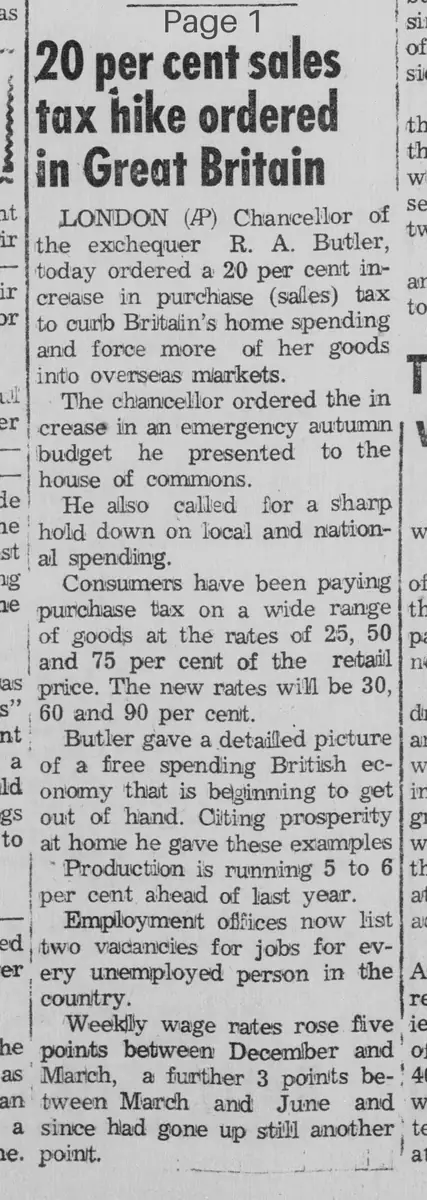
LONDON (AP) Chancellor of the exchequer R. A. Butler, today ordered a 20 per cent increase in purchase (sales) tax to curb Britain's home spending and force more of her goods into overseas markets.
The chancellor ordered the increase in an emergency autumn budget he presented to the house of commons.
He also called for a sharp hold down on local and national spending.
Consumers have been paying purchase tax on a wide range of goods at the rates of 25, 50 and 75 per cent of the retail price. The new rates will be 30, 60 and 90 per cent
Butler gave a detailed picture of a free spending British economy that is beginning to get out of hand. Citing prosperity at home he gave these examples
- Production is running 5 to 6 per cent ahead of last year.
Employment offices now list two vacancies for jobs for every unemployed person in the country.
Weekly wage rates rose five points between December and March, a further 3 points between March and June and since had gone up still another point.
What sub-type of article is it?
What keywords are associated?
What entities or persons were involved?
Where did it happen?
Foreign News Details
Primary Location
London
Key Persons
Outcome
purchase tax rates increased from 25, 50, and 75 per cent to 30, 60, and 90 per cent; sharp hold down on local and national spending called for.
Event Details
Chancellor of the exchequer R. A. Butler ordered a 20 per cent increase in purchase tax to curb Britain's home spending and force more goods into overseas markets, presented in an emergency autumn budget to the house of commons. He described a free spending economy with production 5 to 6 per cent ahead of last year, two job vacancies per unemployed person, and weekly wage rates rising five points December to March, three points March to June, and another point since.