Thank you for visiting SNEWPapers!
Sign up free
The New Hampshire Gazette And Historical Chronicle
Portsmouth, Greenland, Rockingham County, New Hampshire
What is this article about?
London, December 15: Transcript of Edmund Burke's speech in the Robinhood Society on November 27 criticizing the Attorney General's power to file official informations as unconstitutional and abused, especially in Almon's case, with replies from Attorney-General DeGrey defending the prosecution.
Merged-components note: These two components form a single continuous article transcribing Mr. E-d B-r-ke's speech and related replies in the Robinhood Society.
Clipping
OCR Quality
Full Text
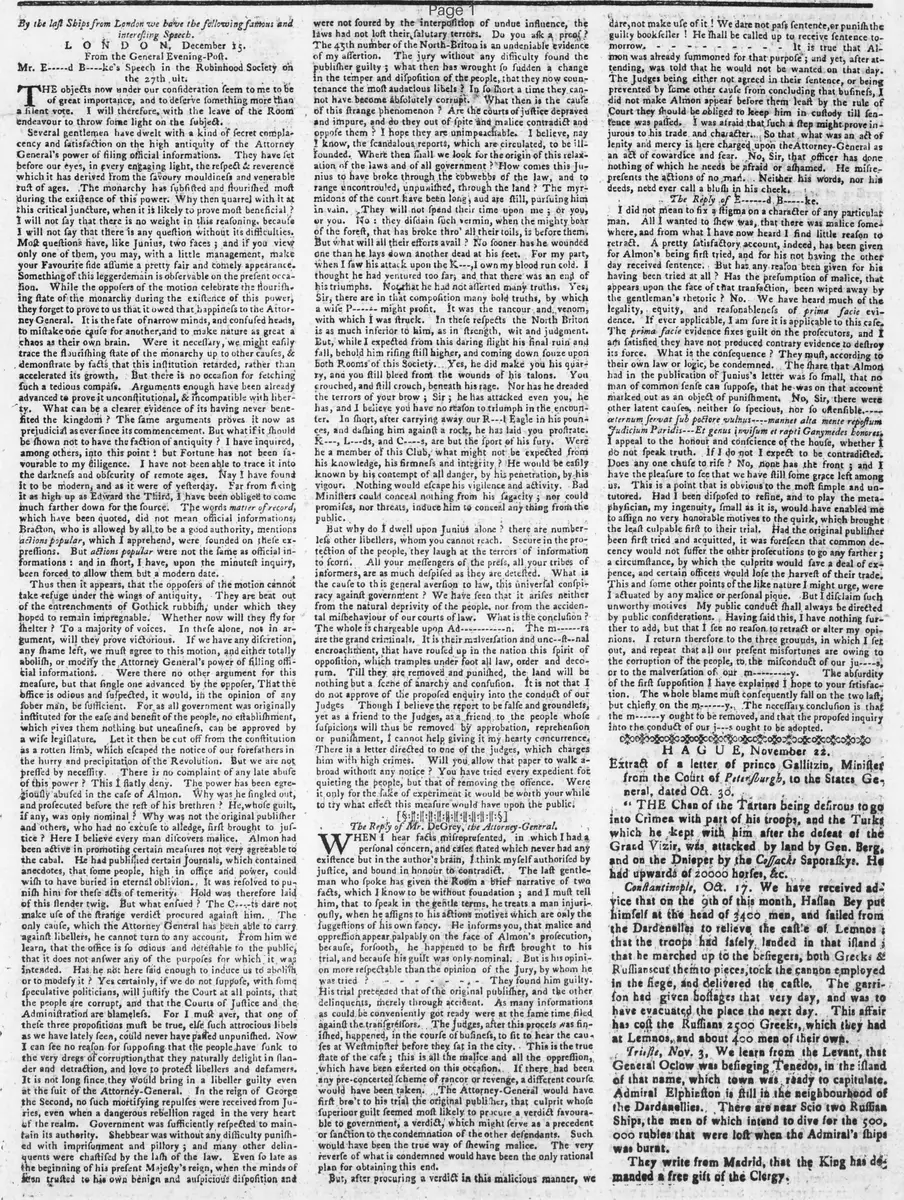
LONDON. December 15.
From the General Evening-Post.
Mr. E-d B-r-ke's Speech in the Robinhood Society on the 27th ult.
The objects now under our consideration seem to me to be of great importance, and to deserve something more than a silent vote. I will therefore, with the leave of the Room, endeavour to throw some light on the subject.
Several gentlemen have dwelt with a kind of secret complacency and satisfaction on the high antiquity of the Attorney General's power of filing official informations. They have set before our eyes, in every engaging light, the respect & reverence which it has derived from the hoary mouldiness and venerable rust of ages. The monarchy has subsisted and flourished most during the existence of this power. Why then quarrel with it at this critical juncture, when it is likely to prove most beneficial?
I will not say that there is no weight in this reasoning, because I will not say that there is any question without its difficulties. Most questions have, like Janus, two faces; and if you view only one of them, you may, with a little management, make your favourite side assume a pretty fair and comely appearance.
Something of this legerdemain is observable on the present occasion. While the opposers of the motion celebrate the flourishing state of the monarchy during the existence of this power they forget to prove to us that it owed that happiness to the Attorney General. It is the fate of narrow minds, and confused heads, to mistake one cause for another, and to make nature as great a chaos as their own brain. Were it necessary, we might easily trace the flourishing state of the monarchy up to other causes, & demonstrate by facts that this institution retarded, rather than accelerated its growth. But there is no occasion for fetching such a tedious compass. Arguments enough have been already advanced to prove it unconstitutional, & incompatible with liberty. What can be a clearer evidence of its having never benefited the kingdom? The same arguments prove it now as prejudicial as ever since its commencement. But what if it should be shown not to have the sanction of antiquity? I have inquired, among others, into this point: but Fortune has not been favourable to my diligence. I have not been able to trace it into the darkness and obscurity of remote ages. Nay I have found it to be modern; and as it were of yesterday. Far from fixing it as high up as Edward the Third, I have been obliged to come much farther down for the source. The words matter of record, which have been quoted, did not mean official informations.
Bracton, who is allowed by all to be a good authority, mentions actions popular, which I apprehend, were founded on these expressions. But actions popular were not the same as official informations: and in short, I have, upon the minutest inquiry, been forced to allow them but a modern date.
Thus then it appears, that the opposers of the motion cannot take refuge under the wings of antiquity. They are beat out of the entrenchments of Gothick rubbish; under which they hoped to remain impregnable. Whether now will they fly for shelter? To a majority of voices. In these alone, not in argument, will they prove victorious. If we have any discretion, any shame left, we must agree to this motion, and either totally abolish, or modify the Attorney General's power of filing official informations. Were there no other argument for this measure, but that single one advanced by the opposer, That the office is odious and suspected, it would, in the opinion of any sober man, be sufficient. For as all government was originally instituted for the ease and benefit of the people, no establishment, which gives them nothing but uneasiness, can be approved by a wise legislature. Let it then be cut off from the constitution as a rotten limb, which escaped the notice of our forefathers in the hurry and precipitation of the Revolution. But we are not pressed by necessity. There is no complaint of any late abuse of this power? This I flatly deny. The power has been egregiously abused in the case of Almon. Why was he singled out, and prosecuted before the rest of his brethren? He, whose guilt, if any, was only nominal? Why was not the original publisher and others, who had no excuse to allege, first brought to justice? Here I believe every man discovers malice. Almon had been active in promoting certain measures not very agreeable to the cabal. He had published certain Journals, which contained anecdotes, that some people, high in office and power, could wish to have buried in eternal oblivion. It was resolved to punish him for these acts of temerity. Hold was therefore laid of this slender twig. But what ensued? The Cr-fts dare not make use of the strange verdict procured against him. The only cause, which the Attorney General has been able to carry against libellers, he cannot turn to any account. From him we learn, that the office is so odious and detestable to the public, that it does not answer any of the purposes for which it was intended. Has he not here said enough to induce us to abolish or to modify it? Yes certainly, if we do not suppose, with some speculative politicians, who will justify the Court at all points, that the people are corrupt, and that the Courts of Justice and the Administration are blameless. For I must aver, that one of these three propositions must be true, else such atrocious libels as we have lately seen, could never have passed unpunished. Now I can see no reason for supposing that the people have sunk to the very dregs of corruption, that they naturally delight in slander and detraction, and love to protect libellers and defamers.
It is not long since, they would bring in a libeller guilty even at the suit of the Attorney-General. In the reign of George the Second, no such mortifying repulses were received from Juries, even when a dangerous rebellion raged in the very heart of the realm. Government was sufficiently respected to maintain its authority. Shebbear was without any difficulty punished with imprisonment and pillory; and many other delinquents were chastised by the lash of the Law. Even so late as the beginning of his present Majesty's reign, when the minds of men trusted to his own benign and auspicious disposition and
were not soured by the interposition of undue influence, the laws had not lost their salutary terrors. Do you ask a proof? The 45th number of the North-Briton is an undeniable evidence of my assertion. The jury without any difficulty found the publisher guilty; what then has wrought so sudden a change in the temper and disposition of the people, that they now countenance the most audacious libels? In so short a time they cannot have become absolutely corrupt. What then is the cause of this strange phenomenon? Are the courts of justice depraved and impure, and do they out of spite and malice contradict and oppose them? I hope they are unimpeachable. I believe, nay I know, the scandalous reports, which are circulated, to be ill-founded. Where then shall we look for the origin of this relaxation of the laws and of all government? How comes this Junius to have broke through the cobwebs of the law, and to range uncontrouled, unpunished, through the land? The myrmidons of the court have been long, and are still, pursuing him in vain. They will not spend their time upon me; or you, or you. No: they disdain such vermin, when the mighty boar of the forest, that has broke thro' all their toils, is before them.
But what will all their efforts avail? No sooner has he wounded one than he lays down another dead at his feet. For my part, when I saw his attack upon the K---, I own my blood run cold. I thought he had ventured too far; and that there was an end of his triumphs. Not that he had not asserted many truths, Yes, Sir, there are in that composition many bold truths, by which a wise P--rs-- might profit. It was the rancour and venom, with which I was struck. In these respects the North Briton is as much inferior to him, as in strength, wit and judgment.
But, while I expected from this daring flight his final ruin and fall, behold him rising still higher, and coming down once upon both Rooms of this Society... Yes, he did make you his quarry, and you still bleed from the wounds of his talons. You crouched, and still crouch, beneath his rage. Nor has he dreaded the terrors of your brow; Sir; he has attacked even you, he has, and I believe you have no reason to triumph in the encounter. In short, after carrying away our R--l Eagle in his pounces, and dashing him against a rock, he has laid you prostrate. K---, L--ds, and C--ts, are but the sport of his fury. Were he a member of this Club, what might not be expected from his knowledge, his firmness and integrity? He would be easily known by his contempt of all danger, by his penetration, by his vigour. Nothing would escape his vigilance and activity. Bad Ministers could conceal nothing from his sagacity; nor could promises, nor threats, induce him to conceal anything from the public.
But why do I dwell upon Junius alone? there are numberless other libellers, whom you cannot reach. Secure in the protection of the people, they laugh at the terrors of information to scorn. All your messengers of the press, all your tribes of informers, are as much despised as they are detested. What is the cause of this general aversion to law, this universal conspiracy against government? We have seen that it arises neither from the natural depravity of the people, nor from the accidental misbehaviour of our courts of law. What is the conclusion? The whole is chargeable upon Ad--n--tration. The m--sters are the grand criminals. It is their malversation and unconst-tutional encroachments, that have roused up in the nation this spirit of opposition, which tramples under foot all law, order and decorum. Till they are removed and punished, the land will be nothing but a scene of anarchy and confusion. It is not that I do not approve of the proposed enquiry into the conduct of our Judges Though I believe the report to be false and groundless, yet as a friend to the Judges, as a friend to the people whose suspicions will thus be removed by approbation, reprehension or punishment, I cannot help giving it my hearty concurrence.
There is a letter directed to one of the judges, which charges him with high crimes. Will you allow that paper to walk abroad without any notice? You have tried every expedient for quieting the people, but that of removing the offence. Were it only for the sake of experiment it would be worth your while to try what effect this measure would have upon the public!
The Reply of Mr. DeGrey, the Attorney-General.
When I hear facts misrepresented, in which I had a personal concern, and cases stated which never had any existence but in the author's brain, I think myself authorised by justice, and bound in honour to contradict. The last gentleman who spoke has given the Room a brief narrative of two facts, which I know to be without foundation; and I must tell him, that to speak in the gentlest terms, he treats a man injuriously, when he assigns to his actions motives which are only the suggestions of his own fancy. He informs you, that malice and oppression appear palpably on the face of Almon's prosecution, because, forsooth, he happened to be first brought to his trial, and because his guilt was only nominal: But is his opinion more respectable than the opinion of the Jury, by whom he was tried They found him guilty.
His trial preceded that of the original publisher, and the other delinquents, merely through accident. As many informations as could be conveniently got ready were at the same time filed against the transgressors. The judges, after this process was finished, happened, in the course of business, to sit to hear the causes at Westminster before they sat in the city. This is the true state of the case; this is all the malice and all the oppression, which have been exerted on this occasion. If there had been any pre-concerted scheme of rancor or revenge, a different course would have been taken. The Attorney-General would have first bro't to his trial the original publisher, that culprit whose superior guilt seemed most likely to procure a verdict favourable to government, a verdict, which might serve as a precedent or sanction to the condemnation of the other defendants. Such would have been the true way of shewing malice. The very reverse of what is condemned would have been the only rational plan for obtaining this end.
But, after procuring a verdict in this malicious manner, we dare not make use of it! We dare not pass sentence, or punish the guilty bookseller! He shall be called up to receive sentence to-morrow.
It is true that Almon was already summoned for that purpose; and yet, after attending, was told that he would not be wanted on that day. The Judges being either not agreed in their sentence, or being prevented by some other cause from concluding that business, I did not make Almon appear before them lest by the rule of Court they should be obliged to keep him in custody till sentence was passed. I was afraid that such a step might prove injurious to his trade, and character. So that what was an act of lenity and mercy is here charged upon the Attorney-General as an act of cowardice and fear. No, Sir, that officer has done nothing of which he needs be afraid or ashamed. He misrepresents the actions of no man. Neither his words, nor his deeds, need ever call a blush in his cheek.
The Reply of E--d B-r-ke
I did not mean to fix a stigma on a character of any particular man. All I wanted to shew was, that there was malice somewhere, and from what I have now heard I find little reason to retract. A pretty satisfactory account, indeed, has been given for Almon's being first tried, and for his not having the other day received sentence. But has any reason been given for his having been tried at all? Has the presumption of malice, that appears upon the face of that transaction, been wiped away by the gentleman's rhetoric? No. We have heard much of the legality, equity, and reasonableness of prima facie evidence. If ever applicable, I am sure it is applicable to this case. The prima facie evidence fixes guilt on the prosecutors, and I am satisfied they have not produced contrary evidence to destroy its force. What is the consequence? They must, according to their own law or logic, be condemned. The share that Almon had in the publication of Junius's letter was so small, that no man of common sense can suppose, that he was on that account marked out as an object of punishment. No, Sir, there were other latent causes, neither so specious, nor so ostensible.---
ceternum servat ubi poetare vulnus----manet alta mente repositum
Judicium Paridis---Et genus invium et rapti Ganymedes honores
I appeal to the honour and conscience of the house, whether I do not speak truth. If I do not I expect to be contradicted. Does any one chuse to rise? No, none has that front; and I have the pleasure to see that we have still some grace left among us. This is a point that is obvious to the most simple and untutored. Had I been disposed to refine, and to play the metaphysician, my ingenuity, small as it is, would have enabled me to assign no very honourable motives to the quirk, which brought the least culpable first to their trial. Had the original publisher been first tried and acquitted, it was foreseen that common decency would not suffer the other prosecutions to go any farther; a circumstance, by which the culprits would save a deal of expense, and certain officers would lose the harvest of their trade.
This and some other points of the like nature I might urge, were I actuated by any malice or personal pique. But I disclaim such unworthy motives My public conduct shall always be directed by public considerations. Having said this, I have nothing further to add, but that I see no reason, to retract or alter my opinions. I return therefore to the three grounds, in which I set out, and repeat that all our present misfortunes are owing to the corruption of the people, to, the misconduct of our ju----s, or to the malversation of our m--r--stry.
The absurdity of the first supposition I have explained I hope to your satisfaction. The whole blame must consequently fall on the two last. but chiefly on the m-----y. The necessary conclusion is that the m------y ought to be removed, and that the proposed inquiry into the conduct of our j---s ought to be adopted.
What sub-type of article is it?
What keywords are associated?
What entities or persons were involved?
Where did it happen?
Foreign News Details
Primary Location
London
Event Date
27th Ult. (Reported December 15)
Key Persons
Outcome
calls to abolish or modify the attorney general's power of filing official informations; almon to receive sentence tomorrow; debate highlights alleged abuses and public discontent with administration.
Event Details
Edmund Burke argues against the antiquity and constitutionality of the Attorney General's power to file official informations, citing abuse in prosecuting bookseller Almon for publishing Junius letters, blaming ministerial corruption for public resistance to government prosecutions. Attorney-General DeGrey defends the prosecution as accidental and not malicious, announcing Almon's impending sentencing. Burke replies insisting on underlying malice and need for ministerial removal and judicial inquiry.