Thank you for visiting SNEWPapers!
Sign up free
Norfolk Gazette And Publick Ledger
Norfolk, Virginia
What is this article about?
The Treaty of Tilsit, signed on July 7, 1807, between Napoleon I of France and Alexander I of Russia, establishes peace, restores Prussian territories, creates the Duchy of Warsaw under Saxony, restores Danzig's independence, and includes mutual recognitions and territorial adjustments in Europe.
Clipping
OCR Quality
Full Text
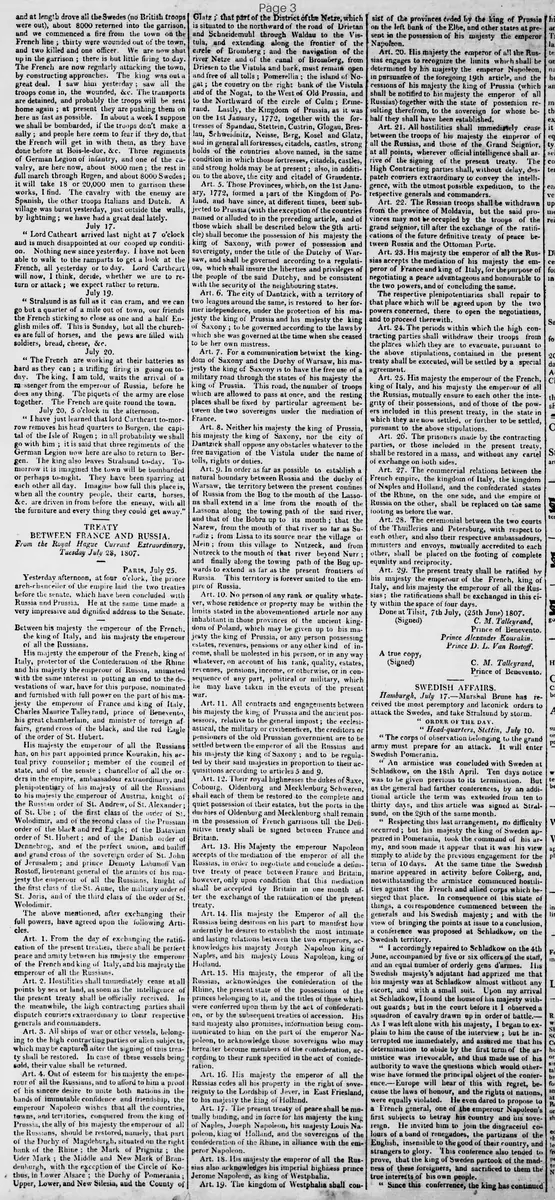
From the Royal Hague Courant Extraordinary, Tuesday July 28, 1807.
Paris, July 25.
Yesterday afternoon, at four o'clock, the prince arch-chancellor of the empire laid the two treaties before the senate, which have been concluded with Russia and Prussia. He at the same time made a very impressive and dignified address to the Senate.
Between his majesty the emperor of the French, the king of Italy, and his majesty the emperor of all the Russians.
His majesty the emperor of the French, king of Italy, protector of the Confederation of the Rhine and his majesty the emperor of Russia, animated with the same interest in putting an end to the devastations of war, have for this purpose, nominated and furnished with full power on the part of his majesty the emperor of France and king of Italy. Charles Maurice Talleyrand, prince of Benevento, his great chamberlain, and minister of foreign affairs, grand cross of the black, and the red Eagle of the order of St. Hubert.
His majesty the emperor of all the Russians has, on his part appointed prince Kourakin, his actual privy counsellor; member of the council of state, and of the senate; chancellor of all the orders in the empire, ambassador extraordinary, and plenipotentiary of his majesty of all the Russians to his majesty the emperor of Austria, knight of the Russian order of St. Andrew, of St. Alexander; of St. Vladimir; of the first class of the order of St. Wolodimir, and of the second class of the Prussian order of the black and red Eagle; of the Batavian order of St. Hubert; and of the Danish order of Dennebrog, and of the perfect union, and bailiff and grand cross of the sovereign order of St. John of Jerusalem; and prince Demetrius Labanof Van Rostoff, lieutenant general of the armies of his majesty the emperor of all the Russians, knight of the first class of the St. Anne, the military order of St. George, and of the third class of the order of St. Wolodimir.
The above mentioned, after exchanging their full powers, have agreed upon the following Articles.
Art. 1. From the day of exchanging the ratification of the present treaties, there shall be perfect peace and amity between his majesty the emperor of the French and king of Italy, and his majesty the emperor of all the Russians.
Art. 2. Hostilities shall immediately cease at all points by sea or land, as soon as the intelligence of the present treaty shall be officially received. In the meanwhile, the high contracting parties shall dispatch couriers extraordinary to their respective generals and commanders.
Art. 3. All ships of war or other vessels, belonging to the high contracting parties or their subjects, which may be captured after the signing of this treaty shall be restored. In case of these vessels being sold, their value shall be returned.
Art. 4. Out of esteem for his majesty the emperor of all the Russians, and to afford to him a proof of his sincere desire to unite both nations in the bands of immutable confidence and friendship, the emperor Napoleon wishes that all the countries, towns, and territories, conquered from the king of Prussia, the ally of his majesty the emperor of all the Russians, should be restored, namely, that part of the Duchy of Magdeburg, situated on the right bank of the Rhine; the Mark of Prignitz; the Uder Mark; the Middle and New Mark of Brandenburg, with the exception of the Circle of Kolmar, in Lower Alsace; the Duchy of Pomerania; Upper, Lower, and New Silesia, and the County of Glatz; that part of the District of the Netze, which is situated to the northward of the road of Driesen and Schneidemuhl through Waldau to the Vistula, and extending along the frontier of the circle of Bromberg; and the navigation of the river Netze and of the canal of Bromberg, from Driesen to the Vistula and back, must remain open and free of all tolls; Pomerellia; the island of Nogal; the country on the right bank of the Vistula and of the Nogat, to the West of Old Prussia, and to the Northward of the circle of Culm; Ermeland. Lastly, the Kingdom of Prussia, as it was on the 1st January, 1772, together with the fortresses of Spandau, Stettin, Custrin, Glogau, Breslau, Schweidnitz, Neisse, Graudenz, Kosel and Glatz, and in general all fortresses; citadels, castles, strong holds of the countries above named, in the same condition in which those fortresses, citadels, castles, and strong holds may be at present; also, in addition to the above, the city and citadel of Graudenz.
Art. 5. Those Provinces, which, on the 1st January, 1772, formed a part of the Kingdom of Poland, and have since, at different times, been subjected to Prussia (with the exception of the countries named or alluded to in the preceding article, and of those which shall be described below the 9th article) shall become the possession of his majesty the king of Saxony, with power of possession and sovereignty, under the title of the Duchy of Warsaw, and shall be governed according to a regulation, which shall insure the liberties and privileges of the people of the said Duchy, and be consistent with the security of the neighbouring states.
Art. 6. The city of Dantzick, with a territory of two leagues around the same, is restored to her former independence, under the protection of his majesty the king of Prussia and his majesty the king of Saxony; to be governed according to the laws by which she was governed at the time when she ceased to be her own mistress.
Art. 7. For a communication betwixt the kingdom of Saxony and the Duchy of Warsaw, his majesty the king of Saxony is to have the free use of a military road through the states of his majesty the king of Prussia. This road, the number of troops which are allowed to pass at once, and the resting places shall be fixed by particular agreement between the two sovereigns under the mediation of France.
Art. 8. Neither his majesty the king of Prussia, his majesty the king of Saxony, nor the city of Dantzick shall oppose any obstacles whatever to the free navigation of the Vistula under the name of tolls, rights or duties.
Art. 9. In order as far as possible to establish a natural boundary between Russia and the duchy of Warsaw, the territory between the present confines of Russia from the Bug to the mouth of the Lassona shall extend in a line from the mouth of the Lassona along the towing path of the said river, and that of the Bobra up to its mouth; that the Narew, from the mouth of that river so far as Surudiz; from Lissa to its source near the village of Mein; from this village to Nutzeck, and from Nutzeck to the mouth of that river beyond Nurr; and finally along the towing path of the Bug upwards to extend as far as the present frontiers of Russia. This territory is forever united to the empire of Russia.
Art. 10. No person of any rank or quality whatever, whose residence or property may be within the limits stated in the abovementioned article nor any inhabitant in those provinces of the ancient kingdom of Poland, which may be given up to his majesty the king of Prussia, or any person possessing estates, revenues, pensions or any other kind of income, shall be molested in his person, or in any way whatever, on account of his rank, quality, estates, revenues, pensions, income, or otherwise, or in consequence of any part, political or military, which he may have taken in the events of the present war.
Art. 11. All contracts and engagements between his majesty the king of Prussia and the ancient possessors, relative to the general impost; the ecclesiastical, the military or civil benefices, the creditors or pensioners of the old Prussian government are to be settled between the emperor of all the Russias and his majesty the king of Saxony; and to be regulated by their said majesties in proportion to their acquisitions according to articles 5 and 9.
Art. 12. Their royal highnesses the dukes of Saxe, Cobourg, Oldenburg and Mecklenburg Schwerin, shall each of them be restored to the complete and quiet possession of their estates, but the ports in the duchies of Oldenburg and Mecklenburg shall remain in the possession of French garrisons till the Definitive treaty shall be signed between France and Britain.
Art. 13. His Majesty the emperor Napoleon accepts of the mediation of the emperor of all the Russias, in order to negotiate and conclude a definitive treaty of peace between France and Britain, however, only upon condition that this mediation shall be accepted by Britain in one month after the exchange of the ratification of the present treaty.
Art. 14. His majesty the Emperor of all the Russias being desirous on his part to manifest how ardently he desires to establish the most intimate and lasting relations between the two emperors, acknowledges his majesty Joseph Napoleon king of Naples, and his majesty Louis Napoleon, king of Holland.
Art. 15. His majesty, the emperor of all the Russias, acknowledges the confederation of the Rhine, the present state of the possessions of the princes belonging to it, and the titles of those which were conferred upon them by the act of confederation, or by the subsequent treaties of accession. His said majesty also promises, information being communicated to him on the part of the emperor Napoleon, to acknowledge those sovereigns who may hereafter become members of the confederation, according to their rank specified in the act of confederation.
Art. 16. His majesty the emperor of all the Russias cedes all his property in the right of sovereignty to the Lordship of Jever, in East Friesland, to his majesty the king of Holland.
Art. 17. The present treaty of peace shall be mutually binding, and in force for his majesty the king of Naples, Joseph Napoleon, his majesty Louis Napoleon, king of Holland, and the sovereigns of the confederation of the Rhine, in alliance with the emperor Napoleon.
Art. 18. His majesty the emperor of all the Russias also acknowledges his imperial highness prince Jerome Napoleon, as king of Westphalia.
Art. 19. The kingdom of Westphalia shall consist of the provinces ceded by the king of Prussia on the left bank of the Elbe, and other states at present in the possession of his majesty the emperor Napoleon.
Art. 20. His majesty the emperor of all the Russias engages to recognize the limits which shall be determined by his majesty the emperor Napoleon, in pursuance of the foregoing 19th article, and the cessions of his majesty the king of Prussia (which shall be notified to his majesty the emperor of all Russias)-together with the state of possession resulting therefrom, to the sovereign or whose behalf they shall have been established.
Art. 21. All hostilities shall immediately cease between the troops of his majesty the emperor of all the Russias, and those of the Grand Seignior, at all points, wherever official intelligence shall arrive of the signing of the present treaty. The High Contracting parties shall, without delay, dispatch couriers extraordinary to convey the intelligence, with the utmost possible expedition, to the respective generals and commanders.
Art. 22. The Russian troops shall be withdrawn from the province of Moldavia, but the said provinces may not be occupied by the troops of the grand seignior, till after the exchange of the ratifications of the future definitive treaty of peace between Russia and the Ottoman Porte.
Art. 23. His majesty the emperor of all the Russias accepts the mediation of his majesty the emperor of France and king of Italy, for the purpose of negotiating a peace advantageous and honourable to the two powers, and of concluding the same. The respective plenipotentiaries shall repair to that place which will be agreed upon by the two powers concerned, there to open the negotiations, and to proceed therewith.
Art. 24. The periods within which the high contracting parties shall withdraw their troops from the places which they are to evacuate, pursuant to the above stipulations, contained in the present treaty shall be executed, will be settled by a special agreement.
Art. 25. His majesty the emperor of the French, king of Italy, and his majesty the emperor of all the Russias, mutually ensure to each other the integrity of their possessions, and of those of the powers included in this present treaty, in the state in which they are now settled, or further to be settled, pursuant to the above stipulations.
Art. 26. The prisoners made by the contracting parties, or those included in the present treaty, shall be restored in a mass, and without any cartel of exchange on both sides.
Art. 27. The commercial relations between the French empire, the kingdom of Italy, the kingdom of Naples and Holland, and the confederated states of the Rhine, on the one side, and the empire of Russia on the other, shall be replaced on the same footing as before the war.
Art. 28. The ceremonial between the two courts of the Tuilleries and Petersburg, with respect to each other, and also their respective ambassadors, ministers and envoys, mutually accredited to each other, shall be placed on the footing of complete equality and reciprocity.
Art. 29. The present treaty shall be ratified by his majesty the emperor of the French, king of Italy, and his majesty the emperor of all the Russias; the ratifications shall be exchanged in this city within the space of four days.
Done at Tilsit, 7th July, (25th June) 1807.
(Signed) C. M. Talleyrand, Prince of Benevento. Prince Alexander Kourakin. Prince D. L. Van Rostoff.
A true copy,
(Signed) C. M. Talleyrand, Prince of Benevento.
What sub-type of article is it?
What keywords are associated?
What entities or persons were involved?
Where did it happen?
Foreign News Details
Primary Location
Tilsit
Event Date
7th July, (25th June) 1807
Key Persons
Outcome
peace and amity established; hostilities cease; restoration of prussian territories to pre-1772 status; creation of duchy of warsaw under saxony; danzig restored to independence; territorial gains for russia; recognitions of napoleonic kingdoms and confederation of the rhine; mediation offers for peace with britain and ottoman empire; prisoner exchange; restoration of commercial relations.
Event Details
The Treaty of Tilsit between France and Russia ends hostilities, restores territories conquered from Prussia, assigns former Polish provinces to Saxony as the Duchy of Warsaw, secures Danzig's independence, adjusts borders favoring Russia, ensures free navigation of rivers, provides amnesty for participants in the war, restores estates to German dukes with French garrisons in some ports, accepts mediation for peace with Britain and the Ottomans, acknowledges Napoleonic family kingdoms and the Confederation of the Rhine, creates the Kingdom of Westphalia, and guarantees mutual possessions and equality in diplomatic relations.