Thank you for visiting SNEWPapers!
Sign up free
The New Hampshire Gazette And Historical Chronicle
Portsmouth, Greenland, Rockingham County, New Hampshire
What is this article about?
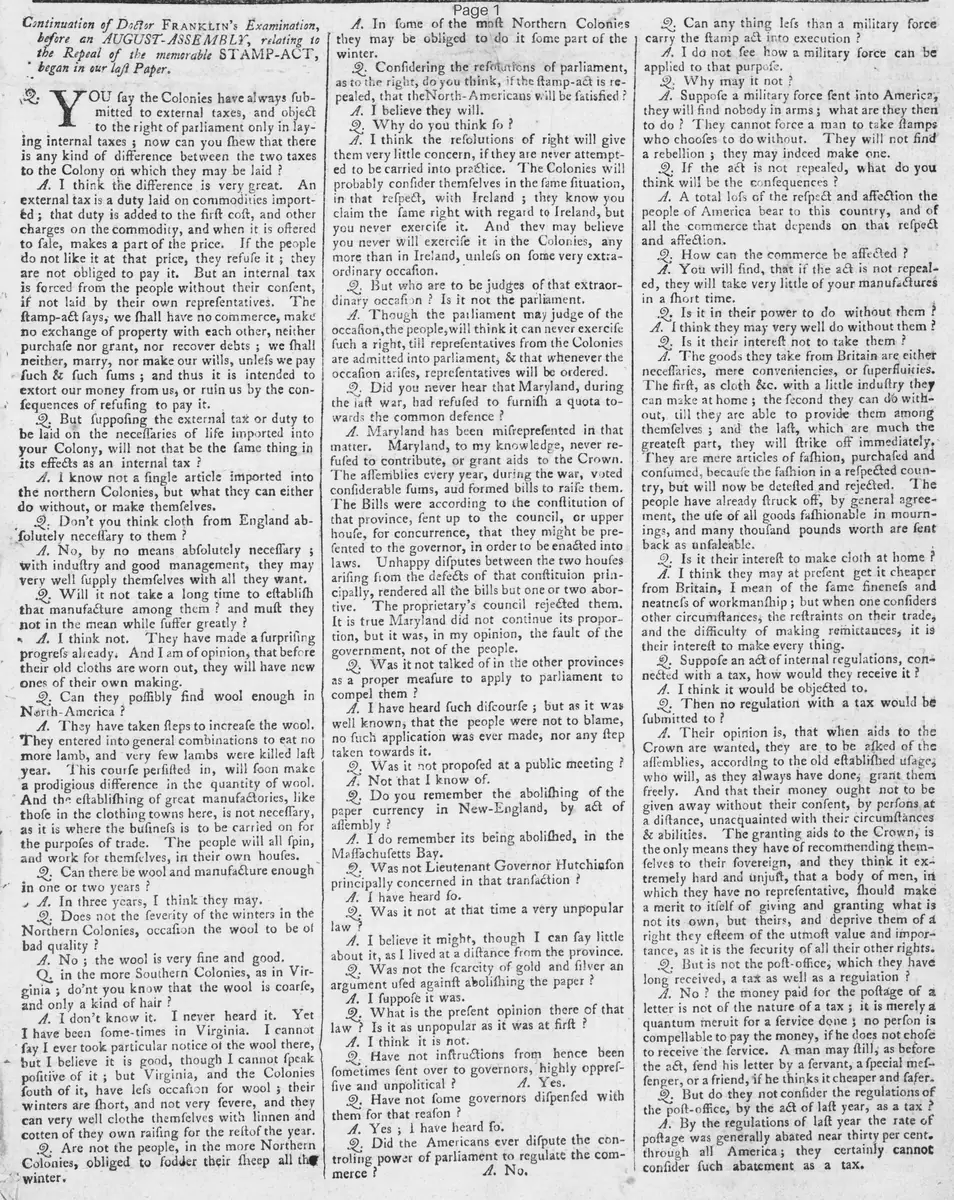
Transcript of Benjamin Franklin's examination before a British parliamentary committee on the Stamp Act repeal, covering differences between external and internal taxes, colonial self-sufficiency in manufacturing, and predicted resistance if the act persists.
Merged-components note: Merged continuation of Doctor Franklin's examination before parliament relating to the Stamp Act.
Clippings
1 of 2
OCR Quality
Full Text
before an AUGUST ASSEMBLY, relating to
the Repeal of the memorable STAMP ACT,
* began in our last Paper.
YOU say the Colonies have always submitted
to external taxes, and object
to the right of parliament only in laying internal taxes; now can you shew that there
is any kind of difference between the two taxes
to the Colony on which they may be laid?
A. I think the difference is very great.
An external tax is a duty laid on commodities imported: that duty is added to the first cost, and other
charges on the commodity, and when it is offered
to sale, makes a part of the price. If the people
do not like it at that price, they refuse it; they
are not obliged to pay it. But an internal tax
is forced from the people without their consent,
if not laid by their own representatives.
The
stamp-act says: we shall have no commerce, make
no exchange of property with each other, neither
purchase nor grant, nor recover debts; we shall
neither marry, nor make our wills, unless we pay
such & such sums: and thus it is intended to
extort our money from us, or ruin us by the consequences of refusing to pay it.
Q. But supposing the external tax or duty to
be laid on the necessaries of life imported into
your Colony, will not that be the same thing in
its effects as an internal tax?
A. I know not a single article imported into
the northern Colonies, but what they can either
do without, or make themselves.
Q. Don't you think cloth from England absolutely necessary to them?
A. No, by no means absolutely necessary;
with industry and good management, they may
very well supply themselves with all they want.
Q. Will it not take a long time to establish
that manufacture among them? and must they
not in the mean while suffer greatly?
A. I think not. They have made a surprising
progress already. And I am of opinion, that before
their old cloths are worn out, they will have new
ones of their own making.
Q. Can they possibly find wool enough in
North-America?
A. They have taken steps to increase the wool.
They entered into general combinations to eat no
more lamb, and very few lambs were killed last
year. This course persisted in, will soon make
a prodigious difference in the quantity of wool.
And the establishing of great manufactories, like
those in the clothing towns here, is not necessary,
as it is where the business is to be carried on for
the purposes of trade. The people will all spin,
and work for themselves, in their own houses.
Q. Can there be wool and manufacture enough
in one or two years?
A. In three years, I think they may.
Q. Does not the severity of the winters in the
Northern Colonies, occasion the wool to be of
bad quality?
A. No; the wool is very fine and good.
Q. in the more Southern Colonies, as in Virginia; don't you know that the wool is coarse,
and only a kind of hair?
A. I don't know it. I never heard it. Yet
I have been some-times in Virginia. I cannot
say I ever took particular notice of the wool there,
but I believe it is good, though I cannot speak
positive of it; but Virginia, and the Colonies
south of it, have less occasion for wool; their
winters are short, and not very severe, and they
can very well clothe themselves with linen and
cotton of their own raising for the rest of the year.
Q. Are not the people, in the more Northern
Colonies, obliged to fodder their sheep all the
winter.
A. In some of the most Northern Colonies
they may be obliged to do it some part of the
winter.
Q. Considering the resolutions of parliament,
as to the right, do you think, if the stamp-act is repealed, that the North-Americans will be satisfied?
A. I believe they will.
Q. Why do you think so?
A. I think the resolutions of right will give
them very little concern, if they are never attempted to be carried into practice. The Colonies will
probably consider themselves in the same situation,
in that respect, with Ireland; they know you
claim the same right with regard to Ireland, but
you never exercise it. And they may believe
you never will exercise it in the Colonies, any
more than in Ireland, unless on some very extraordinary occasion.
Q. But who are to be judges of that extraordinary occasion? Is it not the parliament.
A. Though the parliament may judge of the
occasion, the people, will think it can never exercise
such a right, till representatives from the Colonies
are admitted into parliament, & that whenever the
occasion arises, representatives will be ordered.
Q. Did you never hear that Maryland, during
the last war, had refused to furnish a quota towards the common defence?
A. Maryland has been misrepresented in that
matter.
Maryland, to my knowledge, never refused to contribute, or grant aids to the Crown.
The assemblies every year, during the war, voted
considerable sums, and formed bills to raise them.
The Bills were according to the constitution of
that province, sent up to the council, or upper
house. for concurrence, that they might be presented to the governor, in order to be enacted into
laws.
Unhappy disputes between the two houses
arising from the defects of that constitution principally, rendered all the bills but one or two abortive.
The proprietary's council rejected them.
It is true Maryland did not continue its proportion, but it was, in my opinion, the fault of the
government, not of the people.
Q: Was it not talked of in the other provinces
as a proper measure to apply to parliament to
compel them?
A. I have heard such discourse; but as it was
well known, that the people were not to blame,
no such application was ever made, nor any step
taken towards it.
Q. Was it not proposed at a public meeting?
A. Not that I know of.
Q. Do you remember the abolishing of the
paper currency in New-England, by act of
assembly?
A. I do remember its being abolished, in the
Massachusetts Bay.
Q. Was not Lieutenant Governor Hutchinson
principally concerned in that transaction?
A. I have heard so.
2.
Was it not at that time a very unpopular
law
A. I believe it might, though I can say little
about it, as I lived at a distance from the province.
Q. Was not the scarcity of gold and silver an
argument used against abolishing the paper?
A. I suppose it was.
Q. What is the present opinion there of that
law? Is it as unpopular as it was at first?
A. I think it is not.
Q. Have not instructions from hence been
sometimes sent over to governors, highly oppressive and unpolitical?
A. Yes.
Q. Have not some governors dispensed with
them for that reason?
A. Yes; I have heard so.
Q. Did the Americans ever dispute the controlling power of parliament to regulate the commerce?
A. No.
Q. Can any thing less than a military force
carry the stamp act into execution?
A. I do not see how a military force can be
applied to that purpose.
Q. Why may it not?
A. Suppose a military force sent into America.
They will find nobody in arms; what are they then
to do? They cannot force a man to take stamps
who chooses to do without. They will not find
a rebellion; they may indeed make one.
Q. If the act is not repealed, what do you
think will be the consequences?
A. A total loss of the respect and affection the
people of America bear to this country, and of
all the commerce that depends on that respect
and affection.
Q. How can the commerce be affected?
A. You will find, that if the act is not repealed, they will take very little of your manufactures
in a short time.
Q. Is it in their power to do without them
A. I think they may very well do without them.
Q. Is it their interest not to take them?
A. The goods they take from Britain are either
necessaries, mere conveniences. or superfluities.
The first, as cloth &c. with a little industry they
can make at home; the second they can do without, till they are able to provide them among
themselves; and the last, which are much the
greatest part, they will strike off immediately.
They are mere articles of fashion, purchased and
consumed, because the fashion in a repeated country, but will now be detested and rejected. The
people have already struck off, by general agreement, the use of all goods fashionable in mournings, and many thousand pounds worth are sent
back as unsaleable.
Q. Is it their interest to make cloth at home?
A. I think they may at present get it cheaper
from Britain, I mean of the same fineness and
neatness of workmanship; but when one considers
other circumstances, the restraints on their trade,
and the difficulty of making remittances, it is
their interest to make every thing.
Q. Suppose an act of internal regulations, connected with a tax, how would they receive it?
A. I think it would be objected to.
Q. Then no regulation with a tax would be
submitted to?
A. Their opinion is, that when aids to the
Crown are wanted, they are to be asked of the
assemblies, according to the old established usage
who will, as they always have done; grant them
freely. And that their money ought not to be
given away without their consent, by persons at
a distance, unacquainted with their circumstances
& abilities. The granting aids to the Crown, is
the only means they have of recommending themselves to their sovereign, and they think it extremely hard and unjust, that a body of men, in
which they have no representative, should make
a merit to itself of giving and granting what is
not its own, but theirs, and deprive them of a
right they esteem of the utmost value and importance, as it is the security of all their other rights.
Q. But is not the post-office, which they have
long received, a tax as well as a regulation?
A. No; the money paid for the postage of a
letter is not of the nature of a tax; it is merely a
quantum meruit for a service done; no person is
compellable to pay the money, if he does not choose
to receive the service. A man may still; as before
the act, send his letter by a servant, a special messenger, or a friend, if he thinks it cheaper and safer.
Q. But do they not consider the regulations of
the post-office, by the act of last year, as a tax?
A. By the regulations of last year the rate of
postage was generally abated near thirty per cent.
through all America; they certainly cannot
consider such abatement as a tax.
Q. If an excise was laid by parliament, which they might likewise avoid paying, by not consuming the article exciled, would they then not object to it?
A. They would certainly object to it, as an excise unconnected with any service done, and is merely an aid which they think ought to be asked of them, and granted by them, if they are to pay it, and can be granted for them by no others whatsoever, whom they have not impowered for that purpose.
Q. You say they do not object to the right of parliament in laying duties on goods to be paid on their importation: now, is there any kind of difference between a duty on the importation of goods, and an excise on their consumption?
A. Yes; a very material one; an excise, for the reasons I have just mentioned, they think you can have no right to lay within their country. But the sea is yours; you maintain, by your fleets, the safety of navigation in it; and keep it clear of pirates; you may have therefore a natural and equitable right to some toll or duty on merchandizes carried throughout that part of your dominions, towards defraying the expence you are at in ships to maintain the safety of that carriage.
Q. Does this reasoning hold in the case of a duty laid on the produce of their lands exported? and would they not then object to such a duty?
A. If it tended to make the produce so much dearer abroad as to lessen the demand for it, to be sure they would object to such a duty; not to your right of laying it, but they would complain of it as a burthen, and petition you to lighten it.
Q. Is not the duty paid on the tobacco exported a duty of that kind?
A. That, I think, is only on tobacco carried coastwise from one Colony to another, and appropriated as a fund for supporting the college at Williamsburg, in Virginia.
Q. Have not the assemblies in the West-Indies the same natural rights with those in North-America?
A. Undoubtedly.
Q. And is there not a tax laid on their sugars exported?
A. I am not much acquainted with the West-Indies, but the duty of four and a half per cent. on sugars exported, was, I believe, granted by their own assemblies.
Q. How much is the poll-tax in your province laid on unmarried men?
A. It is, I think, Fifteen Shillings, to be paid by every single freeman, upwards of twenty-one years old.
Q. What is the annual amount of all the taxes in Pennsylvania?
A. I suppose about 20,000 Pounds sterling.
Q. Supposing the stamp act continued, and enforced, do you imagine that ill humour will induce the Americans to give as much for worse manufactures of their own, and use them, preferable to better of ours?
A. Yes I think so. People will pay as freely to gratify one passion as another, their resentment as their pride.
Q. Would the people at Boston discontinue their trade?
A. The merchants are a very small number, compared with the body of the people, and must discontinue their trade, if nobody will buy their goods.
Q. What are the body of the people in the Colonies?
A. They are farmers, husbandmen or planters.
Q. Would they suffer the produce of their lands to rot?
A. No; but they would not raise so much. They would manufacture more, and plough less.
Q. Would they live without the administration of justice in civil matters, and suffer all the inconveniencies of such a situation for any considerable time, rather than take the stamps, supposing the stamps, were protected by a sufficient force, where every one might have them?
A. I think the supposition impracticable, that the stamps should be so protected as that every one might have them. The act requires sub-distributors to be appointed in every county town, district and village, and they would be necessary. But the principal distributors, who were to have had a considerable profit on the whole, have not thought it worth while to continue in the office, and I think it impossible to find sub-distributors fit to be trusted, who, for the trifling profit that must come to their share, would incur the odium,
and run the hazard that would attend it: and if they could be found, I think it impracticable to protect the stamps in so many distant and remote places.
Q. But in places where they could be protected, would not the people use them rather than remain in such a situation, unable to obtain any right, or recover, by law, any debt?
A. It is hard to say, what they would do. I can only judge what other people will think, and how they will act, by what I feel within myself. I have a great many debts due to me in America, and I had rather they should remain unrecoverable by any law, than submit to the Stamp-Act. They will be debts of honour. It is my opinion the people will either continue in that situation, or find some way to extricate themselves, perhaps by generally agreeing to proceed in the courts without stamps.
Q. What do you think a sufficient military force to protect the distribution of the stamps in every part of America.
A. A very great force: I can't say what, if the disposition of America is for a general resistance.
Q. What is the number of men in America able to bear arms, or of disciplined militia?
A. There are, I suppose, at least--
[Question objected to. He withdrew. Called in again.]
Q. Is the American Stamp-Act an equal tax on that country?
A. I think not.
Q. Why so?
A. The greatest part of the money must arise from law suits for the recovery of debts, and be paid by the lower sort of people, who were too poor easily to pay their debts. It is therefore a heavy tax on the poor, & a tax upon them for being poor.
Q. But will not this increase of expence be a means of lessening the number of law suits.
A. I think not; for as the costs all fall upon the debtor, and are to be paid by him, they would be no discouragement to the creditor to bring his action.
Q. Would it not have the effect of excessive usury
A. Yes, as an oppression of the debtor.
Q. How many ships are there laden annually in North-America with flax-seed for Ireland?
A. I cannot speak to the number of ships, but I know that in 1752, 10,000 hogsheads of flax-seed, each containing 7 bushels, were exported from Philadelphia to Ireland. I suppose the quantity is greatly increased since that time; and it is understood that the exportation from New-York is equal to that from Philadelphia.
Q. What becomes of the flax that grows with that flaxseed?
A. They manufacture some into coarse, and some into a middling kind of linen.
Q. Are there any fulling mills in America?
A. I think there are, but I believe only one at present employed. I suppose they will all be set to work, if the interruption of the trade continues.
Q. Are there any fulling mills there?
A. A great many.
Q. Did you never hear that a great quantity of stockings were contracted for, for the army during the war, and manufactured at Philadelphia?
A. I have heard so.
Q. If the Stamp-Act should be repealed, would not the Americans think they could oblige the parliament to repeal every external tax law now in force?
A. It is hard to answer questions of what people at such a distance will think.
Q. But what do you imagine they will think were the motives of repealing the act?
A. I suppose they will think that it was repealed from a conviction of its inexpediency; and they will rely upon it, that while the same inexpediency subsists, you will never attempt to make such another.
Q. What do you mean by its inexpediency?
A. I mean its inexpediency on several accounts; the poverty & inability of those who were to pay the tax; the general discontent it has occasioned, and the impracticability of enforcing it.
[To be continued.]
What sub-type of article is it?
What themes does it cover?
What keywords are associated?
What entities or persons were involved?
Where did it happen?
Story Details
Key Persons
Location
Before An August Assembly
Story Details
Benjamin Franklin testifies on the distinction between external and internal taxes, argues colonies can achieve self-sufficiency in manufacturing, defends colonial rights to consent on taxation, and warns of resistance and loss of affection if the Stamp Act is not repealed.