Thank you for visiting SNEWPapers!
Sign up free
Literary
September 21, 1890
The Cheyenne Daily Leader
Cheyenne, Laramie County, Wyoming
What is this article about?
Farmer Orlando McCusick recounts to Bill Nye the challenges of hosting summer boarders in the Catskills, including city children's mischief with a new milch cow, a pretentious guest Etiquette McCracken, a churchgoer's woes, and an anecdote about Deacon Decker's thumb stuck in a pew.
Merged-components note: Images overlap spatially with the literary piece 'THE OTHER SIDE OF IT' and are in consecutive reading order; merging as illustrations for the article.
Clipping
OCR Quality
65%
Fair
Full Text
THE OTHER SIDE OF IT
A Farmer Tells Bill Nye About Summer Boarders.
Sad Tale of a New Milch Cow—
Boys and Other Things.
Deacon Decker and His Thumb:
Also Jay Gould.
[Copyright by Edgar W. Nye.]
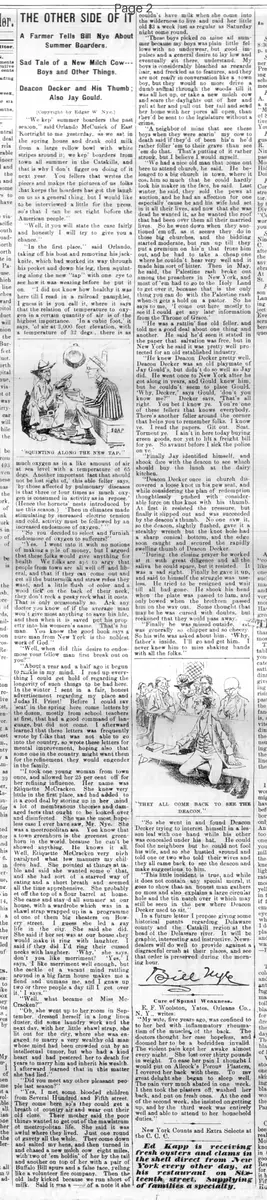
“We kep' summer boarders the past season," said Orlando McCusick of East Kortright to me yesterday, as we sat in the spring house and drank cold milk from a large yellow bowl with white stripes around it; we kep' boarders from town all summer in the Catskills, and that is why I don't figger on doing of it next year. You fellers that writes the pieces and makes the pictures of us folks that keeps the boarders has got the laugh on us as a general thing, but I would like to be interviewed a little for the press, so's that I can be set right bafore the American people."
"Well, if you will state the case fairly and honestly I will try to give you a chance."
“In the first place," said Orlando, taking off his boot and removing his jack-knife, which had worked its way through his pocket and down his leg, then squinting along the new "tap" with one eye to see how it was wearing before he put it on. …"I did not know how healthy it was here till I read in a railroad pamphlet, I guess it is you call it, where it says that the relation of temperature to oxygen in a certain quantity of air is of the highest importance. 'In a cubic foot,' it says, 'of air at 3,000 feet elevation, with a temperature of 32 degs, there is as much oxygen as in a like amount of air at sea level with a temperature of 65 degs. Another important fact that should not be lost sight of,' this able feller says, 'by those affected by pulmonary diseases is that three or four times as much oxygen is consumed in activity as in repose. (Hence the hornets' nests introduced by we this season.) Then in climates made stimulating by increased electric tension and cold, activity must be followed by an increased endosmose of oxygen."
"So you decided to select and furnish endosmose of oxygen to sufferers?"
“…Yes. I went into it with no notions of making a pile of money, but I argued that these folks would give anything for health. We folks are apt to argy that people from town are all well off and liberal, and that if they can come out and get all the buttermilk and straw rides they want, and a little flush of color and a woodtick on the back of their neck, they don't reck a pesky reck what it costs. That is only occasionally so. Ask any doctor you know of if the average man wou't give most anything to save his life, and then when it is saved put his property into his womern's name. That's human. You know the good book says a pure man from New York is the noblest work of God."
"Well, when did this desire to endosmose your fellow man first break out on you?"
"About a year and a half ago it begun to rankle in my mind. I read up everything I could get hold of regarding the longevity of such things to be had here. In the winter I sent in a fair, honest advertisement regarding my place and Judas H. Priest! Before I could say 'scat' in the spring here come letters by the dozen, mostly from school teachers at first, that had a good command of language, but did not come. I afterward learned that these letters was frequently wrote by folks that was not able to go into the country, so wrote these letters for mental improvement, hoping also that some one in the country might want them for the refinement they would engender in the family.
…I took one young woman from town once, and allowed her 25 per cent off for her refining influence. Her name was Etiquette McCracken. She knew very little in the first place, and had added to it a good deal by storing up in her mind a lot of membranous theories and damaged facts that ought to be looked over and disinfected. She was the most hopeless case I ever have saw, Mr. Nye. She was a metropolitan ass. You know that a town greenborn is the greenest greenhorn in the world, because he can't be showed anything. He knows it all.
Well, Etiquette McCracken very pish paralyzed what few manners my children had. She pointed at things at table and said she wanted some o' that, and she had sort of a starved way of eating and a short breath and seemed all the time apprehensive. She probably et off the top of a flour barrel at home. She came and stayed all summer at our house, with a wardrobe which was in a shawl strap wrapped up in a programme of one of them big theaters on Bowery street. I guess she led a gay life in the city. She said she did. She said if her set was at our house they would make it ring with laughter. I said if they did I'd ring their cussed necks with laughter. "Why," she says, "don't you like merriment?" "Yes," I says, "I like merriment well enough, but the cackle of a vacant mind rattling around in a big farm house makes me a fiend and unmans me, and I gnaw up two or three people a day till I get over it," I says.
"Well," what became of Miss McCracken?"
"Oh, she went up to her room in September, dressed herself in a long linen duster, did some laundry work and the next day, with her little shawl strap, she lit out for the city, where she was engaged to marry a very wealthy old man whose mind had been crowded out by an intellectual tumor, but who had a kind heart and had pestered her to death for years to marry him and inherit his wealth. I afterward learned that in this matter she had lied."
"Did you meet any other pleasant people last season?"
Yes, I met some blooded children from Several Hundred and Fifth street. They come here so's they could get a breath of country air and wear out their old cloze. Their mother said the poor things wanted to get out of the mawlstrum of metropolitan life. She said it was awful where they lived. Just one round of gayety all the while. They come down and salted my hens, and then turned in and chased a new milch cow eight miles, with two of 'em holdin' of her by the tail and another on top of her with a pair of Buffalo Bill spurs and a false face, yelling like a volunteer fire company. Then the old lady kicked because we run short of milk. Said it was a - of a note if she couldn't have milk when she come into the wilderness to live and paid her little old $3 a week just as regular as Saturday night come round.
These boys picked on mine all summer because my boys was plain little fellows with no underwear, but good impulses and a general desire to lay low and eventually git there, understand. My boys is considerably bleached as regards hair, and freckled as to features, and they are not ready in conversation like a town boy, but they would no more drive a dumb animal through the woods till it was all het up, or take a new milch cow and scare the daylights out of her and yell at her and pull out her tail and send her home with her pores all open, than they'd be sent to the legislature without a crime.
"A neighbor of mine that see these boys when they were scarin' my cow to death said if they'd of been his'n he'd rather foller 'em to their grave than see 'em do that. That's putting of it rather strong, but I believe I would myself.
"We had a nice old man that come out here to attend church, he said. He belonged to a big church in town, where it cost him so much that he could hardly look his maker in the face, he said. Last winter, he said, they sold the pews at auction, and he had an affection for one especially 'cause he and his wife had set in it all their lives, and now that she was dead he wanted it, as he wanted the roof that had been over them all their married lives. So he went down when they auctioned 'em off, as it seems they do in those big churches, and the bidding started moderate, but run up till they put a premium on his'n that froze him out, and he had to take a cheap one where he couldn't hear very well and it made him sort of bitter. Then in May, he said, the Palestine rash broke out among the preachers in New York, and most of 'em had to go to the Holy Land to get over it, because that is the only thing you can do with the Palestine rash when it gets a hold on a pastor. So he says to me, 'I come out here mostly to see if I could get any late information from the Throne of Grace."
"He was a rattlin' fine old feller, and told me a good deal about one thing and another. He said he'd seen it stated in the paper that salvation was free, but in New York he said it was pretty well protected for an old established industry.
"He knew Deacon Decker pretty well. Deacon Decker was an old playmate of Jay Gould's, but didn't do so well as Jay did. He went once to New York after he got along in years, and Gould knew him, but he couldn't seem to place Gould. 'Why, Decker,' says Gould, 'don't you know me?"
Decker says, "That's all right. You bet I know ye. You're one of these fellers that knows everybody. There's another feller around the corner that helps you to remember folks. I know ye. I read the papers. Git out. Scat. Torment ye. I ain't in here today buying green goods, nor yet to lift a freight bill for ye. So avaunt before I sick the police on ye."
Finally Jay identified himself, and shook dice with the deacon to see which should buy the lunch at the dairy kitchen.
"Deacon Decker once in church discovered a loose knot in his pew seat, and while considering the plan of redemption thoughtlessly pushed with considerable force on this knot with his thumb. At first it resisted the pressure, but finally it slipped out and was succeeded by the deacon's thumb. No one saw it, so the deacon, slightly flushed, gave it a stealthy wrench, but the knot hole had a sharp conical bottom, and the edge soon caught and secured the rapidly swelling thumb of Deacon Decker.
"During the closing prayer he worked at it with great diligence and all the saliva he could spare, but it resisted. It was a sad sight. Finally he gave it up, and said to himself the struggle was useless. He tried to be resigned and wait till all had gone. He shook his head when the plate was passed to him, and only bowed when the brethren passed him on the way out. Some thought that may be he was cursed with doubts, but reckoned that they would pass away.
"Finally he was missed outside. He was generally so chipper and so cheery. So his wife was asked about him. 'Why, father's inside. I'll go and get him. I never knew him to miss shaking hands with all the folks.'
"THEY ALL COME BACK TO deacon."
So she went in and found Deacon Decker trying to interest himself in a lesson leaf with one hand while his other was concealed under his hat. He could fool the neighbors but he could not fool his wife, and so she bustled around and told one or two who told their wives and they all came back to see the deacon and make suggestions to him.
"This little incident is true, and while it does not contain any special moral, it goes to show that an honest man gathers no moss and also explains a large circular hole and the tin patch over it which may still be seen in the pew where Deacon Decker used to sit.
In a future letter I propose giving some historical points regarding Delaware county and the Catskill region at the head of the Delaware river. It will be graphic, interesting and instructive. Newsdealers will do well to provide against a disgraceful crush at their places, and see that order is preserved during the morning hour.
A Farmer Tells Bill Nye About Summer Boarders.
Sad Tale of a New Milch Cow—
Boys and Other Things.
Deacon Decker and His Thumb:
Also Jay Gould.
[Copyright by Edgar W. Nye.]
“We kep' summer boarders the past season," said Orlando McCusick of East Kortright to me yesterday, as we sat in the spring house and drank cold milk from a large yellow bowl with white stripes around it; we kep' boarders from town all summer in the Catskills, and that is why I don't figger on doing of it next year. You fellers that writes the pieces and makes the pictures of us folks that keeps the boarders has got the laugh on us as a general thing, but I would like to be interviewed a little for the press, so's that I can be set right bafore the American people."
"Well, if you will state the case fairly and honestly I will try to give you a chance."
“In the first place," said Orlando, taking off his boot and removing his jack-knife, which had worked its way through his pocket and down his leg, then squinting along the new "tap" with one eye to see how it was wearing before he put it on. …"I did not know how healthy it was here till I read in a railroad pamphlet, I guess it is you call it, where it says that the relation of temperature to oxygen in a certain quantity of air is of the highest importance. 'In a cubic foot,' it says, 'of air at 3,000 feet elevation, with a temperature of 32 degs, there is as much oxygen as in a like amount of air at sea level with a temperature of 65 degs. Another important fact that should not be lost sight of,' this able feller says, 'by those affected by pulmonary diseases is that three or four times as much oxygen is consumed in activity as in repose. (Hence the hornets' nests introduced by we this season.) Then in climates made stimulating by increased electric tension and cold, activity must be followed by an increased endosmose of oxygen."
"So you decided to select and furnish endosmose of oxygen to sufferers?"
“…Yes. I went into it with no notions of making a pile of money, but I argued that these folks would give anything for health. We folks are apt to argy that people from town are all well off and liberal, and that if they can come out and get all the buttermilk and straw rides they want, and a little flush of color and a woodtick on the back of their neck, they don't reck a pesky reck what it costs. That is only occasionally so. Ask any doctor you know of if the average man wou't give most anything to save his life, and then when it is saved put his property into his womern's name. That's human. You know the good book says a pure man from New York is the noblest work of God."
"Well, when did this desire to endosmose your fellow man first break out on you?"
"About a year and a half ago it begun to rankle in my mind. I read up everything I could get hold of regarding the longevity of such things to be had here. In the winter I sent in a fair, honest advertisement regarding my place and Judas H. Priest! Before I could say 'scat' in the spring here come letters by the dozen, mostly from school teachers at first, that had a good command of language, but did not come. I afterward learned that these letters was frequently wrote by folks that was not able to go into the country, so wrote these letters for mental improvement, hoping also that some one in the country might want them for the refinement they would engender in the family.
…I took one young woman from town once, and allowed her 25 per cent off for her refining influence. Her name was Etiquette McCracken. She knew very little in the first place, and had added to it a good deal by storing up in her mind a lot of membranous theories and damaged facts that ought to be looked over and disinfected. She was the most hopeless case I ever have saw, Mr. Nye. She was a metropolitan ass. You know that a town greenborn is the greenest greenhorn in the world, because he can't be showed anything. He knows it all.
Well, Etiquette McCracken very pish paralyzed what few manners my children had. She pointed at things at table and said she wanted some o' that, and she had sort of a starved way of eating and a short breath and seemed all the time apprehensive. She probably et off the top of a flour barrel at home. She came and stayed all summer at our house, with a wardrobe which was in a shawl strap wrapped up in a programme of one of them big theaters on Bowery street. I guess she led a gay life in the city. She said she did. She said if her set was at our house they would make it ring with laughter. I said if they did I'd ring their cussed necks with laughter. "Why," she says, "don't you like merriment?" "Yes," I says, "I like merriment well enough, but the cackle of a vacant mind rattling around in a big farm house makes me a fiend and unmans me, and I gnaw up two or three people a day till I get over it," I says.
"Well," what became of Miss McCracken?"
"Oh, she went up to her room in September, dressed herself in a long linen duster, did some laundry work and the next day, with her little shawl strap, she lit out for the city, where she was engaged to marry a very wealthy old man whose mind had been crowded out by an intellectual tumor, but who had a kind heart and had pestered her to death for years to marry him and inherit his wealth. I afterward learned that in this matter she had lied."
"Did you meet any other pleasant people last season?"
Yes, I met some blooded children from Several Hundred and Fifth street. They come here so's they could get a breath of country air and wear out their old cloze. Their mother said the poor things wanted to get out of the mawlstrum of metropolitan life. She said it was awful where they lived. Just one round of gayety all the while. They come down and salted my hens, and then turned in and chased a new milch cow eight miles, with two of 'em holdin' of her by the tail and another on top of her with a pair of Buffalo Bill spurs and a false face, yelling like a volunteer fire company. Then the old lady kicked because we run short of milk. Said it was a - of a note if she couldn't have milk when she come into the wilderness to live and paid her little old $3 a week just as regular as Saturday night come round.
These boys picked on mine all summer because my boys was plain little fellows with no underwear, but good impulses and a general desire to lay low and eventually git there, understand. My boys is considerably bleached as regards hair, and freckled as to features, and they are not ready in conversation like a town boy, but they would no more drive a dumb animal through the woods till it was all het up, or take a new milch cow and scare the daylights out of her and yell at her and pull out her tail and send her home with her pores all open, than they'd be sent to the legislature without a crime.
"A neighbor of mine that see these boys when they were scarin' my cow to death said if they'd of been his'n he'd rather foller 'em to their grave than see 'em do that. That's putting of it rather strong, but I believe I would myself.
"We had a nice old man that come out here to attend church, he said. He belonged to a big church in town, where it cost him so much that he could hardly look his maker in the face, he said. Last winter, he said, they sold the pews at auction, and he had an affection for one especially 'cause he and his wife had set in it all their lives, and now that she was dead he wanted it, as he wanted the roof that had been over them all their married lives. So he went down when they auctioned 'em off, as it seems they do in those big churches, and the bidding started moderate, but run up till they put a premium on his'n that froze him out, and he had to take a cheap one where he couldn't hear very well and it made him sort of bitter. Then in May, he said, the Palestine rash broke out among the preachers in New York, and most of 'em had to go to the Holy Land to get over it, because that is the only thing you can do with the Palestine rash when it gets a hold on a pastor. So he says to me, 'I come out here mostly to see if I could get any late information from the Throne of Grace."
"He was a rattlin' fine old feller, and told me a good deal about one thing and another. He said he'd seen it stated in the paper that salvation was free, but in New York he said it was pretty well protected for an old established industry.
"He knew Deacon Decker pretty well. Deacon Decker was an old playmate of Jay Gould's, but didn't do so well as Jay did. He went once to New York after he got along in years, and Gould knew him, but he couldn't seem to place Gould. 'Why, Decker,' says Gould, 'don't you know me?"
Decker says, "That's all right. You bet I know ye. You're one of these fellers that knows everybody. There's another feller around the corner that helps you to remember folks. I know ye. I read the papers. Git out. Scat. Torment ye. I ain't in here today buying green goods, nor yet to lift a freight bill for ye. So avaunt before I sick the police on ye."
Finally Jay identified himself, and shook dice with the deacon to see which should buy the lunch at the dairy kitchen.
"Deacon Decker once in church discovered a loose knot in his pew seat, and while considering the plan of redemption thoughtlessly pushed with considerable force on this knot with his thumb. At first it resisted the pressure, but finally it slipped out and was succeeded by the deacon's thumb. No one saw it, so the deacon, slightly flushed, gave it a stealthy wrench, but the knot hole had a sharp conical bottom, and the edge soon caught and secured the rapidly swelling thumb of Deacon Decker.
"During the closing prayer he worked at it with great diligence and all the saliva he could spare, but it resisted. It was a sad sight. Finally he gave it up, and said to himself the struggle was useless. He tried to be resigned and wait till all had gone. He shook his head when the plate was passed to him, and only bowed when the brethren passed him on the way out. Some thought that may be he was cursed with doubts, but reckoned that they would pass away.
"Finally he was missed outside. He was generally so chipper and so cheery. So his wife was asked about him. 'Why, father's inside. I'll go and get him. I never knew him to miss shaking hands with all the folks.'
"THEY ALL COME BACK TO deacon."
So she went in and found Deacon Decker trying to interest himself in a lesson leaf with one hand while his other was concealed under his hat. He could fool the neighbors but he could not fool his wife, and so she bustled around and told one or two who told their wives and they all came back to see the deacon and make suggestions to him.
"This little incident is true, and while it does not contain any special moral, it goes to show that an honest man gathers no moss and also explains a large circular hole and the tin patch over it which may still be seen in the pew where Deacon Decker used to sit.
In a future letter I propose giving some historical points regarding Delaware county and the Catskill region at the head of the Delaware river. It will be graphic, interesting and instructive. Newsdealers will do well to provide against a disgraceful crush at their places, and see that order is preserved during the morning hour.
What sub-type of article is it?
Satire
Prose Fiction
Essay
What themes does it cover?
Agriculture Rural
Social Manners
Moral Virtue
What keywords are associated?
Summer Boarders
Catskills
Farm Life
City Children
Deacon Decker
Jay Gould
Rural Satire
Dialect Humor
What entities or persons were involved?
Edgar W. Nye
Literary Details
Title
The Other Side Of It
Author
Edgar W. Nye
Subject
A Farmer Tells Bill Nye About Summer Boarders
Form / Style
Humorous Prose Narrative In Dialect
Key Lines
You Fellers That Writes The Pieces And Makes The Pictures Of Us Folks That Keeps The Boarders Has Got The Laugh On Us As A General Thing
The Cackle Of A Vacant Mind Rattling Around In A Big Farm House Makes Me A Fiend And Unmans Me
They'd Rather Foller 'Em To Their Grave Than See 'Em Do That
Salvation Was Free, But In New York He Said It Was Pretty Well Protected For An Old Established Industry