Thank you for visiting SNEWPapers!
Sign up free
Providence Daily Journal
Providence, Providence County, Rhode Island
What is this article about?
Publication of 1830 correspondence between President Andrew Jackson and Vice President John C. Calhoun, exposing a rift over Calhoun's 1818 Cabinet stance on Jackson's Seminole War invasion of Florida. Involves William H. Crawford's misrepresentations to sow discord, with Calhoun defending his position amid political intrigue.
Merged-components note: Merged continuation of the Jackson-Calhoun correspondence story across sequential reading orders.
Clipping
OCR Quality
Full Text
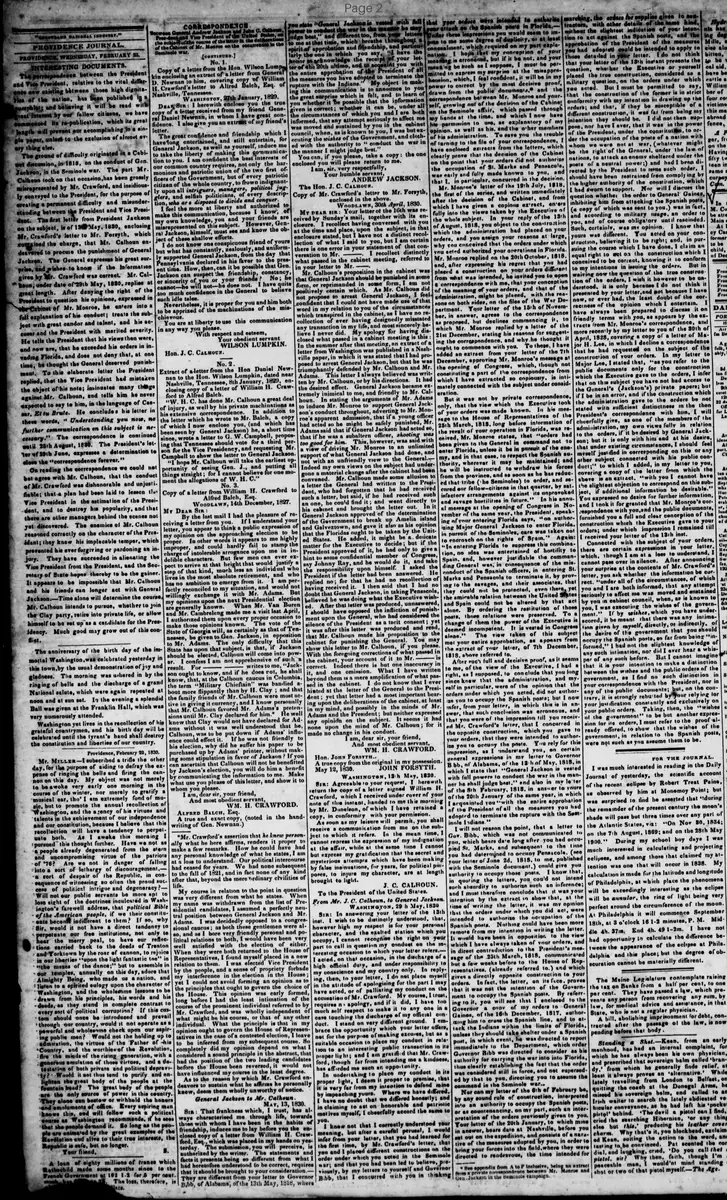
The correspondence between the President and Vice President, relative to the vital difference now existing between those high dignitaries of the nation, has been published in a pamphlet; and believing it will be read with great interest by our fellow citizens, we have commenced its re-publication, which its great length will prevent our accomplishing in a single paper, unless to the exclusion of almost every thing else.
The ground of difficulty originated in a Cabinet discussion, in 1818, on the conduct of Gen. Jackson, in the Seminole war. The part Mr. Calhoun took on that occasion, has been grossly misrepresented by Mr. Crawford, and insidiously conveyed to the President, for the purpose of creating permanent difficulty and misunderstanding between the President and Vice President. The first letter from President Jackson on the subject, is of 19 May, 1830, enclosing Mr. Crawford's letter to Mr. Forsyth, which contained the charge, that Mr. Calhoun endeavored to procure the punishment of General Jackson. The General expresses his great surprise, and wishes to know if the information given by Mr. Crawford was correct. Mr. Calhoun, under date of 29th May, 1830, replies at great length. After denying the right of the President to question his opinions, expressed in the Cabinet of Mr. Monroe, he enters into a full explanation of his conduct; treats the subject with great candor and talent, and his accuser and the President with merited severity. He tells the President that his views then were, and now are, that he exceeded his orders in invading Florida, and does not deny that, at one time, he thought the General deserved punishment. To this elaborate letter the President replied, that the Vice President had mistaken the object of his note; insinuates many things against Mr. Calhoun, and tells him he never expected to say to him, in the language of Caesar, Et tu Brute. He concludes his letter in these words, "Understanding you now, no further communication on this subject is necessary." The correspondence is continued until 25th August, 1830. The President's letter of 29th June, expresses a determination to close the "correspondence forever."
On reading the correspondence we could not but agree with Mr. Calhoun, that the conduct of Mr. Crawford was dishonorable and unjustifiable; that a plan had been laid to lessen the Vice President in the estimation of the President, and to destroy his popularity, and that there are other managers behind the scenes not yet discovered. The enemies of Mr. Calhoun reasoned correctly on the character of the President; they knew his implacable temper, which prevented his ever forgiving or pardoning an injury. They have succeeded in alienating the Vice President from the President, and the Secretary of State hopes thereby to be the gainer. It appears to be impossible that Mr. Calhoun and his friends can longer act with General Jackson. Time alone will determine the course Mr. Calhoun intends to pursue, whether to join the Clay party, retire into private life, or allow himself to be set up as a candidate for the Presidency. Much good may grow out of this conflict.
See appendix from A to F inclusive, being an extract from a private correspondence between Mr. Monroe and Gen. Jackson in the Seminole campaign.
Between General Andrew Jackson and John C. Calhoun of the Cabinet of Mr. Monroe on the occurrences in the Seminole war. [CONTINUED.]
No. 1.
Copy of a letter from the Hon. Wilson Lumpkin to Alfred Balch, Esq. covering copy of William H. Crawford's letter to D. Newnan to him, enclosing an extract of a letter from General Daniel Newnan, in whom I have great confidence. I also give you an extract of my friend's letter.
Washington, 27th January, 1829.
Dear Sir: I herewith enclose you the true copy of a letter received from my friend General Daniel Newnan, in whom I have great confidence. I also give you an extract of my friend's letter.
Nashville, Tennessee.
The great confidence and friendship which I have long entertained, and still entertain, for General Jackson, as well as yourself, induce me to take the liberty of making this communication to you. I am confident the best interests of our common country requires, not only the harmonious and patriotic union of the two first officers of the Government, but of every patriotic citizen of the whole country, to frown indignantly upon all intriguers, managers, political jugglers, and selfish politicians, of every description, who are disposed to divide and conquer.
I feel the more at liberty and authorized to make this communication, because I know, of my own knowledge, you and your friends are misrepresented on this subject. However, General Jackson, himself, must see and know the object of these shallow efforts.
I do not know one conspicuous friend of yours but what has constantly, zealously, and uniformly supported General Jackson, from the day that Pennsylvania declared in his favor to the present time. How, then, can it be possible that Gen. Jackson can suspect the friendship, constancy, or sincerity of you or your friends? No; he cannot—he will not—he does not. I have too much confidence in the General to believe such idle tales.
Nevertheless, it is proper for you and him both to be apprised of the machinations of the mischievous.
You are at liberty to use this communication in any way you please.
With respect and esteem,
Your obedient servant,
WILSON LUMPKIN.
Hon. J. C. Calhoun.
No. 2.
Extract of a letter from the Hon. Daniel Newnan to the Hon. Wilson Lumpkin, dated near Nashville, Tennessee, 8th January, 1829, enclosing copy of a letter of William H. Crawford to Alfred Balch.
"W. H. C. has done Mr. Calhoun a great deal of injury, as well by his private machinations as by his extensive correspondence. In addition to the letter which he wrote to Mr. Balch, a copy of which I now enclose you, (and which has been seen by General Jackson) he, a short time since, wrote a letter to G. W. Campbell, proposing that Tennessee should vote for a third person for the Vice Presidency, and requesting Mr. Campbell to show the letter to General Jackson.
"I hope Mr. Calhoun will take the earliest opportunity of seeing Gen. J., and putting all things straight; for I cannot believe for one moment the allegations of W. H. C."
No. 3.
Copy of a letter from William H. Crawford to Alfred Balch, Esq.
Woodlawn, 14th December, 1827.
Sir:
By the last mail I had the pleasure of receiving a letter from you. If I understand your letter, you appear to think a public expression of my opinion on the approaching election to be proper. In other words it appears to me highly improper, and could hardly fail to stamp the charge of intolerable arrogance upon me in indelible characters. But few men can ever expect to arrive at that height that would justify a step of that kind, much less an individual who lives in the most absolute retirement, and who has no ambition to emerge from it. I am perfectly reconciled to my situation, and would not willingly exchange it with Mr. Adams. But my opinions upon the next Presidential election are generally known. When Mr. Van Buren and Mr. Cambreleng made me a visit last April, I authorized them upon every proper occasion to make those opinions known. The vote of the State of Georgia will, as certainly as that of Tennessee, be given to Gen. Jackson, in opposition to Mr. Adams. The only difficulty that this State has upon that subject, is that, if Jackson should be elected, Calhoun will come into power. I confess I am not apprehensive of such a result. For Mr. Newnan writes to me, "Jackson ought to know, and if he does not, he shall know, that, at the Calhoun caucus in Columbia, the term 'Military Chieftain' was bandied about more flippantly than by H. Clay; and that the family friends of Mr. Calhoun were most active in giving it currency, and I know personally that Mr. Calhoun favored Mr. Adams's pretensions until Mr. Clay declared for him." He well knew that Clay would not have declared for Adams without it was well understood that he, Calhoun, was to be put down if Adams' influence could effect it. If he was not friendly to his election, why did he suffer his paper to be purchased up by Adams' printer, without making some stipulation in favor of Jackson? If you can ascertain that Calhoun will not be benefitted by Jackson's election, you will do him a benefit by communicating the information to me. Make what use you please of this letter, and show it to whom you please.
A true and exact copy, (noted in the hand writing of Gen. Newnan.)
Alfred Balch, Esq.
*Mr. Crawford's assertion that he knew personally what he here affirms, renders it proper to make a few remarks. How he could have had any personal knowledge of what he states, I am at a loss to understand. Our political intercourse had ceased for years. We had none subsequent to the fall of 1821, and in fact none of any kind after that, beyond the mere ordinary civilities of life.
My course in relation to the point in question was very different from what he states. "When my name was withdrawn from the list of Presidential candidates, I assumed a perfectly neutral position between General Jackson and Mr. Adams. I was decidedly opposed to a congressional caucus; as both these gentlemen were also, and as I bore very friendly personal and political relations to both, I would have been very well satisfied with the election of either.
When they were both returned to the House of Representatives, I found myself placed in a new relation to them. I was elected Vice President by the people, and a sense of propriety forbade my interference in the election in the House; yet I could not avoid forming an opinion as to the principles that ought to govern the choice of the House. This opinion was early formed, long before I had the least intimation of the course of the prominent individual referred to by Mr. Crawford, and was wholly independent of what might be his course, or that of any other individual. What the principle is that in my opinion ought to govern the House of Representatives in the case of a contested election, I leave to be inferred from my subsequent course. So completely did my opinion depend on what I considered a sound principle in the abstract, that had the position of the two leading candidates before the House been reversed, it would not have influenced my course in the least degree.
As to the reason by which Mr. Crawford endeavors to sustain what he affirms he personally knew, deem them wholly unworthy of notice.
General Jackson to Mr. Calhoun.
May 13, 1830.
Sir: That frankness which, I trust, has always characterised me through life, towards those with whom I have been in the habits of friendship, induces me to lay before you the enclosed copy of a letter from William H. Crawford, Esq., which was placed in my hands on yesterday. The submission, you will perceive, is authorized by the writer. The statements and facts it presents being so different from what I had heretofore understood to be correct, requires that it should be brought to your consideration. They are different from your letter to Governor Bibb, of Alabama, of the 13th May, 1818, where you state "General Jackson is vested with full power to conduct the war in the manner he may judge best," and different too, from your letters to me at that time, which breathe throughout a spirit of approbation and friendship, and particularly the one in which you say, "I have the honor to acknowledge the receipt of your letter of the 20th ultimo, and to acquaint you with the entire approbation of the President of all the measures you have adopted to terminate the rupture with the Indians." My object in making this communication is to announce to you the great surprise which is felt, and to learn of you whether it be possible that the information given is correct; whether it can be, under all the circumstances of which you and I are both informed, that any attempt seriously to affect me was moved and sustained by you in the cabinet council, when, as is known to you, I was but executing the wishes of the Government, and clothed with the authority to "conduct the war in the manner I might judge best."
You can, if you please, take a copy: the one enclosed you will please return to me.
I am, sir, very respectfully,
Your humble servant,
ANDREW JACKSON.
The Hon. J. C. Calhoun.
Copy of Mr. Crawford's letter to Mr. Forsyth, enclosed in the above.
Woodlawn, 30th April, 1830.
Mr. Dear Sir: Your letter of the 16th was received by Sunday's mail, together with its enclosure. I recollect having conversed with you at the time and place, upon the subject, in that enclosure stated, but I have not a distinct recollection of what I said to you, but I am certain there is one error in your statement of that conversation to Mr. Calhoun's proposition in the cabinet was that General Jackson should be punished in some form, or reprimanded in some form, I am not positively certain which. As Mr. Calhoun did not propose to arrest General Jackson, I feel confident that I could not have made use of that word in my relation to you of the circumstances which transpired in the cabinet, as I have no recollection of ever having designedly misstated any transaction in my life, and most sincerely believe I never did. My apology for having disclosed what passed in a cabinet meeting is this:
In the summer after that meeting, an extract of a letter from Washington was published in a Nashville paper, in which it was stated that I had proposed to arrest General Jackson, but that he was triumphantly defended by Mr. Calhoun and Mr. Adams. This letter I always believed was written by Mr. Calhoun, or by his directions. It had the desired effect. General Jackson became extremely inimical to me, and friendly to Mr. Calhoun. In stating the arguments of Mr. Adams to induce Mr. Monroe to support General Jackson's conduct throughout, adverting to Mr. Monroe's apparent admission, that if a young officer had acted so he might be safely punished, Mr. Adams said that if General Jackson had acted so, that if he was a subaltern officer, shooting was too good for him. This, however, was said with a view of driving Mr. Monroe to an unlimited support of what General Jackson had done, and not with an unfriendly view to the General.
Indeed my own views on the subject had undergone a material change after the cabinet had been convened. Mr. Calhoun made some allusion to a letter the General had written to the President, who had forgotten that he had received such a letter, but said, if he had received such an one, he could find it; and went directly to his cabinet and brought the letter out. In it General Jackson approved of the determination of the Government to break up Amelia island and Galveztown, and gave it also as his opinion that the Floridas ought to be taken by the United States. He added, it might be a delicate matter for the Executive to decide; but if the President approved of it, he had only to give a hint to some confidential member of Congress, and he would do it, and take the responsibility upon himself. I asked the President if the letter had been answered. He replied no; for that he had no recollection of having received it. I then said that I had no doubt that General Jackson, in taking Pensacola, believed he was doing what the Executive wished. After that letter was produced, unanswered, I should have opposed the infliction of punishment upon the General, who had considered the silence of the President as a tacit consent; yet it was after this letter was produced and read, that Mr. Calhoun made his proposition to the cabinet for punishing the General. You may show this letter to Mr. Calhoun, if you please.
With the foregoing corrections of what passed in the cabinet, your account of it to Mr. -- is correct. Indeed there is but one inaccuracy in it, and one omission. What I have written beyond them is a mere amplification of what passed in the cabinet. I do not know that I ever hinted at the letter of the General to the President; yet that letter had a most important bearing upon the deliberations of the cabinet, at least in my mind, and possibly in the minds of Mr. Adams and the President; but neither expressed any opinion on the subject. It seems it had none upon the mind of Mr. Calhoun; for it made no change in his conduct.
I am, dear sir, your friend,
And most obedient servant,
WM. H. CRAWFORD.
Hon. John Forsyth.
A true copy from the original in my possession.
May 12, 1830.
JOHN FORSYTH.
Washington, 13th May, 1830.
Sir: Agreeable to your request, I herewith return the copy of a letter signed William H. Crawford, which I received under cover of your note of this instant, handed to me this morning by Mr. Donelson, of which I have retained copy, in conformity with your permission.
As soon as my leisure will permit, you shall receive a communication from me on the subject to which it refers. In the mean time, I cannot repress the expression of my indignation at the affair, while at the same time I cannot but express my gratification that the secret and mysterious attempts which have been making by false insinuations, for years, for political purposes, to injure my character, are at length brought to light.
Sir: In answering your letter of the 13th inst. I wish to be distinctly understood, that, however high my respect is for your personal character, and the exalted station which you occupy, I cannot recognise the right on your part to call in question my conduct on the interesting occasion to which your letter refers.—I acted, on that occasion, in the discharge of a high official duty, and under responsibility to my conscience and my country only. In replying, then, to your letter, I do not place myself in the attitude of apologising for the part I may have acted, or of palliating my conduct on the accusation of Mr. Crawford. My course, I trust, requires no apology, and if it did, I have too much self respect to make it to any one in a case touching the discharge of my official conduct. I stand on very different ground. I embrace the opportunity which your letter offers, not for the purpose of making excuses, but as a suitable occasion to place my conduct in relation to an interesting public transaction in its proper light; and I am gratified that Mr. Crawford, though far from intending me a kindness, has afforded me such an opportunity.
In undertaking to place my conduct in its proper light, I deem it proper to premise, that it is very far from my intention to defend mine by impeaching yours. Where we have differed, I have no doubt that we differed honestly; and in claiming to act on honorable and patriotic motives myself, I cheerfully accord the same to you.
I knew not that I correctly understood your meaning, but after a careful perusal, I would infer from your letter, that you had learned for the first time, by Mr. Crawford's letter, that you and I placed different constructions on the order under which you acted in the Seminole war; and that you had been led to believe, previously, by my letters to yourself and Governor Bibb, that I concurred with you in thinking that your orders were intended to authorize your attack on the Spanish posts in Florida.—Under these impressions you would seem to impute to me some degree of duplicity, or at least concealment, which required on my part explanation. I hope that my conception of your meaning be such as I suppose, I must be permitted to express my surprise at the 'misapprehension, which, I feel confident, it will be in my power to correct by the most decisive proof, drawn from the public documents, and the correspondence between Mr. Monroe and yourself, growing out of the decision of the Cabinet on the Seminole affair, which passed through my hands at the time, and which I now have his permission to use, as explanatory of my opinion, as well as his, and the other members of his administration. To save you the trouble of turning to the file of your correspondence, I have enclosed extracts from the letters, which clearly prove that the decision of the Cabinet on the point that your orders did not authorize the occupation of St. Marks and Pensacola, was early and fully made known to you, and that I, in particular, concurred in the decision.
Mr. Monroe's letter of the 29th June, 1818, the first of the series, and written immediately after the decision of the Cabinet, and from which I have given a copious extract, enters fully into the views taken by the Executive of the whole subject. In your reply of the 13th of August, 1818, you object to the construction which the administration had placed on your orders, and you assign your reasons at large, why you conceived that the orders under which you acted authorized your operations in Florida.
Mr. Monroe replied on the 20th October, 1818, and, after expressing his regret that you had placed a construction on your orders different from what was intended, he invited you to open a correspondence with me, that your conception of the meaning of your orders, and that of the administration, might be placed, with the reasons on both sides, on the files of the War Department. Your letter of the 15th of November, in answer, agrees to the correspondence as proposed, but declines commencing it. To which Mr. Monroe replied by a letter of the 21st December, stating his reasons for suggesting the correspondence, and why he thought it ought to commence with you. To these, I have added an extract from your letter of the 7th December, approving Mr. Monroe's message at the opening of Congress, which, though not constituting a part of the correspondence from which I have extracted so copiously, is intimately connected with the subject under consideration.
But it was not by private correspondence, only, that the view which the Executive took of your orders was made known. In his message to the House of Representatives of the 25th March, 1818, long before information of the result of your operation in Florida, was received, Mr. Monroe states, that "orders had been given to the General in command not to enter Florida, unless it be in pursuit of the enemy, and in that case, to respect the Spanish authority, wherever it may be maintained; and he will be instructed to withdraw his forces from the province, and as soon as he has reduced that tribe (the Seminoles) to order, and secured our fellow-citizens in that quarter, by satisfactory arrangements against its unprovoked and savage hostilities in future." In his annual message at the opening of Congress in November of the same year, the President, speaking of your entering Florida says, "on authorizing Major General Jackson to enter Florida, in pursuit of the Seminoles, care was taken not to encroach on the rights of Spain." Again: "In entering Florida to suppress this combination, no idea was entertained of hostility to Spain." and, however justifiable the commanding General was, in consequence of the misconduct of the Spanish officers, in entering St. Marks and Pensacola to terminate it, by proving to the savages, and their associates, that they could not be protected, even there, yet the amicable relation between the United States and Spain could not be altered by that act alone. By ordering the restitution of those posts, those relations were preserved. To a change of them the power of the Executive is deemed incompetent. It is vested in Congress alone.
The view taken of this subject met your entire approbation, as appears from the extract of your letter, of 7th December, 1818, above referred to.
After such full and decisive proof, as it seems to me, of the view of the Executive, I had a right, as I supposed, to conclude that you long since knew that the administration, and myself in particular, were of the opinion that the orders under which you acted, did not authorize you to occupy the Spanish posts; but I now infer, from your letter, in which this is in answer, that such conclusion was erroneous, and that you were of the impression till you received Mr. Crawford's letter, that I concurred in the opposite construction, which you gave to your orders, that they were intended to authorize you to occupy the posts. You rely for this impression, as I understand you, on certain general expressions in my letter to Governor Bibb, of Alabama, of the 13th of May, 1818, in which I state that "General Jackson is vested with full powers to conduct the war in the manner he shall judge best," and also in my letter of the 6th February, 1818, in answer to yours of the 20th January of the same year, in which I acquainted you "with the entire approbation of the President of all the measures you had adopted to terminate the rupture with the Seminole Indians."
I will not reason on the point, that a letter to Gov. Bibb, which was not communicated to you, which bears date long after you had occupied St. Marks, and subsequent to the time you had determined to occupy Pensacola, (see your letter of June 2d, 1818, to me, published with the Seminole documents,) could give you authority to occupy those posts. I know that, in quoting the letters, you could not intend such absurdity to authorize such an inference; and I must therefore conclude that it was your intention by the extract to show that, at the time of writing the letter, it was my opinion that the orders under which you did act, were intended to authorize the occupation of the Spanish posts. Nothing could have been more remote from my intention in writing the letter. It would have been in opposition to the view which I have always taken of your orders, and in direct contradiction to the President's message of the 25th March, 1818, communicated but a few weeks before to the House of Representatives, (already referred to,) and which gives a directly opposite construction to your orders. In fact, the letter, on its face, proves that it was not the intention of the Government to occupy the Spanish posts. By referring to it, you will see that I enclosed to the Governor a copy of my orders to General Gaines, of the 16th December, 1817, authorizing him to cross the Spanish line, and to attack the Indians within the limits of Florida, unless they should take shelter under a Spanish post, in which event, he was directed to report immediately to the Department, which order Governor Bibb was directed to consider as his authority for carrying the war into Florida, thus clearly establishing the fact that the order was considered still in force, and not superseded by that to you, directing you to assume the command in the Seminole war.
Nor can my letter of the 6th of February be, by any sound rule of construction, interpreted into an authority to occupy the Spanish posts, or as countenancing, on my part, such an interpretation of the orders previously given to you.
Your letter of the 20th January, to which mine in answer, bears date at Nashville, before you set out on the expedition, and consists of a narrative of the measures adopted by you, in order to bring your forces into the field, where they were directed to rendezvous, the time intended for marching, the orders for supplies given to contractors, with other details of the same kind, without the slightest indication of your intention to act against the Spanish posts, and the approbation of the President of the measures you had adopted could be intended to apply to those detailed in your letter. I do not think that your letter of the 15th instant presents the question, whether the Executive or yourself placed the true construction, considered as a military question, on the orders under which you acted. But I must be permitted to say, that the construction of the former is in strict conformity with my intention in drawing up the orders; and that, if they be susceptible of a different construction, it was far from being my intention they should be. I did not then suppose, nor have I ever, that it was in the power of the President, under the constitution, to order the occupation of the posts of a nation with whom we were not at war, (whatever might be the right of the General, under the laws of nations, to attack an enemy sheltered under the posts of a neutral power;) and had I been directed by the President to issue such order, I should have been restrained from complying by the higher authority of the constitution, which I had sworn to support. Nor will I discuss the question whether the order to General Gaines, inhibiting him from attacking the Spanish posts, (copy of which was sent to you,) was in fact, and according to military usage, an order to you, and of course obligatory until rescinded. Such, certainly, was my opinion. I know that yours was different. You acted on your construction, believing it to be right; and, in pursuing the course which I have done, I claim an equal right to act on the construction which I conceived to be correct, knowing it to conform to my intentions in issuing the orders. But in waiving now the question of the true construction of the orders, I wish it however to be understood, it is only because I do not think it presented by your letter, and not because I have the least doubt of the correctness of the opinion which I entertain. I have always been prepared to discuss it on friendly terms with you, as appears by the extracts from Mr. Monroe's correspondence, and more recently by my letter to you of the 30th of April, 1828, covering a copy of a letter of Major H. Lee, in which I decline a correspondence that he had requested on the subject of the construction of your orders. In my letter to Major Lee, I stated that, "as you refer to the public documents only for the construction which the Executive gave to the orders, I infer that on this subject you have not had access to the General's (Jackson's) private papers; but if I be in error, and if the construction which the administration gave to the orders be not stated with sufficient distinctness in the then President's correspondence with him, I will cheerfully give, as one of the members of the administration, my own views fully in relation to the orders, if it be desired by General Jackson; but it is only with him and at his desire, that under existing circumstances, I should feel myself justified in corresponding on this or any other subject connected with his public conduct;" to which I added, in my letter to you, covering a copy of the letter from which the above is an extract. "with you I cannot have the slightest objection to correspond on this subject, if additional information be desirable."
You expressed no desire for further information, and I took it for granted that Mr. Monroe's correspondence with you, and the public documents, furnished you a full and clear conception of the construction which the Executive gave to your orders; under which impression I remained till I received your letter of the 13th inst.
Connected with the subject of your orders, there are certain expressions in your letter, which, though I am at a loss to understand, I cannot pass over in silence. After announcing your surprise at the contents of Mr. Crawford's letter, you ask whether the information be correct, "under all of the circumstances, of which you and I are both informed, that any attempt seriously to affect me was moved and sustained by you in cabinet council, when, as is known to you, I was executing the wishes of the government, and clothed with the authority to conduct the war in the manner I might judge best." If by wishes, which you have underscored, it be meant that there was any intimation given by myself, directly, or indirectly, of the desire of the government that you should occupy the Spanish posts, so far from being "informed," I had not the slightest knowledge of any such intimation, nor did I ever hear a whisper of any such before. But I cannot imagine that it is your intention to make a distinction between the wishes and the public orders of the government, as I find no such distinction in your correspondence with the President, nor in any of the public documents; but, on the contrary, it is strongly rebutted by your relying for your justification constantly and exclusively on your public orders. Taking, then, the "wishes of the government" as but another expression for its orders, I must refer to the proof already offered, to show that the wishes of the government, in relation to the Spanish posts were not such as you assume them to be.
What sub-type of article is it?
What themes does it cover?
What keywords are associated?
What entities or persons were involved?
Where did it happen?
Story Details
Key Persons
Location
Washington, Nashville, Tennessee, Woodlawn, Florida
Event Date
1818 1830
Story Details
Correspondence between President Jackson and Vice President Calhoun published, revealing a dispute originating from a 1818 Cabinet discussion on Jackson's Seminole War actions in Florida. Crawford misrepresented Calhoun's position to create rift; Calhoun defends his conduct, denying intent to punish Jackson beyond orders. Includes letters from 1827-1830 detailing accusations, explanations, and political machinations.