Thank you for visiting SNEWPapers!
Sign up free
The Southern Enterprise
Greenville, Greenville County, South Carolina
What is this article about?
A detailed defense of South Carolina's plan to guarantee $200 million of Confederate war debt, contrasting it favorably against Alabama's full guarantee proposal. The author argues SC's approach saves principal and interest through premium bond sales and avoids locking in the entire debt, including calculations and tables. Signed J. P. R., Greenville, S.C., Dec. 30, 1862.
Merged-components note: This is a single long letter to the editor by J.P.R. on Confederate debt guarantee, split across columns and including the embedded financial table.
Clipping
OCR Quality
Full Text
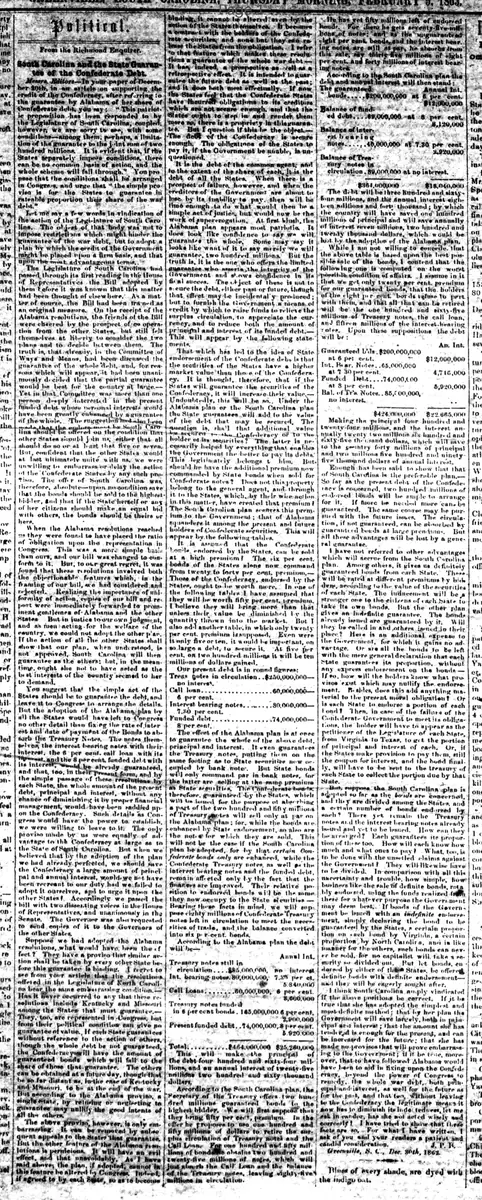
Let me say a few words in vindication of the action of the Legislature of South Carolina. The object of that body was not to impose restrictions which might hinder the guarantee of the war debt, but to adopt a plan by which the credit of the Government might be placed upon a firm basis, and that upon the most advantageous terms.
The Legislature of South Carolina had passed through its first reading in the House of Representatives the Bill adopted by them before it was known that this matter had been thought of elsewhere. As a matter of course, the Bill had been framed as an original measure. On the receipt of the Alabama resolutions, the friends of the Bill were cheered by the prospect of co-operation from the other States, but still felt themselves, at liberty to consider the two plans and to decide between them. The truth is, that already, in the Committee of Ways and Means, had been discussed the guarantee of the whole debt,—and, for reasons which will appear, it had been unanimously decided that the partial guarantee would be best for the country at large.
Yet in that Committee was more than one person deeply interested in the present funded debt whose personal interests would have been greatly enhanced by a guarantee of the whole. The suggestion had been made that the guarantee by South Carolina should be offered on the condition that other States should join us, either that all should do so or at least that five or seven. But, confident that the other States would at last ultimately unite with us, we were unwilling to embarrass or delay the petition of the Confederate States by any such proposition. The offer of South Carolina was therefore, absolute—upon no condition save that she bonds should be sold to the highest bidder, and that if the State herself or any of her citizens should make an equal bid with others, the bonds should be theirs or hers.
When the Alabama resolutions reached us they were found to have placed the ratio of obligation upon the representation in Congress. This was a more simple basis than ours, and our bill was changed accordingly. But, to our great regret, it was found that these resolutions involved both the objectionable features which, in the framing of our bill, we had considered and rejected. Realizing the importance of uniformity of action, copies of our bill and report were immediately forwarded to prominent gentlemen of Alabama and the other States. But in justice to our own judgment, and as meeting for the welfare of the country, we could not adopt the other plan.
If the action of all the other States shall show that our plan, when understood, is not approved, South Carolina will then guarantee as the others; but, in the mean time, ought she not to have acted as the best interests of the country seemed to her to demand.
You suggest that the simple act of the States should be to guarantee the debt, and leave it to Congress to arrange the details. But the adoption of the Alabama plan by all the States would have left to Congress no other detail than fixing the rate of interest and date of payment of the Bonds to absorb the Treasury Notes. The notes, themselves, the interest bearing notes with their interest, the 6 per cent. call loan with its interest, and the 8 per cent. funded debt with its interest, would be already guaranteed, and that, too, in their present form, and by the simple passage of these resolutions by each State, the whole amount of the present debt, principal and interest, without any chance of diminishing it by proper financial management, would have been saddled upon the Confederacy. Such details as Congress would have the power to establish, we were willing to leave to it. The only proviso made by us were equally of advantage to the Confederacy at large as in the State of South Carolina. But, as we believed that by the adoption of the plan we had already perfected, we should save the Confederacy a large amount of principal and annual interest, would we not have been recreant to our duty had we failed to adopt it ourselves, and to urge it upon the other States. Accordingly we passed the bill with two dissenting voices in the House of Representatives, and unanimously in the Senate. The Governor was also requested to send copies of it to the Governors of the other States.
Suppose we had adopted the Alabama resolutions, what would have been the effect? They have a proviso that similar action shall be taken by every other State before the guarantee is binding. I regret to see from your article that the resolutions offered in the Legislature of North Carolina bear the same embarrassing condition.
Has it never occurred to any that these resolutions include Kentucky and Missouri among the States that must guarantee? They, too, are represented in Congress, but from their political condition can give no guarantee of value. If each State guarantees without reference to the action of others, though the whole debt be not guaranteed, the Confederacy will have the amount of guaranteed bonds which will fall to the share of those that guarantee. The others can be obtained at a future day, though that be so far distant as, in the case of Kentucky and Missouri, to be at the end of the war.
But according to the Alabama proviso, a single State, by refusing or neglecting to guarantee may nullify the good intents of all the others.
The above proviso, however, is only embarrassing. It can be removed by some joint appeals to the States that guarantee. But the other feature of the Alabama resolutions is pernicious. It will have an evil effect, and that unavoidably. As I have said above; the plan, if adopted, cannot in this feature be altered by Congress. Indeed, I urged to my each State, so as to become binding it cannot be altered even by the action of this State themselves. The contract with the holders of the Confederate securities and none but they can release the States from the obligation. I refer to that feature which makes these resolutions a guarantee of the whole war debt. It has indeed, a prospective as well as a retrospective effect. It is intended to guarantee the future debt as well as the past; and it does both most effectually. If now the States feel that the Confederate States have incurred obligations to its creditors which are not secure enough, and that the States ought to step in and render them more so, there is a propriety in the guarantee. But I question if this is the object. The debt of the Confederacy is secure enough. The obligations of the States to pay it, if the Government be unable, is unquestioned. It is the debt of the common agent, and to the extent of the share of each, it is the debt of all the States. When there is a prospect of failure, however, and when the creditors of the Government are about to lose by its inability to pay, then will be time enough to do what would then be a simple act of justice, but would now be the work of supererogation. At first blush, the Alabama plan appears most patriotic. It does look like confidence to say we will guarantee the whole. Some may say it looks like want of it to say merely we will guarantee two hundred millions. But the truth is, it is the one who offers the limited guarantee who asserts the integrity of the Government and avows confidence in its final success. The object of these is not to secure the debt, either past or future, though that effect may be incidentally produced; but to furnish the government means of credit by which to raise funds to relieve the surplus circulation, to appreciate the currency, and to reduce both the amount of principal and interest of its funded debt.
This will appear by the following statements.
That which has led to the idea of State endorsement of the Confederate debt is that the securities of the States have a higher market value than those of the Confederacy. It is thought, therefore, that if the States will guarantee the securities of the Confederacy, it will increase their value. Undoubtedly, this will be so. Under the Alabama plan or the South Carolina plan the State guarantees will add to the value of the debt that may be secured. The question is, shall that additional value be secured to the Confederacy or to the holder of its securities? The latter is necessarily helped by everything that enables the Government the better to pay its debts. This legitimately belongs to him. But should he have the additional premium now commanded by State bonds when sold for Confederate notes? Does not this property belong to the general agent, and through it to the States, which, by their wise action in this matter, have created that premium?
The South Carolina plan secures this premium to the Government; that of Alabama squanders it among the present and future holders of Confederate securities. This will appear by the following tables.
It is assumed that the Confederate bonds, endorsed by the States, can be sold at a high premium. The six per cent. bonds of the States alone now command from twenty to forty per cent. premium. Those of the Confederacy, endorsed by the States, ought to be worth more. In one of the following tables I have assumed that they will be worth fifty per cent. premium. I believe they will bring more than that unless their value be diminished by the quantity thrown into the market. But I also give another table, in which only twenty per cent. premium is assumed. Even were it only five or ten, it would be important, on so large a debt, to secure it. At five per cent. on two hundred millions it will be ten millions of dollars gained.
Our present debt is in round figures:
Treasury notes in circulation...$250,000,000—no interest.
Call loan...$60,000,000—6 per cent.
Interest bearing notes...$50,000,000—7.30 per cent.
Funded debt...$74,000,000—8 per cent.
The effect of the Alabama plan is at once to guarantee the whole of the above debt, principal and interest. It even guarantees the Treasury notes, putting them on the same footing as to State security now occupied by bank notes. But State bonds will only command par in bank notes, for the latter are selling at the same premium as State securities. The Confederate Treasury, therefore, guaranteed by the States, which will be issued for the purpose of absorbing a part of the two hundred and fifty millions of Treasury paper will sell only at par on the Alabama plan; for, while the bonds are enhanced by State endorsement, so also are the notes for which they are sold. This will not be the case if the South Carolina plan be adopted, for by that, certain Confederate bonds only are enhanced, while the Confederate Treasury notes, as well as the interest bearing notes and the funded debt, remain affected only by the fact that the finances are improved. Their relative position to endorsed bonds will be the same they now occupy to the State securities.
Bearing those facts in mind, we will suppose eighty millions of Confederate Treasury notes left in circulation to meet the necessities of trade, and the balance converted into six per cent. bonds.
According to the Alabama plan the debt will be:
Total......$464,000,000—$25,260,000
This will make the principal of the debt four hundred and sixty-four millions, and an annual interest of twenty-five millions two hundred and sixty thousand dollars.
According to the South Carolina plan, the Secretary of the Treasury offers two hundred millions guaranteed bonds to the highest bidder. We will first suppose that they bring fifty per cent. premium. In the offer he proposes to use one hundred and fifty millions of dollars to retire the surplus circulation of Treasury notes and the Call Loan. For one hundred and fifty millions of bonds he obtains two hundred and twenty-five millions of notes, which will just absorb the Call Loan and the balance of the Treasury notes, leaving eighty-five millions in circulation.
For the remaining fifty millions he buys forty millions of the eight per cent. funded debt and ten millions of interest bearing notes at par.
No balance of Treasury notes.
According to the South Carolina plan the debt and annual interest will then stand:
The guaranteed bonds....$200,000,000 at 6 per cent....$12,000,000
Balance of funded debt...$9,000,000 at 8 per cent....$720,000
Balance of interest bearing notes......$10,000,000 at 7.30 per cent....$730,000
Balance of Treasury notes in circulation. $85,000,000 at no interest.
$364,000,000—$13,450,000
The debt will be three hundred and sixty-four millions, and the annual interest eighteen millions and forty thousand; by which the country will have saved one hundred millions of principal and will pay annually seven millions, two hundred and sixty thousand dollars, which would be lost by the adoption of the Alabama plan.
While I am not willing to concede that the above table is based upon the best possible sale of the bonds, I contend that the following one is computed on the worst possible condition of affairs. I assume in it that we get only twenty per cent. premium for our guaranteed bonds, that the holders of the eight per cent. bonds refuse to part with them, and that all that can be retired will be the one hundred and sixty-five millions of Treasury notes, the call loan, and fifteen millions of the interest bearing notes. Upon these suppositions the debt will be:
Guaranteed bonds $200,000,000 at 6 per cent. $12,000,000
Int. Bear. Notes..$65,000,000 at 7.30 per cent $4,745,000
Funded debt....$74,000,000 at 8 per cent. $5,920,000
Bal. of Tra Notes.. $85,000,000, no interest.
$424,000,000—$22,665,000
Making the principal four hundred and twenty-four millions, and the interest annually twenty-two millions six hundred and sixty-five thousand dollars, which will save to the country forty millions of principal and two millions five hundred and ninety-five thousand dollars of annual interest.
Enough has been said to show that that of South Carolina is the preferable plan. So far as the present debt of the Confederacy is concerned, two hundred millions of endorsed bonds will be ample to arrange for it, if more be needed more can be guaranteed. The same course may be pursued with the future issues. The circulation, if not guaranteed, can be absorbed by guaranteed bonds at large premiums. But all these advantages will be lost by a general guarantee.
I have not referred to other advantages which will accrue from the South Carolina plan. Among others, it gives us definitely guaranteed bonds from each State. These will be rated at different premiums by bidders, according to the value of the securities of each State. The inducement will be a stronger one to the citizens of each State to take its own bonds. But the other plan gives an indefinite guarantee. The bonds already issued are guaranteed by it. Will they be called in and others issued in their place? Here is an additional expense to the government, for which it gains no advantage. Or are all the bonds to be left with the mere general declaration that each State guarantees its proportion, without any express endorsement on the bonds? If so, how will the holders know what provisos exist which may nullify the endorsement. By sales, does this add anything material to the present moral obligation? Or is each State to endorse a portion of each bond? Then, in case of the failure of the Confederate Government to meet its obligations, the holder will have to appear as the petitioner of the legislature of each State, from Virginia to Texas, to get the portion of principal and interest of each. Or, if the States make provision to pay them, still the coupon for interest, and the bond finally, will have to be sent to the treasurer of each State to collect the portion due by that State.
But, suppose the South Carolina plan is adopted so far as the bonds are concerned, and those are divided among the States, and a certain number of bonds endorsed by each? There yet remain the "Treasury notes and the interest bearing notes already issued and yet to be issued." How can they be arranged? Each guarantees its proportion of these too. How will each know how much and what ones to pay? What, too, is to be done with the unsettled claims against the Government? They will likewise have to be divided. In comparison with all this uncertainty and trouble, how simple, how business like the plan of definite bonds, manly endorsed, using the funds realized from these for whatever purpose the Government may deem best.
If bonds of the Government be issued with an indefinite endorsement, simply declaring the bond to be guaranteed by the States, a certain proportion on each bond by Virginia, a certain proportion by North Carolina, and in like manner for the others, such bonds can never be sold, for no capitalist will take a security so divided out. But let bonds, endorsed by either of the States, be offered—definite bonds with definite endorsement—and they will be eagerly sought after.
I think South Carolina amply vindicated if the above positions be correct. If it be true that she has adopted the simplest and most definite method; that by her plan the Government will save largely, both in principal and interest; that the amount she has taken is enough for the present, and can be increased for the future; that she has made no provisos that will prove embarrassing to the government; if it be true, moreover, that to have followed Alabama would have been to aid in fixing upon the Confederacy, beyond the power of Congress to remedy, the whole war debt, both principal and interest, as well for the future as for the past, and that too, without leaving to the Confederacy the legitimate means it now has to diminish its indebtedness, let me ask in candor, has she not acted wisely and correctly? I have tried to show that these facts are so. For what I have written, I ask of you and your readers a patient and candid consideration.
Greenville, S. C., Dec. 30th, 1862.
J. P. R.
| Treasury notes still in circulation...$85,000,000, no interest Int. bearing notes 80,000,000, 7.5% per cent. 5.840,000 |
| Call Loans...$0,000,000, 6 per cent. 8,600,000 |
| Treasury notes funded in 6 per cent bonds. 185,000,000 6 per cent. 2,900,000 |
| Presentfunded debt. 74,000,000, 8 per cent. 5.920,000 |
What sub-type of article is it?
What themes does it cover?
What keywords are associated?
What entities or persons were involved?
Letter to Editor Details
Author
J. P. R.
Recipient
Messrs. Editors
Main Argument
south carolina's plan to guarantee only $200 million of confederate debt is superior to alabama's full guarantee, as it allows the confederacy to sell bonds at a premium, absorb excess currency, retire high-interest debt, and save significantly on principal and interest without locking in the entire debt irrevocably.
Notable Details