Thank you for visiting SNEWPapers!
Sign up free
The Mahnomen Pioneer
Mahnomen, Mahnomen County, Minnesota
What is this article about?
Chief Earle Brown of the new Minnesota Highway-State Patrol emphasizes that officers are there to assist safe driving via warnings, not arrests, after two weeks with minimal enforcement on state highways. Common issues include center-line hugging and improper licensing.
Clipping
OCR Quality
Full Text
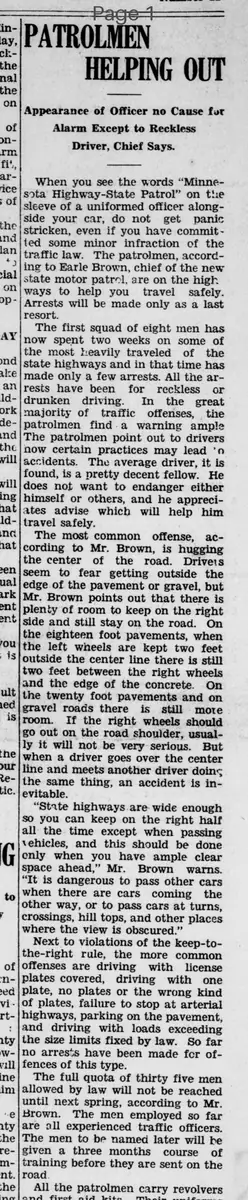
HELPING OUT
Appearance of Officer no Cause for Alarm Except to Reckless Driver, Chief Says.
When you see the words "Minnesota Highway-State Patrol" on the sleeve of a uniformed officer alongside your car, do not get panic stricken, even if you have committed some minor infraction of the traffic law. The patrolmen, according to Earle Brown, chief of the new state motor patrol, are on the highways to help you travel safely. Arrests will be made only as a last resort.
The first squad of eight men has now spent two weeks on some of the most heavily traveled of the state highways and in that time has made only a few arrests. All the arrests have been for reckless or drunken driving.
In the great majority of traffic offenses, the patrolmen find a warning ample. The patrolmen point out to drivers how certain practices may lead to accidents. The average driver, it is found, is a pretty decent fellow. He does not want to endanger either himself or others, and he appreciates advice which will help him travel safely.
The most common offense, according to Mr. Brown, is hugging the center of the road. Drivers seem to fear getting outside the edge of the pavement or gravel, but Mr. Brown points out that there is plenty of room to keep on the right side and still stay on the road. On the eighteen foot pavements, when the left wheels are kept two feet outside the center line there is still two feet between the right wheels and the edge of the concrete. On the twenty foot pavements and on gravel roads there is still more room. If the right wheels should go out on the road shoulder, usually it will not be very serious. But when a driver goes over the center line and meets another driver doing the same thing, an accident is inevitable.
"State highways are wide enough so you can keep on the right half all the time except when passing vehicles, and this should be done only when you have ample clear space ahead," Mr. Brown warns. "It is dangerous to pass other cars when there are cars coming the other way, or to pass cars at turns, crossings, hill tops, and other places where the view is obscured."
Next to violations of the keep-to-the-right rule, the more common offenses are driving with license plates covered, driving with one plate, no plates or the wrong kind of plates, failure to stop at arterial highways, parking on the pavement, and driving with loads exceeding the size limits fixed by law. So far no arrests have been made for offenses of this type.
The full quota of thirty five men allowed by law will not be reached until next spring, according to Mr. Brown. The men employed so far are all experienced traffic officers. The men to be named later will be given a three months course of training before they are sent on the road.
All the patrolmen carry revolvers and first aid kits. Their uniforms are of dark gray whipcord. The words "Minnesota Highway-State Patrol" are in large yellow letters on the right sleeve.
What sub-type of article is it?
What themes does it cover?
What keywords are associated?
What entities or persons were involved?
Where did it happen?
Story Details
Key Persons
Location
Minnesota Highways
Story Details
Chief Earle Brown describes the new Minnesota Highway-State Patrol's focus on helping drivers travel safely through warnings rather than arrests, with the first squad making few arrests for reckless or drunken driving after two weeks. Common offenses include hugging the center of the road and other traffic violations, but warnings suffice for most. The patrol will expand to 35 men next spring, all trained and equipped with revolvers and first aid kits.