Thank you for visiting SNEWPapers!
Sign up free
The Enquirer
Richmond, Henrico County, Virginia
What is this article about?
U.S. Congress sessions December 12-17, 1811, debated and voted on military expansion bills, foreign relations resolutions for troops, volunteers, militia, and navy readiness amid tensions; Senate passed military establishment bill; House approved most resolutions; included Randolph's opposition speech.
Merged-components note: Continuation of congressional proceedings report, including the full text of Mr. Randolph's speech; relabeled from 'story' to 'domestic_news' as it pertains to U.S. legislative matters.
Clippings
1 of 2
OCR Quality
Full Text
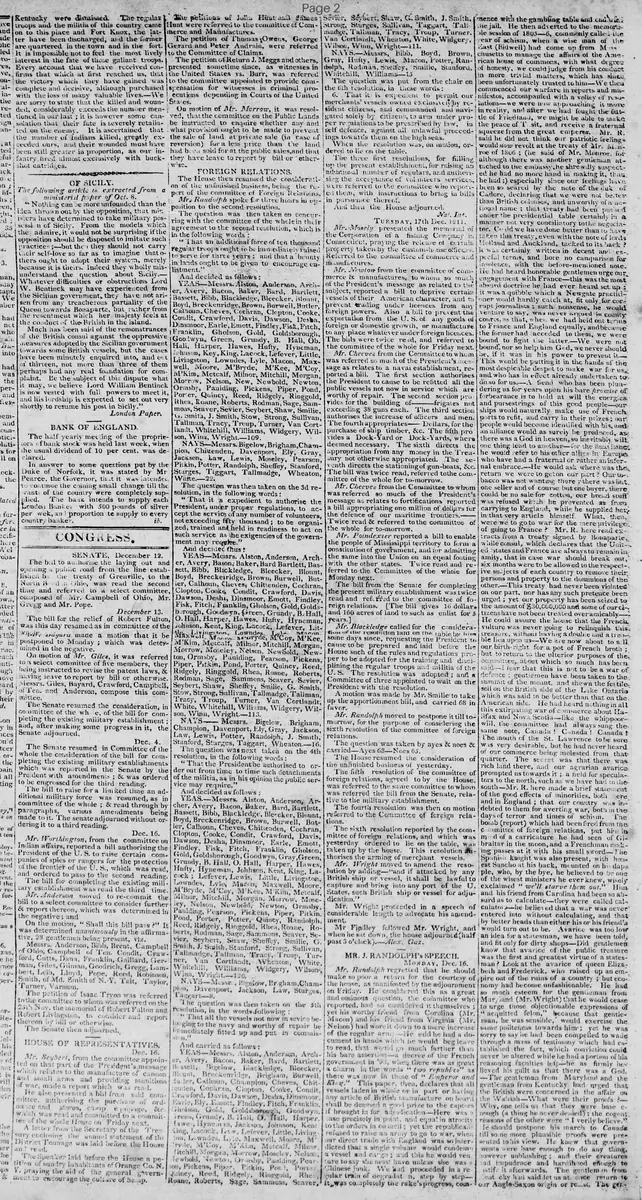
SENATE. December 12.
The bill to authorise the laying out and opening a public road from the line established by the treaty of Greenville, to the North Bend Ohio, was read the second time and referred to a select committee, composed of Mr. Campbell of Ohio, Mr. Gregg and Mr. Pope.
December 13.
The bill for the relief of Robert Fulton, was this day resumed as in committee of the whole. Mr. Taylor made a motion that it be postponed to Monday; which was determined in the negative.
On motion of Mr. Giles, it was referred to a select committee of five members, they being instructed to revise the patent laws, & having leave to report by bill or otherwise. Messrs. Giles, Bayard, Crawford, Campbell, of Tenn. and Anderson, compose this committee.
The Senate resumed the Consideration, in committee of the whole, of the bill for completing the existing military establishment: and, after making some progress in it, the Senate adjourned.
Dec. 14.
The Senate resumed in Committee of the whole the consideration of the bill for completing the existing military establishments which was reported in the Senate by the President with amendments; & was ordered to be engrossed for the third reading.
The bill to raise for a limited time an additional military force was resumed, as in committee of the whole; & read through by paragraphs, various amendments being made to it. The senate adjourned without ordering it to a third reading.
Dec. 16.
Mr. Worthington, from the committee on Indian affairs, reported a bill authorising the President of the U. S. to raise certain companies of spies or rangers for the protection of the frontier of the U. S., which was read, and ordered to pass to the second reading.
The bill for completing the existing military establishment was read the third time. Mr. Anderson moved to re-commit the bill to a select committee to consider further & report thereon, which was determined in the negative: and On the motion, "Shall this bill pass?" It was determined unanimously in the affirmative, 28 gentlemen being present, viz. Messrs. Anderson, Bibb, Brent, Campbell of Ohio, Campbell of Tenn. Condit, Crawford, Cutts, Dana, Franklin, Gaillard, German, Giles, Gilman, Goodrich, Gregg, Lambert, Leib, Lloyd, Pope, Reed, Robinson, Smith, of Md. Smith of N. Y. Tait, Taylor, Turner, Varnum.
The petition of Isaac Tyson was referred to the committee to whom was referred on the 25th Nov. the memorial of Robert Fulton and Robert Livingston, to Consider and report thereon by bill or otherwise.
The Senate then adjourned.
HOUSE OF REPRESENTATIVES.
Dec. 16.
Mr. Seybert, from the committee appointed on that part of the President's message which relates to the manufacture of cannon and small arms and providing munitions of war, made a report which was read.
He also presented a bill from said committee, authorising the purchase of ordnance and stores, camp equipage, &c. which was read and committed to a committee of the whole house on Friday next.
A letter from the Secretary of the Treasury enclosing the annual statement of the District Tonnage was laid before the House and read.
The Speaker laid before the House a petition of sundry inhabitants of Orange Co. N. Y. praying the aid of the general government to encourage the culture of hemp.
The petitions of John Hunt and James Hunt were referred to the committee of Commerce and Manufactures.
The petition of Thomas Owens, George Gerard and Peter Andrain, were referred to the Committee of Claims.
The petition of Return J. Meigs and others, presented sometime since, as witnesses in the United States vs. Burr, was referred to the committee appointed to provide compensation for witnesses in criminal prosecutions depending in Courts of the United States.
On motion of Mr. Mercer, it was resolved, that the committee on the Public Lands be instructed to enquire whether any and what provision ought to be made to prevent the sale of land at private sale (in case of reversion) for a less price than the land had been sold for at the public sales, and that they have leave to report by bill or otherwise.
FOREIGN RELATIONS.
The House then resumed the consideration of the unfinished business, being the report of the committee of Foreign Relations.
Mr. Randolph spoke for three hours in opposition to the second resolution.
The question was then taken on concurring with the committee of the whole in their agreement to the second resolution, which is in the following words:
"That an additional force of ten thousand regular troops ought to be immediately raised to serve for three years; and that a bounty in lands ought to be given to encourage enlistment."
And decided as follows:
YEAS—Messrs. Alston, Anderson, Archer, Avery, Bacon, Baker, Bard, Bartlett, Bassett, Bibb, Blackledge, Bleecker, Blount, Boyd, Breckenridge, Brown, Burwell, Butler, Calhoun, Cheves, Cochran, Clopton, Cooke, Condit, Crawford, Davis, Dawson, Desha, Dinsmoor, Earle, Emott, Findley, Fisk, Fitch, Franklin, Gholson, Gold, Goldsborough, Goodwin, Green, Grundy, B. Hall, O. Hall, Harper, Hawes, Hufty, Hyneman, Johnson, Key, King, Lacock, Lefever, Little, Livingston, Lowndes, Lyle, Macon, Maxwell, Moore, M'Bryde, M'Kee, M'Coy, M'Kim, Metcalf, Milnor, Mitchill, Morgan, Morrow, Nelson, New, Newbold, Newton, Ormsby, Paulding, Pickens, Piper, Pond, Porter, Quincy, Reed, Ridgely, Ringgold, Rhea, Roane, Roberts, Rodman, Sage, Sammons, Seaver, Sevier, Seybert, Shaw, Smilie, G. Smith, J. Smith, Stow, Strong, Sullivan, Tallman, Tracy, Troup, Turner, Van Cortlandt, Whitehill, Williams, Widgery, Wilson, Winn, Wright.—109.
NAYS—Messrs. Bigelow, Brigham, Champion, Chittenden, Davenport, Ely, Gray, Jackson, Law, Lewis, Moseley, Pearson, Pitkin, Potter, Randolph, Sheffey, Stanford, Sturges, Taggart, Tallmadge, Wheaton, Zane.—22.
The question was then taken on the 3d resolution, in the following words:
"That it is expedient to authorise the President, under proper regulations, to accept the service of any number of volunteers, not exceeding fifty thousand; to be organized, trained and held in readiness to act on such service as the exigencies of the government may require."
And decided thus:
YEAS—Messrs. Alston, Anderson, Archer, Avery, Bacon, Baker, Bard, Bartlett, Bassett, Bibb, Blackledge, Bleecker, Blount, Boyd, Breckenridge, Brown, Burwell, Butler, Calhoun, Cheves, Chittenden, Cochran, Clopton, Cooke, Condit, Crawford, Davis, Dawson, Desha, Dinsmoor, Emott, Findley, Fisk, Fitch, Franklin, Gholson, Gold, Goldsborough, Goodwin, Green, Grundy, B. Hall, O. Hall, Harper, Hawes, Hufty, Hyneman, Johnson, Kent, King, Lacock, Lefever, Little, Livingston, Lowndes, Lyle, Macon, Maxwell, Moore, M'Bryde, M'Coy, M'Kee, M'Kim, Metcalf, Milnor, Mitchill, Morgan, Morrow, Moseley, Nelson, Newbold, Newton, Ormsby, Paulding, Pearson, Pickens, Piper, Pitkin, Pond, Porter, Quincy, Reed, Ridgely, Ringgold, Rhea, Roane, Roberts, Rodman, Sage, Sammons, Seaver, Sevier, Seybert, Shaw, Sheffey, Smilie, G. Smith, J. Smith, Stanford, Strong, Sullivan, Tallmadge, Tallman, Tracy, Troup, Turner, Van Cortlandt, White, Whitehill, Williams, Widgery, Wilson, Winn, Wright.—113.
NAYS—Messrs. Bigelow, Brigham, Champion, Davenport, Ely, Gray, Jackson, Law, Lewis, Potter, Randolph, J. Smith, Stanford, Sturges, Taggart, Wheaton.—16.
The question was next taken on the 4th resolution, in the following words:
"That the President be authorised to order out from time to time such detachments of the militia, as in his opinion the public service may require."
And decided as follows:
YEAS.—Messrs. Alston, Anderson, Archer, Avery, Bacon, Baker, Bard, Bartlett, Bassett, Bibb, Blackledge, Bleecker, Blount, Boyd, Breckenridge, Brown, Burwell, Butler, Calhoun, Cheves, Chittenden, Cochran, Clopton, Cooke, Condit, Crawford, Davis, Dawson, Desha, Dinsmoor, Earle, Emott, Findley, Fisk, Fitch, Franklin, Gholson, Gold, Goldsborough, Goodwin, Gray, Green, Grundy, B. Hall, O. Hall, Harper, Hawes, Hufty, Hyneman, Johnson, Kent, King, Lacock, Lefever, Lewis, Little, Livingston, Lowndes, Lyle, Macon, Maxwell, Moore, M'Bryde, M'Coy, M'Kee, M'Kim, Metcalf, Milnor, Mitchill, Morgan, Morrow, Moseley, Nelson, Newbold, Newton, Ormsby, Paulding, Pearson, Pickens, Piper, Pitkin, Pond, Porter, Potter, Quincy, Randolph, Reed, Ridgely, Ringgold, Rhea, Roane, Roberts, Rodman, Sage, Sammons, Seaver, Sevier, Seybert, Shaw, Sheffey, Smilie, G. Smith, J. Smith, Stanford, Strong, Sullivan, Tallmadge, Tallman, Tracy, Troup, Turner, Van Cortlandt, Wheaton, White, Whitehill, Williams, Widgery, Wilson, Winn, Wright.—120.
NAYS—Messrs. Bigelow, Brigham, Champion, Davenport, Jackson, Law, Sturges, Taggart—8.
The question was then taken on the 5th resolution, in the words following:
"That all the vessels not now in service belonging to the navy and worthy of repair be immediately fitted up and put in commission."
And carried as follows:
YEAS—Messrs. Alston, Anderson, Archer, Avery, Bacon, Baker, Bard, Bartlett, Bassett, Bigelow, Blackledge, Bleecker, Blount, Breckenridge, Brigham, Burwell, Butler, Calhoun, Champion, Cheves, Chittenden, Cochran, Clopton, Cooke, Condit, Crawford, Davis, Dawson, Desha, Dinsmoor, Earle, Ely, Emott, Findley, Fitch, Franklin, Gholson, Gold, Goldsborough, Goodwin, Green, Grundy, B. Hall, O. Hall, Harper, Hawes, Hufty, Hyneman, Jackson, Johnson, Kent, King, Lacock, Law, Lefever, Little, Livingston, Lowndes, Lyle, Maxwell, Moore, M'Bryde, M'Coy, M'Kim, Metcalf, Milnor, Mitchill, Morgan, Morrow, Moseley, Nelson, Newbold, Newton, Ormsby, Paulding, Pearson, Pickens, Piper, Pitkin, Pond, Porter, Quincy, Reed, Ridgely, Ringgold, Rhea, Roane, Roberts, Sage, Sammons, Seaver, Sevier, Seybert, Shaw, G. Smith, J. Smith, Strong, Sturges, Sullivan, Taggart, Tallmadge, Tallman, Tracy, Troup, Turner, Van Cortlandt, Wheaton, White, Widgery, Wilson, Winn, Wright—111.
NAYS.—Messrs. Bibb, Boyd, Brown, Gray, Hufty, Lewis, Macon, Potter, Randolph, Rodman, Sheffey, Smilie, Stanford, Whitehill, Williams—15
The question was put from the chair on the 6th resolution, in these words:
6. That it is expedient to permit our merchants' vessels owned exclusively by resident citizens, and commanded and navigated solely by citizens, to arm under proper regulations to be prescribed by law, in self defence, against all unlawful proceedings towards them on the high seas.
When the resolution was, on motion, ordered to lie on the table.
The three first resolutions, for filling up the present establishment, for raising an additional number of regulars, and authorising the acceptance of volunteers services, were referred to the committee who reported them, with instructions to bring in bills in pursuance thereof.
And then the House adjourned.
N. Y. Int.
Tuesday, 17th Dec. 1811.
Mr. Mosely presented the memorial of the Corporation of a fishing Company in Connecticut, praying the recovery of certain property taken by the custom-house officers. Referred to the Committee of commerce and manufactures.
Mr. Mercer from the committee of commerce & manufactures, to whom so much of the President's message as related to the subject, reported a bill to deprive certain vessels of their American character, and to prevent trading under licences from any foreign powers. Also a bill to prevent the exportation from the U. S. of any goods of foreign or domestic growth, or manufacture to any place whatever under foreign licences.
The bills were twice read, and referred to the committee of the whole for Friday next.
Mr. Cheves from the Committee to whom was referred so much of the President's message as relates to a naval establishment, reported a bill. The first section authorises the President to cause to be refitted all the public vessels not now in service which are worthy of repair. The second section provides for the building of—frigates not exceeding 38 guns each. The third section authorises the increase of officers and men. The fourth appropriates—Dollars, for the purchase of ship timber, &c. The fifth provides a Dock-Yard or Dock-Yards, where deemed necessary. The sixth directs the appropriation from any money in the Treasury not otherwise appropriated. The seventh directs the stationing of gun-boats, &c.
The bill was twice read, referred to the committee of the whole for to-morrow.
Mr. Cheves from the Committee to whom was referred so much of the President's message as relates to fortifications reported a bill appropriating one million of dollars for the defence of our maritime frontiers.—Twice read & referred to the committee of the whole for to-morrow.
Mr. Poindexter reported a bill to enable the people of Mississippi territory to form a constitution of government, and for admitting the same into the Union on an equal footing with the other states. Twice read and referred to the Committee of the whole for Monday next.
The bill from the Senate for completing the present military establishment was twice read and referred to the committee of foreign relations. [The bill gives 16 dollars and 160 acres of land to such as enlist for 5 years.]
Mr. Blackledge called for the consideration of the resolution laid on the table by him some days since, requesting the President to cause to be prepared and laid before the House such of the rules and regulations proper to be adopted for the training and disciplining the regular troops and militia of the U. S. The resolution was adopted; and a Committee of three appointed to wait on the President with the resolution.
A motion was made by Mr. Smilie to take up the apportionment bill, and carried 68 in favor.
Mr. Randolph moved to postpone it till to-morrow, for the purpose of considering the sixth resolution of the committee of foreign relations.
The question was taken by ayes & noes & carried—Ayes 68—Noes 65.
The House resumed the consideration of the unfinished business of yesterday.
The fifth resolution of the committee of foreign relations, agreed to by the House, was referred to the same committee to whom was referred the bill from the Senate, relative to the military establishment.
The fourth resolution was then on motion referred to the Committee of foreign relations.
The sixth resolution reported by the committee of foreign relations, and which was yesterday ordered to lie on the table, was taken up by the house. This resolution authorises the arming of merchant vessels.
Mr. Wright moved to amend the resolution by adding—"and if attacked by any British ship or vessel, it shall be lawful to capture and bring into any port of the U. States, such British ship or vessel for adjudication."
Mr. Wright proceeded in a speech of considerable length to advocate his amendment.
Mr. Findley followed Mr. Wright, and when he sat down, the house adjourned (half past 3 o'clock).—Alex. Gaz.
MR. J. RANDOLPH'S SPEECH.
Monday, Dec. 16.
Mr. Randolph regretted that he should make so poor a return for the courtesy of the house, as manifested by the adjournment on Friday. He considered this as a great and ominous question, the committee who reported, had so considered it themselves; yet his worthy friend from Carolina (Mr. Macon) and his friend from Virginia (Mr. Nelson) had worn it down to a mere increase of the regular army.—He said he had a document in hands which he would beg leave to read, that would go much farther than his bare assertion—a decree of the French government in '99, when there was as great a charm in the words "two republics" as there was now in those of "Emperor and King." This paper, then, declares that all vessels laden in whole or in part or having any article of British manufacture on board shall be deemed a good prize to the captors if brought in for adjudication—Here was a case precisely in point, and equal in atrocity to the orders in council; yet the republicans refused to raise an army to go to war, when our direct trade with England was so interdicted that a single volume would condemn a vessel and cargo; and this he would venture to say she must have unless she was a Chinese junk. We had proceeded in a regular train of degradation, step by step—it was completely the rake's progress, commence with the gambling table and end with the jail. He then adverted to the memorable session of 1805-6, commonly called the year of schism, when a wise man of the East (Bidwell) had come up from Mass chusetts to manage the affairs of the American house of commons. with what degree of honesty, we could judge from his conduct in more trivial matters, which has since been unfortunately trusted to him—We then commenced our warfare in reports and manifestos, accompanied with a volley of resolutions—we were now approaching it more in reality, and after we had fought the battle of Friedland, we might be able to make the peace of Tilsit, and receive a fraternal squeeze from the great emperor. Mr. R. said he did not think our patriotic feelings would now revolt at the treaty of Mr. Monroe of 1803; (he said of Mr. Monroe, for although there was another gentleman attached to the embassy, he shrewdly suspected he had no more hand in making it, than he had;) especially since our feelings have been so seared by the note of the duke of Cadore, declaring that we were not better than British colonies, and unworthy of a national name: that treaty had been pushed under the presidential table certainly in a manner not very conciliatory to the negotiator. Could we have done better than to have taken this treaty, even with the note of lords Holland and Auckland, tacked to its back? it was certainly written in decent and respectful terms, and bore no comparison for insolence, with the before-mentioned note.
He had heard honorable gentlemen urge our engagement with France this was the most absurd doctrine he had ever heard set up: it was a quibble which a Newgate practitioner would hardly catch at, fit only for corrupt journalists: such nonsense, he would venture to say, was never argued in county courts, as that, when we had held out terms to France and England equally, and because the former had acceded to them, we were bound to fight the latter.—We were not bound, nor so help him God, we never should be, if it was in his power to prevent it. This would be putting it in the hands of the most despicable despot to make war for us: and who has in effect already undertaken to do so for us.—A fiend who has been plundering us for years upon his bare promise of forbearance is to hold at will the energies and purse-strings of this good people—our ships would naturally make use of French ports to refit, and carry in their prizes; our people would become identified with his, and an alliance would as surely be produced, as there was a God in heaven, so inevitably will one thing lead to another—for the financiers he would refer to his other allies in Europe who have had a fraternal or rather an infernal embrace.—He would ask where was the return we were to get on our part: Our tobacco was not wanting there; there was but one seller and of course but one buyer, there could be no sale for cotton, our bread stuffs was refused which he prevented us from carrying to England, while he supplied her in that very article himself. What, then, were we to go to war for the mere privilege of going to France? Mr. R. here read extracts from a treaty signed by Bonaparte while consul, which declares that the United States and France are always to remain in amity, that in case war should break out, six months were to be allowed to the respective subjects of each country to remove their persons and property to the dominions of the other.—This treaty had never been violated on our part, nor has any such pretence been urged; yet our property has been seized to the amount of $30,000,000 and some of our citizens have not been treated over amicably— He could assure the house that the French vulture was never going to relinquish this treasure, without having a double and a treble lien upon us—We are now about to sell our birth-right for a pot of French broth; but to return to the ulterior purposes of the committee, about which so much has been said—I fear that this is not to be a war of defence; gentlemen have been taken to the summit of the mount, and shewn the fertile soil on the British side of the Lake Ontario which was said to be better than that on the American side. He had heard nothing in all this extirpating war of commerce about Halifax and Nova Scotia—like the whippoorwill, the committee had always sung the same note, Canada! Canada! Canada! The mouth of the St. Lawrence to be sure was very desirable, but he had never heard of our commerce being molested from that quarter. The secret was that there was rich land there, and our agrarian avarice prompted us towards it; a field for speculators to the north, such as we have had to the south—Mr. R. here made a brief statement of the good effects of minorities, both here and in England; that our country was indebted to them for averting war, both in the days of terror and times of schism. The bomb (report) which had been fired from the committee of foreign relations, put him in mind of a caricature he had seen of Gibraltar in the moon, and a Frenchman making passes at it with his small sword—The Spanish knight was also present, with honest Sancho at his back, mounted on his dapple, who, by the bye, he believed to be one of the wisest ministers he ever knew, wisely exclaimed "we'll starve them out." Him and his friend from Carolina had been so absurd as to calculate—they were called calculators—he believed that a war was never entered into without calculating, and that by better heads than either his or his friend's would turn out to be. Avarice was too low an idea for a statesman, we have been told, and fit only for dirty shops—Did gentlemen know that avarice of the public treasure was the first and greatest virtue of a statesman? Look at the avarice of queen Elizabeth and Frederick, who raised up an empire out of the ruins of a country; but economy had become unfashionable. He had so much esteem for the gentleman from Maryland (Mr. Wright) that he would cease to urge those objectionable expressions of "acquitted felon," because that gentleman, he was sensible, would exercise the same politeness towards him; yet he was sorry to say he had been compelled to wade through a mass of testimony which had established the fact, which conviction could never be altered while he had a portion of his reasoning faculties left—he as firmly believed his guilt as that there was a God. —The gentleman from Maryland and the gentleman from Kentucky had urged that the British were concerned in the affair on the Wabash—What were their proofs Why, one tells us that they were base enough (a thing he never denied) ; the cogent reasons of the other were "I verily believe." He should postpone his march to Canada till some more plausible proofs were presented to his view. He knew that governments were base enough to do any thing, however unblushing; and their creatures had impudence and hardihood enough to justify it afterwards. The gentleman from Kentucky had said let us at once return to our Anglo-Saxon origin or rc
Gentleman should recollect that to Anglo-Saxon origin we were indebted for all our boasted theory of government—the habeas corpus act, the trial by jury and many other things which we prized so highly were of Anglo-Saxon origin, and if we ourselves had not been, we would have submitted to the taxes of the Norths and Greenvilles.
Here Mr. Randolph read the names of the first remonstrators to British rapacity: which were of Anglo-Saxon origin; if we had been from French loins, he trembled for the consequence, for though bad masters they were the best slaves in the world, and would never have resisted for the trifling impost of two-pence per pound on tea. We were very particular that our sheep should be of the real merino. our horses of the best blood; our oxen too, or bulls, if gentlemen will have it, must be of the largest size; every thing must be improved but human nature. that must be left to dwindle down to stuff that will make a standing army.
Our forefathers had received their ideas of honor and morality from the most pure sources; they had not received their lectures from the French apostle. the author of the Age of Reason—But he had been accused of the horrible political sin of calculating the resources of the British nation: we had not the surplus capital nor population of that country to war with—nor in the way we were going on he much doubted whether we ever should have it, for by cooping up the savages and depriving them of their land, we had saddled ourselves with an Indian war The western country were now acting upon us, a drain upon us, our richest valleys were depopulated, and our specie carried off; while all this was transacting, the western people would be satisfied, but when they had nothing to gain, we should again hear them clamor against the Atlantic states. It was sometimes necessary to put avarice, dollars and cents, in one scale, and honor in the other; he had no doubt but him and his worthy friend from N. Carolina, (Stanford,) would be outweighed by the generals, colonels and captains in employ. He sincerely wished he could give up his feeble and fruitless opposition, and like the gentlemen on the other side of the house, say go! If he was the enemy of this government he would do so, he would give the administration rope, and let them go to the full length of their tether. We were told there was no danger in thirty thousand standing regulars, this was hooted at, these notions which were hammered into us in Adams's time, were to be kicked out of us now—with twenty two thousand men, Caesar passed the Rubicon. and fought the famous battle of Pharsalia, which made him master of half the world. There always had been, and always would be, a town and country party: As your filthy and populous cities produce disease & pestilence. so will this miserable and execrable thing called a standing army produce a despot, a king. Under the present government, our army and navy had cost us fifty millions of dollars—one million five hundred thousand of which had been expended in oyster boats, or floating hells called gun-boats; while the militia were put off with an appropriation of two hundred and fifty thousand dollars, which the clerk sneered at, as he brought it down from the other House. He was always a friend to the militia, and would always stand up for the militia, for in so doing he was advocating the people themselves—with this view he had reported a bill appropriating one million of dollars, annually, which had been frittered down to the sum before mentioned. There was no patronage in delivering out arms to the militia, and therefore the money must go to the support of navy agents, and to feed hungry commissaries—these creatures knew the hand that fed them, and make a suitable return, they originated in corruption and were fit instruments to support the rotten pillars of government—But we were told that party distinctions were to be done away, and this was to be a war of unity—Gentlemen on both sides have laid their heads together, like a couple of lawyers at the expense of their client, or rather like a tailor's shears laid into the cloth of his customer—the poor little minority of 1806, was to be cut in twain. He was glad to hear hat this was to be a war for domestic manufactures, to carry our produce and return home with such articles as our necessities may require. Homespun was no novelty in his country. He had once been vain enough (so strange were his prejudices in favor of it) to pride himself as being dressed in a suit of Virginia cloth, till he discovered that a man's patriotism did not consist in what he eat, drank and wore, when he shook it off, as far as related to externals.
He was almost persuaded to believe that the wife of Hector and lady Lucretia herself must have been Virginia matrons, especially the latter, as she was found spinning among her maids—When he saw a Virginia lady occupied in the affairs of her household and domestic manufactures, he could bow down and do her reverence, so much was his heart impressed with the divinity of the object.
Had the empress of France made her appearance at our agricultural exhibition, held some days since in George Town, how proud would have been the comparison to the American house-wife. He then returned to the subject of the war, which, if entered into, he declared would be as much an object of calculation by the administration as a pound of powder and shot was to a Potomac ducker; one says this will produce me so many white-backs, the other says we shall gain Canada. He declared the political Millennium to be at hand, when the lion & lamb should lie down together. Citizen Genet & John Adams had become flaming patriots, and if their friend and coadjutor Peter Porcupine, was not permitted to join them and make the trio, it was the fault of the keeper of Newgate. He declared that he was not the versatile tool of power, but had always been the same; whether in the reign of John, Thomas or James, he should set his face against armies and all mercenary dependents, and not like some follow the ignes fatui which hover about the marshes of Goose Creek [a stream which runs below the president's house, now called the Tiber.] He presented to the view of the house the injuries which would arise from speculators—he complimented Mr. Nelson of Virginia on the patriotism of his father, who had sacrificed a princely fortune in the revolutionary contest; this was a kind of patriotism which had grown out of fashion now, and had to give precedence to the more modern kind that went smelling and rooting for office.
He declared that His heart had beat responsive at the name of a statesman to whom he had been compared by the gentleman from South Carolina (Mr. Calhoun)—it had impressed him more sensibly than he otherwise should have been with the imperfections of his poor weak and feeble frame—He wished to God he possessed any one quality in common with that man, whose stern voice and eagle eye, had held at bay the corruption of the throne, whose wrath and air could allure but not destroy, yet however much of a pigmy he might be to that giant in all great and political essentials, he was proud in the idea that like him he had arrived at the honor of being hated by every scoundrel in the nation.
[When Mr. R. sat down he declared his heart to be too full to give utterance to his feelings—He was more argumentative to-day than common, and more eloquent at the close. The above are a few of his most prominent ideas, which were hastily sketched during his speaking—He occupied the floor for 3 hours & 20 minutes.]
Alex. Herald.
What sub-type of article is it?
What keywords are associated?
What entities or persons were involved?
Where did it happen?
Domestic News Details
Primary Location
Washington
Event Date
December 12 17, 1811
Key Persons
Outcome
senate passed bill for completing military establishment unanimously (28-0). house votes: second resolution 109-22 yeas; third 113-16 yeas; fourth 120-8 yeas; fifth 111-15 yeas; sixth ordered to lie on table. various bills referred to committees. apportionment bill consideration postponed.
Event Details
Reports on U.S. Senate and House proceedings from December 12-17, 1811, including bills on public roads, relief for Robert Fulton, revising patent laws, military establishment, additional military force, Indian affairs rangers, purchase of ordnance, tonnage statement, petitions for hemp culture and claims, public lands sales, foreign relations resolutions on troops, volunteers, militia, navy vessels, and arming merchant ships. Includes Mr. Randolph's extended speech opposing military increases and war preparations.