Thank you for visiting SNEWPapers!
Sign up free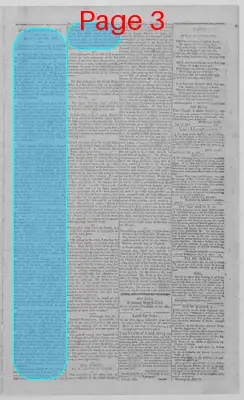
Editorial
July 31, 1801
The National Intelligencer And Washington Advertiser
Washington, District Of Columbia
What is this article about?
Editorial reports President Jefferson and Secretary Madison leaving Washington, notes European news, previews a British Commons debate on crisis, and defends philosophers and science against historical and recent persecution, urging American leaders to support learning and reject intolerance.
Clipping
OCR Quality
98%
Excellent
Full Text
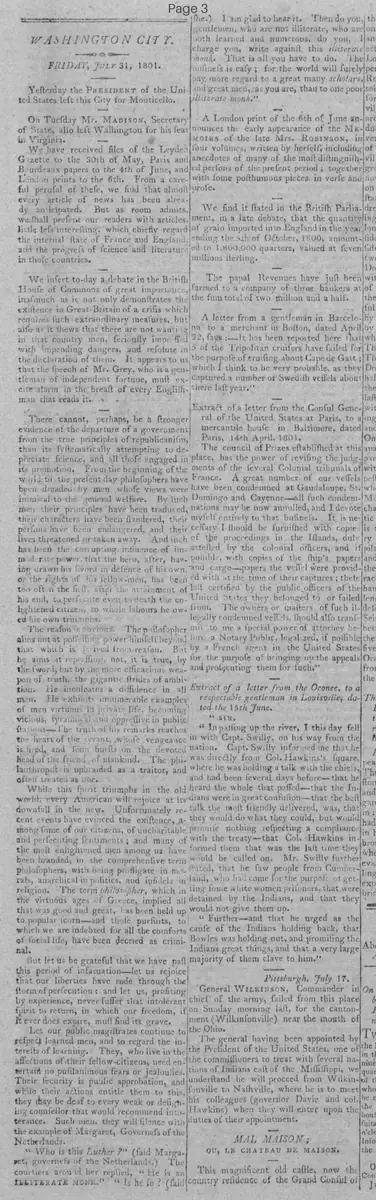
WASHINGTON CITY
FRIDAY, JULY 31, 1801.
Yesterday the President of the United States left this City for Monticello.
On Tuesday Mr. Madison, Secretary of State, also left Washington for his seat in Virginia.
We have received files of the Leyden Gazette to the 30th of May, Paris and Bourdeaux papers to the 4th of June, and London prints to the 6th. From a careful perusal of these, we find that almost every article of news has been already anticipated. But as room admits, we shall present our readers with articles little less interesting, which chiefly regard the internal state of France and England, and the progress of science and literature in those countries.
We insert to-day a debate in the British House of Commons of great importance, inasmuch as it not only demonstrates the existence in Great-Britain of a crisis which requires such extraordinary measures, but also as it shows that there are not wanting in that country men, seriously impressed with impending dangers, and resolute in the declaration of them. It appears to us that the speech of Mr. Grey, who is a gentleman of independent fortune, must excite alarm in the breast of every Englishman that reads it.
There cannot, perhaps, be a stronger evidence of the departure of a government from the true principles of republicanism, than its systematically attempting to depreciate science, and all those engaged in its promotion. From the beginning of the world to the present day philosophers have been dreaded by men whose views were inimical to the general welfare. By such men their principles have been traduced, their characters have been slandered, their persons have been endangered, and their lives threatened or taken away. And such has been the corrupting influence of immoderate power, that the hero, after having drawn his sword in defence of his own, or the rights of his fellow-men, has been too often the first, after the attainment of his end, to persecute even to death the enlightened citizen, to whose labours he owed his own triumphs.
The reason is obvious. The philosopher aims not at possessing power himself beyond that which is derived from reason. But he aims at repressing, not, it is true, by the sword, but by the more efficacious weapon of truth, the gigantic strides of ambition. He inculcates a diffidence in all men. He exhibits innumerable examples of men virtuous in private life, becoming vicious, tyrannical and oppressive in public stations. The truth of his remarks reaches the heart of the tyrant, whose vengeance is fired, and soon bursts on the devoted head of the friend of mankind. The philanthropist is upbraided as a traitor, and often treated as one.
While this spirit triumphs in the old world, every American will rejoice at its downfall in the new. Unfortunately recent events have evinced the existence, among some of our citizens, of uncharitable and persecuting sentiments; and many of the most enlightened men among us have been branded, in the comprehensive term philosophers, with being profligate in morals, anarchical in politics, and infidels in religion. The term philosopher, which in the virtuous ages of Greece, implied all that was good and great, has been held up to popular scorn—and those pursuits, to which we are indebted for all the comforts of social life, have been decried as criminal.
But let us be grateful that we have past this period of infatuation—let us rejoice that our liberties have rode through the storm of persecution: and let us, profiting by experience, never suffer that intolerant spirit to return, in which our freedom, if it ever does expire, must find its grave.
Let our public magistrates continue to respect learned men, and to regard the interests of learning. They, who live in the affections of their fellow-citizens, need entertain no pusillanimous fears or jealousies. Their security is public approbation, and while their actions entitle them to this, they may be deaf to every weak or designing counsellor that would recommend intolerance. Such men, they will silence with the example of Margaret, Governess of the Netherlands.
"Who is this Luther?" (said Margaret, governess of the Netherlands.) The courtiers around her replied, "He is an illiterate monk." "Is he so?" (said she.) "I am glad to hear it. Then do you, gentlemen, who are not illiterate, who are both learned and numerous, do you, I charge you, write against this illiterate monk. That is all you have to do. The business is easy; for the world will surely pay more regard to a great many scholars and great men, as you are, than to one poor illiterate monk."
FRIDAY, JULY 31, 1801.
Yesterday the President of the United States left this City for Monticello.
On Tuesday Mr. Madison, Secretary of State, also left Washington for his seat in Virginia.
We have received files of the Leyden Gazette to the 30th of May, Paris and Bourdeaux papers to the 4th of June, and London prints to the 6th. From a careful perusal of these, we find that almost every article of news has been already anticipated. But as room admits, we shall present our readers with articles little less interesting, which chiefly regard the internal state of France and England, and the progress of science and literature in those countries.
We insert to-day a debate in the British House of Commons of great importance, inasmuch as it not only demonstrates the existence in Great-Britain of a crisis which requires such extraordinary measures, but also as it shows that there are not wanting in that country men, seriously impressed with impending dangers, and resolute in the declaration of them. It appears to us that the speech of Mr. Grey, who is a gentleman of independent fortune, must excite alarm in the breast of every Englishman that reads it.
There cannot, perhaps, be a stronger evidence of the departure of a government from the true principles of republicanism, than its systematically attempting to depreciate science, and all those engaged in its promotion. From the beginning of the world to the present day philosophers have been dreaded by men whose views were inimical to the general welfare. By such men their principles have been traduced, their characters have been slandered, their persons have been endangered, and their lives threatened or taken away. And such has been the corrupting influence of immoderate power, that the hero, after having drawn his sword in defence of his own, or the rights of his fellow-men, has been too often the first, after the attainment of his end, to persecute even to death the enlightened citizen, to whose labours he owed his own triumphs.
The reason is obvious. The philosopher aims not at possessing power himself beyond that which is derived from reason. But he aims at repressing, not, it is true, by the sword, but by the more efficacious weapon of truth, the gigantic strides of ambition. He inculcates a diffidence in all men. He exhibits innumerable examples of men virtuous in private life, becoming vicious, tyrannical and oppressive in public stations. The truth of his remarks reaches the heart of the tyrant, whose vengeance is fired, and soon bursts on the devoted head of the friend of mankind. The philanthropist is upbraided as a traitor, and often treated as one.
While this spirit triumphs in the old world, every American will rejoice at its downfall in the new. Unfortunately recent events have evinced the existence, among some of our citizens, of uncharitable and persecuting sentiments; and many of the most enlightened men among us have been branded, in the comprehensive term philosophers, with being profligate in morals, anarchical in politics, and infidels in religion. The term philosopher, which in the virtuous ages of Greece, implied all that was good and great, has been held up to popular scorn—and those pursuits, to which we are indebted for all the comforts of social life, have been decried as criminal.
But let us be grateful that we have past this period of infatuation—let us rejoice that our liberties have rode through the storm of persecution: and let us, profiting by experience, never suffer that intolerant spirit to return, in which our freedom, if it ever does expire, must find its grave.
Let our public magistrates continue to respect learned men, and to regard the interests of learning. They, who live in the affections of their fellow-citizens, need entertain no pusillanimous fears or jealousies. Their security is public approbation, and while their actions entitle them to this, they may be deaf to every weak or designing counsellor that would recommend intolerance. Such men, they will silence with the example of Margaret, Governess of the Netherlands.
"Who is this Luther?" (said Margaret, governess of the Netherlands.) The courtiers around her replied, "He is an illiterate monk." "Is he so?" (said she.) "I am glad to hear it. Then do you, gentlemen, who are not illiterate, who are both learned and numerous, do you, I charge you, write against this illiterate monk. That is all you have to do. The business is easy; for the world will surely pay more regard to a great many scholars and great men, as you are, than to one poor illiterate monk."
What sub-type of article is it?
Science Or Medicine
Moral Or Religious
Social Reform
What keywords are associated?
Philosophers
Persecution
Science
Learning
Republicanism
Intolerance
Tyranny
American Liberties
What entities or persons were involved?
Mr. Grey
Margaret, Governess Of The Netherlands
Luther
President Of The United States
Mr. Madison
Editorial Details
Primary Topic
Defense Of Philosophers And Science Against Persecution
Stance / Tone
Supportive Of Learning And Republican Principles, Against Intolerance
Key Figures
Mr. Grey
Margaret, Governess Of The Netherlands
Luther
President Of The United States
Mr. Madison
Key Arguments
Governments Depart From Republicanism By Depreciating Science
Philosophers Are Persecuted By Tyrants For Challenging Ambition With Truth
Americans Should Rejoice At Downfall Of Intolerance In The New World
Recent U.S. Events Show Lingering Persecuting Sentiments Against Philosophers
Public Magistrates Must Respect Learned Men And Reject Intolerance
Example Of Margaret Urging Scholars To Refute Luther