Thank you for visiting SNEWPapers!
Sign up free
Literary
July 30, 1828
Virginia Statesman
Wheeling, Ohio County, West Virginia
What is this article about?
Description of albinos among African negroes and Darien Indians, their physical traits, nocturnal habits, and societal rejection. Discusses Buffon's theory that they result from degeneration of primitive white humans due to climate, food, and manners, with examples from nature.
Clipping
OCR Quality
80%
Good
Full Text
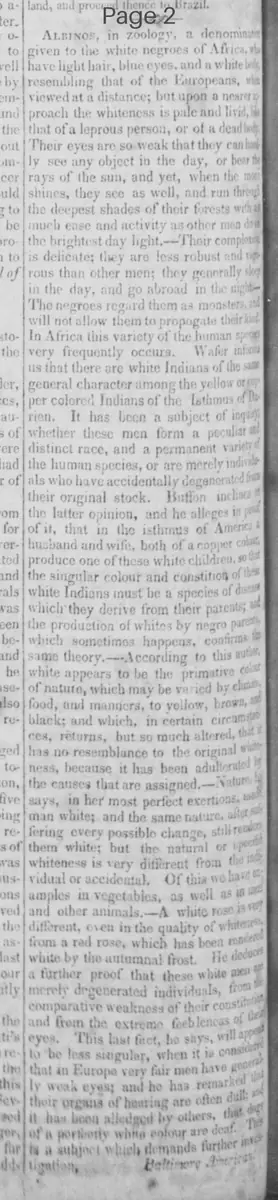
Albinos, in zoology, a denomination given to the white negroes of Africa, who have light hair, blue eyes, and a white body, resembling that of the Europeans, viewed at a distance; but upon a nearer approach the whiteness is pale and livid, like that of a leprous person, or of a dead body. Their eyes are so weak that they can hardly see any object in the day, or bear the rays of the sun, and yet, when the moon shines, they see as well, and run through the deepest shades of their forests with as much ease and activity as other men do in the brightest daylight. Their complexion is delicate: they are less robust and numerous than other men; they generally sleep in the day, and go abroad in the night. The negroes regard them as monsters, and will not allow them to propagate their kind. In Africa this variety of the human species very frequently occurs. We are informed that there are white Indians of the general character among the yellow or copper colored Indians of the Isthmus of Darien. It has been a subject of inquiry whether these men form a peculiar and distinct race, and a permanent variety of the human species, or are merely individuals who have accidentally degenerated in their original stock. Buffon inclines to the latter opinion, and he alleges in proof of it, that in the isthmus of America husband and wife, both of a copper color produce one of these white children, so that the singular colour and constitution of the white Indians must be a species of diathesis which they derive from their parents; the production of whites by negro parents, which sometimes happens, confirms the same theory.—According to this author, the white appears to be the primitive color of nature, which may be varied by climate, food, and manners, to yellow, brown, black; and which, in certain circumstances, returns, but so much altered, that its whiteness, because it has been adulterated has no resemblance to the original the causes that are assigned.—Nature says, in her most perfect exertions, man is white; and the same nature, after suffering every possible change, still retains in them white; but the natural or perfect whiteness is very different from the individual or accidental. Of this we have examples in vegetables, as well as in men and other animals.—A white rose is different, even in the quality of whiteness, from a red rose, which has been made white by the autumnal frost. He adduces a further proof that these white men are merely degenerated individuals, from the extreme feebleness of their eyesight, and from the comparative weakness of their constitution, which will appear less singular, when it is considered that in Europe very fair men have generally weak eyes; and he has remarked that their organs of hearing are often dull. It has been alleged by others, that probably when this color are deaf.
Baltimore Surgeant
Baltimore Surgeant
What sub-type of article is it?
Essay
What themes does it cover?
Nature
What keywords are associated?
Albinos
White Negroes
Buffon
Degeneration
Human Variation
Primitive White
Racial Diathesis
What entities or persons were involved?
Baltimore Surgeant
Literary Details
Author
Baltimore Surgeant
Subject
Albinos, In Zoology
Key Lines
Albinos, In Zoology, A Denomination Given To The White Negroes Of Africa, Who Have Light Hair, Blue Eyes, And A White Body, Resembling That Of The Europeans, Viewed At A Distance; But Upon A Nearer Approach The Whiteness Is Pale And Livid, Like That Of A Leprous Person, Or Of A Dead Body.
According To This Author, The White Appears To Be The Primitive Color Of Nature, Which May Be Varied By Climate, Food, And Manners, To Yellow, Brown, Black; And Which, In Certain Circumstances, Returns, But So Much Altered, That Its Whiteness, Because It Has Been Adulterated Has No Resemblance To The Original The Causes That Are Assigned.