Thank you for visiting SNEWPapers!
Sign up free
Lynchburg Virginian
Lynchburg, Virginia
What is this article about?
In the U.S. Senate during the 22nd Congress 2nd Session, Virginia Senator John Tyler speaks against the Revenue Collection Bill, arguing it empowers the President excessively and threatens states' rights. He reviews U.S. constitutional history, defends federalism over nationalism, and urges peaceful resolution to avoid civil conflict amid the Nullification Crisis.
Merged-components note: These components form a continuous narrative of Mr. Tyler's speech on the Revenue Collection Bill, spanning multiple columns on page 1 and continuing onto page 2. The content flows sequentially without interruption, making it a single logical story unit. Label adjusted to 'story' as it best describes the full political narrative.
Clippings
1 of 2
OCR Quality
Full Text
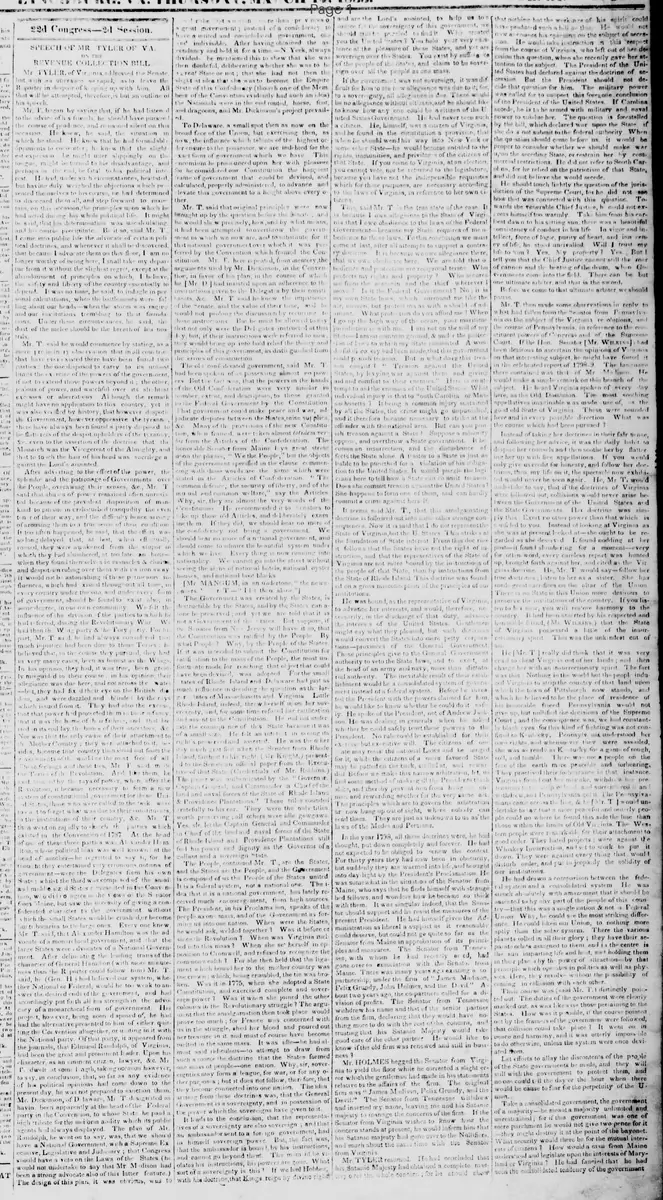
SPEECH OF MR. TYLER, OF VA.
On the Revenue Collection Bill.
Mr. TYLER, of Virginia, addressed the Senate with such unfeigned rapidity, as to leave the Reporter in despair of keeping up with him. All that will be attempted, therefore, is but an outline of his speech.
Mr. T. began by saying that, if he had listened to the advice of his friends, he should have pursued the course of patience, and remained silent on this occasion. He knew, he said, the situation in which he stood. He knew that he had formidable opponents to encounter. He knew that the slightest expression he might utter, slippingly on the tongue, might be turned to his disadvantage, and perhaps in the end, be fatal to his political interests. He had, under such circumstances, hesitated. But having duly weighed the objections which presented themselves to his course, he had determined to disregard them all, and step forward to maintain, on this occasion, the principles upon which he had acted during his whole political life. It might be said, that his determination was uncalculating and his course precipitate. Be it so, said Mr. T. I came into public life the advocate of certain political doctrines, and whenever it shall be discovered that because I advocate them on this floor, I am no longer worthy of being here, I shall take my departure from it without the slightest regret, except at the abandonment of principles on which, I believe, the safety and liberty of the country essentially depend. It was no time, he said, to indulge in personal calculations, when the battlements were falling about our heads—when the storm was raging, and our institutions trembling to their foundations. Under those circumstances, he said, the dust of the melee should be the breath of his nostrils.
Mr. T. said he would commence by stating, as a mere introductory observation, that in all countries that have ever existed there have been found two parties—the one disposed to carry to the utmost limits the exercise of the powers of the government, if not to extend those powers beyond it; the other, jealous of power, and watchful over its slightest excesses or aberrations. Although the remark might have no application to this country, yet it was always verified by history, that however despotic the government, however oppressive the tyrant, there have always been found a party disposed to be flatterers of the despot, upholders of the tyranny, even to the assertion of the doctrine that the Monarch was the Vicegerent of the Almighty, and that to touch the hair of his head was sacrilege against the Lord's anointed.
After adverting to the effect of the power, the splendor and the patronage of Governments over the People, overawing their senses, &c., Mr. T. said that abuse of power remained often unrestrained because of the prevalent disposition of mankind to pursue in undisturbed tranquility the even tenor of their way, and the difficulty hence arising of arousing them to a true sense of their condition. It too often happened, he said, that the effort was so long delayed that, at last, when effectual, roused, they were awakened from the stupor in which they had slumbered, at too late an hour—when they found themselves in manacles & chains, and despotism ruling over them with its iron sway. It would not be astonishing if these pernicious influences, which had existed throughout all time, in every country under the sun and under every form of government, should be found to exist also, in some degree, in our own community. We felt the influence of the division of the parties to which he had referred, during the Revolutionary War. We had then the Whig party & the Tory party. For his part, Mr. T. said, he had always considered that much injustice had been done to those Tories: he believed that, in the course they pursued, they had, in very many cases, been as honest as the Whigs. In his opinion, they had, it was true, been greatly misguided in their course: in his opinion, their allegiance was due here, and not across the water—but, they had fixed their eye on the British drum, and were dazzled and blinded by the rays which issued from it. They had also the excuse that power had protected them with money. That it was the home of their fathers, and that buried in its soil lay the bones of their ancestors. &c. Nor was that the only cause of their attachment to the Mother Country, they were attached to it, said he, because that country then stood out from the governments of the world the most free of all the free seas and hearts. Mr. T. said in the Irish Revolution. And like them. Le nd sinned by the rays of power, when after the Revolution, it became necessary to form a new system of constitutional government for these United States, those who were called to the task were too apt to forget what was due to their constituents o the institutions of their country, &c. Mr. T. then went on rapidly to sketch the parties which exerted in the Convention of 1787. At the head of one of these three parties was Alexander Hamilton, whose political bias was well known at the head of another—he regretted to say it, for he thought they entertained very erroneous notions of government—were the Delegates from his own State: whilst the third was composed of the small and middle sized States represented in the Convention, who did not agree in the views of the Senator from Maine, but saw the necessity of giving a confederated character to the government without which the small States would be crushed, or become but tributaries to the large ones. Every one knew, Mr. T. said, that Alexander Hamilton was the advocate of a monarchical government, and that the large States were advocates of a National Government. After delineating the leading traits of the character of General Hamilton (with more minuteness than the Reporter could follow him) Mr. T. said, he (Gen. H.) had believed our system, whether National or Federal, would be too weak to answer the desired ends of the government, and had accordingly put forth all his strength in the advocacy of a monarchical form of government. His project, however, being soon disposed of, he had had the alternative presented to him of either quitting the Convention altogether, or uniting in it with the National party. Of that party, it appeared from the journals, that Edmund Randolph, of Virginia, had been the great and prominent leader. Upon his character, as an eminent citizen, lawyer, &c. Mr. T. dwelt at some length, taking occasion however, to say, in conclusion, that, so far as any evidence of his political opinions had come down to the present day, he was not prepared to sanction them. Mr. Dickinson, of Delaware, Mr. T. designated as having been apparently at the head of the Federal party in the Convention, to whose State he paid a high tribute for the uniform loyalty which its public agents had always displayed. The plan of Mr. Randolph, he went on to say, was, that we should have a National Government, with a Supreme Executive, Legislative and Judiciary; that Congress should have a veto on the Laws of the States (he would not undertake to say that Mr. Madison had been a strong advocate also of this latter feature.) The design of this plan, it was obvious, was to have a great government; instead of a confederacy. To have a united and consolidated government, one and indivisible. After having obtained the ascendancy and held it for a time—N. York, always divided—he mentioned this to show that she was then doubtful, deliberating whether she was to be a great State or not; that she had not then the slightest idea that she was to become the Empire State of this Confederacy (though one of the Members of the Convention evidently had such an idea) the Nationals were in the end routed, horse, foot, and dragoons, and Mr. Dickinson's project prevailed.
To Delaware, a small spot then as now on the broad face of the Union, but exercising then, as now, the influence which talents of the highest order ensure to the possessor, we are indebted for the exact form of government which we have. This encomium he pronounced upon her with pleasure for he considered our Constitution the happiest frame of government that could be devised, and calculated, properly administered, to advance and elevate this government to a height above every other.
Mr. T. said that original principles were now brought up by the question before the Senate, and he would show precisely, how, and by what means it had been attempted to overthrow the government in which we now are, and to substitute for it that national government over which it was preferred by the Convention which framed the Constitution. Mr. T. here repeated, from memory, the arguments used by Mr. Dickinson, in the Convention, in favor of his plan, in the course of which he [Mr. D.] had insisted upon an adherence to the instructions given to the Delegates by their constituents &c. Mr. T. said he knew the importance of the Senate, and the value of their time, and he would not prolong the discussion by reading those instructions. But he must be allowed to say that not only were the Delegates instructed at that time, but, if their instructions were referred to now, they would bring up into bold relief the theory and principles of this government, as distinguished from the errors of construction.
The old confederated government, said Mr. T., had been spoken of as possessing almost no powers. But the fact was, that the powers in the hands of the Old Confederation were very similar in number, extent, and description, to those granted to the Federal Government by the Constitution. That government could make peace and war, and adjudicate disputes between the States, raise supplies, &c. Many of the provisions of the new Constitution, when formed, were taken almost totidem verbis from the Articles of the Confederation. The honorable Senator from Maine lays great stress upon the phrase, "We the People," but the objects of the government specified in the clause commencing with those words are the same which were stated in the Articles of Confederation. "The common defence, the security of liberty, and of the mutual and common welfare," say the Articles. Why, sir, they are almost the very words of the Constitution. I recommend it to Senators to take up those old Articles, and deliberately examine them. If they did, we should hear no more of the confederacy not being a government. We should hear no more of a national government, and should come to admire the beautiful system under which we live. Every thing is now running into nationality. We cannot go into the street without seeing the signs of national hotels, national oyster houses, and national boot blacks.
{Mr. MANGUM, in an undertone. "the news papers—I'll then alone"}
The Government was created by the States, is destructible by the States, and by the States can alone be preserved, and yet we are told that it is not a government of the States. But suppose, if the Senator from N. Jersey will have it so, that the Constitution was ratified by the People. By what People? Why, by the People of the States. If it was intended to submit the Constitution for ratification to the mass of the People, the most unfortunate mode for reaching that object that could have been devised, was adopted. For the small States of Rhode Island and Delaware had just as much influence in deciding the question as the large States of Massachusetts and Virginia. Little Rhode Island, indeed, threw herself upon her sovereignty, and, for some time refused her ratification and assent to the Constitution. He did not understand the consequence of this State because it was of a small size. He felt an interest in seeing its rights preserved and asserted. He was therefore much gratified when the Senator from Rhode Island, (Mr. Knight) presented to the Senate an official paper from the Executive of that State. (Credentials of Mr. Robbins.) The paper was authenticated by the "Governor and Commander in Chief of the land and naval forces of the State of Rhode Island & Providence Plantations." These titles sounded gratefully to his ear. They were the only titles worth preserving, all others were idle gewgaws. Yes, sir, let the Captain General and Commander in Chief of the land and naval forces of the State of Rhode Island and Providence Plantations still feel his power and dignity as the Governor of a gallant and a sovereign State.
The People, continued Mr. T., are the States, and the States are the People, and the Government is composed of us the People of the States united. It is a federal system, not a national one. The idea that it is a national government, has lately received much encouragement, from high sources. The President, in his Proclamation, speaks of the people as one mass, and of the Government as forming us into one nation. When were the States, he would ask, welded together? Was it before or since the Revolution? When was Virginia melted into this mass? When she set herself in opposition to Cromwell, and refused to recognize the commonwealth? For she then held that the ligament which bound her to the mother country was the crown; which, being crumbled, the tie was broken. Was it in 1776, when she adopted a State Constitution, and exercised complete and sovereign power? Was it when she joined the other colonies in the Revolutionary struggle? The argument that the amalgamation then took place would prove too much, for France was concerned with us in the struggle, shed her blood and poured out her treasure in it and must of course have become melted in the same mass. It was idle—he had almost said ridiculous—to attempt to draw from such a source the doctrine that the States formed one mass of people—one nation. Why, sir, sovereignties may form a league, for war, or for any other purpose; but it does not follow, therefore, that they become connected into one nation. The idea Government is a sovereignty, and in possession of all the attributes of sovereignty, except those which the States have transferred to it. An ambassador sent to a foreign government, had the attributes of a sovereignty also, and that it leads to the conclusion, that the representative in himself possesses sovereign power. But, the fact was, that the ambassador is bound by his instructions, and cannot go beyond them. The moment he violates his instructions, his powers are gone. What sort of a sovereignty is this? If we had Hobbes, with his doctrine, that Kings reign by divine right and are the Lord's anointed, to help us to square the sovereignty of this government, we should be compelled to find it created you the United States? You hold your very existence at the pleasure of these States, and yet are sovereign over the States. You exist by sufferance of the people of the States, and claim to be sovereign over all the people as one mass.
If the government was not sovereign, it was difficult for him to see to whom allegiance was due to it, for, to a sovereignty, all allegiance is due. There would be no allegiance without citizens, and he should like to know how any one could be a citizen of the United States Government. He had never seen such a citizen. He, himself, was a citizen of Virginia, and he found in the constitution a provision, that when he should wend his way into New York or some other State—he would become entitled to the rights, immunities, and privileges of the citizenry of that State. If you come to Virginia, at an election, you cannot vote, nor be returned to the legislature, because you have not the indispensable requisites which for those purposes, are necessary according to the laws of Virginia, in reference to her own citizens.
Thus, said Mr. T., is the true state of the case. It is because I owe allegiance to the State of Virginia that I owe obedience to the laws of the Federal Government—because my State requires of me obedience to these laws. To this conclusion we must come at last, after all attempts to support a contrary doctrine. It is because we owe allegiance there, that we owe obedience here. We are told that obedience and protection are reciprocal terms. Who protects my rights and property? Who secures us from the assassin and the thief wherever I may be? Is it the Federal Government? No, It is my own State laws, which surround me like the air, unseen but protecting me with a shield of adamant. What protection do you afford me? When I go upon the high way of the ocean, your maritime jurisdiction is with me. I am not on the soil of my State—I am on common ground, & under the protection of a law to which my State consented. A word desultory may be here made, that this government could punish treason. But in what does this consist? "Treason against the United States, by levying war against them, and giving aid and comfort to their enemies." Here an attempt to aid the enemies of the United States. What individual injury is that to South Carolina or Massachusetts? It being a common injury sustained by all the States, the crime might go unpunished, and it therefore became necessary to strike at the offender with the national arm. But can you punish treason against a State! Suppose a minority opposes, and overthrows a State government. It becomes an insurrection, and the disturbance affects the State alone. A traitor to a State is just as liable to be punished for a violation of his obligation to the United States. It would puzzle the logicians here to tell how a State can commit treason. Does she commit treason against the United States? She happens to form one of them, and can hardly commit a crime against herself.
It seems, said Mr. T., that this amalgamating doctrine is followed out into some other strange consequences. Now it is said that I do not represent the State of Virginia, but the U. States. This strikes at the foundation of state rights. From this doctrine it follows that the States have not the right of instruction, and that the representatives of the State of Virginia are not more bound by the instructions of the people of that State, than by instructions from the State of Rhode Island. This doctrine was founded on a gross misconception of the principles of our institutions.
He was bound, as the representative of Virginia, to advance her interests, and would, therefore, necessarily, in the discharge of that duty, advance the interests of the United States. Gentlemen might say what they pleased, but such doctrines would convert the States into mere petty corporations—provinces of the General Government. These principles give to the General Government authority to veto the State laws, and to exercise, at the head of an army and navy, more than dictatorial authority. The inevitable result of their establishment would be a consolidated system of government instead of a federal system. Before he invested the President with the powers claimed for him, he would like to know whether he could do it safely. He spoke of the President, not of Andrew Jackson. He was dealing in generals when he asked whether he could safely trust these powers to the President. No rule could be established for their exercise but executive will. The citizens of one State may resist the national laws and be hanged for it, while the citizens of a more favored State may be patted on the back, smiled at, and rewarded. Before we make this narrow arbitration, it is but find some method of making the Presidents think alike, and thereby prevent one from hanging men and rewarding another for the very same act.
The principles which are to govern the arbitration are now hung up out of sight, where nobody can read them. They are just as unknown to us as the laws of the Medes and Persians.
In the year 1798, all these doctrines were, he had thought, put down completely and forever. He had not expected to be obliged to renew the contest. For thirty years they had now been in obscurity, but suddenly they are warmed into life, and brought into day-light by the President's Proclamation. He was somewhat in the situation of the Senator from Maine, who says that he finds himself with strange bed fellows, and wonders how he became so thick with them. It was singular indeed, that the Senator should support and he resist the measures of the present President. He had himself given the Administration as liberal a support as it reasonably could deserve, but could not go quite so far as the Senator from Maine in approbation of its principles and measures. The Senator from Tennessee, with whom he had recently agreed, had gone over to association with the Senator from Maine. There was many years ago existing a copartnership, under the firm of "James Madison, Felix Grundy, John Holmes, and the Devil." About two years ago, the co-partners called for a division of profits. The Senator from Tennessee withdrew his name and that of the senior partner from the firm, declaring that they would have nothing more to do with the rest of the concern, and trusting that his Satanic Majesty would take good care of the other partner. He would like to know if the old firm was renewed and still in business?
Mr. HOLMES begged the Senator from Virginia to yield the floor while he corrected a slight error which the gentleman had made in his statements relative to the affairs of the firm. The original firm was "James Madison, Felix Grundy, and the Devil." The Senator from Tennessee withdrew and inserted my name, leaving me and his Satanic majesty to manage the concerns of the firm. If the Senator from Virginia wishes to know how the concern stands at present, he would inform him that his Satanic majesty had gone over to the Nullifiers, and much about the same time with the Senator from Virginia.
Mr. TYLER resumed. He had concluded that his Satanic Majesty had obtained a complete mastery over the whole concern, for he should show that nothing but the working of his spirit could have produced such a Babel as this. He would not announce his opinions on the subject of secession. He would take instruction in this respect from the course of Virginia, who left out of her decision this question, when she recently gave her attention to the subject. The President of the United States had declared against the doctrine of secession. But the President should not decide that question for him. The military power was called for to support this foregone conclusion of the President of the United States. If Carolina secede, he is to be armed with military and naval power to subdue her. The question is forestalled by the bill, which declared war upon the State, if she does not submit to the federal authority. When the question should come before us, it would be proper to consider whether we should make war upon the seceding State, or restrain her by commercial restrictions. He did not refer to South Carolina, for he relied on the patriotism of that State and did not believe she would secede.
He should touch lightly the question of the jurisdiction of the Supreme Court, for he did not see how that was connected with this question. Towards the venerable Chief Justice, he could not express himself too warmly. Taking him from his earliest dawn to his setting sun, there was a beautiful consistency of conduct in his life. In vigor and intellect, force of logic, purity of heart, and integrity of life, he stood unrivalled. Will I trust my life to him? Yes. My property? Yes. But I tell you that the Chief Justice cannot still the roar of cannon and the beating of the drum, when Governments come into the field. There can be but one ultimate arbiter and that is the sword. But, before we come to that ultimate arbiter we should pause.
Mr. T. then made some observations in reply to what had fallen from the senator from Pennsylvania on the subject of the Virginia resolutions, and the course of Pennsylvania, in reference to the constituent powers of Congress and of the Supreme Court. If the Hon. Senator [Mr. Wilkins], had been desirous to ascertain the opinions of Virginia on that interesting subject, he might have found it in the celebrated report of 1799. The language there contained was that of Mr. Madison. He would make a single remark on this branch of the subject. He heard Virginia spoken of every day here, as the Old Dominion. The most soothing appellatives imaginable was made use of, as the good old State of Virginia. These were sounded here and in every possible direction. What was the course which had been pursued? Instead of taking her doctrines in their fair sense, and following her advice, it was the daily habit to despise her counsels and then soothe her by flattering her up with fine appellations. If you would only give us credit for honesty, and follow her doctrines, then my life on it, the spectacle now exhibited would never be seen again. He, Mr. T. would mistake to say, that if the doctrines of Virginia were followed out, collisions would never arise between the Government of the United States and the State Governments. His doctrine was simply this: Exert no other power than that which is conceded to you. Instead of looking at Virginia as she was at present looked at—she ought to be regarded as she deserved. He found nodding at her post—it found all unerring for a moment—every forgotten word, every careless report was hunted up, brought forth against her, and cited as the Virginia doctrine. He, Mr. T. would say—follow her true doctrines, listen to her as a sister. She has made great sacrifices on the altar of the Union. There is no State in this Union more desirous to preserve the institutions of the country. If you listen to her truly, you will restore harmony to the country. It had been asserted by his respected and honored friend (Mr. Wilkins) that the State of Virginia possessed a little of the insurrectionary spirit. This was the unkindest cut of all.
He [Mr. T.] really did think that it was very cruel to beat Virginia out of her lands; and then charge her with an insurrectionary spirit. The fact was thus: Nothing in the world but the people induced and Virginia to strip the country of that land upon which the town of Pittsburgh now stands, and which he believed to be the place of residence of his honorable friend. Pennsylvania would not give up, but nullified the decisions of the Supreme Court, and the consequence was, we had constantly black eyes—for this kind of fighting was not confined to Kentucky. Pennsylvania understood her own rights, and whenever they were assailed, she was as ready as Kentucky for a game of rough, roll, and tumble. There was not a people on the face of the earth more peaceable and forbearing. They practised their forbearance in that instance. Virginia long mistook, when the proposition to divide and surrender entered and she withdrew, and Pennsylvania again gained. The Pennsylvanians came across at her & r. T. I would undertake to say that a more peaceable and orderly people could nowhere be found this side the line than those within the limits of Old Virginia. The Western people were remarkable for their attachment to good order. They hated projects; were against the Whiskey Insurrection, and first to work to put it down. They were against every thing that would disturb order, and put in jeopardy the stability of our institutions.
He had drawn a comparison between the federal system and a consolidated system. He was struck absolutely with amazement that it should be assented to by any part of the people of this country—that this was a single nation & not a Federal Union. Why, he could see the most striking difference. He could liken our Union, to nothing more aptly than the solar system. There the various planets rolled in all their glory; they have their separate orbits assigned to them, and in the centre is the sun imparting life and heat, and holding them in their places by the power of attraction—by that principle which operates in politics as well as physics. Here, they revolve without the possibility of coming in collision with each other.
Their course was (said Mr. T.) distinctly pointed out. The duties of the government were clearly marked out, as was likewise those pertaining to the States. How was it possible, if the course pointed out by the framers of the government were followed, that collision could take place? It went on in peace and harmony, and it was utterly impossible to do otherwise, unless the system were once deviated from.
Let efforts to allay the discontents of the people of the State governments be made, and they will still wish the government to protect them, and no one could tell the day or the hour when there would be cause to fear for the perpetuity of the U. nion.
of a majority—he meant a majority unlimited and unrestrained; for if this government was one of mere parchment he would not give two-pence for it—they might destroy it at the point of the bayonet. What security would there be for the mutual interests of citizens? How would a man from Maine understand and legislate upon the interests of Maryland or Virginia? He had fancied that he had seen the consolidated tendency of the government.
He thought he had seen it in the assertion of various powers. It could not come immediately—it will not come all at once, but by degrees, as the path for it is opened by the gradual inroads into the Constitution. The adoption of a system of internal improvement, and the protective system, are preparing the way for this consolidation. The State Governments form a cumbrous and useless part of the machinery of the system, which must be first got rid of. Then they must enlarge the Presidential term. After that comes a popular convulsion, which will form the pretence for making a President for life. These things cannot, must not be. Rely upon it the People are roused. The Campbells are coming, the banner of State rights is floating in the breeze, and its broad folds are waving over the Mississippi. The patriots who have heretofore been separated by party contests, will come back again and sit down with us on the great common principles which our self preservation as a Federal Union, calls upon us to defend. He (Mr. T.) had no fear for the result. They might be overwhelmed in the first onset, because the power which would be brought against them would be gigantic. But he was perfectly satisfied of their final victory. They had triumphed in 1828 and then they had greater disadvantages than the South and rely on it they would triumph again. He had not argued in favor of and had made no allusion to South Carolina and her difficulties. Let her take care of herself; she rests in the hands of her able Senators on this floor. He disclaimed the policy adopted by her, for it did not meet his approval. All knew that he had not approved of her course, but he was unwilling to hear denunciations tendered against her when she was only asserting her rights. He would leave South Carolina precisely where she was, without making further reference to her.
In the course of the examination he had made to this subject, he had been led to analyze certain documents which had gone out to the world over the signature of the President. He knew that his language might be seized on by those who were disposed to carp at his course, and to misrepresent him. Since he had held a place on this floor, he had not courted the smiles of the Executive, but whenever he had done any act in violation of the constitutional rights of the citizen, or trenching on the wall of this branch of the Government he had been found in opposition to him. When he appointed members of Congress to official stations and when he gave appointments to the Corps of Engineers, he thought it was his duty to oppose his course. When he nominated a Minister to a foreign Court without the approbation of the Senate he also went against him in his conscience. He believed that the act was wrong.
He defended his course, acting as he did under a sense of duty he owed to the Constitution, and he would now say, he cared not how loudly the trumpet might be sounded nor how low the priests might bend their knees before the object of their idolatry. He would stand at the side of the President, crying in his ear—Remember, Philip, thou art mortal.
He now came to the most important part of the work he had to perform. He should now proceed to touch the bill itself to which he proposed to devote a thorough examination and with such minuteness he hoped to dissect its provisions, and expose its enormities. He would take it up by sections because he believed that the work had not as yet been thoroughly done, and he desired that the Senate should be fully advised of the character of the bill before they enacted it into a law.
He objected to the first section of the bill, because it conferred on the President the power of closing ports of entry, and establishing new ones. The language of the Constitution was that all duties, imposts and excises shall be uniform throughout the United States. This provision which was general in its nature, and applicable as much to one State as to another, enabled the President to annul this clause of the Constitution. It proposed to confer a general power to close all ports of entry and to establish new ones. It was rightly said by the gentleman from Kentucky, that this was the cause which led to the revolution. It was the Boston Port bill by which the Custom house was removed to Salem which first roused the people to resistance. To guard against the very power here exercised by any Legislative body, the United States Constitution has one express provision—Congress shall establish post offices and post roads. Congress transfers in this power, to any other hand. If they could confer the power and possess it, they cannot transfer it? It would only be necessary to pass a law to destroy the object of the framers of the Constitution in intending us this provision. It was the design of those who supported this bill to transfer this power, vested by the Constitution in Congress, into the hands of the President. It is a measure expressly ensured, that the President shall hereafter set at naught the Constitution. What would become of the clause to which he had alluded the resolution of the Senate if the President should ever take it into his head to close the custom houses in one State and establishing them in another. And if the President had the further power given by this bill, to exact cash duties in one State while he allowed a credit for them in another, the advantage which this would give to the latter over the former must be obvious to all.
Was this a course which could, by any reasoning, be shown to be the exercise of a rightful power? Would Congress invest the Executive with authority to declare war at his will and pleasure, against the towns, villages, and cities of the United States? Heretofore there had been a great unwillingness to invest the factionaries with extraordinary powers.
Again: this section of the bill which he was now considering, seemed every possible violation of the revenue laws. If any vessel should come into the port of Charleston with a cargo of goods, no matter of what character, the Collector had the power to seize, &c. Might not the extent to which this provision went, be a little too far? Might it not involve the innocent with the guilty. If ninety nine merchants were disposed to pay the laws, and one held out, would not the effect of this provision be to involve the actual property of every one of the hundred, and of every man, woman, and child in Charleston? If the effect of this bill should be to change the channel of trade, how is it ever to be restored to its former position? If they removed the custom house from Charleston, and thus ruined the trade from that port, could they bring back the trade by re-establishing the custom house here? Would not the removal of the custom house be likely to destroy the commerce of the port, and with it, the fortunes of every man, woman, and child in Charleston? And this extraordinary power might be exercised, under the provisions of this bill, not only to put down unlawful combinations, but it might be done whenever there were unlawful threats. Now; he wished to know, as he was much attached to a distinct and definite phraseology, what would be considered as constituting unlawful threats? Was it to be left to the discretion of the President to determine what was a unlawful threat? If one of the United States Inspectors should chance to be abused by a drunken blackguard in the street, was that to be deemed an unlawful threat which would be an authority for the President to use the powers with which he is to be vested by this bill? Every power is surrendered into the hands of the President, whenever anything is thus left loose, to be construed at his discretion.
But this was not all. He is further empowered to employ the land and naval force to put down those who aid in or abet any violation of the laws. All aiders and abettors, therefore, are to be put down. Suppose the Legislature of the State of South Carolina should happen to be in session— he would not blink the question—suppose the Legislature to be in session, passing laws in furtherance of the ordinance which has been adopted by the Convention of that State. In the opinion of the President, might they not be deemed aiders and abettors? All aiders and abettors are to be suppressed. The President, at the head of his troops, might not perhaps march into the State House yard of Columbia; but if he did so, it would be nothing more than had been, as would be seen by reference to British history. It any one should ever give countenance to the laws and conduct of South Carolina, he might be deemed an aider and abettor, and the President might feel himself authorized to put him down, and suppress him. But, said Mr. T., I will not stop here. My own State has passed certain resolutions, the effect of which may be that a Convention of the Southern States may be assembled during the next summer. That Convention should probably take steps which would have the effect of bringing the people over this Union. The members of that Convention might be considered as aiders and abettors. I myself said he, lately attended the Tariff suppressing and wise meeting at Petersburg. Perhaps it may be my fate to be called an aider and abettor. I may be punished under the foot of the Constitution.
He had a supreme confidence in the people but was not disposed to confer very great powers on any Executive. If the vicious should even be used by the present President for the most good and our institutions should commit safe from the trial the President would be. He finding on the statute book a fully. He was peculiarly warm hearted and the Presidential might not use the power conferred when she called Virginians from the nah, and clothed them in the powers of the Government, but she has leisure to retrieve long when she gave the dictatorship to Sylla and Marius. I therefore, continued Mr. T. must say no to this grant of powers. He cared not what might be the character of the Chief Magistrate how highly he might be rated, let how splendidly he might have served his country. He would not trust such powers in his hand he would not even commit them to him who was properly called Pater Patriae.
The second section of the bill extends the criminal jurisdiction that now is in the State Courts the courts of the United States. There Mr. T. read that part of this section. So that even if a man commits murder within the State the United States Courts have jurisdiction. Mr. T. thought a higher power when he mentioned to the last clause tale a good new that an to onveahn making alampiiile, to whoh he sate ths he oh cteas yer Ca) and ar n ustahle, as he coilt jmiqine no puoscn wheh vife g hartfa n ther comfuenes, sparly a thy didrt lak cn ly to Southea olina l nen he aplial sencrally to any Siat a the Unan. H aian r the 3l getan, aad ohfeated t th now Oea therinla ramscat the pia aus oepar aonao gie goan taa thr fngat Uhalll, t vmld he remarked anapir aallth ofsa wththgiit of propheey I n oly, Ua t wao of aoherongin Bat th aetas avaryertable, mad, juatree into a popad endoa hum with the trouliy ot freligcomnon M Ithanafen le the Iinean e ot the bit, whue caprvre the I'res tent to e ll an the milit ary and naval foree, when hshall b informedtht the "leas wdin dny sif be obstenteIIfhe Prsident as inform I mhat th laws el be ubstructed! Ihus, the rats of ireti mment are trauslatol intoproph s to tweil caning events, which are to bn pre wete Ihy the ntery osta of the Iigecutive power HIow could thos work ? A constable -No. atIge picks up an abonymons letter, on a gearral ord, su hne habenixnota!hieby thegut m from Penasglyandy in whagh thae wat a gr a tatk abut a mituy fore he pre n s th odh nom paper to the Presad ot dais tadal with tch annteadonat ahif r ny hve ima eued or d'e cosip haye compred up, and the Pres a nt th n adats the coudaian ot h jt that she revnue laws aill he ebir ted He accor. Saglyna he Prahaton Yetitmy afi al catn ent thot has mdi aimt nas been righitecat w th defa sadthat cholowa may hae hal m a tnthdthet n thou tot o bv a dolarów Kumar 1 H rfon dioe cntroveray iow pagh I tap the Statof New York aai the Siit of Vaa Jt uhahmderally I ts the mt er fthe yN a Yok Hwoull sppostha Na Coutd eadthus cas rinst Nex Youk, and nsus ito Ires agtnt Governos Mury Te poplsof N a York, aterouad by thad ieiun, d ntee th Suate Coirt. haw theer meihga in io aC'hy Idl and puade then steccte n a maiseig atiande What i to b fome? Uad r the provis omof ihis hill it miy b Ie m ithtth p yeiswiie ohyiuett at I th Presud at my therefore orr out th military to enforee it, and thus at onee bri on th mt awfu cllsn The siath srctton of the Bill Lo viawel ns a Botany Bay law. I. way hit rally and substanti dly a Bolany Bay liw, withthis singleexeeption shat th I w in Ingiaad renders convicton naees sary b lere taputttion: whal, by this law tr napeltsta s nade toprec.de convictian. 11 iit not overchuge thr picture Suppose thnt a poou I btar falls m o the bands of the Marshal There are nls& hehas tofintaplace wher hecn cur his prisoner.I hat poor dest or is complete by mn th power of the offieer, and he may drag ha away. under pret ne of finding a prson, far r m hs fenls, 'o any place he pleases, put ch ins up n his limbs, throw bim nto a loithsone dun- gean, or carry him to the end of the carih Could any A neucan Senator. holding the liberties of the enizens in th ir hands, give to any Marshal pow crs of ths extensive and oppressive character, such as rever had been conferred, and such as were un known tothe spirit of o ir Oonsttatton. He cared not whether this Bil! should recieve the sanction of a majority of the Senate or not It was a saorifice of every thing to abitrary power, and he therefore could not consent to give his vote for it There was no ambiguty about this Bill The prophccy had alrealy gon forth The Presudent had said th't the laws welt be obstructed The pro phecy, therefore, had gone out, and the President is to be armed with powers whch he will proba. bly call sato opetation before his prophecy shall be fulfiled. He had not o sly prophested,but he had al realy assembled an army The ci y of Charleston was at ths moment almost entiroly blockaded. and hore the appearance of a holeaguered city Th can. ons of Fort Pinckney are directed against it : & al the'gh they are now quetly sleeping,they are rendy to open th ir thuwlers whenever the voice of author ty shall give com navd And shall these hoyrors be let looge on that p a tul city ? He hoged that S uth Carolina wo il t give no cause for catling this bill into operation I hope, continued Mr. T. that voice which has gone forth from my State will reach her un tune I have heard Vurginia named slghtungly as the modiator State. We are so Ard I coild vish, sir, on ths floor to act so as to sustain that characterfrevery State here. In such a cause I would joyfully press forward whenever there was an Opaninr to success I trust, sir, tha South Carolina will suspend her ordinance and her laws untii after the next session, if things should not be previously restored to tranquility. Be found, however, that the course of this goverome t had not bren calculated to prevent a r ipture. Every thing which h d been done was calculat d io chaf. the sp.it of that honored and lofty State. Aaimy had beensent thither, reve- nue cutters, an armed sunp, and a proclamation had been issued. These were not calcuiated to aliay the exeitemcnt which had been arousel. If thePresi- dent h od followed up the seutunents of his messng at the opening of the session, the Tariff would, by this tim, have been shivered to a'oms. But it was the noture of man, aud, he was sorry to admit it to fight for money Some of the advocates of the Tariff wure ready to vicld a portion, but he feared that the te npiation presented by a hugh rate of duticy was to great to be reststed. If the recom mendauon of the mcssage had been acted on. these disquietodes might have been all settled. It a as a bad mode of settling disputes to sead cut solders in uniforn, tothreaten to hang dp citizens as tehttors andthe likI. titbJaguiedas it might, toc mll wasa declaration of war againyt a sovereign State nod he would ngt give to the President the nower, at his will anl peswure, to doclae war a gainst a fo cign countey an I he calied on thr Sen ate to eay if thi was dot a m re ioaportant queston which givepower to Ieclare wat agunat ad sose raign State. If the majority should pars this hit, they moust do ston their own responsibuityIleoraid have no port in it Sull Un I'edetal Un on must b preser ve Coold gentlenn a hope to prsaveit by Corce? Wasthatthe way tope serve it? -upoae that th y were t go on, an Isappress the State of Sou'h Carolina and reduce hes to the situuuon of a pro tnce, aod hasg up her to enor aod her L g ala tUre as trators , and suprose that hercitizers were haate l inio those murasses into which Sumpter and Marion retured, w h n thoy were obhgI tu take refuge from the Botish army ? Would Whey afterall. havesaved th Uanon ? Here are twer. tv four States -Would they have eaved the Uns b, rikfing out one of these Siates, and that one o' th Oid Thirte n 3 (eat nen had boasted ofthe flagofou country. with its thist n stars and strpey Would that any long (be the ag under whh our rathers fought when an shall hate ob Iitera'ed onr ofthage vtars? Ii wi Were to go on eirkmemutstar afer star, what w all faally b lef bntthis centrol nd hu nang sun, withe ring and contaming eyery thng? The fla eaid he, ahich I wisht wayeoverre isthe flig of my fthrs ah h aay d oye rthemdarmgthe R volutimary aar, an i which bogeuon it the thutoeh ste. of whi h South Caolina was ms I hope soah C'arolina will hson to he, far ls eive ms I conf lener, and aule in the canvietn of retora tog sense on the part of the People o" the Uaited states. IIame! fpreaetvingth Iran woull hav difr attrom ihatwi hal ien pasd I would he tok te oot medy wheh I bad ponted out Thare as an evee of ss odams efdollas n the Iretny Ie woaldd toy thet ex eas Yt h wonit not rasil wooleyIy hondeonthe Tarfarh-Ladpaer tdo Whle seatotinghermony toareseein he woald becautrots, notto prodae dheeod in a mothet. It w as a poor way to appeaes diseord in neectie n, and to ra ge it in atoilir. Tha man Afo tur radraire tims. He yould g vethomtime- wple time. Ifthey would eom down to the re senue stin lard antabunloa the protestive princi ple he woald allow th m full tne. He presented theat am ndmente for he wis nax ous to pr serve t country from civil var. He b gged th S not to bear in mud, that there wis a great dif Crened between preserv.ng ths Union and p.rserv Ing the Governlinent Tiy might destroy the States, ardeitll preserve the (iovernment. He was for preserving the Iederal Uninn, & to bring ingbackthatp ace whren seemeIto have dlod fron 1 Ithat haer, said tht it woald not do to offer ters whi deuhCa dmna manlaid herm na cung athiile Phs was a wromg siewof thesuh jot He wid throa Suth carolina enttely out of the gursion. Ihore were oth, southen ttes whehcallelformslfeton.Bat eyn of it was Satg("nolins alore, pride was the worst of all corls aadceutnsls nly were crdae tveof vt Agunathsprle Iord Chathumad Mr Bake LaIup their wsnth Uutel Pahom nt atthe tg of the r voluen Tet solt Iioverm ntof Inglan I suisddnot coa poit with theird guty tom k coacessrons I n In t of ali monitors should be prude I h stats man ean oilcr terms to the wesh, and by conces don rxl,bit ms mnguaoum y. So it is with Taehm ns Thisr nciplepi hdcaed a sre bausd hones thah any wei p mople whe ateerwudaenced the atiogsen aIt wa sathraoptthesgstnivof pr eaer anxm Stt a will gaesstoddo juatr'e By sucha colles Palaalntnbesivad to Rnesla-Ielandto Ins fani-d uth Caoina tothe Untel Sates notaaproyinge, wi her Paimatoranngwn th dui bit as a svoreiga and malepndent Sate Iat vas hia alvee If we conqier South Caro tia, what can we do wath her ? It wedive her ciizens mntotha morasses wh re Woron and sumpter fotd rofuge--after we hat tollen her in the dust, de toyed her citizeps, s'aghter d their aivos and childeen, and establish ed a miliiny d spotsm in South Carolna, wher shonld w fiodthe glory and honor of the enter priz? (iaclous God'(gaid he) is it necessary to i rewsidrthiols ofths sat on the Ameia Congress ? Havethe days ofthe revoluton ps sed, without leavnng auy of its spit t nehini? We have had darker days than the pes nt-some o them in the course of the war ; but an appeal to 'h spirit of the Am riean peoole had prevented an d s strous results,and we had gone on happily unt now. Put away force-it is the madn ss of th tumes that suggests force. Are we to satisfy the discontents of the people by force--by shooting some, and bayoneting others? You may mak slaves by farce, ani by the anplication of foce con vert freemen snto slaves , but after you hive mada them slives, wil they look wih complacency on their chauns? When you have subdued Seat Carolina, fowered her proud fg and tranpdi i frerdom in the dust, will shr love you for the kiond ness yoghave shown her ? No she will hate and despise you. Would you follow the ex mple of that miserable despot the emperor of Ress) , w h has exiled some of th biavest of the sons of P'oland in order to win the Iove of South Carolna ? Po land will hate Russia until she is aga'n fiee : so it would be with Souh Carolna. I would, satd he, that I had moral mfluence epough to save my country in this hour ofperl. Ifl know myself, I would peril all-life and strength-could I be the means, in the remotest degree of pacifying th ag tated billows. I have no such p wer. I stand here manacled in a minorty, for I can count bu 15 votes in this "enate. Y u, who are the mjority have the destiny of your country in your hands If war should grow out of this measure, you will be responsible I wi wash my hands of the busi- ness. Rath r than give my aid I would surrender my station here, for I aspire not to umitate the ras boy who set fire to the Ephesian done. No, sir. I would lend no aid to the passage of this bill. I had almost said, " I would rather be a dog, and bay the moon, than such a Roman" Rome had her Cur uus-Athens, her Leonidas-and Sparta, her band of devoted patriots; and, no matter whe th man may be whosteps forward to rescue us from our perilous situation, though his name may neve reach us--though he may never wear the crown Eternal Fam shali wreathe an evergreen around his brow, and his name shall rank with that of the proudest patriots of the prou lest climes. Under these circumstances he was opposed to the bill. He was devoted to his country, and on her altars he on this occasion, offered up every selfish consid eration.
What sub-type of article is it?
What themes does it cover?
What keywords are associated?
What entities or persons were involved?
Where did it happen?
Story Details
Key Persons
Location
Senate
Event Date
22nd Congress—2d Session
Story Details
Mr. Tyler of Virginia delivers a speech defending states' rights and federalism against national consolidation, critiques the Revenue Collection Bill for granting excessive powers to the President, recounts historical party divisions in the Constitutional Convention, and warns against using force to suppress potential secession.