Thank you for visiting SNEWPapers!
Sign up free
Lynchburg Daily Virginian
Lynchburg, Virginia
What is this article about?
A Massachusetts citizen replies to Pennsylvania Rep. B. F. Junkin's speech, describing a march in Natick protesting economic hardship and blaming Senator Henry Wilson's anti-slavery agitation for job losses and strikes among shoe factory workers, linked to reduced Southern trade.
Clipping
OCR Quality
Full Text
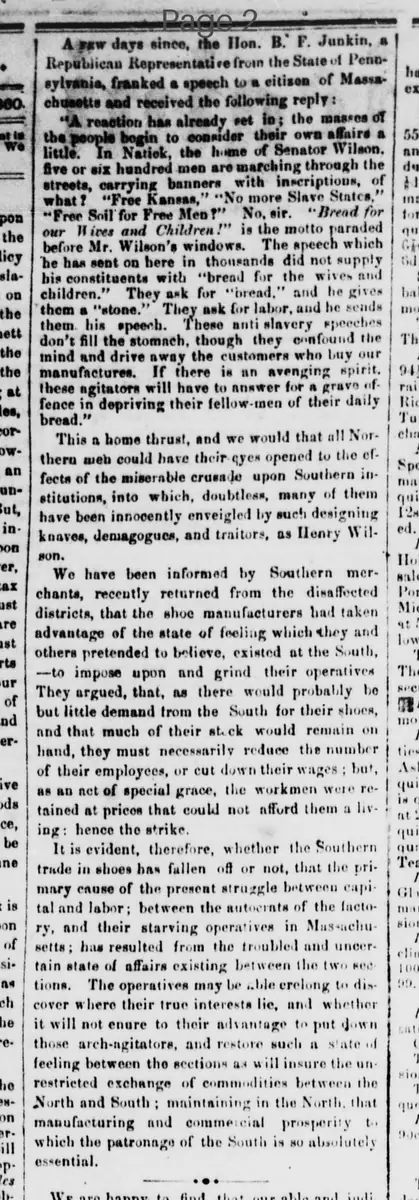
“A revolution has already set in; the masses of the people begin to consider their own affairs a little. In Natick, the home of Senator Wilson, five or six hundred men are marching through the streets, carrying banners with inscriptions, of what? “Free Kansas,” “No more Slave States.” “Free Soil for Free Men?” No, sir. “Bread for our Wives and Children!” is the motto paraded before Mr. Wilson's windows. The speech which he has sent on here in thousands did not supply his constituents with “bread for the wives and children.” They ask for “bread,” and he gives them a “stone.” They ask for labor, and he sends them his speech. These anti-slavery speeches don't fill the stomach, though they confound the mind and drive away the customers who buy our manufactures. If there is an avenging spirit, these agitators will have to answer for a grave offense in depriving their fellow-men of their daily bread.”
This is a home thrust, and we would that all Northern men could have their eyes opened to the effects of the miserable crusade upon Southern institutions, into which, doubtless, many of them have been innocently inveigled by such designing knaves, demagogues, and traitors, as Henry Wilson.
We have been informed by Southern merchants, recently returned from the disaffected districts, that the shoe manufacturers had taken advantage of the state of feeling which they and others pretended to believe, existed at the South,—to impose upon and grind their operatives. They argued, that, as there would probably be but little demand from the South for their shoes, and that much of their stock would remain on hand, they must necessarily reduce the number of their employees, or cut down their wages; but, as an act of special grace, the workmen were retained at prices that could not afford them a living: hence the strike.
It is evident, therefore, whether the Southern trade in shoes has fallen off or not, that the primary cause of the present struggle between capital and labor: between the autocrats of the factory, and their starving operatives in Massachusetts; has resulted from the troubled and uncertain state of affairs existing between the two sections. The operatives may be able ere long to discover where their true interests lie, and whether it will not enure to their advantage to put down those arch-agitators, and restore such a state of feeling between the sections as will insure the unrestricted exchange of commodities between the North and South: maintaining in the North, that manufacturing and commercial prosperity to which the patronage of the South is so absolutely essential.
What sub-type of article is it?
What keywords are associated?
What entities or persons were involved?
Where did it happen?
Domestic News Details
Primary Location
Natick, Massachusetts
Event Date
A Few Days Since
Key Persons
Outcome
labor strike among shoe factory operatives due to wage cuts and reduced employment blamed on sectional tensions
Event Details
A citizen of Massachusetts replies to Rep. Junkin's speech, reporting a march of 500-600 men in Natick with banners demanding 'Bread for our Wives and Children,' criticizing Senator Wilson's anti-slavery speeches for causing economic distress by driving away Southern customers for manufactures; shoe manufacturers exploit fears of lost Southern trade to cut wages, leading to strikes; commentary urges restoration of North-South trade relations.