Thank you for visiting SNEWPapers!
Sign up free
The New Hampshire Gazette
Portsmouth, Rockingham County, New Hampshire
What is this article about?
Return J. Meigs details the Cherokee nation's advancements in agriculture, crafts, manufacturing, and education since 1794, crediting U.S. government support for their civilization and increased population, as observed during a 1805 visit by Cherokee chiefs to Washington.
Clipping
OCR Quality
Full Text
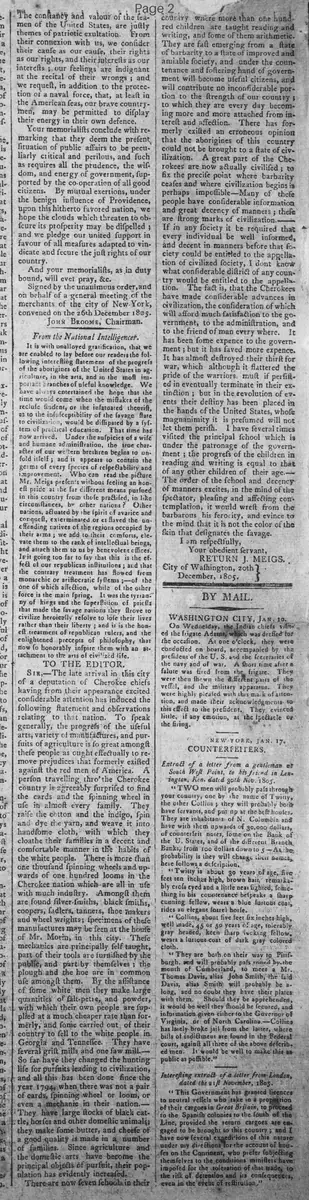
It is with unalloyed gratification, that we are enabled to lay before our readers the following interesting statement of the progress of the aborigines of the United States in agriculture, in the arts, and in the most important branches of useful knowledge. We have always entertained the hope that the time would come when the mistakes of the recluse student, or the infatuated theorist, as to the in susceptibility of the savage state to civilization, would be dissipated by a system of practical education. That time has now arrived. Under the auspices of a wise and humane administration, the true character of our western brethren begins to unfold itself; and it appears to contain the germs of every species of respectability and improvement. Who can read the picture Mr. Meigs presents without feeling an honest pride at the far different means pursued in this country from those practiced, in like circumstances, by other nations? Other nations, actuated by the spirit of avarice and conquest, exterminated or enslaved the unoffending natives of the regions occupied by their arms; we add to their comforts, elevate them to the rank of intellectual beings, and attach them to us by benevolent offices. Is it going too far to say that this is the effect of our republican institutions; and that the contrary treatment has flowed from monarchic or aristocratic systems;—of the one of which affection, while of the other force is the main spring. It was the tyranny of kings and the superstition of priests that made the savage nations they strove to civilize heroically resolve to lose their lives rather than their liberty; and it is the honest treatment of republican rulers, and the enlightened precepts of philosophy, that now so honorably inspire them with an attachment to the arts of civilized life.
TO THE EDITOR.
Sir,—The late arrival in this city of a deputation of Cherokee chiefs having from their appearance excited considerable attention has induced the following statement and observations relating to that nation. To speak generally, the progress of the useful arts, variety of manufactures, and pursuits of agriculture is so great amongst these people as ought effectually to remove prejudices that formerly existed against the red men of America. A person travelling thro' the Cherokee country is agreeably surprised to find the cards and the spinning wheel in use in almost every family. They raise the cotton and the indigo, spin and dye the yarn, and weave it into handsome cloth, with which they clothe their families in a decent and comfortable manner in the habits of the white people. There is more than one thousand spinning wheels and upwards of one hundred looms in the Cherokee nation which are all in use with much industry. Amongst them are found silver-smiths, black smiths, coopers, saddlers, tanners, shoe makers and wheel wrights; specimens of these manufactures may be seen at the house of Mr. Morin, in this city. These mechanics are principally self taught, part of their tools are furnished by the public, and part by themselves; the plough and the hoe are in common use amongst them. By the assistance of some white men they make large quantities of salt-petre, and powder, with which their own people are supplied at a much cheaper rate than formerly, and some carried out of their country to sell to the white people in Georgia and Tennessee. They have several grist mills and one saw mill.—So far have they changed the hunting life for pursuits leading to civilization, and all this has been done since the year 1794, when there was not a pair of cards, spinning wheel or loom, or even a mechanic in their nation.—They have large stocks of black cattle, horses and other domestic animals; they make some butter, and cheese of a good quality is made in a number of families. Since agriculture and the domestic arts have become the principal objects of pursuit, their population has evidently increased.
There are now seven schools in their country where more than one hundred children are taught reading and writing, and some of them arithmetic. They are fast emerging from a state of barbarity to a state of improved and amiable society, and under the countenance and fostering hand of government will become useful citizens, and will contribute no inconsiderable portion to the strength of our country; to which they are every day becoming more and more attached from interest and affection. There has formerly existed an erroneous opinion that the aborigines of this country could not be brought to a state of civilization. A great part of the Cherokees are now actually civilized; to fix the precise point where barbarity ceases and where civilization begins is perhaps impossible—Many of these people have considerable information and great decency of manners; these are strong marks of civilization.—If in any society it be required that every individual be well informed and decent in manners before that society could be entitled to the appellation of civilized society, I dont know what considerable district of any country would be entitled to the appellation. The fact is, that the Cherokees have made considerable advances in civilization, the consideration of which will afford much satisfaction to the government, to the administration, and to the friend of man every where. It has been some expense to the government; but it has saved more expense. It has almost destroyed their thirst for war, which although it flattered the pride of the warriors, must if persisted in eventually terminate in their extinction; but in the revolution of events their destiny has been placed in the hands of the United States, whose magnanimity it is presumed will not let them perish. I have several times visited the principal school which is under the patronage of the government; the progress of the children in reading and writing is equal to that of any other children of their age.—The order of the school and decency of manners excites, in the mind of the spectator, pleasing and affecting contemplation, it would wrest from the barbarous his ferocity, and evince to the mind that it is not the color of the skin that designates the savage.
I am respectfully,
Your obedient servant,
RETURN J. MEIGS.
City of Washington, 20th December, 1805.
What sub-type of article is it?
What keywords are associated?
What entities or persons were involved?
Where did it happen?
Domestic News Details
Primary Location
Cherokee Nation
Event Date
Since 1794
Key Persons
Outcome
increased population; reduced thirst for war; becoming useful citizens attached to the united states
Event Details
The Cherokee nation has advanced in agriculture, manufacturing, and education since 1794, with over 1000 spinning wheels, 100 looms, various mechanics, mills, livestock, and seven schools teaching over 100 children; self-taught skills and government support have facilitated this transition from hunting to civilized pursuits.