Thank you for visiting SNEWPapers!
Sign up free
The Daily Herald
New Haven, New Haven County, Connecticut
What is this article about?
The Commonwealth Bank in Boston, a favored institution of the administration, failed on January 12, 1837, stopping payment and causing public sensation. It held $370,000 in government deposits, leading to losses for fishermen paid in its depreciated bills. The failure is blamed on partisan management and speculation, sparing other banks.
Clipping
OCR Quality
Full Text
From the Boston Atlas, Jan. 13.
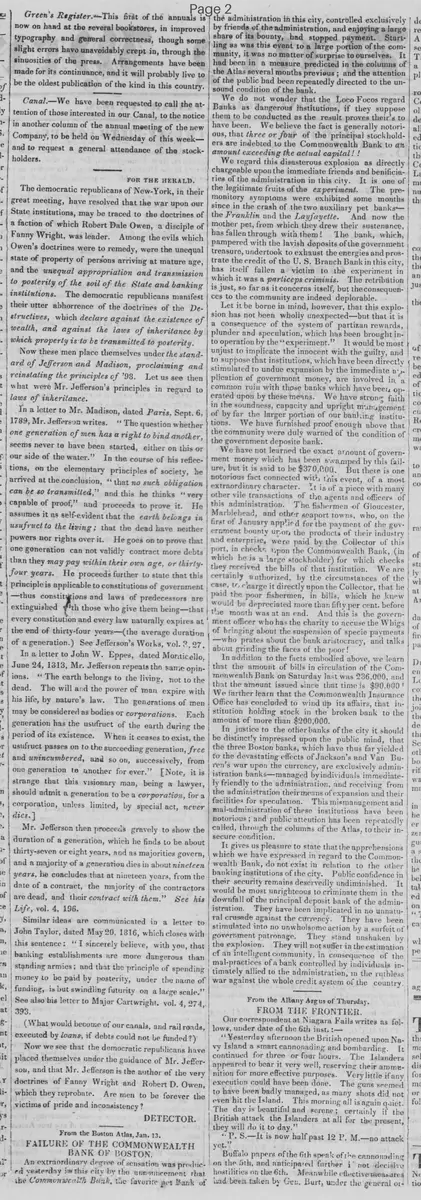
FAILURE OF THE COMMONWEALTH BANK OF BOSTON.
An extraordinary degree of sensation was produced yesterday in this city by the announcement that the Commonwealth Bank, the favorite pet Bank of the administration in this city, controlled exclusively by friends of the administration, and enjoying a large share of its bounty, had stopped payment. Startling as was this event to a large portion of the community, it was no matter of surprise to ourselves. It had been in a measure predicted in the columns of the Atlas several months previous; and the attention of the public had been repeatedly directed to the unsound condition of the bank.
We do not wonder that the Loco Focos regard Banks as dangerous institutions, if they suppose them to be conducted as the result proves theirs to have been. We believe the fact is generally notorious, that three or four of the principal stockholders are indebted to the Commonwealth Bank to an amount exceeding the actual capital!!
We regard this disastrous explosion as directly chargeable upon the immediate friends and beneficiaries of the administration in this city. It is one of the legitimate fruits of the experiment. The premonitory symptoms were exhibited some months since in the crash of the two auxiliary pet banks—the Franklin and the Lafayette. And now the mother pet, from which they drew their sustenance, has fallen through with them! The bank, which pampered with the lavish deposits of the government treasure, undertook to exhaust the energies and prostrate the credit of the U. S. Branch Bank in this city, has itself fallen a victim to the experiment in which it was a parliceps criminis. The retribution is just, so far as it concerns itself, but the consequences to the community are indeed deplorable.
Let it be borne in mind, however, that this explosion has not been wholly unexpected—but that it is a consequence of the system of partizan rewards, plunder and speculation, which has been brought into operation by the "experiment." It would be most unjust to implicate the innocent with the guilty, and to suppose that institutions, which have been directly stimulated to undue expansion by the immediate application of government money, are involved in a common ruin with those banks which have been operated upon by these means. We have strong faith in the soundness, capacity and upright management of by far the larger portion of our banking institutions. We have furnished proof enough above that the community were duly warned of the condition of the government deposit bank.
We have not learned the exact amount of government money which has been swamped by this failure, but it is said to be $370,000. But there is one notorious fact connected with this event, of a most extraordinary character. It is of a piece with many other vile transactions of the agents and officers of this administration. The fishermen of Gloucester, Marblehead, and other seaport towns, who, on the first of January applied for the payment of the government bounty upon the products of their industry and enterprise, were paid by the Collector of this port, in checks, upon the Commonwealth Bank, (in which he is a large stockholder) for which checks they received the bills of that institution. We are certainly authorized, by the circumstances of the case, to charge it directly upon the Collector, that he paid the poor fishermen, in bills, which he knew would be depreciated more than fifty per cent. before the month was at an end. And this is the government officer who has the charity to accuse the Whigs of bringing about the suspension of specie payments—who prates about the bank aristocracy, and talks about grinding the faces of the poor!
In addition to the facts embodied above, we learn that the amount of bills in circulation of the Commonwealth Bank on Saturday last was 236,000, and that the amount issued since that time is $90,000. We further learn that the Commonwealth Insurance Office has concluded to wind up its affairs, that institution holding stock in the broken bank to the amount of more than $200,000.
In justice to the other banks of the city it should be distinctly impressed upon the public mind, that the three Boston banks, which have thus far yielded to the devastating effects of Jackson's and Van Buren's war upon the currency, are exclusively administration banks—managed by individuals immediately friendly to the administration, and receiving from the administration their means of expansion and their facilities for speculation. This mismanagement and mal-administration of these institutions have been notorious; and public attention has been repeatedly called, through the columns of the Atlas, to their insecure condition.
It gives us pleasure to state that the apprehensions which we have expressed in regard to the Commonwealth Bank, do not exist in relation to the other banking institutions of the city. Public confidence in their security remains deservedly undiminished. It would be most unrighteous to criminate them in the downfall of the principal deposit bank of the administration. They have been implicated in no unnatural crusade against the currency. They have been stimulated into no unwholesome action by a surfeit of government patronage. They stand unshaken by the explosion. They will not suffer in the estimation of an intelligent community, in consequence of the mal-practices of a bank controlled by individuals intimately allied to the administration, in the ruthless war against the whole credit system of the country.
What sub-type of article is it?
What keywords are associated?
What entities or persons were involved?
Where did it happen?
Domestic News Details
Primary Location
Boston
Event Date
Jan. 12 (Yesterday, Per Jan. 13 Article)
Key Persons
Outcome
bank stopped payment; $370,000 in government deposits lost; bills depreciated over 50%; fishermen paid in worthless bills; commonwealth insurance office winding up with over $200,000 in stock; community consequences deplorable but other banks unaffected.
Event Details
The Commonwealth Bank, controlled by administration friends and holding large government deposits, failed unexpectedly to many but predicted by the Atlas. Principal stockholders owed more than capital. Blamed on partisan speculation and government experiment; linked to prior failures of Franklin and Lafayette banks. Fishermen received depreciated bills from the Collector, a bank stockholder.