Thank you for visiting SNEWPapers!
Sign up free
Story
June 27, 1901
The County Record
Kingstree, Williamsburg County, South Carolina
What is this article about?
In a letter dated April 14, 1901, from Santa Clara, Cuba, Bruce Snider describes leaving his unfulfilling job in Selma for a better position, his journey, and vivid impressions of Cuban climate, architecture, customs, economy, and optimism for opportunities.
Clipping
OCR Quality
98%
Excellent
Full Text
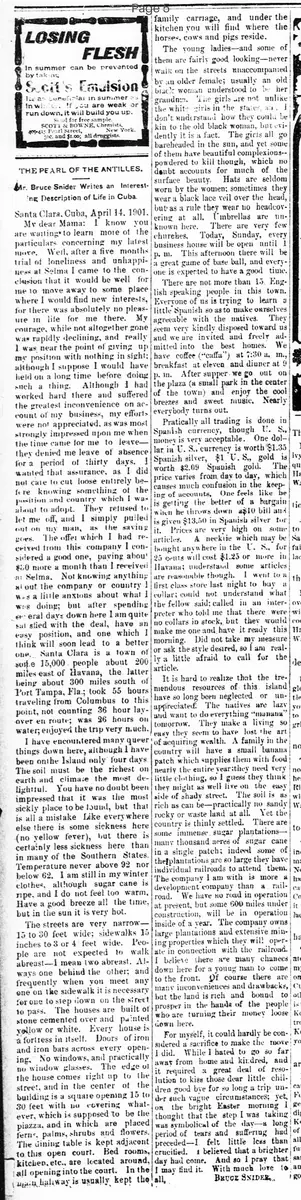
The Pearl of the Antilles.
Mr. Bruce Snider Writes an Interesting Description of Life in Cuba
Santa Clara, Cuba, April 14, 1901.
My dear Mama: I know you are waiting to learn more of the particulars concerning my latest move. Well, after a five months trial of loneliness and unhappiness at Selma I came to the conclusion that it would be well for me to move away to some place where I would find new interests, for there was absolutely no pleasure in life for me there. My courage, while not altogether gone, was rapidly declining, and really I was near the point of giving up my position with nothing in sight, although I suppose I would have held out a long time before doing such a thing. Although I had worked hard there and suffered the greatest inconvenience on account of my business, my efforts were not appreciated, as was most strongly impressed upon me when the time came for me to leave—they denied me leave of absence for a period of thirty days. I wanted that assurance, as I did not care to cut loose entirely before knowing something of the position and country which I was about to adopt. They refused to let me off, and I simply pulled out on my own, as the saying goes. The offer which I had received from this company I considered a good one, paying about $50 more a month than I received at Selma. Not knowing anything about the company or country I was a little anxious about what I was doing; but after spending several days down here I am quite satisfied with the deal, have an easy position, and one which I think will soon lead to a better one. Santa Clara is a town of some 15,000 people about 200 miles east of Havana, the latter being about 300 miles south of Port Tampa, Fla.; took 55 hours traveling from Columbus to this point, not counting 36 hour lay-over en route; was 36 hours on water; enjoyed the trip very much. I have encountered many queer things down here, although I have been on the Island only four days. The soil must be the richest on earth and climate the most delightful. You have no doubt been impressed that it was the most sickly place to be found, but that is all a mistake. Like everywhere else there is some sickness here (no yellow fever), but there is certainly less sickness here than in many of the Southern States. Temperature never above 92 nor below 62. I am still in my winter clothes, although sugar cane is ripe, and I do not feel too warm. Have a good breeze all the time, but in the sun it is very hot. The streets are very narrow—15 to 30 feet wide; sidewalks 15 inches to 3 or 4 feet wide. People are not expected to walk abreast—I mean two abreast. Always one behind the other; and frequently when you meet any one on the sidewalk it is necessary for one to step down on the street to pass. The houses are built of stone cemented over and painted yellow or white. Every house is a fortress in itself. Doors of iron and iron bars across every opening. No windows, and practically no window glasses. The edge of the house comes right up to the street, and in the center of the building is a square opening 15 to 30 feet with no covering whatever, which is supposed to be the piazza, and in which are placed ferns, palms, shrubs and flowers. The dining table is kept adjacent to this open court. Bed rooms, kitchen, etc., are located around, all opening into the court. In the main hallway is usually kept the family carriage, and under the kitchen you will find where the horses, cows and pigs reside. The young ladies—and some of them are fairly good looking—never walk on the streets unaccompanied by an older female; usually an old black woman understood to be her grandma. The girls are not unlike the white girls in the state, and I don't understand how they could be kin to the old black woman, but evidently it is a fact. The girls all go bareheaded in the sun, and yet some of them have beautiful complexions—powdered to kill though, which no doubt accounts for much of the surface beauty. Hats are seldom worn by the women; sometimes they wear a black lace veil over the head, but as a rule they wear no headcovering at all. Umbrellas are unknown here. There are very few churches. Today, Sunday, every business house will be open until 1 p.m. This afternoon there will be a great game of base ball, and everyone is expected to have a good time. There are not more than 15 English speaking people in this town. Everyone of us is trying to learn a little Spanish so as to make ourselves agreeable with the natives. They seem very kindly disposed toward us and we are invited and freely admitted into the best homes. We have coffee ("caffe") at 7:30 a.m., breakfast at eleven and dinner at 9 p.m. After supper we go out on the plaza (a small park in the center of the town) and enjoy the cool breezes and sweet music. Nearly everybody turns out. Practically all trading is done in Spanish currency, though U.S. money is very acceptable. One dollar in U.S. currency is worth $1.35 Spanish silver, $1 U.S. gold is worth $2.09 Spanish gold. The price varies from day to day, which causes much confusion in the keeping of accounts. One feels like he is getting the better of a bargain when he throws down a $10 bill and is given $13.50 in Spanish silver for it. Prices are very high on some articles. A necktie which may be bought anywhere in the U.S. for 25 cents will cost $1.25 or more in Havana; understand some articles are reasonable though. I went to a first class store last night to buy a collar; could not understand what the fellow said; called in an interpreter who told me that there were no collars in stock, but they would make me one and have it ready this morning. Did not take my measure or ask the style desired, so I am really a little afraid to call for the article. It is hard to realize that the tremendous resources of this island have so long been neglected or unappreciated. The natives are lazy and want to do everything "manana"—tomorrow. They make a living so easy they seem to have lost the art of acquiring wealth. A family in the country will have a small banana patch which supplies them with food nearly the entire year; they need very little clothing, so I guess they think they might as well live on the easy side of shady street. The soil is as rich as can be—practically no sandy rocky or waste land at all. Yet the country is thinly settled. There are some immense sugar plantations—many thousand acres of sugar cane in a single patch; indeed some of the plantations are so large they have individual railroads to attend them. The company I am with is more a development company than a railroad. We have no road in operation at present, but some 600 miles under construction, will be in operation inside of a year. The company owns large plantations and extensive mining properties which they will operate in connection with the railroad. I believe there are many chances down here for a young man to come to the front. Of course there are many inconveniences and drawbacks, but the land is rich and bound to prosper in the hands of the people who are turning their money loose down here. For myself, it could hardly be considered a sacrifice to make the move I did. While I hated to go so far away from home and kindred, and it required a great deal of resolution to kiss those dear little children good bye for so long a trip under such vague circumstances; yet on the bright Easter morning I thought that the step I was taking was symbolical of the day—a long period of tears and suffering had preceded—I felt little less than crucified. I believed that a brighter day had come. And so I pray that I may find it. With much love to all,
BRUCE SNIDER.
Mr. Bruce Snider Writes an Interesting Description of Life in Cuba
Santa Clara, Cuba, April 14, 1901.
My dear Mama: I know you are waiting to learn more of the particulars concerning my latest move. Well, after a five months trial of loneliness and unhappiness at Selma I came to the conclusion that it would be well for me to move away to some place where I would find new interests, for there was absolutely no pleasure in life for me there. My courage, while not altogether gone, was rapidly declining, and really I was near the point of giving up my position with nothing in sight, although I suppose I would have held out a long time before doing such a thing. Although I had worked hard there and suffered the greatest inconvenience on account of my business, my efforts were not appreciated, as was most strongly impressed upon me when the time came for me to leave—they denied me leave of absence for a period of thirty days. I wanted that assurance, as I did not care to cut loose entirely before knowing something of the position and country which I was about to adopt. They refused to let me off, and I simply pulled out on my own, as the saying goes. The offer which I had received from this company I considered a good one, paying about $50 more a month than I received at Selma. Not knowing anything about the company or country I was a little anxious about what I was doing; but after spending several days down here I am quite satisfied with the deal, have an easy position, and one which I think will soon lead to a better one. Santa Clara is a town of some 15,000 people about 200 miles east of Havana, the latter being about 300 miles south of Port Tampa, Fla.; took 55 hours traveling from Columbus to this point, not counting 36 hour lay-over en route; was 36 hours on water; enjoyed the trip very much. I have encountered many queer things down here, although I have been on the Island only four days. The soil must be the richest on earth and climate the most delightful. You have no doubt been impressed that it was the most sickly place to be found, but that is all a mistake. Like everywhere else there is some sickness here (no yellow fever), but there is certainly less sickness here than in many of the Southern States. Temperature never above 92 nor below 62. I am still in my winter clothes, although sugar cane is ripe, and I do not feel too warm. Have a good breeze all the time, but in the sun it is very hot. The streets are very narrow—15 to 30 feet wide; sidewalks 15 inches to 3 or 4 feet wide. People are not expected to walk abreast—I mean two abreast. Always one behind the other; and frequently when you meet any one on the sidewalk it is necessary for one to step down on the street to pass. The houses are built of stone cemented over and painted yellow or white. Every house is a fortress in itself. Doors of iron and iron bars across every opening. No windows, and practically no window glasses. The edge of the house comes right up to the street, and in the center of the building is a square opening 15 to 30 feet with no covering whatever, which is supposed to be the piazza, and in which are placed ferns, palms, shrubs and flowers. The dining table is kept adjacent to this open court. Bed rooms, kitchen, etc., are located around, all opening into the court. In the main hallway is usually kept the family carriage, and under the kitchen you will find where the horses, cows and pigs reside. The young ladies—and some of them are fairly good looking—never walk on the streets unaccompanied by an older female; usually an old black woman understood to be her grandma. The girls are not unlike the white girls in the state, and I don't understand how they could be kin to the old black woman, but evidently it is a fact. The girls all go bareheaded in the sun, and yet some of them have beautiful complexions—powdered to kill though, which no doubt accounts for much of the surface beauty. Hats are seldom worn by the women; sometimes they wear a black lace veil over the head, but as a rule they wear no headcovering at all. Umbrellas are unknown here. There are very few churches. Today, Sunday, every business house will be open until 1 p.m. This afternoon there will be a great game of base ball, and everyone is expected to have a good time. There are not more than 15 English speaking people in this town. Everyone of us is trying to learn a little Spanish so as to make ourselves agreeable with the natives. They seem very kindly disposed toward us and we are invited and freely admitted into the best homes. We have coffee ("caffe") at 7:30 a.m., breakfast at eleven and dinner at 9 p.m. After supper we go out on the plaza (a small park in the center of the town) and enjoy the cool breezes and sweet music. Nearly everybody turns out. Practically all trading is done in Spanish currency, though U.S. money is very acceptable. One dollar in U.S. currency is worth $1.35 Spanish silver, $1 U.S. gold is worth $2.09 Spanish gold. The price varies from day to day, which causes much confusion in the keeping of accounts. One feels like he is getting the better of a bargain when he throws down a $10 bill and is given $13.50 in Spanish silver for it. Prices are very high on some articles. A necktie which may be bought anywhere in the U.S. for 25 cents will cost $1.25 or more in Havana; understand some articles are reasonable though. I went to a first class store last night to buy a collar; could not understand what the fellow said; called in an interpreter who told me that there were no collars in stock, but they would make me one and have it ready this morning. Did not take my measure or ask the style desired, so I am really a little afraid to call for the article. It is hard to realize that the tremendous resources of this island have so long been neglected or unappreciated. The natives are lazy and want to do everything "manana"—tomorrow. They make a living so easy they seem to have lost the art of acquiring wealth. A family in the country will have a small banana patch which supplies them with food nearly the entire year; they need very little clothing, so I guess they think they might as well live on the easy side of shady street. The soil is as rich as can be—practically no sandy rocky or waste land at all. Yet the country is thinly settled. There are some immense sugar plantations—many thousand acres of sugar cane in a single patch; indeed some of the plantations are so large they have individual railroads to attend them. The company I am with is more a development company than a railroad. We have no road in operation at present, but some 600 miles under construction, will be in operation inside of a year. The company owns large plantations and extensive mining properties which they will operate in connection with the railroad. I believe there are many chances down here for a young man to come to the front. Of course there are many inconveniences and drawbacks, but the land is rich and bound to prosper in the hands of the people who are turning their money loose down here. For myself, it could hardly be considered a sacrifice to make the move I did. While I hated to go so far away from home and kindred, and it required a great deal of resolution to kiss those dear little children good bye for so long a trip under such vague circumstances; yet on the bright Easter morning I thought that the step I was taking was symbolical of the day—a long period of tears and suffering had preceded—I felt little less than crucified. I believed that a brighter day had come. And so I pray that I may find it. With much love to all,
BRUCE SNIDER.
What sub-type of article is it?
Biography
Journey
What themes does it cover?
Fortune Reversal
Exploration
What keywords are associated?
Cuba
Santa Clara
Expatriate Life
Personal Journey
Sugar Plantations
1901 Letter
What entities or persons were involved?
Bruce Snider
Where did it happen?
Santa Clara, Cuba
Story Details
Key Persons
Bruce Snider
Location
Santa Clara, Cuba
Event Date
April 14, 1901
Story Details
Bruce Snider recounts his decision to leave an unappreciated job in Selma after five months of unhappiness for a better-paying position in Cuba, describes his journey from Columbus, impressions of Santa Clara's climate, architecture, customs, economy, and optimism for future prospects.