Thank you for visiting SNEWPapers!
Sign up free
Literary
October 29, 1868
White Cloud Kansas Chief
White Cloud, Doniphan County, Kansas
What is this article about?
A personal letter-sketch from San Diego, California, dated August 29, 1868, describing the author's attendance at the San Luis Rey fiesta on August 25. It details the multicultural crowd, religious rituals, bull and bear fight, horse races, dancing, gambling, social classes, and a humorous encounter with a protective dog during the night.
Clipping
OCR Quality
88%
Good
Full Text
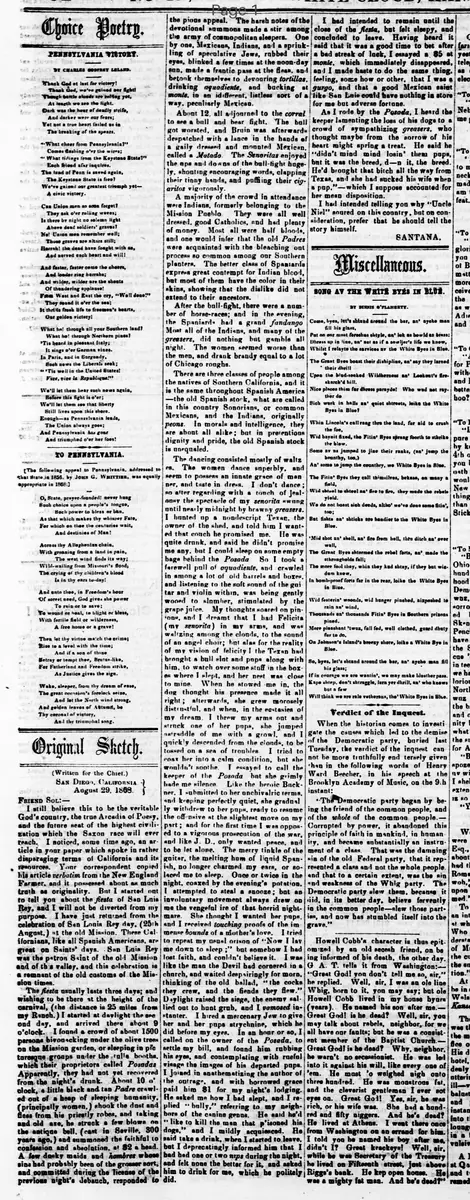
Original Sketch.
(Written for the Chief.)
San Diego, California,
August 29, 1868.
FRIEND SOL:
I still believe this to be the veritable God's country, the true Arcadia of Poesy, and the future seat of the highest civilization which the Saxon race will ever reach. I noticed, some time ago, an article in your paper which spoke in rather disparaging terms of California and its resources. Your correspondent copied his article verbatim from the New England Farmer, and it possessed about as much truth as originality. But I started out to tell you about the fiesta of San Luis Rey, and I will not be diverted from my purpose. I have just returned from the celebration of San Luis Rey day. (25th August,) at the old Mission. These Californians, like all Spanish Americans, are great on Saints' days. San Luis Rey was the patron Saint of the old Mission and of this valley, and this celebration is a remnant of the old customs of the Mission times.
The fiesta usually lasts three days; and wishing to be there at the height of the carnival, (the distance is 25 miles from my ranch,) I started at daylight the second day, and arrived there about 9 o'clock. I found a crowd of about 1500 persons bivouacking under the olive trees on the Mission garden, or sleeping in picturesque groups under the palm booths which their proprietors called Posadas. Apparently, they had not yet recovered from the night's drunk. About 10 o'clock, little black and tan Padre crawled out of a heap of sleeping humanity, (principally women,) shook the dust and fleas from his priestly robes, and taking an old axe, he struck a few blows on the antique bell, (cast in Seville, 300 years ago,) and summoned the faithful to confession and absolution, to a 2 head. A few dusky maids and hombres whose sins had probably been of the grosser sort, and committed during the license of the previous night's debauch, responded to the pious appeal. The harsh notes of the devotional summons made a stir among the army of cosmopolitan sleepers. One by one, Mexican, Indians, and a sprinkling of speculative Jews, rubbed their eyes, blinked a few times at the noon-day sun, made a frantic pass at the fleas, and betook themselves to devouring tortillas, drinking aguardiente, and bucking at monte, in an indifferent, listless sort of a way, peculiarly Mexican.
About 12, all adjourned to the corral to see a bull and bear fight. The bull got worsted, and Bruin was afterwards dispatched with a lance in the hands of a gaily dressed and mounted Mexican, called a Matador. The Senoritas enjoyed the ups and downs of the bull-fight hugely, shouting encouraging words, clapping their tiny hands, and puffing their cigaritos vigorously.
A majority of the crowd in attendance were Indians, formerly belonging to the Mission Pueblo. They were all well dressed, good Catholics, and had plenty of money. Most all were half-breeds, and one would infer that the old Padres were acquainted with the bleaching out process so common among our Southern planters. The better class of Spaniards express great contempt for Indian blood, but most of them have the color in their skins, showing that the dislike did not extend to their ancestors.
After the bull-fight, there were a number of horse-races; and in the evening, the Spaniards had a grand fandango. Most all of the Indians, and many of the greasers, did nothing but gamble all night. The women seemed worse than the men, and drank brandy equal to a lot of Chicago roughs.
There are three classes of people among the natives of Southern California, and it is the same throughout Spanish America—the old Spanish stock, what are called in this country Sonorians, or common Mexicans, and the Indians, originally peons. In morals and intelligence, they are about all alike: but in pretensions, dignity and pride, the old Spanish stock is unequaled.
The dancing consisted mostly of waltzes. The women dance superbly, and seem to possess an innate grace of manner, and taste in dress. I don't dance; so after regarding with a touch of jealousy the spectacle of my senorita swung until nearly midnight by brawny greasers, I hunted up a nondescript Texan, the owner of the shed, and told him I wanted that couch he promised me. He was quite drunk, and said he didn't promise me any, but I could sleep on some empty bags behind the Posada. So I took farewell pull of aguardiente, and crawled in among a lot of old barrels and boxes, and listening to the soft sound of the guitar and violin within, was being gently wooed to slumber, stimulated by the grape juice. My thoughts soared on pinions, and I dreamt that I had Felicita (my senorita) in my arms, and was waltzing among the clouds, to the sound of an angel choir; but alas for the reality of my vision of felicity! the Texan had brought a bull slut and pups along with him, to watch over some stuff in the boxes where I slept, and her nest was close to mine. When he stowed me in, the dog thought his presence made it all right; afterwards, she grew morosely distrustful, and when, in the ecstasies of my dream, I threw my arms out and struck one of her pups, she jumped astraddle of me with a growl, and I quickly descended from the clouds, to be tossed on a sea of troubles. I tried to coax her into a calm condition, but she wouldn't soothe. I essayed to call the keeper of the Posada but she grimly bade me silence. Like the heroic Buckner, I submitted to her unchivalric terms, and keeping perfectly quiet, she gradually withdrew to her pups, ready to resume the offensive at the slightest move on my part; and for the first time I was opposed to a vigorous prosecution of the war, and like J. D., only wanted peace, and to be let alone. The merry tinkle of the guitar, the melting hum of liquid Spanish, no longer charmed my ears, or soothed me to sleep. Once or twice in the night, coaxed by the evening's potation, I attempted to steal a snooze; but an involuntary movement always drew on me the vengeful ire of that horrid nightmare. She thought I wanted her pups, and I received touching proofs of the immense bounds of a mother's love. I tried to repeat my usual orison of 'Now I lay me down to sleep;' but somehow I had lost faith, and couldn't believe it. I was like the man the Devil had cornered in a church, and waited despairingly for morn, thinking of the old ballad, 'the cock he crew, and the fiends they flew.'
Daylight raised the siege, the enemy sallied out to hunt grub, and I vamosed instanter. I hired a mercenary Jew to give her and her pups strychnine, which he did before my eyes. In an hour or so, I called on the owner of the Posada, to settle my bill, and found him rubbing his eyes, and contemplating with rueful visage the corpses of his departed pups. I joined in anathematizing the author of the outrage, and with borrowed grace paid him $1 for my night's lodging. He asked me how I had slept, and I replied 'bully,' referring to my neighbor of the canine genus. He said he'd 'like to kill the man that p'isoned his dogs,' and I mildly acquiesced. He said take a drink, when I started to leave, but I deprecatingly informed him that I had had one or two nips during the night, and felt none the better for it, and asked him to drink for me, which he politely did.
I had intended to remain until the close of the fiesta, but felt sleepy, and concluded to leave. Having heard it said that it was a good time to bet after a bad streak of luck, I essayed a $5 at monte, which immediately disappeared, and I made haste to do the same thing, feeling, some how or other, that I was a Jonah, and that a good Mexican saint like San Luis could have nothing in store for me but adverse fortune.
As I rode by the Posada, I heard the keeper lamenting the loss of his dogs to a crowd of sympathizing greasers, who thought maybe from the sorrow of his heart might spring a treat. He said he 'didn't mind losin' them pups, but it was the breed, d--p it, the breed. He'd brought that bitch all the way from Texas, and she had sucked his wife when a pup.'—which I suppose accounted for her mean disposition.
I had intended telling you why 'Uncle Niel' soured on this country, but on consideration, prefer that he should tell the story himself.
SANTANA.
(Written for the Chief.)
San Diego, California,
August 29, 1868.
FRIEND SOL:
I still believe this to be the veritable God's country, the true Arcadia of Poesy, and the future seat of the highest civilization which the Saxon race will ever reach. I noticed, some time ago, an article in your paper which spoke in rather disparaging terms of California and its resources. Your correspondent copied his article verbatim from the New England Farmer, and it possessed about as much truth as originality. But I started out to tell you about the fiesta of San Luis Rey, and I will not be diverted from my purpose. I have just returned from the celebration of San Luis Rey day. (25th August,) at the old Mission. These Californians, like all Spanish Americans, are great on Saints' days. San Luis Rey was the patron Saint of the old Mission and of this valley, and this celebration is a remnant of the old customs of the Mission times.
The fiesta usually lasts three days; and wishing to be there at the height of the carnival, (the distance is 25 miles from my ranch,) I started at daylight the second day, and arrived there about 9 o'clock. I found a crowd of about 1500 persons bivouacking under the olive trees on the Mission garden, or sleeping in picturesque groups under the palm booths which their proprietors called Posadas. Apparently, they had not yet recovered from the night's drunk. About 10 o'clock, little black and tan Padre crawled out of a heap of sleeping humanity, (principally women,) shook the dust and fleas from his priestly robes, and taking an old axe, he struck a few blows on the antique bell, (cast in Seville, 300 years ago,) and summoned the faithful to confession and absolution, to a 2 head. A few dusky maids and hombres whose sins had probably been of the grosser sort, and committed during the license of the previous night's debauch, responded to the pious appeal. The harsh notes of the devotional summons made a stir among the army of cosmopolitan sleepers. One by one, Mexican, Indians, and a sprinkling of speculative Jews, rubbed their eyes, blinked a few times at the noon-day sun, made a frantic pass at the fleas, and betook themselves to devouring tortillas, drinking aguardiente, and bucking at monte, in an indifferent, listless sort of a way, peculiarly Mexican.
About 12, all adjourned to the corral to see a bull and bear fight. The bull got worsted, and Bruin was afterwards dispatched with a lance in the hands of a gaily dressed and mounted Mexican, called a Matador. The Senoritas enjoyed the ups and downs of the bull-fight hugely, shouting encouraging words, clapping their tiny hands, and puffing their cigaritos vigorously.
A majority of the crowd in attendance were Indians, formerly belonging to the Mission Pueblo. They were all well dressed, good Catholics, and had plenty of money. Most all were half-breeds, and one would infer that the old Padres were acquainted with the bleaching out process so common among our Southern planters. The better class of Spaniards express great contempt for Indian blood, but most of them have the color in their skins, showing that the dislike did not extend to their ancestors.
After the bull-fight, there were a number of horse-races; and in the evening, the Spaniards had a grand fandango. Most all of the Indians, and many of the greasers, did nothing but gamble all night. The women seemed worse than the men, and drank brandy equal to a lot of Chicago roughs.
There are three classes of people among the natives of Southern California, and it is the same throughout Spanish America—the old Spanish stock, what are called in this country Sonorians, or common Mexicans, and the Indians, originally peons. In morals and intelligence, they are about all alike: but in pretensions, dignity and pride, the old Spanish stock is unequaled.
The dancing consisted mostly of waltzes. The women dance superbly, and seem to possess an innate grace of manner, and taste in dress. I don't dance; so after regarding with a touch of jealousy the spectacle of my senorita swung until nearly midnight by brawny greasers, I hunted up a nondescript Texan, the owner of the shed, and told him I wanted that couch he promised me. He was quite drunk, and said he didn't promise me any, but I could sleep on some empty bags behind the Posada. So I took farewell pull of aguardiente, and crawled in among a lot of old barrels and boxes, and listening to the soft sound of the guitar and violin within, was being gently wooed to slumber, stimulated by the grape juice. My thoughts soared on pinions, and I dreamt that I had Felicita (my senorita) in my arms, and was waltzing among the clouds, to the sound of an angel choir; but alas for the reality of my vision of felicity! the Texan had brought a bull slut and pups along with him, to watch over some stuff in the boxes where I slept, and her nest was close to mine. When he stowed me in, the dog thought his presence made it all right; afterwards, she grew morosely distrustful, and when, in the ecstasies of my dream, I threw my arms out and struck one of her pups, she jumped astraddle of me with a growl, and I quickly descended from the clouds, to be tossed on a sea of troubles. I tried to coax her into a calm condition, but she wouldn't soothe. I essayed to call the keeper of the Posada but she grimly bade me silence. Like the heroic Buckner, I submitted to her unchivalric terms, and keeping perfectly quiet, she gradually withdrew to her pups, ready to resume the offensive at the slightest move on my part; and for the first time I was opposed to a vigorous prosecution of the war, and like J. D., only wanted peace, and to be let alone. The merry tinkle of the guitar, the melting hum of liquid Spanish, no longer charmed my ears, or soothed me to sleep. Once or twice in the night, coaxed by the evening's potation, I attempted to steal a snooze; but an involuntary movement always drew on me the vengeful ire of that horrid nightmare. She thought I wanted her pups, and I received touching proofs of the immense bounds of a mother's love. I tried to repeat my usual orison of 'Now I lay me down to sleep;' but somehow I had lost faith, and couldn't believe it. I was like the man the Devil had cornered in a church, and waited despairingly for morn, thinking of the old ballad, 'the cock he crew, and the fiends they flew.'
Daylight raised the siege, the enemy sallied out to hunt grub, and I vamosed instanter. I hired a mercenary Jew to give her and her pups strychnine, which he did before my eyes. In an hour or so, I called on the owner of the Posada, to settle my bill, and found him rubbing his eyes, and contemplating with rueful visage the corpses of his departed pups. I joined in anathematizing the author of the outrage, and with borrowed grace paid him $1 for my night's lodging. He asked me how I had slept, and I replied 'bully,' referring to my neighbor of the canine genus. He said he'd 'like to kill the man that p'isoned his dogs,' and I mildly acquiesced. He said take a drink, when I started to leave, but I deprecatingly informed him that I had had one or two nips during the night, and felt none the better for it, and asked him to drink for me, which he politely did.
I had intended to remain until the close of the fiesta, but felt sleepy, and concluded to leave. Having heard it said that it was a good time to bet after a bad streak of luck, I essayed a $5 at monte, which immediately disappeared, and I made haste to do the same thing, feeling, some how or other, that I was a Jonah, and that a good Mexican saint like San Luis could have nothing in store for me but adverse fortune.
As I rode by the Posada, I heard the keeper lamenting the loss of his dogs to a crowd of sympathizing greasers, who thought maybe from the sorrow of his heart might spring a treat. He said he 'didn't mind losin' them pups, but it was the breed, d--p it, the breed. He'd brought that bitch all the way from Texas, and she had sucked his wife when a pup.'—which I suppose accounted for her mean disposition.
I had intended telling you why 'Uncle Niel' soured on this country, but on consideration, prefer that he should tell the story himself.
SANTANA.
What sub-type of article is it?
Essay
Journey Narrative
What themes does it cover?
Social Manners
Religious
What keywords are associated?
Fiesta
San Luis Rey
Mission
California
Spanish Americans
Bull Fight
Fandango
Gambling
Social Classes
What entities or persons were involved?
Santana
Literary Details
Title
Original Sketch
Author
Santana
Subject
Fiesta Of San Luis Rey
Form / Style
Personal Narrative Letter
Key Lines
I Still Believe This To Be The Veritable God's Country, The True Arcadia Of Poesy, And The Future Seat Of The Highest Civilization Which The Saxon Race Will Ever Reach.
San Luis Rey Was The Patron Saint Of The Old Mission And Of This Valley, And This Celebration Is A Remnant Of The Old Customs Of The Mission Times.
The Senoritas Enjoyed The Ups And Downs Of The Bull Fight Hugely, Shouting Encouraging Words, Clapping Their Tiny Hands, And Puffing Their Cigaritos Vigorously.
The Women Dance Superbly, And Seem To Possess An Innate Grace Of Manner, And Taste In Dress.
I Was Like The Man The Devil Had Cornered In A Church, And Waited Despairingly For Morn, Thinking Of The Old Ballad, 'The Cock He Crew, And The Fiends They Flew.'