Thank you for visiting SNEWPapers!
Sign up free
The Yazoo Democrat
Yazoo City, Yazoo County, Mississippi
What is this article about?
Editorial critiquing British imperial policy of expansion and profit-seeking through diplomacy, conquest, and hypocrisy, citing examples from East Indies, Ceylon, Punjab, China, West Indies, and Nicaragua.
Clipping
OCR Quality
Full Text
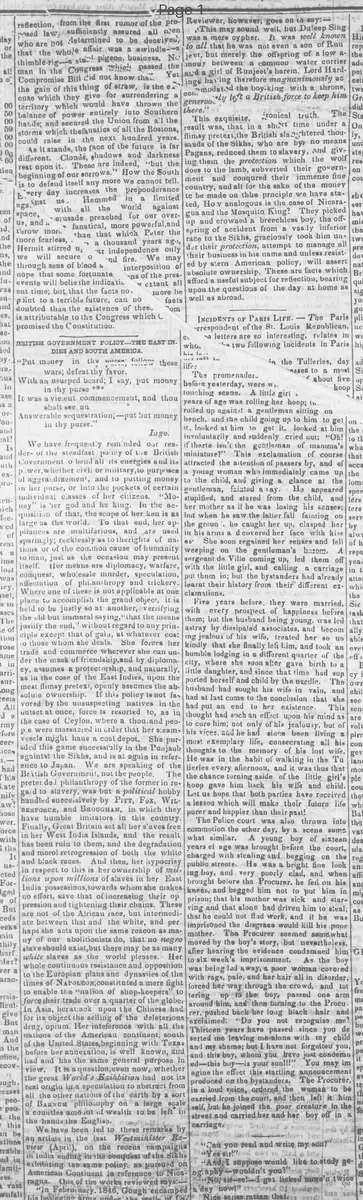
"Put money
in
thy
purse"
follow
these
wars; defeat thy favor.
With an usurped beard; I say, put money
in thy purse.
It was a violent commencement, and thou
shalt see an
Answerable sequestration;—put but money
in thy purse."
We have frequently reminded our readers of the steadfast policy of the British
Government to bend all its energies and its
power, whether civil or military, to purposes
of aggrandizement, and to putting money
in her purse, or into the pockets of certain
individual classes of her citizens. "Money"
is her god and her king. In the acquisition of that, the scope of her ken is as
large as the world. To that end, her appliances are multifarious, and are used
sparingly; recklessly as to the rights of nations or of the common cause of humanity to man, just as the occasion may present
itself. Her means are diplomacy, warfare,
conquest, wholesale murder, speculation,
affectation of philanthropy and trickery.
Where one of these is not applicable at one
place to accomplish the grand object, it is
held to be justly so at another, verifying
the old but immoral saying, "that the means
justify the end," without regard to any principle except that of gain, at whatever cost to those whom she deals. She forces her
trade and commerce wherever she can under the mask of friendship, and by diplomacy, assumes a protectorship, and naturally,
as in the case of the East Indies, upon the
most flimsy pretext, openly assumes the absolute ownership. If this policy is not favored by the unsuspecting natives in the
outset at once, force is resorted to, as in
the case of Ceylon, where a thousand people were massacred in order that her steam-vessels might have a coal depot. She pursued this game successfully in the Punjaub against the Sikhs, and is at it again in reference to Japan. We are speaking of the
British Government, not the people.
The
pretended philanthropy of the former in regard to slavery, was but a political hobby handled successively by Pitt, Fox, Wilberforce, and Brougham, in which they
have humble imitators in this country.
Finally, Great Britain set all her slaves free in her West India Islands, and the result
has been ruin to them, and the degradation and moral retrogression of both the white and black races. And then, her hypocrisy
in respect to this is her ownership of millions upon millions of slaves in her East
India possessions, towards whom she makes
no effort, save that of increasing their oppression and tightening their chains. These
are not of the African race, but intermediate between that and the white, and perhaps she acts upon the same reason as many of our abolitionists do, that no negro
slave should exist, but there may be as many white slaves as the world pleases. Her
whole continuous resistance and opposition to the European plans and dynasties of the times of Napoleon, constituted a mere fight to enable the "nation of shop-keepers" to force their trade over a quarter of the globe.
In Asia, her attack upon the Chinese had
for its object the selling of the deleterious
drug, opium. Her interference with all the
nations of the American continent, south
of the United States, beginning with Texas
before her annexation, is well known, and
had and has the same general purpose in
view. It is a question, even now whether
the great World's Exhibition had not its
real origin in a speculation to abstract from all the other nations of the earth by a sort
of Barnum philosophy on a large scale
a countless amount of wealth to be left in
the hands of the English.
We have been led to these remarks by
an article in the last Westminster Review (April), on the recent campaigns
in India ending in the conquest of the Sikhs exhibiting the same policy as pursued on
American Continent in reference to Nicaragua. One of the works reviewed says:
Reviewer. however goes on to say:
This may sound well, but Duleep Sing
was a mere cypher. It was well known
to all that he was not even a son of Runjeet, but merely the offspring of a low amour between a common water carrier
and a girl of Runjeet's harem. Lord Hardinge having therefore magnanimously accepted the boy-king with a throne,
generously left a British force to keep him
there.
This exquisite
ironical truth.
The
result was, that in a short time under a
flimsy pretext, the British slaughtered thousands of the Sikhs, who are by no means
Pagans, reduced them to slavery, and giving them the protection which the wolf
does to the lamb, subverted their government and conquered their immense fine
country, and all for the sake of the money
to be made on the principle we have stated. How analogous is the case of Nicaragua and the Mosquito King? They picked
up and crowned a breechless boy, the offspring of accident from a vastly inferior
race to the Sikhs, graciously took him under their protection, attempt to manage all
their business in his name and unless resisted by stern American policy, will assert
absolute ownership. These are facts which
afford a useful subject for reflection, bearing upon the questions of the day at home as
well as abroad.
What sub-type of article is it?
What keywords are associated?
What entities or persons were involved?
Where did it happen?
Foreign News Details
Primary Location
East Indies
Event Date
April
Key Persons
Outcome
a thousand people were massacred in ceylon; thousands of the sikhs slaughtered, reduced them to slavery, subverted their government and conquered their country; ruin to west india islands, degradation and moral retrogression of both white and black races
Event Details
Critique of British policy of aggrandizement through diplomacy, warfare, conquest, and hypocrisy, using examples of assuming ownership in East Indies, massacres in Ceylon for coal depot, conquest of Punjab against Sikhs, actions in Japan, opium trade with China, emancipation in West Indies contrasted with East India slavery, opposition to Napoleon for trade, interference in South America including Nicaragua and Mosquito King, referenced in April Westminster Review on Sikh campaigns.