Thank you for visiting SNEWPapers!
Sign up free
The New Hampshire Gazette
Portsmouth, Rockingham County, New Hampshire
What is this article about?
This letter, drawing from Charles Rollin's history, praises ancient Roman religion under Romulus and Numa for instilling virtue, peace, and oath-keeping among Romans, leading to their empire. It contrasts this with modern Christians' superior religious knowledge yet greater neglect, confining faith to private spheres and weakening moral obligations like oaths, potentially causing societal decline.
Clipping
OCR Quality
Full Text
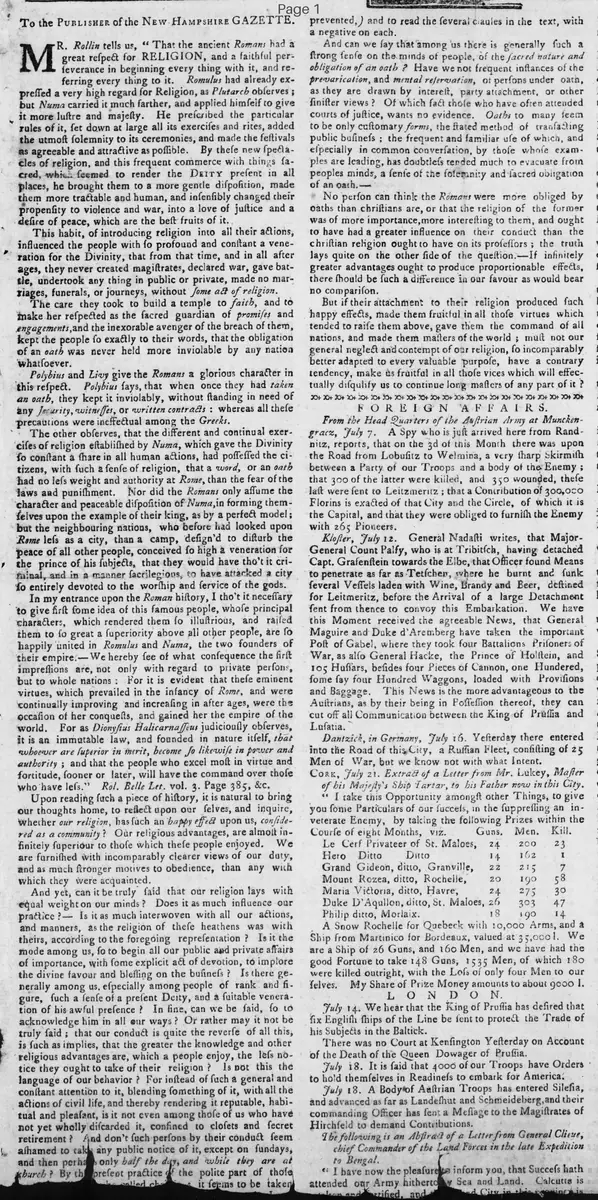
R. Rollin tells us, "That the ancient Romans had a great respect for RELIGION, and a faithful severance in beginning every thing with it, and referring every thing to it. Romulus had already expressed a very high regard for Religion, as Plutarch observes; but Numa carried it much farther, and applied himself to give it more lustre and majesty. He prescribed the particular rules of it, set down at large all its exercises and rites, added the utmost solemnity to its ceremonies, and made the festivals as agreeable and attractive as possible. By these new spectacles of religion, and this frequent commerce with things sacred, which seemed to render the Deity present in all places, he brought them to a more gentle disposition, made them more tractable and human, and insensibly changed their propensity to violence and war, into a love of justice and a desire of peace, which are the best fruits of it.
This habit, of introducing religion into all their actions, influenced the people with so profound and constant a veneration for the Divinity, that from that time, and in all after ages, they never created magistrates, declared war, gave battle, undertook any thing in public or private, made no marriages, funerals, or journeys, without some act of religion. The care they took to build a temple to faith, and to make her respected as the sacred guardian of promises and engagements, and the inexorable avenger of the breach of them, kept the people so exactly to their words, that the obligation of an oath was never held more inviolable by any nation whatsoever.
Polybius and Livy give the Romans a glorious character in this respect. Polybius says, that when once they had taken an oath, they kept it inviolably, without standing in need of any security, witnesses, or written contracts: whereas all these precautions were ineffectual among the Greeks. The other observes, that the different and continual exercises of religion established by Numa, which gave the Divinity so constant a share in all human actions, had possessed the citizens, with such a sense of religion, that a word, or an oath had no less weight and authority at Rome, than the fear of the laws and punishment. Nor did the Romans only assume the character and peaceable disposition of Numa, in forming themselves upon the example of their king, as by a perfect model; but the neighbouring nations, who before had looked upon Rome less as a city, than a camp, deign'd to disturb the peace of all other people, conceived so high a veneration for the prince of his subjects, that they would have thought it criminal, and in a manner sacrilegious, to have attacked a city so entirely devoted to the worship and service of the gods.
In my entrance upon the Roman history, I thought it necessary to give first some idea of this famous people, whose principal characters, which rendered them so illustrious, and raised them to so great a superiority above all other people, are so happily united in Romulus and Numa, the two founders of their empire. We hereby see of what consequence the first impressions are, not only with regard to private persons, but to whole nations: For it is evident that these eminent virtues, which prevailed in the infancy of Rome, and were continually improving and increasing in after ages, were the occasion of her conquests, and gained her the empire of the world. For as Dionysius Halicarnassus judiciously observes, it is an immutable law, and founded in nature itself, that whoever are superior in merit, become so likewise in power and authority; and that the people who excel most in virtue and fortitude, sooner or later, will have the command over those who have less." Rol. Belle Let. vol. 3. Page 385, &c.
Upon reading such a piece of history, it is natural to bring our thoughts home, to reflect upon ourselves, and inquire, whether our religion, has such a happy effect upon us, considered as a community? Our religious advantages, are almost infinitely superior to those which these people enjoyed. We are furnished with incomparably clearer views of our duty, and as much stronger motives to obedience, than any which they were acquainted.
And yet, can it be truly said that our religion lays with equal weight on our minds? Does it as much influence our practice? Is it as much interwoven with all our actions, and manners, as the religion of these heathens was with theirs, according to the foregoing representation? Is it the mode among us, so to begin all our public and private affairs of importance, with some explicit act of devotion, to implore the divine favour and blessing on the business? Is there generally among us, especially among people of rank and figure, such a sense of a present Deity, and a suitable veneration of his awful presence? In fine, can we be said, so to acknowledge him in all our ways? Or rather may it not be truly said; that our conduct is quite the reverse of all this, is such as implies, that the greater the knowledge and other religious advantages are, which a people enjoy, the less notice they ought to take of their religion? Is not this the language of our behavior? For instead of such a general and constant attention to it, blending something of it, with all the actions of civil life, and thereby rendering it reputable, habitual and pleasant, is it not even among those of us who have not yet wholly discarded it, confined to closets and secret retirement? And don't such persons by their conduct seem ashamed to take any public notice of it, except on Sundays, and then perhaps only half the day, and while they are at church? By the present practice of the polite part of those called Christians, it seems to be taken for granted, that religion is prevented, and to read the several clauses in the text, with a negative on each.
And can we say that among us there is generally such a strong sense on the minds of people, of the sacred nature and obligation of an oath? Have we not frequent instances of the prevarication, and mental reservation, of persons under oath, as they are drawn by interest, party attachment, or other sinister views? Of which fact those who have often attended courts of justice, want no evidence. Oaths to many seem to be only customary forms, the stated method of transacting public business; the frequent and familiar use of which, and especially in common conversation, by those whose examples are leading, has doubtless tended much to evacuate from peoples minds, a sense of the solemnity and sacred obligation of an oath.
No person can think the Romans were more obliged by oaths than Christians are, or that the religion of the former was of more importance, more interesting to them, and ought to have had a greater influence on their conduct than the Christian religion ought to have on its professors; the truth lies quite on the other side of the question. If infinitely greater advantages ought to produce proportionable effects, there should be such a difference in our favour as would bear no comparison.
But if their attachment to their religion produced such happy effects, made them fruitful in all those virtues which tended to raise them above, gave them the command of all nations, and made them masters of the world: must not our general neglect and contempt of our religion, so incomparably better adapted to every valuable purpose, have a contrary tendency, make us fruitful in all those vices which will effectually disqualify us to continue long masters of any part of it?
What sub-type of article is it?
What themes does it cover?
What keywords are associated?
What entities or persons were involved?
Letter to Editor Details
Recipient
To The Publisher Of The New Hampshire Gazette
Main Argument
ancient roman religion under romulus and numa profoundly influenced public and private life, fostering virtue, peace, and inviolable oaths that led to empire; modern christians, despite superior religious knowledge, neglect faith in daily conduct, confining it to private spheres and weakening oath obligations, risking societal vices and decline.
Notable Details