Thank you for visiting SNEWPapers!
Sign up free
Literary
October 13, 1790
Gazette Of The United States
New York, New York County, New York
What is this article about?
In this discourse, John Adams recounts French political intrigues during the 16th century, detailing the States General's assembly, the trial and condemnation of the Prince of Condé for treason, the Guises' ambitions, the Queen Mother's dissimulation, religious tensions between Catholics and Huguenots, and the death of King Francis II, succeeded by young Charles IX.
Clipping
OCR Quality
95%
Excellent
Full Text
DISCOURSES ON DAVILA.
No. XXII.
Intervenit deinde, his cogitationibus, avitum malum, regni cupido, atque inde æstum certamen coortum.
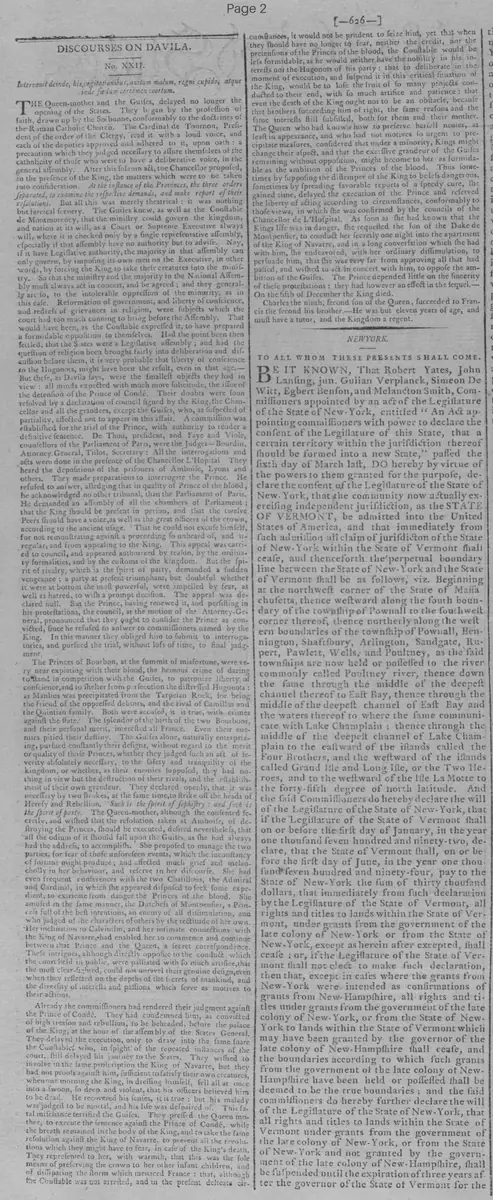
THE Queen-mother and the Guises, delayed no longer the faith, drawn up by the sovereign, conformably to the doctrines of the Roman Catholic Church. The Cardinal de Tournon, President of the order of the Clergy, read it with a loud voice, and each of the deputies approved and adhered to it, upon oath: a precaution which they judged necessary to assure themselves of the catholicity of those who were to have a deliberative voice, in the general assembly. After this solemn act, the Chancellor proposed, in the presence of the King, the matters which were to be taken into consideration. At the instance of the Provinces, the three orders separated, to examine the respective demands, and make report of their resolutions. But all this was merely theatrical: it was nothing but farcical scenery. The Guises knew, as well as the Constable de Montmorency, that the ministry could govern the kingdom, and nation at its will, as a Court or Supreme Executive always will, where it is checked only by a single representative assembly, especially if that assembly have no authority but to advise. Nay, if it have Legislative authority, the majority in that assembly can only govern, by imposing its own men on the Executive, in other words, by forcing the King to take their creatures into the ministry. So that the ministry and the majority in the National Assembly must always act in concert, and be agreed; and they generally are so, to the intolerable oppression of the minority, as in this case. Reformation of government, and liberty of conscience, and redress of grievances in religion, were subjects which the court had too much cunning to bring before the Assembly. That would have been, as the Constable expressed it, to have prepared a formidable opposition to themselves. Had the point been then settled, that the States were a Legislative assembly; and had the question of religion been brought fairly into deliberation and discussion before them, it is very probable that liberty of conscience to the Huguenots, might have been the result, even in that age.— But these, as Davila says, were the smallest objects they had in view: all minds expected with much more solicitude, the issue of the detention of the Prince of Conde. Their doubts were soon resolved by a declaration of council signed by the King, the Chancellor and all the grandees, except the Guises, who, as suspected of partiality, affected not to appear in this affair. A commission was established for the trial of the Prince, with authority to render a definitive sentence. De Thou, president, and Faye and Viole, counsellors of the Parliament of Paris, were the Judges— Bourdin, Attorney General, Tillot, Secretary: All the interrogations and acts were done in the presence of the Chancellor L'Hopital They heard the depositions of the prisoners of Amboise, Lyons and others. They made preparations to interrogate the Prince. He refused to answer, alleging that in quality of Prince of the blood, he acknowledged no other tribunal, than the Parliament of Paris. He demanded an assembly of all the chambers of Parliament: that the King should be present in person, and that the twelve Peers should have a voice, as well as the great officers of the crown, according to the ancient usage. That he could not excuse himself, for not remonstrating against a proceeding so unheard of, and irregular, and from appealing to the King. This appeal was carried to council, and appeared authorized by reason, by the ordinary formalities, and by the customs of the kingdom. But the spirit of rivalry, which is the spirit of party, demanded a sudden vengeance: a party at present triumphant, but doubtful whether it were at bottom the most powerful, were impelled by fear, as well as hatred, to wish a prompt decision. The appeal was declared null. But the Prince, having renewed it, and persisting in his protestations, the council, at the motion of the Attorney-General, pronounced that they ought to consider the Prince as convicted, since he refused to answer to commissioners named by the King. In this manner they obliged him to submit to interrogatories, and pursued the trial, without loss of time, to final judgment.
The Princes of Bourbon, at the summit of misfortune, were very near expiating with their blood, the heinous crime of daring to stand in competition with the Guises, to patronize liberty of conscience, and to shelter from persecution the distressed Huguenots: as Manlius was precipitated from the Tarpeian Rock, for being the friend of the oppressed debtors, and the rival of Camillus and the Quintian family. Both were accused, it is true, with crimes against the state. The splendor of the birth of the two Bourbons, and their personal merit, interested all France. Even their enemies pitied their destiny. The Guises alone, naturally enterprising, pursued constantly their designs, without regard to the merit or quality of those Princes, whether they judged such an act of severity absolutely necessary, to the safety and tranquility of the kingdom, or whether, as their enemies supposed, they had nothing in view but the destruction of their rivals, and the establishment of their own grandeur. They declared openly, that it was necessary by two strokes, at the same time, to strike off the heads of Heresy and Rebellion. Such is the spirit of Sophistry: and such is the spirit of party. The Queen-mother, although she consented secretly, and wished that the resolution taken at Amboise, of destroying the Princes, should be executed, desired nevertheless, that all the odium of it should fall upon the Guises, as she had always had the address, to accomplish. She proposed to manage the two parties, for fear of those unforeseen events, which the inconstancy of fortune might produce; and affected much grief and melancholy in her behaviour, and reserve in her discourse. She had even frequent conferences with the two Chatillons, the Admiral and Cardinal, in which she appeared disposed to seek some expedient, to extricate from danger the Princes of the blood. She amused in the same manner, the Duchess of Montpensier, a Princess full of the best intentions, an enemy of all dissimulation, and who judged of the characters of others by the rectitude of her own. -Her inclination to Calvinism, and her intimate connections with the King of Navarre,-had enabled her to commence and continue between that Prince and the Queen, a secret correspondence. These intrigues, although directly opposite to the conduct which the court held in public, were palliated with so much artifice, that the most clear-sighted, could not unravel their genuine design, even when they reflected on the depths of the secrets of mankind, and the diversity of interests and passions which serve as motives to their actions.
Already the commissioners had rendered their judgment against the Prince of Condé. They had condemned him, as convicted of high treason and rebellion, to be beheaded, before the palace of the King, at the hour of the assembly of the States General. They delayed the execution, only to draw into the same snare the Constable, who, in spite of the repeated instances of the court, still delayed his journey to the States. They wished to involve in the same proscription the King of Navarre, but they had not proofs against him, sufficient to satisfy their own creatures, when one morning the King, in dressing himself, fell all at once into a swoon, so deep and violent, that his officers believed him to be dead. He recovered his senses, it is true: but his malady was judged to be mortal, and his life was despaired of. This fatal mischance terrified the Guises. They pressed the Queen-mother, to execute the sentence against the Prince of Condé, while the breath remained in the body of the King, and to take the same resolution against the King of Navarre, to prevent all the revolutions which they might have to fear, in case of the King's death. They represented to her, with warmth, that this was the sole means of preserving the crown to her other infant children, and of dissipating the storm which menaced France: that, although the Constable was not arrested, and in the present delicate circumstances, it would not be prudent to seize him, yet that when they should have no longer to fear, neither the credit, nor the pretensions of the Princes of the blood, the Constable would be less formidable, as he would neither have the nobility in his interests nor the Huguenots of his party: that to deliberate in the moment of execution, and suspend it in this critical situation of the King, would be to lose the fruit of so many projects conducted to their end, with so much artifice and patience: that even the death of the King ought not to be an obstacle, because that brothers succeeding him of right, the same reasons and the same interests still subsisted, both for them and their mother. The Queen who had known how to preserve herself neuter, at least in appearance, and who had not motives so urgent to precipitate measures, considered that under a minority, Kings might remaining without opposition, might become to her as formidable as the ambition of the Princes of the blood. Thus sometimes by supposing the distemper of the King to be less dangerous, sometimes by spreading favorable reports of a speedy cure, she gained time, delayed the execution of the Prince and reserved the liberty of acting according to circumstances, conformably to those views, in which she was confirmed by the councils of the Chancellor de L'Hospital. As soon as she had known that the Kings life was in danger, she requested the son of the Duke de Montpensier, to conduct her secretly one night into the apartment of the King of Navarre, and in a long conversation which she had with him, she endeavored, with her ordinary dissimulation, to persuade him, that she was very far from approving all that had passed, and wished to act in concert with him, to oppose the ambition of the Guises. The Prince depended little on the sincerity of these protestations: they had however an effect in the sequel.- On the fifth of December the King died. Charles the ninth, second son of the Queen, succeeded to Francis the second his brother.—He was but eleven years of age, and must have a tutor, and the Kingdom a regent.
No. XXII.
Intervenit deinde, his cogitationibus, avitum malum, regni cupido, atque inde æstum certamen coortum.
THE Queen-mother and the Guises, delayed no longer the faith, drawn up by the sovereign, conformably to the doctrines of the Roman Catholic Church. The Cardinal de Tournon, President of the order of the Clergy, read it with a loud voice, and each of the deputies approved and adhered to it, upon oath: a precaution which they judged necessary to assure themselves of the catholicity of those who were to have a deliberative voice, in the general assembly. After this solemn act, the Chancellor proposed, in the presence of the King, the matters which were to be taken into consideration. At the instance of the Provinces, the three orders separated, to examine the respective demands, and make report of their resolutions. But all this was merely theatrical: it was nothing but farcical scenery. The Guises knew, as well as the Constable de Montmorency, that the ministry could govern the kingdom, and nation at its will, as a Court or Supreme Executive always will, where it is checked only by a single representative assembly, especially if that assembly have no authority but to advise. Nay, if it have Legislative authority, the majority in that assembly can only govern, by imposing its own men on the Executive, in other words, by forcing the King to take their creatures into the ministry. So that the ministry and the majority in the National Assembly must always act in concert, and be agreed; and they generally are so, to the intolerable oppression of the minority, as in this case. Reformation of government, and liberty of conscience, and redress of grievances in religion, were subjects which the court had too much cunning to bring before the Assembly. That would have been, as the Constable expressed it, to have prepared a formidable opposition to themselves. Had the point been then settled, that the States were a Legislative assembly; and had the question of religion been brought fairly into deliberation and discussion before them, it is very probable that liberty of conscience to the Huguenots, might have been the result, even in that age.— But these, as Davila says, were the smallest objects they had in view: all minds expected with much more solicitude, the issue of the detention of the Prince of Conde. Their doubts were soon resolved by a declaration of council signed by the King, the Chancellor and all the grandees, except the Guises, who, as suspected of partiality, affected not to appear in this affair. A commission was established for the trial of the Prince, with authority to render a definitive sentence. De Thou, president, and Faye and Viole, counsellors of the Parliament of Paris, were the Judges— Bourdin, Attorney General, Tillot, Secretary: All the interrogations and acts were done in the presence of the Chancellor L'Hopital They heard the depositions of the prisoners of Amboise, Lyons and others. They made preparations to interrogate the Prince. He refused to answer, alleging that in quality of Prince of the blood, he acknowledged no other tribunal, than the Parliament of Paris. He demanded an assembly of all the chambers of Parliament: that the King should be present in person, and that the twelve Peers should have a voice, as well as the great officers of the crown, according to the ancient usage. That he could not excuse himself, for not remonstrating against a proceeding so unheard of, and irregular, and from appealing to the King. This appeal was carried to council, and appeared authorized by reason, by the ordinary formalities, and by the customs of the kingdom. But the spirit of rivalry, which is the spirit of party, demanded a sudden vengeance: a party at present triumphant, but doubtful whether it were at bottom the most powerful, were impelled by fear, as well as hatred, to wish a prompt decision. The appeal was declared null. But the Prince, having renewed it, and persisting in his protestations, the council, at the motion of the Attorney-General, pronounced that they ought to consider the Prince as convicted, since he refused to answer to commissioners named by the King. In this manner they obliged him to submit to interrogatories, and pursued the trial, without loss of time, to final judgment.
The Princes of Bourbon, at the summit of misfortune, were very near expiating with their blood, the heinous crime of daring to stand in competition with the Guises, to patronize liberty of conscience, and to shelter from persecution the distressed Huguenots: as Manlius was precipitated from the Tarpeian Rock, for being the friend of the oppressed debtors, and the rival of Camillus and the Quintian family. Both were accused, it is true, with crimes against the state. The splendor of the birth of the two Bourbons, and their personal merit, interested all France. Even their enemies pitied their destiny. The Guises alone, naturally enterprising, pursued constantly their designs, without regard to the merit or quality of those Princes, whether they judged such an act of severity absolutely necessary, to the safety and tranquility of the kingdom, or whether, as their enemies supposed, they had nothing in view but the destruction of their rivals, and the establishment of their own grandeur. They declared openly, that it was necessary by two strokes, at the same time, to strike off the heads of Heresy and Rebellion. Such is the spirit of Sophistry: and such is the spirit of party. The Queen-mother, although she consented secretly, and wished that the resolution taken at Amboise, of destroying the Princes, should be executed, desired nevertheless, that all the odium of it should fall upon the Guises, as she had always had the address, to accomplish. She proposed to manage the two parties, for fear of those unforeseen events, which the inconstancy of fortune might produce; and affected much grief and melancholy in her behaviour, and reserve in her discourse. She had even frequent conferences with the two Chatillons, the Admiral and Cardinal, in which she appeared disposed to seek some expedient, to extricate from danger the Princes of the blood. She amused in the same manner, the Duchess of Montpensier, a Princess full of the best intentions, an enemy of all dissimulation, and who judged of the characters of others by the rectitude of her own. -Her inclination to Calvinism, and her intimate connections with the King of Navarre,-had enabled her to commence and continue between that Prince and the Queen, a secret correspondence. These intrigues, although directly opposite to the conduct which the court held in public, were palliated with so much artifice, that the most clear-sighted, could not unravel their genuine design, even when they reflected on the depths of the secrets of mankind, and the diversity of interests and passions which serve as motives to their actions.
Already the commissioners had rendered their judgment against the Prince of Condé. They had condemned him, as convicted of high treason and rebellion, to be beheaded, before the palace of the King, at the hour of the assembly of the States General. They delayed the execution, only to draw into the same snare the Constable, who, in spite of the repeated instances of the court, still delayed his journey to the States. They wished to involve in the same proscription the King of Navarre, but they had not proofs against him, sufficient to satisfy their own creatures, when one morning the King, in dressing himself, fell all at once into a swoon, so deep and violent, that his officers believed him to be dead. He recovered his senses, it is true: but his malady was judged to be mortal, and his life was despaired of. This fatal mischance terrified the Guises. They pressed the Queen-mother, to execute the sentence against the Prince of Condé, while the breath remained in the body of the King, and to take the same resolution against the King of Navarre, to prevent all the revolutions which they might have to fear, in case of the King's death. They represented to her, with warmth, that this was the sole means of preserving the crown to her other infant children, and of dissipating the storm which menaced France: that, although the Constable was not arrested, and in the present delicate circumstances, it would not be prudent to seize him, yet that when they should have no longer to fear, neither the credit, nor the pretensions of the Princes of the blood, the Constable would be less formidable, as he would neither have the nobility in his interests nor the Huguenots of his party: that to deliberate in the moment of execution, and suspend it in this critical situation of the King, would be to lose the fruit of so many projects conducted to their end, with so much artifice and patience: that even the death of the King ought not to be an obstacle, because that brothers succeeding him of right, the same reasons and the same interests still subsisted, both for them and their mother. The Queen who had known how to preserve herself neuter, at least in appearance, and who had not motives so urgent to precipitate measures, considered that under a minority, Kings might remaining without opposition, might become to her as formidable as the ambition of the Princes of the blood. Thus sometimes by supposing the distemper of the King to be less dangerous, sometimes by spreading favorable reports of a speedy cure, she gained time, delayed the execution of the Prince and reserved the liberty of acting according to circumstances, conformably to those views, in which she was confirmed by the councils of the Chancellor de L'Hospital. As soon as she had known that the Kings life was in danger, she requested the son of the Duke de Montpensier, to conduct her secretly one night into the apartment of the King of Navarre, and in a long conversation which she had with him, she endeavored, with her ordinary dissimulation, to persuade him, that she was very far from approving all that had passed, and wished to act in concert with him, to oppose the ambition of the Guises. The Prince depended little on the sincerity of these protestations: they had however an effect in the sequel.- On the fifth of December the King died. Charles the ninth, second son of the Queen, succeeded to Francis the second his brother.—He was but eleven years of age, and must have a tutor, and the Kingdom a regent.
What sub-type of article is it?
Essay
What themes does it cover?
Political
Religious
Liberty Freedom
What keywords are associated?
French History
Guises
Prince Of Conde
Queen Mother
States General
Huguenots
Liberty Of Conscience
Political Intrigue
Literary Details
Title
Discourses On Davila. No. Xxii.
Key Lines
Intervenit Deinde, His Cogitationibus, Avitum Malum, Regni Cupido, Atque Inde æstum Certamen Coortum.
Such Is The Spirit Of Sophistry: And Such Is The Spirit Of Party.
They Declared Openly, That It Was Necessary By Two Strokes, At The Same Time, To Strike Off The Heads Of Heresy And Rebellion.