Thank you for visiting SNEWPapers!
Sign up free
The Daily Union
Washington, District Of Columbia
What is this article about?
On January 1, 1851, the Massachusetts Legislature organized with Free-Soil and Democratic support. Henry Wilson was elected Senate President over Whig candidates, and Nathaniel P. Banks became House Speaker. Chauncey L. Knapp and Lewis Josslyn were chosen as clerks, respectively.
Merged-components note: Sequential reading orders 20-21 with adjacent bboxes and continuous text on Massachusetts Legislature proceedings; merging into one domestic news article.
Clipping
OCR Quality
Full Text
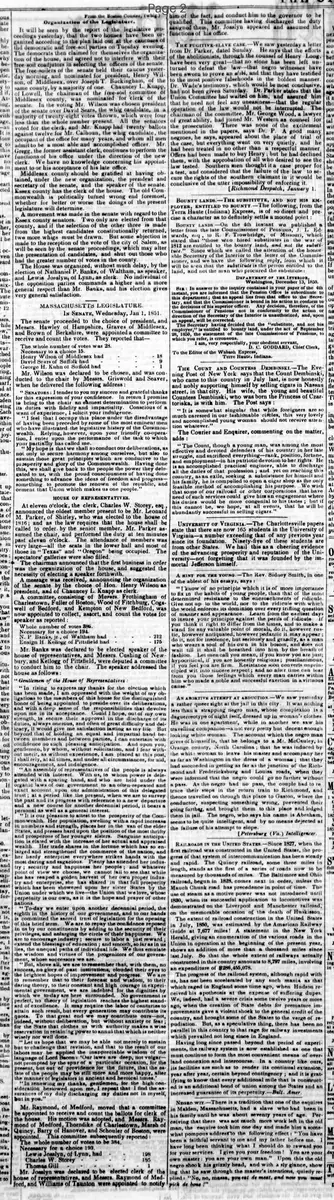
It will be seen by the report of the legislative proceedings yesterday, that the two houses have been organized according to the plan laid out at the caucuses of the democratic and free-soil parties on Tuesday evening. The democrats then claimed for themselves the organization of the house, and agreed not to interfere with their free-soil coadjutors in selecting the officers of the senate. The free-soilers of the senate held their caucus yesterday morning, and nominated for president, Henry Wilson, of Middlesex, over Joseph T. Buckingham, of the same county, by a majority of one. Chauncey L. Knapp, of Lowell, the chairman of the free-soil committee of Middlesex county, was nominated for clerk of the senate. In the voting Mr. Wilson was chosen president of the senate over David Sears, the whig candidate, in a majority of twenty-eight votes thrown, which were four less than the whole number present. All the senators voted for the clerk, and Mr. Knapp had twenty ballots against twelve for Mr. Calhoun, the whig candidate, the occupant of the office for many years, and whom all men admit to be a most able and accomplished officer. Mr. Gregg, the former assistant clerk, continues to perform the functions of his office under the direction of the new clerk. We have no knowledge concerning his appointment to or his acceptance of his late office. Middlesex county should be gratified at having obtained, under the new organization, the president and secretary of the senate, and the speaker of the house. Essex county has the clerk of the house. The old Commonwealth is politically turned wrong end foremost, whether for better or worse the doings of the present legislature will determine. A movement was made in the senate with regard to the Essex county senators. Two only are elected from that county, and if the selection of the other three is made from the highest candidates constitutionally returned, two more whigs must be drawn. But some objection is made to the reception of the vote of the city of Salem, as will be seen by the senate proceedings, which may alter the presentation of candidates, and shut out those who had the greater number of votes in the county. The House was organized, without much delay, by the election of Nathaniel P. Banks, of Waltham, as speaker, and Lewis Josslyn, of Lynn, as clerk. No individual of the opposition parties commands a higher and a more general respect than Mr. Banks, and his election gives very general satisfaction.
MASSACHUSETTS LEGISLATURE. In Senate, Wednesday, Jan 1, 1851. The senate proceeded to the choice of president, and Messrs. Hawley of Hampshire, Graves of Middlesex, and Brown of Berkshire, were appointed a committee to receive and count the votes. They reported that— The whole number of votes was 28. Necessary to a choice 15. Henry Wilson of Middlesex had 18 David Sears of Suffolk had 9 George H. Kuhn of Suffolk had Mr. Wilson was declared to be chosen, and was conducted to the chair by Messrs. Griswold and Seaver when he delivered the following address: "Senators: I tender to you my sincere and grateful thanks for this expression of your confidence. In return I promise to bring to the chair an earnest determination to perform its duties with fidelity and impartiality. Conscious of a want of experience, I solicit your indulgence. "I feel that I occupy this place under the disadvantage of having been preceded by some of the most eminent men who have illustrated the legislative history of the Commonwealth. Relying, however, upon your friendly co-operation, I enter upon the performance of the task to which your partiality has called me. "My hope is that we shall so conduct our deliberations, as not only to secure harmony among ourselves, but also to sustain those great principles which are conducive to the prosperity and glory of the Commonwealth. Having done this, we shall give back to the people the power they delegated to us, with the proud consciousness of having done something to advance the ideas of freedom and progress—something to promote the renown of the republic, and cement that Union which makes us one people.' HOUSE OF REPRESENTATIVES. At eleven o'clock, the clerk, Charles W. Storey, esq. announced the oldest member present to be Mr. Leonard M. Parker, of Shirley, who was elected to the house of 1816; and as the law requires that the house shall be called to order by the senior member, Mr. Parker assumed the chair, and performed the duty at ten minutes past eleven o'clock. The attendance of members was very large all the seats in the lower hall and most of those in "Texas" and "Oregon" being occupied. The spectators' galleries were also filled. The chairman announced that the first business in order was the organization of the house, and suggested the necessity of electing a speaker forthwith. A message was received, announcing the organization of the senate by the choice of Hon. Henry Wilson as president, and of Chauncey L. Knapp as clerk. A committee, consisting of Messrs. Frothingham of Charlestown, Fuller of Boston, Wood of Fitchburg, Cogswell of Bedford, and Kempton of New Bedford, was now appointed to collect, assort, and count the votes for speaker as reported: Whole number of votes 286. Necessary for a choice 194. N. P Banks, jr., of Waltham had 212 Ensign H. Kellogg of Pittsfield had 175 Mr. Banks was declared to be elected speaker of the house of representatives, and Messrs. Cushing of Newbury, and Kellogg of Pittsfield, were deputed a committee to conduct him to the chair. The speaker addressed the house as follows: "Gentlemen of the House of Representatives: "In rising to express my thanks for the election which has been made, I am oppressed with the weight of my obligations to the members of this house for the distinguished honor of being appointed to preside over its deliberations, and with a deep sense of the responsibilities that devolve upon me in its acceptance. Could I hope, out of my own strength, to secure their approval in the discharge of its duties, always onerous, and often of great difficulty and delicacy, it would give me satisfaction lasting as my life. But beyond that of holding an equal and impartial hand between members and between parties, I can entertain with confidence no such pleasing anticipation. And upon you, gentlemen, by whom, without solicitation, and I fear without merit, as without experience, I am placed at this post, I shall rely, at all times, and under all circumstances, for aid, encouragement, and indulgence. "An assembly of representatives of the people is always attended with interest. With us, to whom power is delegated with a sparing hand, and who are held under the organic laws of our government to an often-repeated and exact account upon our administration of this delegated trust; at a period like the present, when we are to survey the past and its progress with reference to a new departure and a new course for another decennial period, it bears a personal as well as a general interest. "It is our pleasure to attest to the prosperity of the Commonwealth. Her population, swelling with a rapid increase in numbers and strength, places her in the van of the elder States, and presses hard upon the position of the most thrifty and prosperous of her younger sisters. Sanguine anticipation is elated with the increase of her actual and appraised wealth. Her trade shares in the fortune which has so enlarged and strengthened the commerce of the nation, and her hardy enterprise everywhere strikes hands with the most daring and sagacious. Plenty has attended her industry; security and happiness her people; and whatever point of view we choose, we cannot fail to see that while she has reaped a golden harvest of her own proper industry and enterprise, she has shared in that full prosperity which has been showered upon her sister States by the Union under which we live—the Union that we love, whose perpetuity is our own, as it is the hope and prayer of other nations. "To-day we enter upon another decennial period, the eighth in the history of our government, and to our hands is committed the sacred trust of legislation for the opening of this brief term. We are to repay the confidence reposed in us by our constituents by adding to the security of their privileges, and enlarging the circle of their happiness. We are to encourage industry; secure to labor a just reward; extend the blessings of education; and smooth, so far as in us lies, the unequal paths of individual life. We thus emulate the wisdom and virtues of the progenitors of our government, whose successors we But, above all, we to remember that, with them, no success, no glory of past institutions, clouded their eyes to the brightest hopes of improvement and progress. We are to remember that to their forecast and wisdom, to their daring theory, to their constant and high courage in experimental government, we are indebted for the dignities by which we to-day are here surrounded. No government is perfect, no theory of legislation reaches the highest standard of excellence. It may require the labor of centuries to attain such result, but every generation may contribute its quota. To that great end we may contribute ours—not, indeed, without deliberation, but without anxiety or fear for the State that clothes us with authority makes a wise reservation in retaining power to annul that which is neither wisely nor well done. "Let us hope that we may be able not merely to sustain but to challenge that revision, and that to the result of our labors may be applied the inappreciable wisdom of the language of Lord Bacon: 'Our laws are deep, not vulgar—not prompted by the spur of a particular occasion, for the present, but out of providence for the future, that the estate of the people may be still more and more happy, after the manner of legislators in ancient and heroical times.' "In renewing my thanks, gentlemen, for the high consideration bestowed upon me, I repeat that I find the assurances of my duly discharging my duties not in myself, but in you." Mr. Raymond, of Medford, moved that a committee be appointed to receive and count the ballots for clerk of the house. His motion was adopted, and Messrs. Raymond of Medford, Thorndike of Charlestown, Marsh of Quincy, Barry of Hanover, and Schouler of Boston, were appointed. This committee subsequently reported: The whole number of votes to be 284, necessary for a choice 143, Lewis Josslyn, of Lynn, had 198 Charles W. Storey 185 Thomas Gill Mr. Josslyn was declared to be elected clerk of the house of representatives, and Messrs. Raymond of Medford, and Williams of Taunton were appointed to notify him of the fact, and conduct him to the governor to be qualified. This committee having discharged the duty assigned them, Mr. Josslyn appeared and assumed the functions of his office.
What sub-type of article is it?
What keywords are associated?
What entities or persons were involved?
Where did it happen?
Domestic News Details
Primary Location
Massachusetts
Event Date
Wednesday, Jan 1, 1851
Key Persons
Outcome
henry wilson elected senate president with 18 votes; chauncey l. knapp elected senate clerk with 20 votes; nathaniel p. banks elected house speaker with 212 votes; lewis josslyn elected house clerk with 198 votes. democrats and free-soilers organized the houses per caucus agreements, defeating whig candidates.
Event Details
The Massachusetts Legislature convened on January 1, 1851. The Senate elected Henry Wilson as President and Chauncey L. Knapp as Clerk following Free-Soil caucus nominations. The House, called to order by senior member Leonard M. Parker, elected Nathaniel P. Banks as Speaker and Lewis Josslyn as Clerk. Both Wilson and Banks delivered inaugural addresses emphasizing impartiality, prosperity, and union. Debate arose over Essex County senators' seating due to Salem vote objections.