Thank you for visiting SNEWPapers!
Sign up free
Story
January 1, 1960
Summit County Labor News
Akron, Summit County, Ohio
What is this article about?
FTC hosts conference on consumer deception, highlighting fraud in sales, advertising, employment, and education; speakers urge stronger enforcement, federal standards, and a cabinet-level consumer department to protect public from scams costing millions annually.
Clipping
OCR Quality
98%
Excellent
Full Text
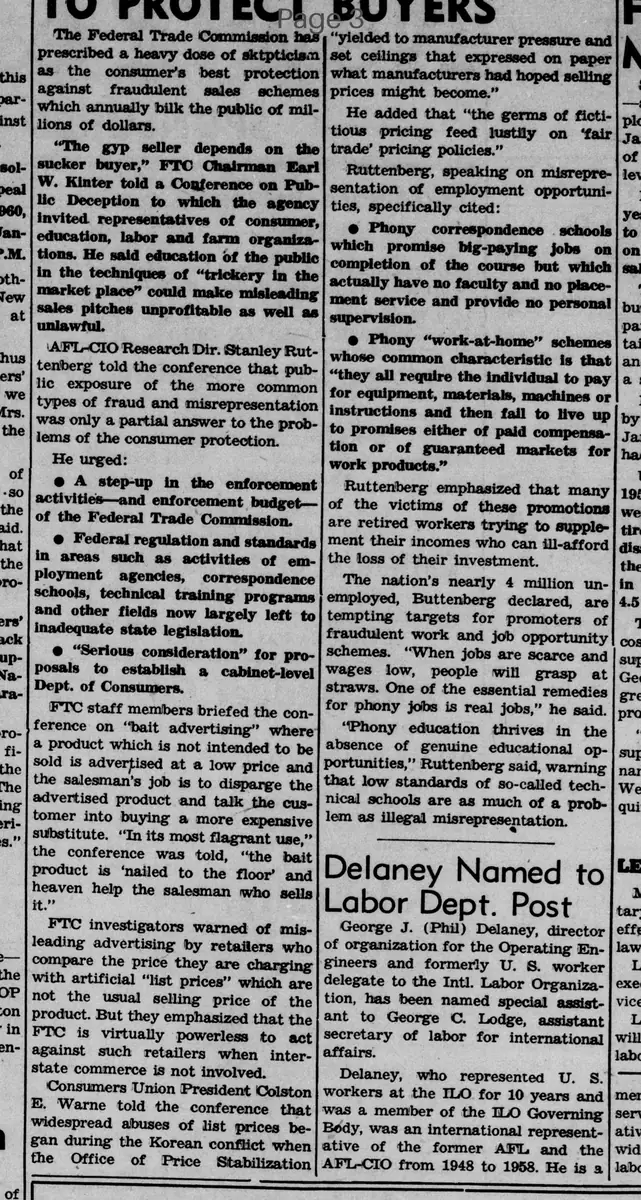
The Federal Trade Commission has prescribed a heavy dose of skepticism as the consumer's best protection against fraudulent sales schemes which annually bilk the public of millions of dollars.
"The gyp seller depends on the sucker buyer," FTC Chairman Earl W. Kinter told a Conference on Public Deception to which the agency invited representatives of consumer, education, labor and farm organizations. He said education of the public in the techniques of "trickery in the market place" could make misleading sales pitches unprofitable as well as unlawful.
AFL-CIO Research Dir. Stanley Ruttenberg told the conference that public exposure of the more common types of fraud and misrepresentation was only a partial answer to the problems of the consumer protection.
He urged:
• A step-up in the enforcement activities--and enforcement budget- of the Federal Trade Commission.
Federal regulation and standards in areas such as activities of employment agencies, correspondence schools, technical training programs and other fields now largely left to inadequate state legislation.
"Serious consideration" for proposals to establish a cabinet-level Dept. of Consumers.
FTC staff members briefed the conference on 'bait advertising" where a product which is not intended to be sold is advertised at a low price and the salesman's job is to disparage the advertised product and talk the customer into buying a more expensive substitute. "In its most flagrant use," the conference was told, "the bait product is 'nailed to the floor' and heaven help the salesman who sells it."
FTC investigators warned of misleading advertising by retailers who compare the price they are charging with artificial "list prices" which are not the usual selling price of the product. But they emphasized that the FTC is virtually powerless to act against such retailers when interstate commerce is not involved.
Consumers Union President Colston E. Warne told the conference that widespread abuses of list prices began during the Korean conflict when the Office of Price Stabilization "yielded to manufacturer pressure and set ceilings that expressed on paper what manufacturers had hoped selling prices might become."
He added that "the germs of fictitious pricing feed lustily on 'fair trade' pricing policies."
Ruttenberg, speaking on misrepresentation of employment opportunities, specifically cited:
Phony correspondence . schools which promise big-paying jobs on completion of the course but which actually have no faculty and no placement service and provide no personal supervision.
Phony "work-at-home" schemes whose common characteristic is that "they all require the individual to pay for equipment, materials, machines or instructions and then fail to live up to promises either of paid compensation or of guaranteed markets for work products."
Ruttenberg emphasized that many of the victims of these promotions are retired workers trying to supplement their incomes who can ill-afford the loss of their investment.
The nation's nearly 4 million unemployed, Ruttenberg declared, are tempting targets for promoters of fraudulent work and job opportunity schemes. "When jobs are scarce and wages low, people will grasp at straws. One of the essential remedies for phony jobs is real jobs," he said.
'Phony education thrives in the absence of genuine educational opportunities," Ruttenberg said, warning that low standards of so-called technical schools are as much of a problem as illegal misrepresentation.
"The gyp seller depends on the sucker buyer," FTC Chairman Earl W. Kinter told a Conference on Public Deception to which the agency invited representatives of consumer, education, labor and farm organizations. He said education of the public in the techniques of "trickery in the market place" could make misleading sales pitches unprofitable as well as unlawful.
AFL-CIO Research Dir. Stanley Ruttenberg told the conference that public exposure of the more common types of fraud and misrepresentation was only a partial answer to the problems of the consumer protection.
He urged:
• A step-up in the enforcement activities--and enforcement budget- of the Federal Trade Commission.
Federal regulation and standards in areas such as activities of employment agencies, correspondence schools, technical training programs and other fields now largely left to inadequate state legislation.
"Serious consideration" for proposals to establish a cabinet-level Dept. of Consumers.
FTC staff members briefed the conference on 'bait advertising" where a product which is not intended to be sold is advertised at a low price and the salesman's job is to disparage the advertised product and talk the customer into buying a more expensive substitute. "In its most flagrant use," the conference was told, "the bait product is 'nailed to the floor' and heaven help the salesman who sells it."
FTC investigators warned of misleading advertising by retailers who compare the price they are charging with artificial "list prices" which are not the usual selling price of the product. But they emphasized that the FTC is virtually powerless to act against such retailers when interstate commerce is not involved.
Consumers Union President Colston E. Warne told the conference that widespread abuses of list prices began during the Korean conflict when the Office of Price Stabilization "yielded to manufacturer pressure and set ceilings that expressed on paper what manufacturers had hoped selling prices might become."
He added that "the germs of fictitious pricing feed lustily on 'fair trade' pricing policies."
Ruttenberg, speaking on misrepresentation of employment opportunities, specifically cited:
Phony correspondence . schools which promise big-paying jobs on completion of the course but which actually have no faculty and no placement service and provide no personal supervision.
Phony "work-at-home" schemes whose common characteristic is that "they all require the individual to pay for equipment, materials, machines or instructions and then fail to live up to promises either of paid compensation or of guaranteed markets for work products."
Ruttenberg emphasized that many of the victims of these promotions are retired workers trying to supplement their incomes who can ill-afford the loss of their investment.
The nation's nearly 4 million unemployed, Ruttenberg declared, are tempting targets for promoters of fraudulent work and job opportunity schemes. "When jobs are scarce and wages low, people will grasp at straws. One of the essential remedies for phony jobs is real jobs," he said.
'Phony education thrives in the absence of genuine educational opportunities," Ruttenberg said, warning that low standards of so-called technical schools are as much of a problem as illegal misrepresentation.
What sub-type of article is it?
Deception Fraud
What themes does it cover?
Deception
Crime Punishment
Justice
What keywords are associated?
Consumer Fraud
Sales Schemes
Bait Advertising
Employment Scams
Correspondence Schools
Ftc Enforcement
What entities or persons were involved?
Earl W. Kinter
Stanley Ruttenberg
Colston E. Warne
Story Details
Key Persons
Earl W. Kinter
Stanley Ruttenberg
Colston E. Warne
Story Details
FTC conference on public deception discusses fraudulent sales schemes, bait advertising, misleading prices, phony employment and education opportunities; calls for increased enforcement, federal regulations, and a Department of Consumers.