Thank you for visiting SNEWPapers!
Sign up free
The Madisonian
Washington, District Of Columbia
What is this article about?
In New York City, Catholics held a meeting at Carroll Hall on Friday evening to nominate candidates opposing the public school system, which they viewed as Protestant-biased. Bishop Hughes spoke, endorsing a mixed ticket with Loco-foco candidates for state legislature to seek school fund allocation for separate Catholic schools. The election was set for the following day.
Merged-components note: The table lists the assembly candidates mentioned in the article on the New York election and Catholic meeting, with spatial and contextual relation.
Clipping
OCR Quality
Full Text
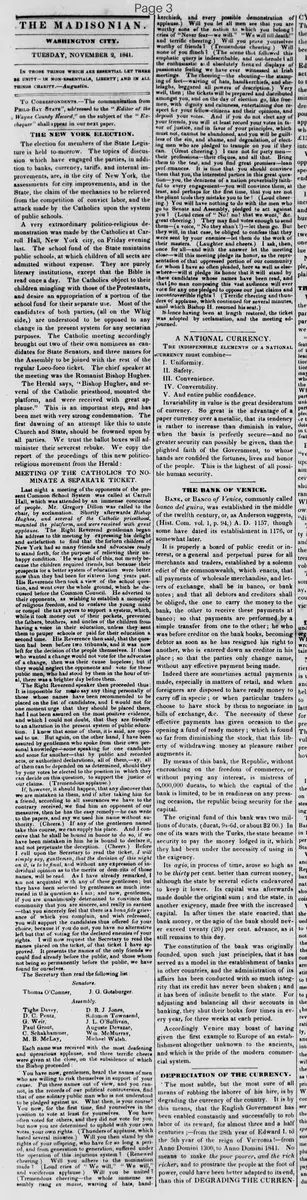
The election for members of the State Legislature is held to-morrow. The topics of discussion which have engaged the parties, in addition to banks, currency, tariffs, and internal improvements, are, in the city of New York, the assessments for city improvements, and in the State, the claim of the mechanics to be relieved from the competition of convict labor, and the attack made by the Catholics upon the system of public schools.
A very extraordinary politico-religious demonstration was made by the Catholics at Carroll Hall, New York city, on Friday evening last. The school fund of the State maintains public schools, at which children of all sects are admitted without expense. They are purely literary institutions, except that the Bible is read once a day. The Catholics object to their children mingling with those of the Protestants, and desire an appropriation of a portion of the school fund for their separate use. Most of the candidates of both parties, (all on the Whig side,) are understood to be opposed to any change in the present system for any sectarian purposes. The Catholic meeting accordingly brought out two of their own nominees as candidates for State Senators, and three names for the Assembly to be joined with the rest of the regular Loco-foco ticket. The chief speaker at the meeting was the Romanist Bishop Hughes. The Herald says, "Bishop Hughes, and several of the Catholic priesthood, mounted the platform, and were received with great applause." This is an important step, and has been met with very strong condemnation. The first dawning of an attempt like this to unite Church and State, should be frowned upon by all parties. We trust the ballot boxes will administer their severest rebuke. We copy the report of the proceedings of this new politico-religious movement from the Herald:
MEETING OF THE CATHOLICS TO NOMINATE A SEPARATE TICKET.
Last night a meeting of the opponents of the present Common School System was called at Carroll Hall, which was attended by an immense concourse of people. Mr. Gregory Dillon was called to the chair, by acclamation. Shortly afterwards Bishop Hughes, and several of the Catholic priesthood mounted the platform, and were received with great applause. The Right Reverend gentleman began his address to the meeting by expressing his delight and satisfaction to find that the forlorn children of New York had so many friends and advocates ready to stand forth, for the purpose of relieving their unhappy condition. He was glad of this, not merely because the children required friends, but because their prospects for a better system of education were better now than they had been for sixteen long years past. His Reverence then took a view of the school question, and went over the whole ground, which he discussed before the Common Council. He adverted to their opponents, as wishing to establish a monopoly of religious freedom, and to enslave the young mind or compel the tax payers to support a system, which, while it took money out of their pockets, prevented the fathers, brothers, and uncles of the children from having a voice in their education, unless they sent them to pauper schools or paid for their education a second time. His Reverence then said, that the question had been before two tribunals, and it was now left for the decision of the people themselves. If those who wanted a change would not vote for the advocates of a change, then was their cause hopeless; but if they would neglect the opponents and vote for these public men, who had stood by them in the hour of trial, there was a brighter day before them.
The Right Reverend speaker then proceeded thus:
It is impossible for me to say any thing personally of those whose names have been recommended to be placed on the list of candidates, and I would not for one moment urge that they should be placed there, had I not been assured on the most positive evidence and which I could not doubt, that they are friendly to an alteration in the present system of public education. I know that some of them, it is said, are opposed to us. But again, on the other hand, I have been assured by gentlemen who spoke from their own personal knowledge some speaking for one candidate and some for another—that by public and recorded acts, or authorized declarations, all of them,—ay, all of them can be depended on as determined, should they by your votes be elected to the position in which they can decide on this question, to support the justice of our claims. (Tremendous applause.)
If, however, it should happen, that any discover that we are mistaken in them, and if after taking him for a friend, according to all assurances we have to the contrary received, we find him an opponent of our measures, then he has the easy remedy—he can write to the papers, and say we used his name without authority. (Cheers.) If any of the gentlemen named take this course, we can supply his place. And I conceive that he shall be bound in honor to do so, if we have been mistaken in him he is bound to declare it. and not perpetuate the deception. (Cheers.) Before I call upon the Secretary to read the ticket, I will simply say, gentlemen, that the decision of this night on it, is to be final, and without any expression of individual opinion as to the merits or demerits of those names, will be read. As I have already remarked, I am not acquainted with any of these gentlemen; but they have been selected by gentlemen as much interested in this question as I am; and now, gentlemen, if you are unanimously determined to convince this community that you are sincere, and really in earnest—that you sincerely feel that there is a bona fide grievance of which you complain, and wish redressed, you will support the candidates thus offered for your choice, because if you do not, you have no alternative left but that of voting for the declared enemies of your rights. I will now request the Secretary to read the names placed on the ticket, of that ticket I have approved. It presents the names of the only friends we could find already before the public, and those whom not being so permanently before the public, we have found for ourselves.
The Secretary then read the following list
Senators.
Thomas O'Conner,
J. G. Gotsburger.
Assembly
Each name was received with the most deafening and uproarious applause, and three terrific cheers were given at the close, on the subsidence of which the Bishop proceeded:
You have now, gentlemen, heard the names of men who are willing to risk themselves in support of your cause. Put these names out of view, and you cannot, in the records of our political controversies, find that of one solitary public man who is not understood to be pledged against us. What then, is your course? You now, for the first time, find yourselves in the position to vote at least for yourselves. You have often voted for others, and they did not vote for you, but now you are determined to uphold with your own votes, your own rights. (Thunders of applause, which lasted several minutes.) Will you then stand by the rights of your offspring, who have for so long a period, and from generation to generation, suffered under the operation of this injurious system? (Renewed cheering) Will you adhere to the nomination made? (Loud cries of "We will." "We will," and vociferous applause) Will you be united? (Tremendous cheering—the whole immense assembly rising en masse, waving of hats, handkerchiefs, and every possible demonstration of applause.) Will you let all men see that you are worthy sons of the nation to which you belong? (Cries of "Never fear—we will." "We will till death!" and terrific cheering.) Will you prove yourselves worthy of friends? (Tremendous cheering) Will none of you flinch? (The scene that followed this emphatic query is indescribable, and out-Herods all the enthusiastic and absolutely frenzied displays of passionate feeling we have ever witnessed at Irish meetings. The cheering—the shouting—the stamping of feet—waving of hats, handkerchiefs, and shillelaghs, beggared all powers of description.) Very well, then; the tickets will be prepared and distributed amongst you, and on the day of election go, like freemen, with dignity and calmness, entertaining due respect for your fellow-citizens and their opinions, and deposit your votes. And if you do not elect any of your friends, you will at least record your votes in favor of justice, and in favor of your principles, which must not, cannot be abandoned, and you will be guiltless of the sin, and shame, and degradation, of electing men who are pledged to trample on you if they can. (Great cheering.) I care not for party men their professions—their cliques, and all that. Bring them to the test, and you find great promises—lean performances. It is time that you should convince them that you, the interested parties in this great question—you, the denizens of a nation proverbially faithful to every engagement—you will convince them, at least, and perhaps for the first time, that you are not the pliant tools they mistake you to be! (Loud cheering.) You will have nothing to do with the men who go to Senate and Assembly, pledged to act against you? (Loud cries of "No! no! that we won't," &c. great cheering.) They may find votes enough to send them—(a voice, "No they shan't!"—let them go. But they will, in that case, be obliged to confess that they were sent by your enemies—let them do the work of their masters. (Laughter and cheers.) I ask, then, once for all—and with the answer let the meeting close—will this meeting pledge its honor, as the representation of that oppressed portion of our community for whom I have so often pleaded, here as well as elsewhere—will it pledge its honor that it will stand by these candidates whose names have been read, and that no man composing this vast audience will ever vote for any one pledged to oppose our just claims and incontrovertible rights? (Terrific cheering and thunders of applause, which continued for several minutes, amid which Bishop H. resumed his seat.)
Silence having been at length restored, the ticket was adopted by acclamation, and the meeting adjourned.
| Tighe Davey, | D. R. J. Jones, |
| D. C. Pentz, | Solomon Townsend, |
| G. Weir, | J. L. O'Sullivan, |
| Paul Grout, | Auguste Devazac, |
| C. Schakhammer, | Wm. McMurray, |
| M. B. McLay, | Michael Walsh. |
What sub-type of article is it?
What keywords are associated?
What entities or persons were involved?
Where did it happen?
Domestic News Details
Primary Location
New York City
Event Date
Friday Evening Last
Key Persons
Outcome
the meeting adopted the nominated ticket by acclamation.
Event Details
Catholics opposed to the public school system, where the Bible is read daily, held a meeting at Carroll Hall to nominate candidates for State Senate and Assembly to join the Loco-foco ticket and advocate for allocating part of the school fund for separate Catholic schools. Bishop Hughes addressed the crowd, assuring the candidates' support for change, and the audience pledged to vote for them.