Thank you for visiting SNEWPapers!
Sign up free
Republican Herald
Providence, Providence County, Rhode Island
What is this article about?
Informational article from Albany Daily Advertiser on French wines, detailing production in Burgundy, Hermitage, Muscadine, and Medoc regions, including cultivation, fermentation, qualities, and famous varieties like Romanee Conti and Lafitte.
Clipping
OCR Quality
Full Text
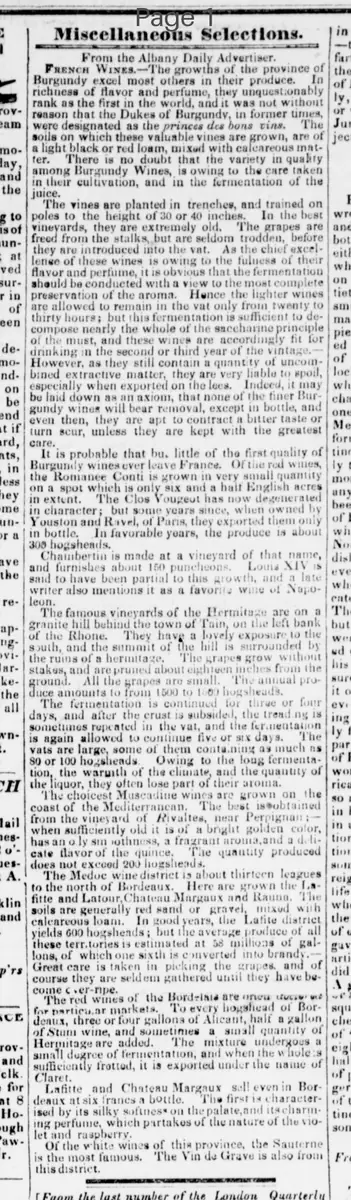
From the Albany Daily Advertiser.
French Wines.—The growths of the province of
Burgundy excel most others in their produce. In
richness of flavor and perfume, they unquestionably
rank as the first in the world, and it was not without
reason that the Dukes of Burgundy, in former times,
were designated as the princes des bons vins. The
soils on which these valuable vines are grown, are of
a light black or red loam, mixed with calcareous matter.
There is no doubt that the variety in quality
among Burgundy Wines, is owing to the care taken
in their cultivation, and in the fermentation of the
juice.
The vines are planted in trenches, and trained on
poles to the height of 30 or 40 inches. In the best
vineyards, they are extremely old. The grapes are
freed from the stalks, but are seldom trodden before
they are introduced into the vat. As the chief excellence
of these wines is owing to the fulness of their
flavor and perfume, it is obvious that the fermentation
should be conducted with a view to the most complete
preservation of the aroma. Hence the lighter wines
are allowed to remain in the vat only from twenty to
thirty hours; but this fermentation is sufficient to decompose
nearly the whole of the saccharine principle
of the must, and these wines are accordingly fit for
drinking in the second or third year of the vintage.—
However, as they still contain a quantity of uncombined
extractive matter, they are very liable to spoil,
especially when exported on the lees. Indeed, it may
be laid down as an axiom, that none of the finer Burgundy
wines will bear removal, except in bottle, and
even then, they are apt to contract a bitter taste or
turn sour, unless they are kept with the greatest
care.
It is probable that but little of the first quality of
Burgundy wines ever leave France. Of the red wines,
the Romanee Conti is grown in very small quantity
on a spot which is only six and a half English acres
in extent. The Clos Vougeot has now degenerated
in character; but some years since, when owned by
Youston and Ravel, of Paris, they exported them only
in bottle. In favorable years, the produce is about
300 hogsheads.
Chambertin is made at a vineyard of that name.
and furnishes about 150 puncheons. Louis XIV. is
said to have been partial to this growth, and a late
writer also mentions it as a favorite wine of Napoleon.
The famous vineyards of the Hermitage are on a
granite hill behind the town of Tain, on the left bank
of the Rhone. They have a lovely exposure to the
south, and the summit of the hill is surrounded by
the ruins of a hermitage. The grapes grow without
stakes, and are pruned about eighteen inches from the
ground. All the grapes are small. The annual produce
amounts to from 1500 to 2000 hogsheads.
The fermentation is continued for three or four
days, and after the crust is subsided, the treading is
sometimes repeated in the vat, and the fermentation
is again allowed to continue five or six days. The
vats are large, some of them containing as much as
50 or 100 hogsheads. Owing to the long fermentation,
the warmth of the climate, and the quantity of
the liquor, they often lose part of their aroma.
The choicest Muscadine wines are grown on the
coast of the Mediterranean. The best is obtained
from the vineyard of Rivesaltes, near Perpignan;—
when sufficiently old it is of a bright golden color.
has an oily smoothness, a fragrant aroma, and a delicate
flavor of the quince. The quantity produced
does not exceed 200 hogsheads.
The Medoc wine district is about thirteen leagues
to the north of Bordeaux. Here are grown the Lafitte
and Latour, Chateau Margaux and Haut Brion. The
soils are generally red sand or gravel, mixed with
calcareous loam. In good years, the Lafitte district
yields 800 hogsheads; but the average produce of all
these territories is estimated at 5 1/2 millions of gallons,
of which one sixth is converted into brandy.—
Great care is taken in picking the grapes, and of
course they are seldom gathered until they have become
over-ripe.
The red wines of the Bordeaux are often concocted
for particular markets. To every hogshead of Bordeaux,
three or four gallons of Alicante, half a gallon
of Sun wine, and sometimes a small quantity of
Hermitage are added. The mixture undergoes a
small degree of fermentation, and when the whole is
sufficiently frotted, it is exported under the name of
Claret.
Lafitte and Chateau Margaux sell even in Bordeaux
at six francs a bottle. The first is characterized
by its silky softness on the palate, and its charming
perfume, which partakes of the nature of the violet
and raspberry.
Of the white wines
of this province, the Sauterne
is the most famous.
The Vin de Grave is also from
this district.
What sub-type of article is it?
What themes does it cover?
What keywords are associated?
What entities or persons were involved?
Where did it happen?
Story Details
Key Persons
Location
Province Of Burgundy, France; Town Of Tain On The Rhone; Coast Of The Mediterranean Near Perpignan; Medoc District North Of Bordeaux
Story Details
Detailed description of French wine production, focusing on Burgundy wines' superiority, cultivation methods, fermentation processes, specific vineyards like Romanee Conti and Chambertin, Hermitage on the Rhone, Muscadine at Rivesaltes, and Bordeaux varieties in Medoc including blending practices.