Thank you for visiting SNEWPapers!
Sign up free
Wheeling Register
Wheeling, Ohio County, West Virginia
What is this article about?
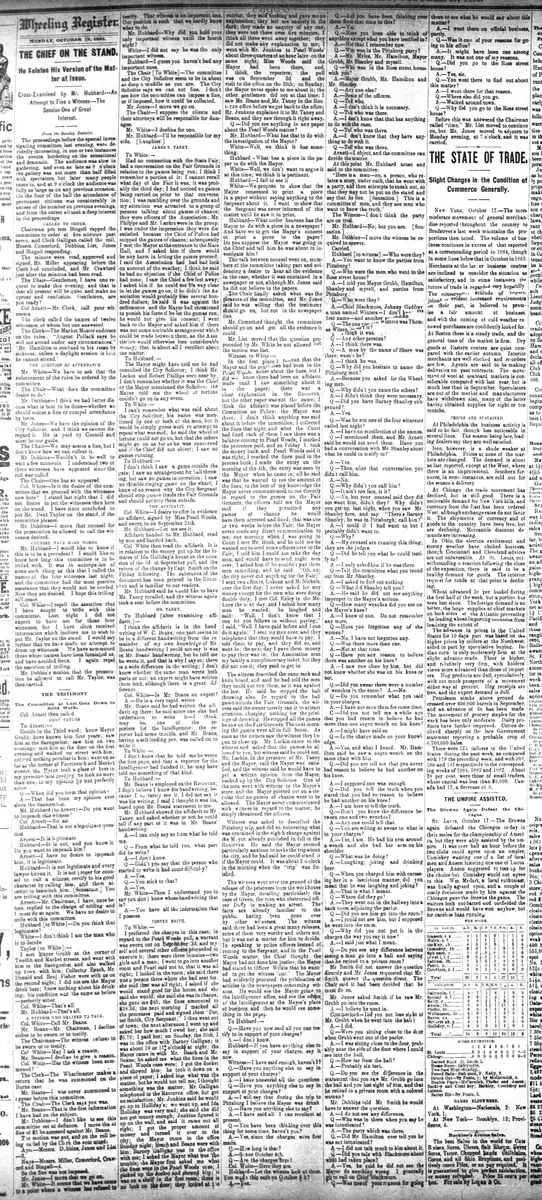
Report on a special investigating committee session examining Mayor Grubb's conduct. Witnesses Dent Taylor, James B. Taney, and Porter Smith testify on mayor's sobriety at Saengerfest, fair games, fines in Pearl Woods case, and Pittsburgh trip. Debates on witness attendance, fines, and evidence admissibility occur.
Merged-components note: Parts of the same article reporting on the special investigating committee proceedings.
Clipping
OCR Quality
Full Text
Attempt to Fine a Witness---The
Session One of Great
Interest.
From the Sunday Register.
The proceedings before the special inves-
tigating committee, last evening, were de-
cidedly interesting, in one or two instances
the events bordering on the sensational
and dramatic. The audience was slow in
gathering, and even as late as 8 o'clock
the gallery was not more than half filled
with spectators, but later many people
came in, and at 9 o'clock the audience was
fully as large as on any previous occasion.
On the floor of the hall the attendance of
prominent citizens was considerably in
excess of the number on previous evenings,
and from the outset all took a deep interest
in the proceedings
CALLED TO ORDER.
Chairman pro tem Bingell rapped the
committee to order at five minutes past
seven, and Clerk Galligan called the roll,
Messrs. Comerford, Dobbins, List, Jones
and Bingell responding.
The minutes were read, approved and
signed, Mr. Miller appearing before the
Clerk had concluded, and Mr. Crawford
just after the minutes had been read.
The Chair-Gentlemen. I have one re-
quest to make this evening, and that is
that all present will be quiet and make no
uproar and confusion. Gentlemen, are
you ready?
Col Arnett-Mr. Clerk, call your wit-
nesses.
The clerk called the names of twelve
witnesses, of whom but one answered.
The Clerk-The Market Master endorses
on the rules: "August Pollack says he
will not attend under any circumstances
"Mr. Hamilton is confined to his room by
sickness; unless a daylight session is held
he cannot attend.
THE QUESTION OF ATTENDANCE.
Mr White-We have to ask that the
enforcement of the rules be ordered by the
committee.
The Chair-What does the committee
desire to do?
Mr. Dobbins-I think we had better dis-
cuss what is best to be done-whether we
should assess a fine or compel attendance
by force.
Mr Jones-We have the opinion of the
City Solicitor. and I think we cannot dis-
regard it. He is paid by Council and
must be our guide.
The Chair-We may assess a fine, but I
don't know how we can collect it.
Mr. Dobbins-Wouldn't it be well to
wait a few moments. I understand two or
three witnesses have appeared since the
roll was called
The ChairOne has so appeared.
Col. WhiteIs it the desire of the com-
mittee that we proceed with the witnesses
now here? I stated last night that I did
not desire to put the witnesses then here
on the stand. I have since concluded to
put Mr. Dent Taylor on the stand, if the
committee pleases.
Mr. Dobbins--I move that counsel for
the prosecution be allowed to call the wit-
nesses desired.
COUNSEL HAVE SOME WORDS
Mr. Hubbard-I would like to know if
this is to be a precedent? I would like to
know how long this committee is to be
trifled with. It was in anticipation of
some such thing as this that I called the
names of the four witnesses last night,
and the committee had the most positive
assurance that they would not be needed.
Now they are desired. I hope this trifling
will cease.
Col. White-I repel the assertion that
I have sought to trifle with this
committee. Last night I did not
expect to have use for those four
witnesses, but I have since received
information which inclines me to wish to
put Mr. Taylor on the stand. I would say
further that we have made no attempt to
drum up witnesses We have summoned
those whose names have been furnished us
and have avoided force. I again repel
the assertion of trifling.
Mr. Dobbins motion, that the prosecu-
tion be allowed to call Mr. Taylor, was
then carried.
THE TESTIMONY
The Committee at Last Gets Down to
Solid Work.
Col. Arnett then called
DENT TAYLOR
To Arnett:--
Reside in the Third ward: know Mayor
Grubb; have known him four years; saw
him at the Saengerfest; saw him on two
evenings: met him at the door on the first
evening and walked up street with him;
noticed nothing peculiar in him; went up as
far as the corner of Fourteenth and Market
street; the Mayor took a glass of beer in
my presence that evening. he took no more
than one; in my opinion he was perfectly
sober
Q -When did you form that opinion
A-That has been my opinion ever
since the Saengerfest.
Mr. Hubbard (to Arnett)-Do you want
to impeach this witness?
Col. Arnett-No, sir
Hubbard-That is not a legitimate ques-
tion
Arnett-It is legitimate
Hubbard-It is not, and you know it
Do you want to impeach him?
Arnett-I have no desire to impeach
him; it is legitimate.
Hubbard-It is not legitimate and every
lawyer knows it. It is not proper for coun-
sel to call a witness, certify to his good
character by calling him, and then at-
tempt to besmirch him. [Sensation.] You
are trifling with this committee.
Arnett-Mr. Chairman, I have, once be-
fore, replied to the charge of trifling and
I must do so again. We have no desire to
trifle with this committee.
Hubbard [to White]-Do you think that
legitimate?
White-I don't think I am the man who
is to decide.
Taylor [to White]:—
I met Mayor Grubb at the corner of
Twelfth and Market streets, and went with
him up town; Collector Beach, Mr.
Donald and Benj. Fisher were with us on
the second night; I did not see the Mayor
drink beer: know nothing about his drinking;
his condition was the same as before
-perfectly sober.
Col. White-That's all
Mr. Hubbard-That's all.
A WITNESS WHO DECLINED TO TALK.
Mr. Beans-Mr. Chairman, I decline
Col. White-Call Mr. Beans.
either to be sworn or to testify.
The Chairman-The witness refuses to
be sworn or to testify.
Col. White-May I ask a reason.
Mr. Beans-I decline to give a reason.
Col. White-Has the witness been sum-
moned?
The Clerk-The Wharfmaster makes a
return that he was summoned on the
Burns case.
Mr. Beans-I was never summoned to
appear before this committee.
The Chair-The Clerk says you was.
Mr. Beans-That is the first information
I have had on the subject.
Mr. DobbinsI don't like to see this
committee set at defiance, I move that a
fine of $5 be assessed against Mr. Beans.
The motion was put, and on the roll be-
ing called by the Clerk the vote stood:
Ayes-Messrs. Dobbins, Jones and List
3.
Nays-Messrs. Miller, Comerford and Bing
2.
Mr. DobbinsI don't like to see this
committee set at defiance, I move that a
fine of $5 be assessed against Mr. Beans.
The motion was put, and on the roll be-
ing called by the Clerk the vote stood:
Ayes-Messrs. Dobbins, Jones and List
3.
Nays-Messrs. Miller, Comerford and Bing
2.
testify. That witness is an important one.
Our position is such that we hardly know
what to do.
Mr. Hubbard-Why did you hold your
only important witness until the fourth
night?
White-I did not say he was the only
important witness.
Hubbard-I guess you haven't had any
important ones.
The Chair [To White]-The committee
and the City Solicitor seem to be in about
as deep a muddle as you are. The City
Solicitor says we can not fine. I don't
see how the committee can impose a fine,
or if imposed, how it could be collected.
Mr. Jones-I move we go on.
The Chair-I suppose the clients and
their attorneys will be responsible for dam-
ages.
Mr. WhiteI decline for one.
Mr. Hubbard-I'll be responsible for my
side. [Laughter.]
JAMES B TANEY.
To White:-
Had no connection with the State Fair:
had a conversation on the Fair Grounds in
relation to the games being run: I think I
remember a portion of it; I cannot recall
what day of the Fair it was; it was prob-
ably the third day; I had noticed no games
being carried on prior to that conversa-
tion: I was rambling over the grounds and
my attention was attracted to a group of
persons talking about games of chance;
they were officers of the Association: Mr.
Philips and Mr. Larkin were in the group;
I was under the impression they were dis-
satisfied because the Chief of Police had
stopped the games of chance; subsequently
I met the Mayor at the entrance to the Main
Hall, and I asked him if there would
be any harm in letting the games proceed:
I said the Association had had bad luck
on account of the weather: I think he said
he had no objection if the Chief of Police
had none; I saw the Chief a few feet away;
I asked him if he could see his way clear
to let the games go on, if he didn't the As-
sociation would probably lose several hun-
dred dollars; he said it was against the
ordinances and the Mayor had threatened
to punish his force if he let the games run;
he would not give his consent: I went
back to the Mayor and asked him if there
was not some amicable arrangement which
could be made between them, as the Asso-
ciation would otherwise lose considerable
money; that is about all I recollect about
the matter.
To Hubbard:-
The Mayor might have told me he had
consulted the City Solicitor: I think Mr.
Larkin and Robert Phillips were near by:
I don't remember whether it was the Chief
or the Mayor mentioned the Solicitor; the
Mayor told me the wheel of fortune
couldn't go on in any event.
To White :-
I can't remember what was said about
the City Solicitor: his name was men-
tioned by one or both of the men, but it
would be simply guess work to attempt to
repeat what was said; he said the wheel of
fortune could not go on, but that the others
might go on as far as he was concerned
and if the Chief did not object; I saw no
games running.
To Hubbard:-
I don't think I saw a game outside the
gate; I saw an arrangement for ball throwing,
but saw no games in operation; I saw
no thimble-rigging game on the wharf; I
know of no reason why the City Sergeant
should stop games inside the Fair Grounds
and should not stop them outside.
THE AFFIDAVIT.
Col. WhiteI desire to offer in evidence
an affidavit, signed by Miss Pearl Woods,
and sworn to on September 24th.
Mr. Hubbard-Let me see it.
Affidavit handed to Mr. Hubbard. read
by him and handed back.
Col White then read the affidavit. It is
in relation to the money put up for the in-
mates of Ida Holliday's house on the occa-
sion of the 3d of September pull, and the
return of the change by Capt Smith on the
Friday following. The substance of the
document has been printed in the Register
and is familiar to our readers.
Mr. Hubbard said he would like to have
Mr. Taney recalled, and the witness again
took a seat before the committee.
MR. TANEY.
To Hubbard after examining affidavit.]
I think the affidavit is in the hand
writing of W. C. Beans; one part seems to
be in a different handwriting from the re-
mainder: of my own knowledge of Mr.
Beans' handwriting I could not say it was
in Mr. Beans' handwriting, but he told me
he wrote it, and that is why I say so; there
is a wide difference in the writing: I don't
know whether the same man wrote both
parts or not; an expert might have written
them both, although there is a great dif-
ference.
Col. White-Is Mr. Beans an expert?
A.-He is a very rapid writer.
Mr. Beans said he had written the affi-
davit up there; he said some one else had
undertaken to write it-I think,
may
be,
one
of
the
re-
porters for the Intelligencer; the re-
porter had some trouble, and Mr Beans,
having a self-feeding pen, was called on to
write it.
To White:—
I don't know that he told me he wrote
the first page, and that a reporter for the
Intelligencer had finished it; he may have
told me something of that kind.
To Hubbard:-
Mr. Beans is employed on the Register;
I don't believe I know his handwriting. be-
cause I rarely see it; I did not say it
was his writing, I said I thought it was his,
based upon Mr. Beans' statement to me.
Mr. Hubbard showed the affidavit to Mr
Taney, and asked whether or not he could
tell if any part of it was in Mr. Beans'
handwriting.
A.-I can only say so from what he told
me.
Q-From what he told you, what part
did he write?
A.-I don't know.
Q -Didn't you say that the person who
started to write it had some difficulty?
A.-Yes.
Q.-You stick to that?
A.-Yes.
Mr. WhiteThen I understand you to
say you don't know whose handwriting that
is?
A.-You have all the information that
I possess.
PORTER SMITH.
To White:—
I preferred the charges in this case; in
regard to the Pearl Woods pull, a warrant
was sworn out on September 3d, and my-
self and several other officers proceeded to
execute it; there were three inmates-two
girls and a man; I went to go into another
room and Pearl said not to, that it was all
right; I looked in the room; she said there
was a person there whom she had sent for.
she said that was all right; I asked if she
would stand good for the house, and she
said she would; she said she was in charge:
she gave me $45; the fines amounted to
$39.30; the next morning I marked all
the processes paid and signed them "Porter
Smith, City Sergeant;" I then went out
of town; the next afternoon I went up and
asked her how much I owed her; she said
$5.70; I paid her; on Sunday, the 20th, I
was in the office with Barney Galligan; it
was about 10 or 11 o'clock at night; the
Mayor came in with Mr. Beach and Mr.
Beans; he asked me what the fines in the
Pearl Woods case were; I got the docket
and showed him; he took it down on a
piece of paper; I asked him what was the
matter, but he would not tell me; I thought
something was the matter; Mr. Galligan
telephoned to the Register office, but got
no satisfaction; Mr. Junkins said he would
go up to Holliday's; we went up, and Ida
Holliday was very mad; she said she did
not get money enough; Junkins figured it
up on the wall, and said it came out all
right; I got the proper amount of
money and turned it over to the
city; the Mayor came to the office
Sunday night; Beach and Beans were with
him; Barney Galligan was in the office
with me; I asked the Mayor what was the
trouble; the Mayor first asked me what
the fines were in the Pearl Woods case; I
picked up the docket and showed him; it
was on a shelf in the first room; there is
no lock on the door; they looked at the
docket; the Mayor did not make any explanation to me;
Same night; Miss
Mayor
had been there,
way on September
Beans, and they saw through it right away.
about the Pearl Woods matter to
the investigation of the Mayor.
White-Well, we think it
some
thing.
Hubbard -What has a piece in the pa-
per to do with the Mayor.
White--Well, we don't want to argue it
at this time; we think it is pertinent.
Hubbard-I fail to see it
WhiteWe propose to show that the
Mayor consented to print a piece
in a paper without saying anything to the
Sergeant about it. I want to show that
the Sergeant was never informed of this
matter until he saw it in print.
Hubbard-What under heavens has the
Mayor to do with a piece in a newspaper?
And have we to get the Mayor's consent
to print a piece in the paper?
Do you suppose the Mayor was going to
the Chief and tell him he was about to in-
vestigate him?
The talk between counsel went on, mem-
bers of the committee taking part and evi-
dencing a desire to hear all the evidence
in the case, whether it was contained in a
newspaper or not, although Mr. Jones said
he did not believe in the papers.
The Chair finally asked what was the
pleasure of the committee, and Mr. Jones
said he was willing that the testimony
should go on, but not in the newspaper
line.
Mr. Comerford thought the committee
should go on and get all the evidence it
could.
Mr. List moved that the question pro-
pounded by Mr. White be not allowed but
the motion was lost
Witness, to White:—
In the first place I learned that the
Mayor and the gentlemen had been in the
Pearl Woods house about the fines, but I
did not know there had been an affidavit
made until I saw something about it
in
the
paper;
there
was a
clear explanation in the Register.
but the other paper was not the same; I
think the affidavit was placed before the
Committee on Police: the Mayor was
there: I don't think anything was said
about it before the committee; I collected
the fines that night, and after the Court
had fined each of them I saw there was a
balance coming to Pearl Woods; I marked
the processes paid, and on Friday I took
the money back, and Pearl Woods said it
was right; I marked the fines paid in the
procers book; I made the entry on the
morning of the 4th; the entry was seen by
the Mayor when he came in; all he said
was that he wanted to see the amount of
the fines; to the best of my knowledge the
Mayor never communicated to me directly
in regard to the games on the Fair
Grounds; the officers told me the Mayor
said
if they
permitted
any
games
of
chance
he
would
have them arrested and fined; that was one
or two weeks before the Fair; the Mayor
never made any direct communication to
me; one morning when I was going to
Court I met Mr. Hook, and he told me he
wanted me to send some officers over to the
Fair; I told him I could not take the day
men, and would have to send night men
over; I asked him if he couldn't pay these
men something, and he said: "Oh, no;
the city never did anything for the Fair;
I sent two officers, Lukens and McNichols
over the first day; I never asked for any
money except for the men who were doing
double duty; I met Col. Exley in the Mc-
Lure the next day, and I asked how many
men he wanted; he laughed and
said: "Well, I don't know that I
can let you fellows in without paying:"
I said, "Well. I have paid before and I can
do it again;" I sent my men over, and they
telephoned that they would have to pay;
told them to pay. and they did so, and
went in; the next day I gave them money
to pay their way in; the Association sent
my family a complimentary ticket, but they
did not use it; they paid to get in.
The witness described the cane rack and
knife board, and said he had told the men
they could not run them, as it was against
the law. He said he stopped the ball
throwing also. In regard to the ball
game outside the Fair Grounds, the wit-
ness said the owner merely ran it to attract
attention, charging nothing for the privi-
lege of throwing. He stopped all the games
he saw on the Fair Grounds. The next morn-
ing the games were all in full bloom. As
soon as the owners saw the witness they be-
gan to close up. Mr. Larkin came to the
witness and asked that the games be al-
lowed to run, but witness said he could not.
Mr. Larkin, in the presence of Mr. Taney
and the Mayor, said the Mayor was satis-
fied, and the witness said he would have to
get a written opinion from the Mayor.
backed up by the City Solicitor. One of
the men went with witness to the Mayor's
store, and the Mayor pointed out on a cir-
cular that no games of chance were to be
allowed. The Mayor never communicated
with witness in regard to the matter; he
simply threatened the officers.
Witness was asked to describe the
Pittsburg trip, and did so, reiterating what
was contained in the eighth charge against
the Mayor, already published in full in the
Register He said the Mayor seemed
particularly anxious to make the trip about
the city, and he had said he could stand it
if the Mayor could. It was about 2 o'clock
in the morning when the "trip" was fin-
ished.
The witness went over the ground of the
release of the prisoners from the workhouse
by the Mayor, detailing particularly the
case of Green, the man who obstructed offi-
cer Duffy in making an arrest. The
facts are already familiar to the
public, having been gone
over
by other witnesses. The witness
said there had been a great many releases,
some of them very worthy and others not.
but it was not a matter for him to decide.
In speaking to police officers instead of
coming to the Sergeant, and in the Pearl
Woods matter, the Chief thought the
Mayor had not done him justice: the Mayor
had stated to Officer Wilkie that he want-
ed to get the witness "out." The Mayor
had evidently procured the publication of
articles in the newspapers concerning wit-
ness. He would see the Mayor going to
the Intelligencer office, and see the editor
of the Intelligencer at the Mayor's place
of business, and then he would see some-
thing in the paper.
To Hubbard:-
Q.-Have you now said all you can tes-
tify to in support of your charges?
A-I don't know.
Hubbard-If you have anything else to
say in support of your charges, say it
now.
Witness—I have said enough, haven't I?
Q.-Have you anything else to say in
support of your charges?
A.-I have answered all the questions
Q.-Have you anything else to say in
support of your charges?
A.-I will say that during the trip to
Pittsburg I believe the Mayor was drunk
Q.-Have you anything else to say?
A.-I have said all I can recollect at
present.
Q.-You have been thinking over this
thing for some time, haven't you?
A.-Yes, since the charges were first
made.
Q.-How long is that?
A.-Since October 6th.
Q-Are the charges here?
Col. White-Here they are.
Hubbard-Let the witness look at them.
You made this oath on October 5th?
A.-Yes.
Q.-And you have been thinking over
them from that time to this?
A.-Yes.
Q.-Have you been able to think of
anything except what you have testified to?
A.-Not that I remember now.
Q. -Who was in the Pittsburg party?
A -Mr. Myles, Mr. Hamilton, Mayor
Grubb, M. Shanley and myself.
Q -Who was in the Ross street house
with you?
A. Mayor Grubb, Mr. Hamilton and
Mr. Shanley.
Q.-Any one else?
A.-Some of the officers.
Q-Tell who.
A-I don't think it is necessary.
Q -Tell who was there.
A.-I don't know that that has anything
to do with the case.
Q.-Tell who was there.
A.-I don't know that they have any
thing to do with it.
Q.-Tell who was there.
Arnett-I object, and the committee can
decide the matter.
At this point Mr. Hubbard arose and
said to the committee:
"Here is a man-no, a person, who re-
lates a story, under oath, that he went with
a party, and then attempts to sneak out, so
that they may not be put on the stand and
say that he lies. [Sensation.] This is a
committee of men, and they are men who
want to know the truth.
The Witness-I don't think the party
are on trial.
Mr. Hubbard-No; but you are. [Sen-
sation.]
Mr. Dobbins-I move the witness be re-
quired to answer.
Carried.
Hubbard [to witness]:-Who were they?
A.-You want to know the parties from
Pittsburg?
Q.-Who were the men who went to the
Ross street house?
A.-I told you Mayor Grubb, Hamilton,
Shanley and myself, and parties from
Pittsburg.
Q.-Who were they?
A.-Chief Blackmore, Johnny Godfrey
a man named Winters-I don't know-
first name-and another gentleman.
Q —The one run . Winters was Thomas
Witten was it?
A-I think it was.
—Any other persons?
A.--I think there was.
Q -A man by the name of Shore was
there, wasn't he?
A.-I think he was.
Q.-Why did you hesitate to name the
Pittsburg men?
A.-Because you asked for the Wheel-
ing men.
Q.-Why didn't you name the others?
A.-I didn't think they were necessary.
Q -Did you have Barney Shanley sub-
penaed?.
A.-Yes.
Q.—Was he not one of the four witnesses
called last night?
A.-I have no recollection of the names.
Q-I mentioned them, and Mr. Arnett
said he would not need them. Have you
had a conversation with Mr. Shanley about
what he could testify to?'
A-Yes.
Q-Then, after that conversation, you
didn't call him.
A.-No.
Q.-Why didn't you call him?
Q.-It ain't too late, is it?
Q.-No. but your counsel said they did
not want him, didn't they? Why didn't
you get up, last night, when you saw Mr.
Shanley here, and say: "There's Barney
Shanley; he was in Pittsburgh; call him?"
A.-I could if I had wanted to, but I
probably didn't want to.
Q.-Why?
A -My counsel are running this thing;
they are the judges.
Q -Did he tell you what he could tes-
tify to?
A --I only asked him if he was there.
Q-Tell the committee what you found
out from Mr. Shanley.
A.-I asked to find out nothing
Q -What did Shanley tell you?
A.-He said he did not see anything
improper in the Mayor's actions.
Q -How many wenches did you see on
the Mayor's knee?
A.-I know of one. Do not remember
any more.
Q-Have you forgotten any of the
women?
A.-No, I have not forgotten any,
Q-Was there more than one.
A.-Not at that time.
Q -Have you any reason to believe
there was another on his knee?
A--I saw one close by him, but did
not know whether she was on his knee or
not.
Q --Did you swear there were a number
of wenches in the room? A.-No.
Q.-Do you remember what you said
in your charges.
A.-I have not seen them for some time
Q.-Did you not tell me a while ago
that you had reason to believe he had
more than one negro wench on his knee?
A -I might have said so
Q-Is the charge made on your knowl-
edge.
A.-Yes. and what I heard. Mr. Ham-
ilton said he saw a negro wench on the
same chair with him.
Q.-Did you not tell me that you never
had reason to believe he had another on
his knee.
A.--I supposed one was enough
Q-Did you tell the truth when you
stated that you had no reason to believe
he had another on his knee?
- A.-I am here to tell the truth.
Q.-Don't you know the difference be-
tween one and two wenches?
A -Any one could tell that.
Q -You are willing to swear to what is
in your charges?
A.-Yes, I am. He had his arm around
a wench and she had her arm on his
shoulder.
Q -What was he doing?
A.-Laughing, joking and drinking
beer.
Q -When you charged him with caress-
ing her in a lascivious manner, did you
mean that he was laughing and joking?
A.-That is what I meant.
Q -Where did they go?
A.-They went out in the hallway into a
back room adjoining the parlor.
Q -Did you see him go into the room?
A.-I could not see him, but I supposed
he went into the room.
Q-Why did you not put it in the
charges the way you say it now
A.-I said just what I mean.
Q-Do you see any difference between
seeing a man go into a hall and saying
that-he retired to a private room?
Mr Smith did not answer the question
directly and Mr. Jones requested that Mr.
Smith answer the question direct, The
Chair said it had been decided that he
must do so.
Mr. Jones asked Smith if he saw Mr
Grubb go into the room.
A -I believe he went in
Comiskey-Did you not lose sight of
Mr. Grubb when he went into the hall?
A.-I did.
Q.-Were you sitting close to the door
when Grubb went out of the parlor.
A.-I was sitting close to the door, prob-
ably near the side of the door where I could
see into the hall.
Q -How far from the hall?
A.-Probably six feet.
Q.-Do you see the difference in the
statement that you saw Mr. Grubb go into
the hall and you lost sight of him, and that
he retired to a private room with a colored
woman?
Mr. Dobbins told Mr. Smith he would
have to answer the question
A.-I do not see any difference.
Q -Who was in there when you say he
was intoxicated?
A.-The party which was there.
Q.-Did Mr. Hamilton ever tell you he
was not intoxicated?
A --I did not talk much to him about it.
Did you talk with Blackmore about
what had taken place?
A -Yes, he said he did not see the
Mayor do anything wrong. I generally
go to call on Chief Blackmore.
there to see what he would say about this
matter?
A.--I went there on official business
partly.
Q.-Was it one of your reasons for go-
ing to his office?
A.-It might have been one among
many. It was not one of my reasons.
Q.-Did you go to the Ross street
house?
A.-Yes. sir
Q.-You went there to find out about
this matter?
A.-I went there for that reason.
Q.-Where else did you go.
A.-Walked around town.
Q.-Why did you go to the Ross street
house?
Before this was answered the Chairman
called "time." Mr. List moved to continue
on. but Mr. Jones moved to adjourn to
Monday evening, at 7 o'clock, and it was
carried.
What sub-type of article is it?
What themes does it cover?
What keywords are associated?
What entities or persons were involved?
Where did it happen?
Story Details
Key Persons
Location
Committee Hall, Fair Grounds, Wheeling
Event Date
Last Evening
Story Details
Special investigating committee hears testimony from witnesses on Mayor Grubb's sobriety at Saengerfest, handling of games at State Fair, fines in Pearl Woods case involving Ida Holliday's house, and conduct during Pittsburgh trip including alleged intoxication and interactions with women. Debates arise over witness attendance, fines, and evidence like affidavits and newspaper articles.