Thank you for visiting SNEWPapers!
Sign up free
Editorial
March 20, 1823
Alexandria Gazette & Advertiser
Alexandria, Virginia
What is this article about?
An anonymous editorial urges freeholders in Prince William, Loudoun, and Fairfax counties to elect experienced legislator Charles F. Mercer over Sydnor Bailey to represent them in the U.S. Congress, highlighting Mercer's qualifications, achievements in Virginia politics, military service, and anti-slave trade efforts.
Clipping
OCR Quality
98%
Excellent
Full Text
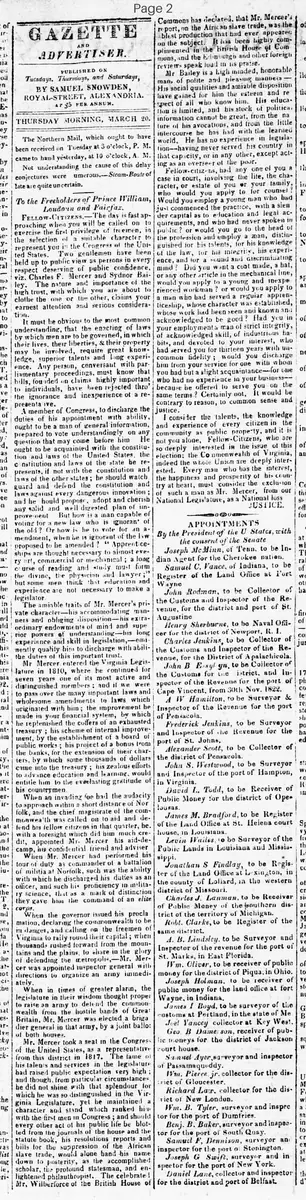
To the Freeholders of Prince William, Loudoun and Fairfax.
Fellow-Citizens,—The day is fast approaching when you will be called on to exercise the first privilege of freemen, in the selection of a suitable character to represent you in the Congress of the United States. Two gentlemen have been held up to public view as persons in every respect deserving of public confidence, viz. Charles F. Mercer and Sydnor Bailey. The nature and importance of the high trust, with which you are about to clothe the one or the other, claims your earnest attention and serious consideration.
It must be obvious to the most common understanding, that the enacting of laws by which men are to be governed, in which their lives, their liberties, & their property may be involved, require great knowledge, superior talents and long experience. Any person, conversant with parliamentary proceedings, must know that bills, founded on claims highly important to individuals, have been rejected thro' the ignorance and inexperience of a representative.
A member of Congress, to discharge the duties of his appointment with ability, ought to be a man of general information, prepared to vote understandingly on any question that may come before him. He ought to be acquainted with the constitution and laws of the United States, the constitution and laws of the state he represents, if not with the constitution and laws of the other states: he should watch guard and defend the constitution and laws against every dangerous innovation; and he should propose, adopt and cherish any solid and well digested plan of improvement But how is a man capable of voting for a new law who is ignorant of the old? Or how is he to vote for an amendment, when he is ignorant of the law proposed to be amended? Apprenticeships are thought necessary to almost every art, commercial or mechanical; a long course of reading and study must form the divine, the physician and lawyer: but some men think that education and experience are not necessary to make a legislator.
The amiable traits of Mr. Mercer's private character—his accommodating manners and obliging disposition—his extraordinary endowments of mind and superior powers of understanding—his long experience and skill in legislation,—eminently qualify him to discharge with ability the duties of this important trust.
Mr Mercer entered the Virginia Legislature in 1810, where he continued for seven years one of its most active and distinguished members: and if we were to pass over the many important laws and wholesome amendments to laws which originated with him; the improvement he made in your financial system, by which he replenished the coffers of an exhausted treasury: his scheme of internal improvement, by the establishment of a board of public works: his project of a bonus from the banks, for the extension of their charters, by which some thousands of dollars came into the treasury; his zealous efforts to advance education and learning, would entitle him to the everlasting gratitude of his countrymen.
When an invading foe had the audacity to approach within a short distance of Norfolk, and the chief magistrate of the commonwealth was called on to aid and defend his fellow citizens in that quarter, he, with a foresight which did him much credit, appointed Mr. Mercer his aid-de-camp, his confidential friend and adviser When Mr. Mercer had performed his tour of duty as commander of a battalion of militia at Norfolk, such was the ability with which he discharged his duties as an officer, and such his proficiency in military science, that as a mark of distinction they gave him the command of an elite corps.
When the governor issued his proclamation, declaring the commonwealth to be in danger, and calling on the freemen of Virginia to rally round their capital; when thousands rushed forward from the mountains and the plains, to share in the glory of defending the metropolis,—Mr. Mercer was appointed inspector general with directions to organize an army immediately.
When in times of greater alarm, the legislature in their wisdom thought proper to raise an army to defend the commonwealth from the hostile bands of Great Britain, Mr. Mercer was elected a brigadier general in that army, by a joint ballot of both houses.
Mr. Mercer took a seat in the Congress of the United States, as a representative from this district in 1817. The fame of his talents and services in the legislature had raised public expectation very high; and though, from particular circumstances he did not shine with that splendour for which he was so distinguished in the Virginia Legislature, yet he maintained a character and stand which ranked him with the first men in Congress; and should every other act of his public life be blotted from the journals of the house and the statute book," his resolutions reports and bills for the suppression of the African slave trade, would alone hand his name down to posterity, as the accomplished scholar, the profound statesman, and enlightened philanthropist. The celebrated Mr. Wilberforce of the British House of Commons has declared, that Mr. Mercer's report, on the African slave trade, was the ablest production that had ever appeared on the subject. It has been highly complimented in the British House of Commons, and the Edinburgh and other foreign reviews speak loud in its praise.
Mr Bailey is a high minded, honorable man, of polite and pleasing manners— His social qualities and amiable disposition have gained for him the esteem and respect of all who know him. His education is limited, and his stock of political information cannot be great, from the nature of his avocations, and from the little intercourse he has had with the learned world. He has no experience in legislation—having never served his country in that capacity, or in any other, except acting as an overseer of the poor.
Fellow-citizens, had any one of you a case in court, involving the life, the character, or estate of you or your family, to whom would you apply for counsel? Would you employ a young man who had just commenced the practice, with a slender capital as to education and legal acquirements, and who had never spoken in public? or would you go to the head of the profession and employ a man, distinguished for his talents, for his knowledge of the law, for his integrity, his experience, and for a sound and discriminating mind? Do you want a coat made, a hat, or any other article in the mechanical line, would you apply to a young and inexperienced workman? or would you apply to a man who had served a regular apprenticeship, whose character was established, whose work had been seen and known and acknowledged to be good? Had you in your employment a man of strict integrity, of acknowledged skill, of industrious habits, and devoted to your interest, who had served you for thirteen years with uncommon fidelity; would you discharge him from your service for one with whom you had but a slight acquaintance—for one who had no experience in your business— because he offered to serve you on the same terms? Certainly not, It would be contrary to reason, to common sense and justice.
I consider the talents, the knowledge and experience of every citizen in the community as public property, and it is not you alone, Fellow-Citizens, who are so deeply interested in the issue of this election; the Commonwealth of Virginia, indeed the whole Union are deeply interested. Every man who has the interest, the happiness and prosperity of his country at heart, must consider the exclusion of such a man as Mr. Mercer, from our National Legislature, as a National loss
JUSTICE.
Fellow-Citizens,—The day is fast approaching when you will be called on to exercise the first privilege of freemen, in the selection of a suitable character to represent you in the Congress of the United States. Two gentlemen have been held up to public view as persons in every respect deserving of public confidence, viz. Charles F. Mercer and Sydnor Bailey. The nature and importance of the high trust, with which you are about to clothe the one or the other, claims your earnest attention and serious consideration.
It must be obvious to the most common understanding, that the enacting of laws by which men are to be governed, in which their lives, their liberties, & their property may be involved, require great knowledge, superior talents and long experience. Any person, conversant with parliamentary proceedings, must know that bills, founded on claims highly important to individuals, have been rejected thro' the ignorance and inexperience of a representative.
A member of Congress, to discharge the duties of his appointment with ability, ought to be a man of general information, prepared to vote understandingly on any question that may come before him. He ought to be acquainted with the constitution and laws of the United States, the constitution and laws of the state he represents, if not with the constitution and laws of the other states: he should watch guard and defend the constitution and laws against every dangerous innovation; and he should propose, adopt and cherish any solid and well digested plan of improvement But how is a man capable of voting for a new law who is ignorant of the old? Or how is he to vote for an amendment, when he is ignorant of the law proposed to be amended? Apprenticeships are thought necessary to almost every art, commercial or mechanical; a long course of reading and study must form the divine, the physician and lawyer: but some men think that education and experience are not necessary to make a legislator.
The amiable traits of Mr. Mercer's private character—his accommodating manners and obliging disposition—his extraordinary endowments of mind and superior powers of understanding—his long experience and skill in legislation,—eminently qualify him to discharge with ability the duties of this important trust.
Mr Mercer entered the Virginia Legislature in 1810, where he continued for seven years one of its most active and distinguished members: and if we were to pass over the many important laws and wholesome amendments to laws which originated with him; the improvement he made in your financial system, by which he replenished the coffers of an exhausted treasury: his scheme of internal improvement, by the establishment of a board of public works: his project of a bonus from the banks, for the extension of their charters, by which some thousands of dollars came into the treasury; his zealous efforts to advance education and learning, would entitle him to the everlasting gratitude of his countrymen.
When an invading foe had the audacity to approach within a short distance of Norfolk, and the chief magistrate of the commonwealth was called on to aid and defend his fellow citizens in that quarter, he, with a foresight which did him much credit, appointed Mr. Mercer his aid-de-camp, his confidential friend and adviser When Mr. Mercer had performed his tour of duty as commander of a battalion of militia at Norfolk, such was the ability with which he discharged his duties as an officer, and such his proficiency in military science, that as a mark of distinction they gave him the command of an elite corps.
When the governor issued his proclamation, declaring the commonwealth to be in danger, and calling on the freemen of Virginia to rally round their capital; when thousands rushed forward from the mountains and the plains, to share in the glory of defending the metropolis,—Mr. Mercer was appointed inspector general with directions to organize an army immediately.
When in times of greater alarm, the legislature in their wisdom thought proper to raise an army to defend the commonwealth from the hostile bands of Great Britain, Mr. Mercer was elected a brigadier general in that army, by a joint ballot of both houses.
Mr. Mercer took a seat in the Congress of the United States, as a representative from this district in 1817. The fame of his talents and services in the legislature had raised public expectation very high; and though, from particular circumstances he did not shine with that splendour for which he was so distinguished in the Virginia Legislature, yet he maintained a character and stand which ranked him with the first men in Congress; and should every other act of his public life be blotted from the journals of the house and the statute book," his resolutions reports and bills for the suppression of the African slave trade, would alone hand his name down to posterity, as the accomplished scholar, the profound statesman, and enlightened philanthropist. The celebrated Mr. Wilberforce of the British House of Commons has declared, that Mr. Mercer's report, on the African slave trade, was the ablest production that had ever appeared on the subject. It has been highly complimented in the British House of Commons, and the Edinburgh and other foreign reviews speak loud in its praise.
Mr Bailey is a high minded, honorable man, of polite and pleasing manners— His social qualities and amiable disposition have gained for him the esteem and respect of all who know him. His education is limited, and his stock of political information cannot be great, from the nature of his avocations, and from the little intercourse he has had with the learned world. He has no experience in legislation—having never served his country in that capacity, or in any other, except acting as an overseer of the poor.
Fellow-citizens, had any one of you a case in court, involving the life, the character, or estate of you or your family, to whom would you apply for counsel? Would you employ a young man who had just commenced the practice, with a slender capital as to education and legal acquirements, and who had never spoken in public? or would you go to the head of the profession and employ a man, distinguished for his talents, for his knowledge of the law, for his integrity, his experience, and for a sound and discriminating mind? Do you want a coat made, a hat, or any other article in the mechanical line, would you apply to a young and inexperienced workman? or would you apply to a man who had served a regular apprenticeship, whose character was established, whose work had been seen and known and acknowledged to be good? Had you in your employment a man of strict integrity, of acknowledged skill, of industrious habits, and devoted to your interest, who had served you for thirteen years with uncommon fidelity; would you discharge him from your service for one with whom you had but a slight acquaintance—for one who had no experience in your business— because he offered to serve you on the same terms? Certainly not, It would be contrary to reason, to common sense and justice.
I consider the talents, the knowledge and experience of every citizen in the community as public property, and it is not you alone, Fellow-Citizens, who are so deeply interested in the issue of this election; the Commonwealth of Virginia, indeed the whole Union are deeply interested. Every man who has the interest, the happiness and prosperity of his country at heart, must consider the exclusion of such a man as Mr. Mercer, from our National Legislature, as a National loss
JUSTICE.
What sub-type of article is it?
Partisan Politics
What keywords are associated?
Congressional Election
Charles Mercer
Sydnor Bailey
Legislative Experience
Slave Trade Suppression
Virginia Politics
Military Service
What entities or persons were involved?
Charles F. Mercer
Sydnor Bailey
Prince William
Loudoun
Fairfax
Virginia Legislature
Congress Of The United States
William Wilberforce
Editorial Details
Primary Topic
Endorsement Of Charles F. Mercer For U.S. Congress
Stance / Tone
Strong Advocacy For Mercer's Re Election Based On Experience
Key Figures
Charles F. Mercer
Sydnor Bailey
Prince William
Loudoun
Fairfax
Virginia Legislature
Congress Of The United States
William Wilberforce
Key Arguments
Legislators Need Great Knowledge, Talents, And Experience To Enact Laws Affecting Lives, Liberties, And Property.
Mercer Has Extensive Legislative Experience Since 1810, Including Key Laws On Finance, Internal Improvements, Education, And Bank Bonuses.
Mercer Served In Military Roles, Including As Aid De Camp, Commander, Inspector General, And Brigadier General During Threats From Britain.
Mercer's Congressional Work, Especially His Report On Suppressing The African Slave Trade, Earned International Praise.
Bailey Lacks Education, Political Information, Legislative Experience, And Has Only Served As Overseer Of The Poor.
Electing An Inexperienced Representative Would Harm Virginia And The Union, As Citizens' Talents Are Public Property.
Analogy To Choosing Lawyers, Craftsmen, Or Retaining Faithful Employees Favors Experienced Mercer.