Thank you for visiting SNEWPapers!
Sign up free
Letter to Editor
December 28, 1822
Herald Of The Valley
Fincastle, Botetourt County, Virginia
What is this article about?
John Darey from Richmond County, Virginia, writes to Mr. Skinner on November 24, 1822, sharing his detailed Virginia method for curing bacon hams, claiming it equals or surpasses Burlington and Westphalia varieties. He discusses salting, smoking, packing, hog breeds, feeding, and annual culling for optimal flavor.
Clipping
OCR Quality
95%
Excellent
Full Text
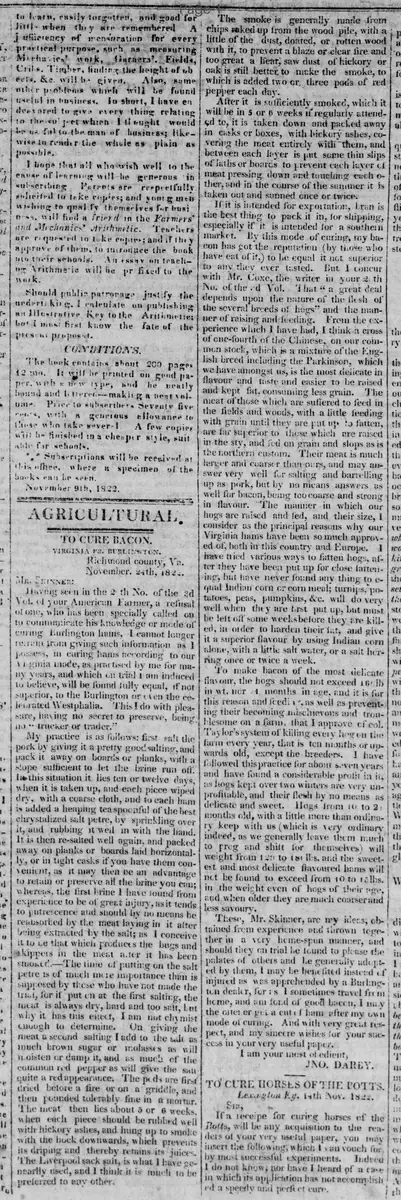
AGRICULTURAL
TO CURE BACON.
VIRGINIA VS. BURLINGTON.
Richmond county, Va.
November 24th, 1822.
MR. SKINNER:
Having seen in the 24th No. of the 2d
Vol. of your American Farmer, a refusal
of one, who has been specially called on
to communicate his knowledge or mode of
curing Burlington hams, I cannot longer
refrain from giving such information as I
possess, in curing hams according to our
Virginia mode, as practised by me for ma-
ny years, and which on trial I am induced
to believe, will be found fully equal, if not
superior, to the Burlington or even the ce-
lebrated Westphalia. This I do with plea-
sure, having no secret to preserve, being.
no "trucker or trader."
My practice is as follows: first salt the
pork by giving it a pretty good salting, and
pack it away on boards or planks, with a
slope sufficient to let the brine run off.
In this situation it lies ten or twelve days.
When it is taken up, and each piece wiped
dry. with a coarse cloth, and to each ham
is added a heaping tea spoonful of the best
chrystalized salt petre, by sprinkling over
it, and rubbing it well in with the hand.
It is then re-salted well again, and packed
away on planks or boards laid horizontal-
ly, or in tight casks if you have them con-
venient, as it may then be an advantage
to retain or preserve all the brine you can;
Whereas, the first brine I have found from
experience to be of great injury, as it tends
to putrescence and should by no means be
reabsorbed by the meat laying in it after
being extracted by the salt; as I conceive
it to be that which produces the bugs and
skippers in the meat after it has been
smoked.--The time of putting on the salt
petre is of much more importance than is
supposed by those who have not made the
trial, for if put on at the first salting, the
meat is always dry, hard and too salt, I know not why it has this effect, I am not chemist enough to determine. On giving the
meat a second salting I add to the salt as
much brown sugar or molasses as will
moisten or damp it, and as much of the
common red pepper as will give the salt
quite a red appearance. The pods are first
dried before a fire or on a griddle, and
then pounded tolerably fine in a mortar.
The meat then lies about 5 or 6 weeks.
When each piece should be rubbed well
with hickory ashes, and hung up to smoke
with the hock downwards, which prevents
its dripping and thereby retains its juices.
The Liverpool sack salt, is what I have ge-
nerally used, and I think it is much to be
preferred to any other.
The smoke is generally made from
chips raked up from the wood pile, with a
little of the dust, rotted, or rotten wood
with it, to prevent a blaze or clear fire and
too great a heat, saw dust of hickory or
oak is still better to make the smoke, to
which is added two or three pods of red
pepper each day.
After it is sufficiently smoked, which it
will be in 5 or 6 weeks if regularly attend-
ed to, it is taken down and packed away
in casks or boxes, with hickory ashes, co-
vering the meat entirely with them, and
between each layer is put some thin slips
of laths or boards to prevent each layer of
meat pressing down and touching each o-
ther, and in the course of the summer it is
taken out and sunned once or twice.
If it is intended for exportation, bran is
the best thing to pack it in, for shipping,
especially if it is intended for a southern
market. By this mode of curing, my ba-
con has got the reputation (by those who
have eat of it) to be equal if not superior
to any they ever tasted. But I concur
with Mr. Coxe, the writer in your 24th
No. of the 3d Vol. that "a great deal
depends upon the nature of the flesh of
the several breeds of hogs" and the man-
ner of raising and feeding. From the ex-
perience which I have had, I think a cross
of one-fourth of the Chinese, on our com-
mon stock, which is a mixture of the Eng-
lish breed including the Parkinson, which
we have amongst us, is the most delicate in
flavour and taste and easier to be raised
and kept fat. consuming less grain. The
meat of those which are suffered to feed in
the fields and woods, with a little feeding
with grain until they are put up to fatten,
are far superior to these which are raised
in the sty, and fed on grain and slops as is
the northern custom. Their meat is much
larger and coarser than ours, and may an-
swer very well for salting and barrelling
up as pork, but by no means answers as
well for bacon, being too coarse and strong
in flavour. The manner in which our
hogs are raised and fed, and their size, I
consider as the principal reasons why our
Virginia hams have been so much approbated, both in this country and Europe. I
have tried various ways to fatten hogs, af-
ter they have been put up for close fattening, but have never found any thing to e-
qual Indian corn or corn meal; turnips, po-
tatoes, peas, pumpkins, &c. will do very
well when they are first put up, but must
be left off some weeks before they are kill-
ed, in order to harden their fat, and give
it a superior flavour by using Indian corn
alone, with a little salt water, or a salt her-
ring once or twice a week.
To make bacon of the most delicate
flavour, the hogs should not exceed 160 lb
in wt. nor 18 months in age, and it is for
this reason and feeding, as well as prevent-
ing their becoming mischievous and trou-
blesome on a farm, that I approve of Col.
Taylor's system of killing every hog on the
farm every year, that is ten months or up-
wards old, except the breeders. I have
followed this practice for about seven years
and have found a considerable profit in it,
as hogs kept over two winters are very un-
profitable, and their flesh by no means as
delicate and sweet. Hogs from 10 to 18
months old, with a little more than ordina-
ry keep with us (which is very ordinary
indeed, as we generally leave them much
to prowl and shift for themselves) will
weight from 120 to 180 lbs. and the sweet-
est and most delicate flavoured hams will
not be found to exceed from 10 to 14 lbs.
in the weight even of hogs of their age,
and when older they are much coarser and
less savoury.
These, Mr. Skinner, are my ideas, ob-
tained from experience and thrown toge-
ther in a very home-spun manner, and
should they on trial be found to please the
palates of others and be generally adopt-
ed by them, I may be benefited instead of
injured as was apprehended by a Burling-
ten dealer, for as I sometimes travel from
home, and am fond of good bacon, I may
then the oftener get a cure of ham after my own mode of curing. And with very great res-
pect, and my sincere wishes for your suc-
cess in your very useful paper.
I am your most obedient;
JNO. DAREY.
TO CURE BACON.
VIRGINIA VS. BURLINGTON.
Richmond county, Va.
November 24th, 1822.
MR. SKINNER:
Having seen in the 24th No. of the 2d
Vol. of your American Farmer, a refusal
of one, who has been specially called on
to communicate his knowledge or mode of
curing Burlington hams, I cannot longer
refrain from giving such information as I
possess, in curing hams according to our
Virginia mode, as practised by me for ma-
ny years, and which on trial I am induced
to believe, will be found fully equal, if not
superior, to the Burlington or even the ce-
lebrated Westphalia. This I do with plea-
sure, having no secret to preserve, being.
no "trucker or trader."
My practice is as follows: first salt the
pork by giving it a pretty good salting, and
pack it away on boards or planks, with a
slope sufficient to let the brine run off.
In this situation it lies ten or twelve days.
When it is taken up, and each piece wiped
dry. with a coarse cloth, and to each ham
is added a heaping tea spoonful of the best
chrystalized salt petre, by sprinkling over
it, and rubbing it well in with the hand.
It is then re-salted well again, and packed
away on planks or boards laid horizontal-
ly, or in tight casks if you have them con-
venient, as it may then be an advantage
to retain or preserve all the brine you can;
Whereas, the first brine I have found from
experience to be of great injury, as it tends
to putrescence and should by no means be
reabsorbed by the meat laying in it after
being extracted by the salt; as I conceive
it to be that which produces the bugs and
skippers in the meat after it has been
smoked.--The time of putting on the salt
petre is of much more importance than is
supposed by those who have not made the
trial, for if put on at the first salting, the
meat is always dry, hard and too salt, I know not why it has this effect, I am not chemist enough to determine. On giving the
meat a second salting I add to the salt as
much brown sugar or molasses as will
moisten or damp it, and as much of the
common red pepper as will give the salt
quite a red appearance. The pods are first
dried before a fire or on a griddle, and
then pounded tolerably fine in a mortar.
The meat then lies about 5 or 6 weeks.
When each piece should be rubbed well
with hickory ashes, and hung up to smoke
with the hock downwards, which prevents
its dripping and thereby retains its juices.
The Liverpool sack salt, is what I have ge-
nerally used, and I think it is much to be
preferred to any other.
The smoke is generally made from
chips raked up from the wood pile, with a
little of the dust, rotted, or rotten wood
with it, to prevent a blaze or clear fire and
too great a heat, saw dust of hickory or
oak is still better to make the smoke, to
which is added two or three pods of red
pepper each day.
After it is sufficiently smoked, which it
will be in 5 or 6 weeks if regularly attend-
ed to, it is taken down and packed away
in casks or boxes, with hickory ashes, co-
vering the meat entirely with them, and
between each layer is put some thin slips
of laths or boards to prevent each layer of
meat pressing down and touching each o-
ther, and in the course of the summer it is
taken out and sunned once or twice.
If it is intended for exportation, bran is
the best thing to pack it in, for shipping,
especially if it is intended for a southern
market. By this mode of curing, my ba-
con has got the reputation (by those who
have eat of it) to be equal if not superior
to any they ever tasted. But I concur
with Mr. Coxe, the writer in your 24th
No. of the 3d Vol. that "a great deal
depends upon the nature of the flesh of
the several breeds of hogs" and the man-
ner of raising and feeding. From the ex-
perience which I have had, I think a cross
of one-fourth of the Chinese, on our com-
mon stock, which is a mixture of the Eng-
lish breed including the Parkinson, which
we have amongst us, is the most delicate in
flavour and taste and easier to be raised
and kept fat. consuming less grain. The
meat of those which are suffered to feed in
the fields and woods, with a little feeding
with grain until they are put up to fatten,
are far superior to these which are raised
in the sty, and fed on grain and slops as is
the northern custom. Their meat is much
larger and coarser than ours, and may an-
swer very well for salting and barrelling
up as pork, but by no means answers as
well for bacon, being too coarse and strong
in flavour. The manner in which our
hogs are raised and fed, and their size, I
consider as the principal reasons why our
Virginia hams have been so much approbated, both in this country and Europe. I
have tried various ways to fatten hogs, af-
ter they have been put up for close fattening, but have never found any thing to e-
qual Indian corn or corn meal; turnips, po-
tatoes, peas, pumpkins, &c. will do very
well when they are first put up, but must
be left off some weeks before they are kill-
ed, in order to harden their fat, and give
it a superior flavour by using Indian corn
alone, with a little salt water, or a salt her-
ring once or twice a week.
To make bacon of the most delicate
flavour, the hogs should not exceed 160 lb
in wt. nor 18 months in age, and it is for
this reason and feeding, as well as prevent-
ing their becoming mischievous and trou-
blesome on a farm, that I approve of Col.
Taylor's system of killing every hog on the
farm every year, that is ten months or up-
wards old, except the breeders. I have
followed this practice for about seven years
and have found a considerable profit in it,
as hogs kept over two winters are very un-
profitable, and their flesh by no means as
delicate and sweet. Hogs from 10 to 18
months old, with a little more than ordina-
ry keep with us (which is very ordinary
indeed, as we generally leave them much
to prowl and shift for themselves) will
weight from 120 to 180 lbs. and the sweet-
est and most delicate flavoured hams will
not be found to exceed from 10 to 14 lbs.
in the weight even of hogs of their age,
and when older they are much coarser and
less savoury.
These, Mr. Skinner, are my ideas, ob-
tained from experience and thrown toge-
ther in a very home-spun manner, and
should they on trial be found to please the
palates of others and be generally adopt-
ed by them, I may be benefited instead of
injured as was apprehended by a Burling-
ten dealer, for as I sometimes travel from
home, and am fond of good bacon, I may
then the oftener get a cure of ham after my own mode of curing. And with very great res-
pect, and my sincere wishes for your suc-
cess in your very useful paper.
I am your most obedient;
JNO. DAREY.
What sub-type of article is it?
Informative
Persuasive
What themes does it cover?
Agriculture
What keywords are associated?
Bacon Curing
Virginia Hams
Burlington Hams
Hog Breeding
Hog Feeding
Saltpetre
Smoking Process
Indian Corn
What entities or persons were involved?
Jno. Darey
Mr. Skinner
Letter to Editor Details
Author
Jno. Darey
Recipient
Mr. Skinner
Main Argument
the virginia method of curing hams, as practiced by the author for many years, is fully equal if not superior to the burlington or westphalia varieties, and he shares the detailed process along with advice on hog raising and feeding for optimal flavor.
Notable Details
First Salting For 10 12 Days With Slope To Drain Brine
Second Salting With Saltpetre, Brown Sugar Or Molasses, And Red Pepper
Smoking With Hickory Ashes And Red Pepper Pods
Packing In Ashes Or Bran For Export
Recommends Crossing Common Stock With One Fourth Chinese Breed
Advocates Killing Hogs Annually After 10 Months Except Breeders
Hogs Should Not Exceed 160 Lbs Or 18 Months For Delicate Flavor