Thank you for visiting SNEWPapers!
Sign up free
Gazette Of The United States
New York, New York County, New York
What is this article about?
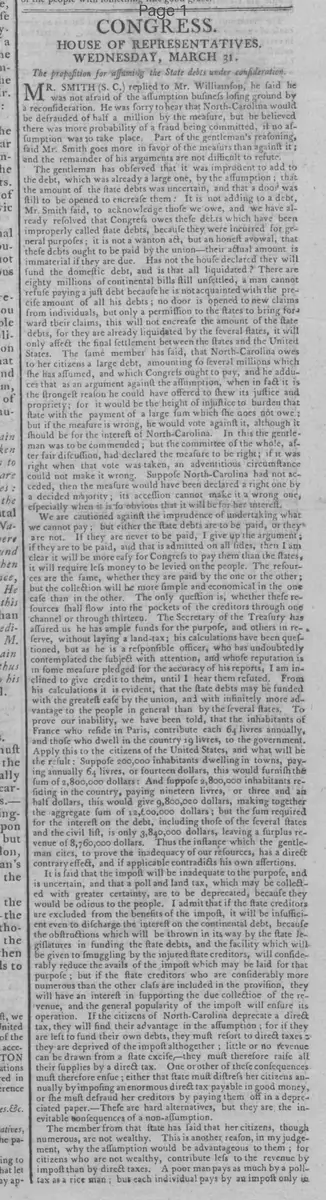
In the House of Representatives on March 31, Mr. Smith of South Carolina defended the federal assumption of state debts in response to Mr. Williamson of North Carolina, arguing it would be more efficient, just, and beneficial, especially for states like North Carolina, while refuting concerns about increased debt, taxation, and state-specific objections.
Merged-components note: Continuation of congressional debate on assumption of state debts across pages; relabeled from 'story' for the second component to 'domestic_news' as it fits proceedings.
Clippings
1 of 2
OCR Quality
Full Text
HOUSE OF REPRESENTATIVES.
WEDNESDAY, MARCH 31.
The proposition for assuming the State debts under consideration.
Mr. SMITH (S. C.) replied to Mr. Williamson, he said he was not afraid of the assumption business losing ground by a reconsideration. He was sorry to hear that North-Carolina would be defrauded of half a million by the measure, but he believed there was more probability of a fraud being committed, if no assumption was to take place. Part of the gentleman's reasoning, said Mr. Smith goes more in favor of the measure than against it; and the remainder of his arguments are not difficult to refute.
The gentleman has observed that it was imprudent to add to the debt, which was already a large one, by the assumption; that the amount of the state debts was uncertain, and that a door was still to be opened to increase them: It is not adding to a debt, Mr. Smith said, to acknowledge those we owe, and we have already resolved that Congress owes these debts which have been improperly called state debts, because they were incurred for general purposes; it is not a wanton act, but an honest avowal, that these debts ought to be paid by the union—their actual amount is immaterial if they are due. Has not the house declared they will fund the domestic debt, and is that all liquidated? There are eighty millions of continental bills still unsettled, a man cannot refuse paying a just debt because he is not acquainted with the precise amount of all his debts; no door is opened to new claims from individuals, but only a permission to the states to bring forward their claims, this will not increase the amount of the state debts, for they are already liquidated by the several states, it will only affect the final settlement between the states and the United States. The same member has said, that North-Carolina owes to her citizens a large debt, amounting to several millions which she has assumed, and which Congress ought to pay, and he adduces that as an argument against the assumption, when in fact it is the strongest reason he could have offered to shew its justice and propriety; for it would be the height of injustice to burden that state with the payment of a large sum which she does not owe; but if the measure is wrong, he would vote against it, although it should be for the interest of North-Carolina. In this the gentleman was to be commended; but the committee of the whole, after fair discussion, had declared the measure to be right; if it was right when that vote was taken, an adventitious circumstance could not make it wrong. Suppose North-Carolina had not acceded, then the measure would have been declared a right one by a decided majority; its accession cannot make it a wrong one, especially when it is so obvious that it will be for her own interest.
We are cautioned against the imprudence of undertaking what we cannot pay; but either the state debts are to be paid, or they are not. If they are never to be paid, I give up the argument if they are to be paid, and that is admitted on all sides, then I am clear it will be more easy for Congress to pay them than the states, it will require less money to be levied on the people. The resources are the same, whether they are paid by the one or the other; but the collection will be more simple and economical in the one case than in the other. The only question is, whether these resources shall flow into the pockets of the creditors through one channel or through thirteen. The Secretary of the Treasury has assured us he has ample funds for the purpose, and others in reserve, without laying a land-tax; his calculations have been questioned, but as he is a responsible officer, who has undoubtedly contemplated the subject with attention, and whose reputation is in some measure pledged for the accuracy of his reports, I am inclined to give credit to them, until I hear them refuted. From his calculations it is evident, that the state debts may be funded with the greatest ease by the union, and with infinitely more advantage to the people in general than by the several states. To prove our inability, we have been told, that the inhabitants of France who reside in Paris, contribute each 64 livres annually, and those who dwell in the country 19 livres, to the government. Apply this to the citizens of the United States, and what will be the result: Suppose 200,000 inhabitants dwelling in towns, paying annually 64 livres, or fourteen dollars, this would furnish the sum of 2,800,000 dollars: And suppose 2,800,000 inhabitants residing in the country, paying nineteen livres, or three and a half dollars, this would give 9,800,000 dollars, making together the aggregate sum of 12,600,000 dollars; but the sum required for the interest on the debt, including those of the several states and the civil list, is only 3,840,000 dollars, leaving a surplus revenue of 8,760,000 dollars. Thus the instance which the gentleman cites, to prove the inadequacy of our resources, has a direct contrary effect, and if applicable contradicts his own assertions.
It is said that the impost will be inadequate to the purpose, and is uncertain, and that a poll and land tax, which may be collected with greater certainty, are to be deprecated, because they would be odious to the people. I admit that if the state creditors are excluded from the benefits of the impost, it will be insufficient even to discharge the interest on the continental debt, because the obstructions which will be thrown in its way by the state legislatures in funding the state debts, and the facility which will be given to smuggling by the injured state creditors, will considerably reduce the avails of the impost which may be laid for that purpose; but if the state creditors who are considerably more numerous than the other class are included in the provision, they will have an interest in supporting the due collection of the revenue, and the general popularity of the impost will ensure its operation. If the citizens of North-Carolina deprecate a direct tax, they will find their advantage in the assumption; for if they are left to fund their own debts, they must resort to direct taxes—they are deprived of the impost altogether; little or no revenue can be drawn from a state excise they must therefore raise all their supplies by a direct tax. One or other of these consequences must therefore ensue; either that state must distress her citizens annually by imposing an enormous direct tax payable in good money, or she must defraud her creditors by paying them off in a depreciated paper.—These are hard alternatives, but they are the inevitable consequences of a non-assumption.
The member from that state has said that her citizens, though numerous, are not wealthy. This is another reason, in my judgment, why the assumption would be advantageous to them; for citizens who are not wealthy, contribute less to the revenue by impost than by direct taxes. A poor man pays as much by a poll-tax as a rich man; but each individual pays by an impost only i
proportion to his riches. He contends, however, that a direct tax, though it would be obnoxious to the people, if collected by continental authority, would be acceptable, if levied by the authority of the states. When we advert to the funding systems of the several states, we shall find them less beneficial to the people than is imagined. The mode of issuing certificates for interest, and calling them in by a direct tax, is injurious both to the creditors and to the other citizens. The creditor is heavily taxed in order to pay himself; money is taken from him in the first instance to pay him the interest on his debt; the poorer part of the community who are unprovided with these certificates delay purchasing them till they are pressed for their taxes, and then they are supplied at an enhanced rate by an accommodating speculator, or a friendly collector, who had previously bought them up for the purpose; the creditor receives no benefit, the public derive no advantage, the citizens are heavily taxed, and the speculators get all the profit.
The constant fluctuation in their schemes of finance is another distressing circumstance to the citizens. In one session those who have purchased public property for which they are to pay in state paper, and which it becomes their interest to depreciate, gain the ascendancy and carry measures productive of that effect. In the next, the holders of the state paper preponderate, and in their turn procure a system which will appreciate the paper. Thus the people are embarrassed and distressed by these speculations and contentions.
The numerous tax collectors in the different states is another cause of expense and inconvenience to the citizens. A direct tax in every state would require, under state regulations, at least 1300 collectors, all of whom must be paid by the people for their trouble. There is another consequence resulting from direct taxes of a very serious nature—Individuals are too apt to neglect making provision for their taxes in due season; executions are issued against them, their property is levied upon and they have ultimately to pay poundage and constable fees, which sometimes amount to more than the tax itself. All these grievances are removed by resorting to the impost, and that species of revenue will alone be nearly competent to provide for the state debts, if assumed by the union. Even should Congress resort to direct taxation (and some members from the southern states have expressed a predilection for it) there is no doubt that it would be levied in a mode adapted to the particular habits and convenience of every state; for by the constitution it is not required that taxes, like duties and excise, should be uniform; and as each state has its particular representation in this house, it is evident that the accommodation of the different parts of the union would be consulted: It would also be levied with more economy under one system than under thirteen.
The cession which the state of North-Carolina has made to the United States is said to contain a provision which is opposed to the assumption: the provision referred to only relates to the final adjustment of the accounts between the individual states; for it requires that in such adjustment the lands ceded, and the inhabitants belonging thereto, shall not be estimated in ascertaining the proportion of North-Carolina with the other states in the common expense occasioned by the war.
An amendment proposed by that state to the constitution has also been expatiated on, as manifesting her aversion to this measure; it is rather extraordinary that this construction should be given to the amendment, when the house have been told that the idea of an assumption was never contemplated in that state; indeed it was improbable the citizens of that country should endeavor to guard against a measure, the bare possibility of which had never occurred to them. An attentive examination of that amendment will prove that it evinces no such intention as has been attributed to it; as it relates expressly to all the states, it could not have had North-Carolina exclusively in view, nor was it designed to guard against any interference with her state paper alone; As it particularly relates to an interference by Congress or the judiciary, it proves an apprehension of some interference by the federal courts, which could not be involved in a question of assumption; it is therefore evident that the true interpretation of that amendment is that the convention of that state were apprehensive of some interposition of the judicial courts of the United States, in enforcing payment of her state securities. That it does not relate to the question of assumption is clear, because were it calculated to prevent an assumption, it would have said so in explicit terms, and declared that Congress should not pay her state debts; and because the gentleman from that state has informed the committee that they never dreamt of an assumption. North-Carolina, is unwilling that Congress should dictate to her how she should discharge her debt, but it does not appear that she has any objection to Congress assuming and paying it themselves.
Admit however the full force of the remark, and it would tend to restrain Congress from funding even the continental and foreign debt without the assent of two thirds of the members present in both houses; for another amendment from that state requires that no navigation law, or law regulating commerce should pass except in the above mode; and the funding system cannot go into operation without such laws. The gentleman however would have no objection to the assumption, provided security could be given that there would be a settlement of the accounts of the several states, but there is no such proviso in the amendment; if it has in view the assumption, it is opposed to it under any modification whatsoever. How can he then reconcile his state to a vote given in contradiction to their express sentiments, merely because the business would be put in a shape which is palatable to himself, is not this another proof that the amendment did not relate to the assumption?
Another local objection is started from that state: It is said that she has issued paper money with which she has bought up and paid off certificates, and which paper money she must lay taxes to redeem, and if Congress do not assume that paper, as part of her debt, she will be under the necessity of paying taxes to sink it, and at the same time of contributing her proportion of revenue for the debts of other states, and that this would be defrauding her of half a million of dollars, the amount of the paper so emitted. If that state has sunk a part of her debt, Congress will have less to assume on her account in proportion to the sum discharged, there will be consequently a smaller charge against her in the ultimate settlement, and she will become a creditor state in the same proportion; if therefore she has bought in her own certificates under par, or paid them off with paper in a depreciated state, she has been a gainer by the negotiation, and is in a better condition than those states which have not had this advantage: The revenue she will contribute will be applied as well to the payment of her own debts as those of other states, which will also contribute their proportion to the payment of her debts. But no measures, it is said, are in forwardness for the completion of this settlement. Commissioners of accounts have been engaged a considerable time in this business, and are now pursuing it with the assistance of a numerous body of clerks, and are in a train of settlement. Should other measures be thought requisite to expedite and ensure the adjustment, Congress may accompany the assumption with a bill making special and effectual provision for that object. North-Carolina it is said, is apprehensive lest some securities of that state which were fraudulently issued should be funded by the union, and charged to her account; how will they be charged to her account if there is to be no settlement of the accounts, and the member from that state says he is persuaded there is to be none? She will then receive the benefit of those securities, and the citizens of the other states will pay her the interest on them; if they are sold to speculators, at all events she or her citizens have received a consideration for them: But either that state will be able to detect the fraud, or she will not; if she can discover the fraud, so can Congress; they will therefore be rejected, and there is no ground of apprehension; if the fraud is not liable to detection, then at any rate North-Carolina must pay them; inasmuch therefore as it is for her interest that they should be paid by Congress rather than by herself, this circumstance is rather an argument in favor of the assumption.
What sub-type of article is it?
What keywords are associated?
What entities or persons were involved?
Where did it happen?
Domestic News Details
Primary Location
House Of Representatives
Event Date
Wednesday, March 31.
Key Persons
Outcome
ongoing debate with mr. smith defending the assumption measure as just and advantageous, refuting north carolina's objections; no final resolution mentioned.
Event Details
Mr. Smith of South Carolina responded to Mr. Williamson of North Carolina in the House debate on assuming state debts, arguing that assumption acknowledges existing union obligations, simplifies collection via federal impost over state direct taxes, benefits poorer states like North Carolina, and addresses concerns about uncertainty, taxation, settlements, and state amendments without fraud or increased burden.