Thank you for visiting SNEWPapers!
Sign up free
Editorial
January 9, 1836
The Northern Star, And Constitutionalist
Warren, Bristol County, Rhode Island
What is this article about?
Editorial quotes Dr. Channing's work on slavery criticizing mobs as threats to liberty and republican institutions, arguing they usurp the people's sovereignty expressed through law. Discusses historical role of mobs in the Revolution but condemns their use against abolition, which elevates it as a cause of freedom.
Clipping
OCR Quality
85%
Good
Full Text
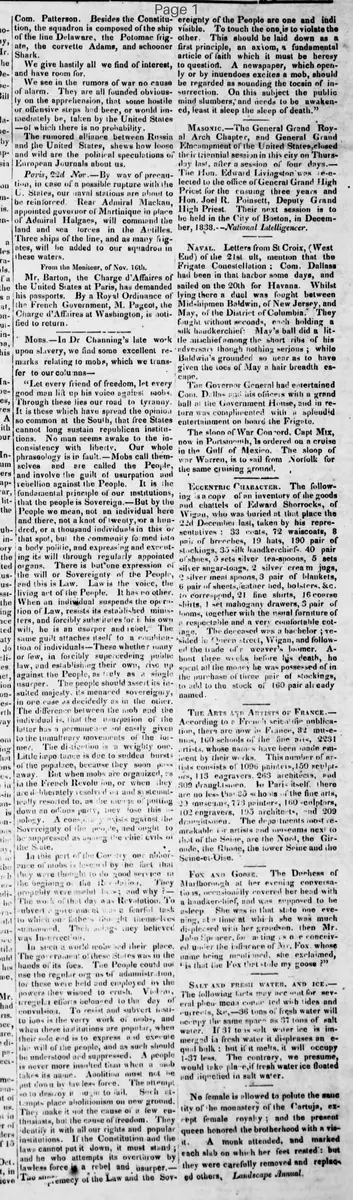
MOBS.—In Dr Channing's late work upon slavery, we find some excellent remarks relating to mobs, which we transfer to our columns—
'Let every friend of freedom, let every good man lift up his voice against mobs. Through these lies our road to tyranny. It is these which have spread the opinion so common at the South, that free States cannot long sustain republican institutions. No man seems awake to the inconsistency with liberty. Our whole phraseology is in fault.—Mobs call themselves and are called the People, and involve the guilt of usurpation and rebellion against the People. It is the fundamental principle of our institutions, that the people is Sovereign. But by the People we mean, not an individual here and there, not a knot of twenty, or a hundred, or a thousand individuals in this or that spot, but the community formed into a body politic, and expressing and executing its will through regularly appointed organs. There is but one expression of the will or Sovereignty of the People, and this is Law. Law is the voice, the living act of the People. It has no other. When an individual suspends the operation of Law, resists its established ministers, and forcibly substitutes for it his own will, he is an usurper and rebel.' The same guilt attaches itself to a combination of individuals—These whether many or few, in forcibly superseding public law, and establishing their own, rise up against the People, as truly as a single usurper. The people should assert its insulted majesty, its menaced sovereignty, in one case as decidedly as in the other. The difference between the mob and the individual is, that the usurpation of the latter has a permanence not easily given to the tumultuary movements of the former. The distinction is a weighty one. Little importance is due to sudden bursts of the populace, because they soon pass away. But when mobs are organized, as in the French Revolution, or when they are deliberately resolved on and systematically resorted to, as the means of putting down an odious party, they lose this apology. A conspiracy exists against the Sovereignty of the people, and ought to be suppressed as among the chief evils of the State.
In this part of the country our abhorrence of mobs is lessened by the fact that they were thought to do good service in the beginning of the revolution. They probably were useful but—and why?—The work of that day was Revolution. To subvert a government was a fearful task to which our fathers thought themselves summoned. Their existing agency believed was insurrection.
In such a world mobs had their place. The government of these States was in the hands of its foes. The People could not use the regular organs of administration for these were held and employed by the powers they wished to crush.' Violence, irregular efforts belonged to the day of convulsion. To resist and subvert institutions is the very work of mobs, and when these institutions are popular, when their sole end is to express and execute the will of the people, and as such should be defended and protected. A people is never more insulted than when a mob takes its name. Abolition must not be put down by lawless force. The attempt so to destroy it ought to fail. Such attempts place abolitionism on new ground. They make it not the cause of a few enthusiasts, but the cause of freedom. They identify it with all our rights and popular institutions. If the Constitution and the laws cannot put it down, it must stand and he who attempts its overthrow by lawless force is a rebel and usurper.—The
Supremacy of the Law and the Sovereignty of the People are one and indivisible. To touch the one is to violate the other. This should be laid down as a first principle, an axiom, a fundamental article of faith which it must be heresy to question. A newspaper, which openly or by innuendoes excites a mob, should be regarded as sounding the tocsin of insurrection. On this subject the public mind slumbers, and needs to be awakened, lest it sleep the sleep of death.'
'Let every friend of freedom, let every good man lift up his voice against mobs. Through these lies our road to tyranny. It is these which have spread the opinion so common at the South, that free States cannot long sustain republican institutions. No man seems awake to the inconsistency with liberty. Our whole phraseology is in fault.—Mobs call themselves and are called the People, and involve the guilt of usurpation and rebellion against the People. It is the fundamental principle of our institutions, that the people is Sovereign. But by the People we mean, not an individual here and there, not a knot of twenty, or a hundred, or a thousand individuals in this or that spot, but the community formed into a body politic, and expressing and executing its will through regularly appointed organs. There is but one expression of the will or Sovereignty of the People, and this is Law. Law is the voice, the living act of the People. It has no other. When an individual suspends the operation of Law, resists its established ministers, and forcibly substitutes for it his own will, he is an usurper and rebel.' The same guilt attaches itself to a combination of individuals—These whether many or few, in forcibly superseding public law, and establishing their own, rise up against the People, as truly as a single usurper. The people should assert its insulted majesty, its menaced sovereignty, in one case as decidedly as in the other. The difference between the mob and the individual is, that the usurpation of the latter has a permanence not easily given to the tumultuary movements of the former. The distinction is a weighty one. Little importance is due to sudden bursts of the populace, because they soon pass away. But when mobs are organized, as in the French Revolution, or when they are deliberately resolved on and systematically resorted to, as the means of putting down an odious party, they lose this apology. A conspiracy exists against the Sovereignty of the people, and ought to be suppressed as among the chief evils of the State.
In this part of the country our abhorrence of mobs is lessened by the fact that they were thought to do good service in the beginning of the revolution. They probably were useful but—and why?—The work of that day was Revolution. To subvert a government was a fearful task to which our fathers thought themselves summoned. Their existing agency believed was insurrection.
In such a world mobs had their place. The government of these States was in the hands of its foes. The People could not use the regular organs of administration for these were held and employed by the powers they wished to crush.' Violence, irregular efforts belonged to the day of convulsion. To resist and subvert institutions is the very work of mobs, and when these institutions are popular, when their sole end is to express and execute the will of the people, and as such should be defended and protected. A people is never more insulted than when a mob takes its name. Abolition must not be put down by lawless force. The attempt so to destroy it ought to fail. Such attempts place abolitionism on new ground. They make it not the cause of a few enthusiasts, but the cause of freedom. They identify it with all our rights and popular institutions. If the Constitution and the laws cannot put it down, it must stand and he who attempts its overthrow by lawless force is a rebel and usurper.—The
Supremacy of the Law and the Sovereignty of the People are one and indivisible. To touch the one is to violate the other. This should be laid down as a first principle, an axiom, a fundamental article of faith which it must be heresy to question. A newspaper, which openly or by innuendoes excites a mob, should be regarded as sounding the tocsin of insurrection. On this subject the public mind slumbers, and needs to be awakened, lest it sleep the sleep of death.'
What sub-type of article is it?
Slavery Abolition
Constitutional
Moral Or Religious
What keywords are associated?
Mobs
Slavery
Abolition
Sovereignty
Law
Revolution
Tyranny
What entities or persons were involved?
Dr Channing
The People
Mobs
Abolitionists
Editorial Details
Primary Topic
Opposition To Mobs As Threats To Law And Abolition
Stance / Tone
Strongly Against Mobs And Violence, Defending Legal Sovereignty And Abolition
Key Figures
Dr Channing
The People
Mobs
Abolitionists
Key Arguments
Mobs Usurp The Sovereignty Of The People By Substituting Their Will For Law
Law Is The Only True Expression Of The People's Will
Mobs Against Abolition Elevate It To The Cause Of Freedom And All Rights
Historical Mobs Were Justified In Revolution But Not Against Popular Institutions
Newspapers Inciting Mobs Are Traitors To Insurrection