Thank you for visiting SNEWPapers!
Sign up free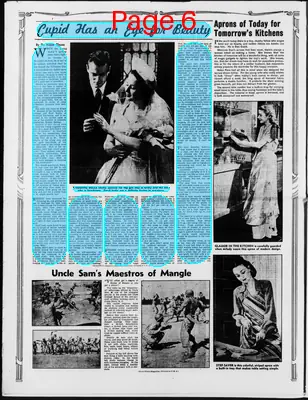
Las Vegas Age
Las Vegas, Clark County, Lincoln County, Nevada
What is this article about?
University of Chicago and Stanford researchers analyzed 1000 engaged couples in a midwestern city, finding attractive individuals marry earlier, especially women (by ~2 years). Neurotic traits do not delay marriage, as love fosters confidence and change. (218 characters)
Clipping
OCR Quality
Full Text
By Dr. Frank Thone
When the young man's fancy lightly turns to thoughts of love, he is apt to be sooner satisfied that he has found the Ultimate She, if his critical eye lights upon a pretty face and a trim figure. Conversely, his quest is likely to end the more quickly if he, too, can present a handsome profile and a good pair of shoulders.
There's no particular news in that: it has been a matter of common observation and comment for generations. Now, however, an effort has been made to get some kind of measurement of the romance-promoting effects of good looks, that can be expressed in terms of plain arithmetic, complete with decimals.
The study was made by Ernest W. Burgess of the University of Chicago and Paul Wallin of Stanford University, and is reported in the current issue of one of the soberest of scientific quarterlies, Human Biology.
Subjects of their survey were a thousand young engaged couples, in a large midwestern city and its environs. As described by the two researchers, they were "almost entirely in the age range from 20 to 30. Three-fourths of the young men and not quite two-thirds of the women were at the college level of education. Most of the remainder were high school graduates. Their parents were predominantly native-born, Protestant, and in the middle and upper-middle class. Most of them were engaged in business or the professions."
This sample population, therefore, was what we like to call "typically American": though obviously it was a decided cut above average both in intellectual achievement and economic comfort. If this circumstance should weight the results at all, one would expect it to be in the direction of "being sensible" and away from sheer impulsiveness, from going off the deep end just for a pretty face or an errant blonde curl.
RESULTS were measured by following up, and getting the age at marriage for both men and women among the thousand couples, after three years of wedded life. In an inquiry of this kind, many things prevent complete returns; however, the two investigators were able to complete the histories of nearly half (483) of their original thousand.
Good looks were found to pay off in terms of earlier wedded bliss by about two years in the case of the girls. The ones rated as best-looking were married at an average age of 23.3 years, while their plainer sisters had to wait until they were 25.3 years old before they could sign themselves "Mrs."
Looks didn't seem to score so heavily among the men, or if they did they were overcome by factors not measured in the present study. Still, there was a slight advantage, at least, for the Handsome Hals: the best-looking men had their brides at an average age of 25.4 years, the plainer ones at 25.8.
Standards of good looks are notoriously more subjective than objective, and the investigators wisely did not try to lay down any rigid rules, or undertake to measure the curve of a lady's eyebrow (or ankle) with a steel-square.
They simply asked for opinions, dividing the belles and swains into five common-sense, common-English categories: very good-looking, good-looking, fairly good-looking, plain-looking, very plain-looking.
Each person got a triple rating according to this simple classification. She (or he) was asked for a self-estimate. The prospective spouse was also asked for his (or her) opinion. Finally, the perhaps more nearly impartial ratings of friends was requested.
On the self-estimates, the girls tended toward modest self-deprecation, but 2 per cent of them believed what their mirrors told them and listed themselves as "very good-looking."
Forty-two per cent plucked up courage enough to claim the "good-looking" classification for themselves, and another large block (52.3 per cent) chose the middle road of just "good-looking."
Only one (perhaps in a fit of the blues) admitted herself to be "very plain-looking."
Their fiances, as might be expected, gallantly up-graded their ladies' charms. In their en-glamored eyes, not a mere 2 per cent, but 19.2 per cent, rated as "very good-looking"; and the "good-looking" class was upped from the girls' own 42 per cent to 57.1 per cent. Of course no man would admit that his girl was very plain-looking, and only seven wretched males so far forgot their manners as to say their fiancees were merely plain.
FRIENDS' ratings took a middle course: four girls, or 1.2 per cent, were considered "very plain"; 12.3 per cent were listed as just "plain." At the other end of the scale, 12.1 per cent of the young women were classed by their friends as "very good-looking"—almost exactly a midpoint between the modest 2 per cent of the self-estimates and the 19.2 per cent of their fiances'.
When it came to the estimates of male beauty, the men's own assessment of their looks was even more modest than that of the ladies. Only half as many (four men, or 1.1 per cent) claimed to be "very good-looking"; five times as many (five men, or 1.4 per cent) set themselves down as "very plain."
The men plumped heavily for the middle-of-the-road "fairly good-looking," voting that rating to themselves to the extent of 54.8 per cent.
Their girls didn't agree with this mediocre estimate. They called 55.1 per cent of their prospective mates "good-looking."
Moreover, they took a risk with husbandly vanity, voting 8.9 per cent of the men to be "very good-looking." (There must have been some really personable males among them at that.)
And of course the girls reciprocated their swains' rebellion against the idea of a mate being "very plain-looking" by voting nobody at all into that cellar category.
WEDDING BELLS chime quickly for the girl who is lovely and the man who is handsome. Good looks are a definite factor in marriage.
that, for even the cooler eyes of friends saw 6.9 per cent of the men as "very good-looking.")
The same two researchers made another study at the same time, on the same group of engaged couples. Good looks were expected to promote romance and hasten marriage; the one question with them has been, "how much?" But the group of painful behavior peculiarities lumped together as neuroticism could reasonably be expected to work the other way. Did it?
They set to work to find out.
Neurotics are described as "having ups and downs in mood, easily hurt, subject to depression, self-conscious in public and shy in intimate relations, lacking in self-confidence and having a tendency to daydream."
That sounds like a forbidding lineup: and to make it worse, several or all of these characteristics are likely to appear in the same individual. A young fellow, moody, mercurial, touchy, stepping all over his own feet, not knowing how to get started even when a girl maneuvers him out of the crowd and into the moonlight—how on earth could anyone expect him to get himself a wife? The two researchers thought that the answer would be simply, It can't be done.
To their surprise, however, they found that it apparently is done; and that girls similarly afflicted also find themselves husbands. In their technical language: "Age at marriage was correlated with the total neurotic score and no significant relationship was found for the men or women."
Admittedly neurosis is a handicap in courtship as it is in marriage, but like so many other obstacles altar-bound couples must hurdle, this one, too, can be overcome.
The deep faith that comes with love often makes a surprising change in the neurotic personality. Under the guidance of a wise man or woman confidence is built up.
This is true mainly because the neurotic already has a deep capacity for love, but fear has deprived him of the ability to express his emotions. When he finds that someone of the opposite sex has a high regard for him, he often lives up to that estimate.
The neurotic is seldom stupid, and is very likely to be faithful in the extreme. High ideals often go right along with his affliction. These qualities make the man or woman of neurotic nature a pretty fair bet for marriage in spite of handicaps. But, of course, sound psychology should be practiced in the relationship.
In less scholarly terms, so far as the men are concerned at least, it may boil down to what every woman knows but seldom tells until she's been married quite a while: that all men are super-goofs, but that with a little management her goof can be made to amount to something after all. And anyhow, she loves the big goof.
What sub-type of article is it?
What themes does it cover?
What keywords are associated?
What entities or persons were involved?
Where did it happen?
Story Details
Key Persons
Location
Large Midwestern City And Its Environs
Story Details
A study of 1000 engaged couples aged 20-30 found that good looks accelerate marriage, with attractive women marrying at average age 23.3 vs 25.3 for plainer ones, and men at 25.4 vs 25.8. Ratings from self, partners, and friends showed biases. Neuroticism did not significantly correlate with age at marriage, as love can overcome such traits.