Thank you for visiting SNEWPapers!
Sign up free
Story
October 4, 1954
Trainman News
Indianapolis, Marion County, Indiana
What is this article about?
Continuation of article reviewing Railroad Unemployment Insurance Act activities in 1953-54, reporting $729 million in benefits paid to 1.65 million employees over 15 years, with significant increases in unemployment benefits due to economic decline, technological changes, and reduced coal usage.
Clipping
OCR Quality
100%
Excellent
Full Text
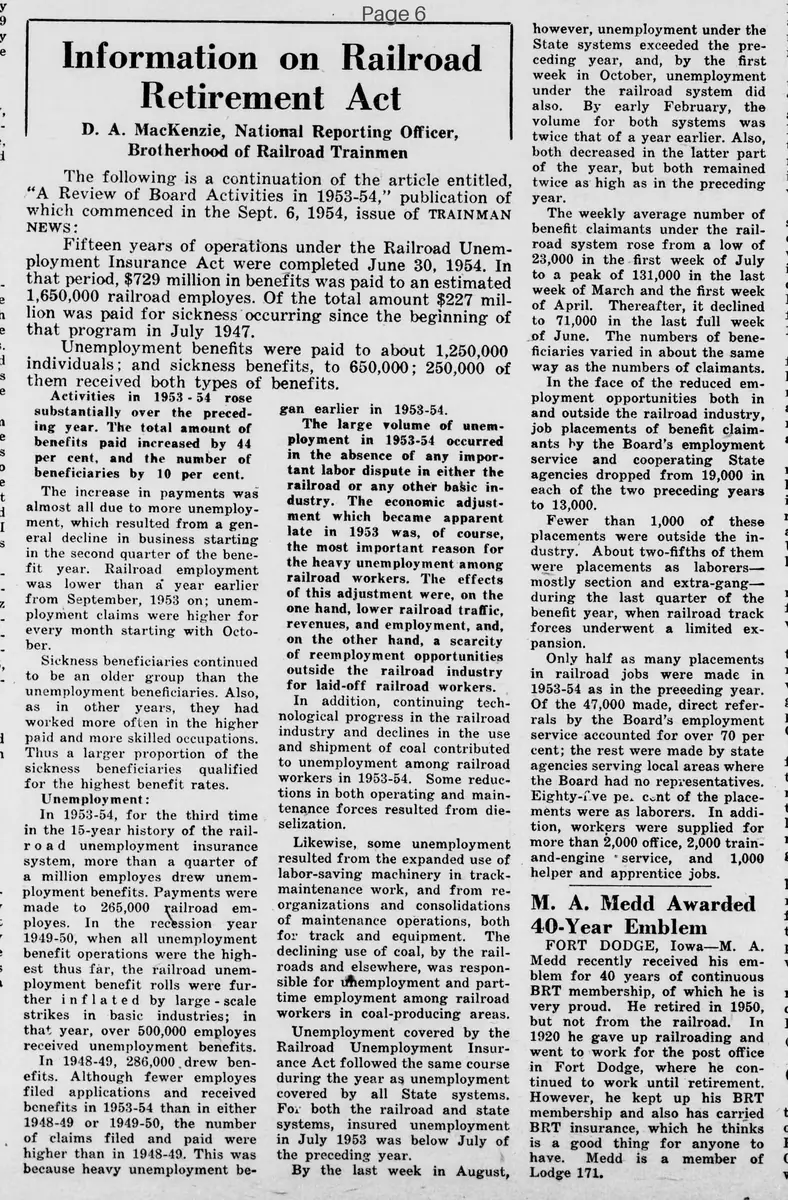
Information on Railroad Retirement Act
D. A. MacKenzie, National Reporting Officer, Brotherhood of Railroad Trainmen
The following is a continuation of the article entitled, "A Review of Board Activities in 1953-54," publication of which commenced in the Sept. 6, 1954, issue of TRAINMAN NEWS:
Fifteen years of operations under the Railroad Unemployment Insurance Act were completed June 30, 1954. In that period, $729 million in benefits was paid to an estimated 1,650,000 railroad employees. Of the total amount $227 million was paid for sickness occurring since the beginning of that program in July 1947.
Unemployment benefits were paid to about 1,250,000 individuals; and sickness benefits, to 650,000; 250,000 of them received both types of benefits.
Activities in 1953 - 54 rose substantially over the preceding year. The total amount of benefits paid increased by 44 per cent, and the number of beneficiaries by 10 per cent.
The increase in payments was almost all due to more unemployment, which resulted from a general decline in business starting in the second quarter of the benefit year.
Railroad employment was lower than a year earlier from September, 1953 on; unemployment claims were higher for every month starting with October.
Sickness beneficiaries continued to be an older group than the unemployment beneficiaries. Also, as in other years, they had worked more often in the higher paid and more skilled occupations.
Thus a larger proportion of the sickness beneficiaries qualified for the highest benefit rates.
Unemployment:
In 1953-54, for the third time in the 15-year history of the railroad unemployment insurance system, more than a quarter of a million employees drew unemployment benefits. Payments were made to 265,000 railroad employees. In the recession year 1949-50, when all unemployment benefit operations were the highest thus far, the railroad unemployment benefit rolls were further inflated by large-scale strikes in basic industries; in that year, over 500,000 employees received unemployment benefits.
In 1948-49, 286,000 drew benefits. Although fewer employees filed applications and received benefits in 1953-54 than in either 1948-49 or 1949-50, the number of claims filed and paid were higher than in 1948-49. This was because heavy unemployment began earlier in 1953-54.
The large volume of unemployment in 1953-54 occurred in the absence of any important labor dispute in either the railroad or any other basic industry. The economic adjustment which became apparent late in 1953 was, of course, the most important reason for the heavy unemployment among railroad workers. The effects of this adjustment were, on the one hand, lower railroad traffic, revenues, and employment, and, on the other hand, a scarcity of reemployment opportunities outside the railroad industry for laid-off railroad workers.
In addition, continuing technological progress in the railroad industry and declines in the use and shipment of coal contributed to unemployment among railroad workers in 1953-54. Some reductions in both operating and maintenance forces resulted from dieselization.
Likewise, some unemployment resulted from the expanded use of labor-saving machinery in track-maintenance work, and from reorganizations and consolidations of maintenance operations, both for track and equipment. The declining use of coal, by the railroads and elsewhere, was responsible for unemployment and part-time employment among railroad workers in coal-producing areas.
Unemployment covered by the Railroad Unemployment Insurance Act followed the same course during the year as unemployment covered by all State systems.
For both the railroad and state systems, insured unemployment in July 1953 was below July of the preceding year.
By the last week in August, however, unemployment under the State systems exceeded the preceding year, and, by the first week in October, unemployment under the railroad system did also. By early February, the volume for both systems was twice that of a year earlier. Also, both decreased in the latter part of the year, but both remained twice as high as in the preceding year.
The weekly average number of benefit claimants under the railroad system rose from a low of 23,000 in the first week of July to a peak of 131,000 in the last week of March and the first week of April. Thereafter, it declined to 71,000 in the last full week of June. The numbers of beneficiaries varied in about the same way as the numbers of claimants.
In the face of the reduced employment opportunities both in and outside the railroad industry, job placements of benefit claimants by the Board's employment service and cooperating State agencies dropped from 19,000 in each of the two preceding years to 13,000.
Fewer than 1,000 of these placements were outside the industry. About two-fifths of them were placements as laborers--mostly section and extra-gang--during the last quarter of the benefit year, when railroad track forces underwent a limited expansion.
Only half as many placements in railroad jobs were made in 1953-54 as in the preceding year.
Of the 47,000 made, direct referrals by the Board's employment service accounted for over 70 per cent; the rest were made by state agencies serving local areas where the Board had no representatives.
Eighty-five per cent of the placements were as laborers. In addition, workers were supplied for more than 2,000 office, 2,000 train-and-engine service, and 1,000 helper and apprentice jobs.
D. A. MacKenzie, National Reporting Officer, Brotherhood of Railroad Trainmen
The following is a continuation of the article entitled, "A Review of Board Activities in 1953-54," publication of which commenced in the Sept. 6, 1954, issue of TRAINMAN NEWS:
Fifteen years of operations under the Railroad Unemployment Insurance Act were completed June 30, 1954. In that period, $729 million in benefits was paid to an estimated 1,650,000 railroad employees. Of the total amount $227 million was paid for sickness occurring since the beginning of that program in July 1947.
Unemployment benefits were paid to about 1,250,000 individuals; and sickness benefits, to 650,000; 250,000 of them received both types of benefits.
Activities in 1953 - 54 rose substantially over the preceding year. The total amount of benefits paid increased by 44 per cent, and the number of beneficiaries by 10 per cent.
The increase in payments was almost all due to more unemployment, which resulted from a general decline in business starting in the second quarter of the benefit year.
Railroad employment was lower than a year earlier from September, 1953 on; unemployment claims were higher for every month starting with October.
Sickness beneficiaries continued to be an older group than the unemployment beneficiaries. Also, as in other years, they had worked more often in the higher paid and more skilled occupations.
Thus a larger proportion of the sickness beneficiaries qualified for the highest benefit rates.
Unemployment:
In 1953-54, for the third time in the 15-year history of the railroad unemployment insurance system, more than a quarter of a million employees drew unemployment benefits. Payments were made to 265,000 railroad employees. In the recession year 1949-50, when all unemployment benefit operations were the highest thus far, the railroad unemployment benefit rolls were further inflated by large-scale strikes in basic industries; in that year, over 500,000 employees received unemployment benefits.
In 1948-49, 286,000 drew benefits. Although fewer employees filed applications and received benefits in 1953-54 than in either 1948-49 or 1949-50, the number of claims filed and paid were higher than in 1948-49. This was because heavy unemployment began earlier in 1953-54.
The large volume of unemployment in 1953-54 occurred in the absence of any important labor dispute in either the railroad or any other basic industry. The economic adjustment which became apparent late in 1953 was, of course, the most important reason for the heavy unemployment among railroad workers. The effects of this adjustment were, on the one hand, lower railroad traffic, revenues, and employment, and, on the other hand, a scarcity of reemployment opportunities outside the railroad industry for laid-off railroad workers.
In addition, continuing technological progress in the railroad industry and declines in the use and shipment of coal contributed to unemployment among railroad workers in 1953-54. Some reductions in both operating and maintenance forces resulted from dieselization.
Likewise, some unemployment resulted from the expanded use of labor-saving machinery in track-maintenance work, and from reorganizations and consolidations of maintenance operations, both for track and equipment. The declining use of coal, by the railroads and elsewhere, was responsible for unemployment and part-time employment among railroad workers in coal-producing areas.
Unemployment covered by the Railroad Unemployment Insurance Act followed the same course during the year as unemployment covered by all State systems.
For both the railroad and state systems, insured unemployment in July 1953 was below July of the preceding year.
By the last week in August, however, unemployment under the State systems exceeded the preceding year, and, by the first week in October, unemployment under the railroad system did also. By early February, the volume for both systems was twice that of a year earlier. Also, both decreased in the latter part of the year, but both remained twice as high as in the preceding year.
The weekly average number of benefit claimants under the railroad system rose from a low of 23,000 in the first week of July to a peak of 131,000 in the last week of March and the first week of April. Thereafter, it declined to 71,000 in the last full week of June. The numbers of beneficiaries varied in about the same way as the numbers of claimants.
In the face of the reduced employment opportunities both in and outside the railroad industry, job placements of benefit claimants by the Board's employment service and cooperating State agencies dropped from 19,000 in each of the two preceding years to 13,000.
Fewer than 1,000 of these placements were outside the industry. About two-fifths of them were placements as laborers--mostly section and extra-gang--during the last quarter of the benefit year, when railroad track forces underwent a limited expansion.
Only half as many placements in railroad jobs were made in 1953-54 as in the preceding year.
Of the 47,000 made, direct referrals by the Board's employment service accounted for over 70 per cent; the rest were made by state agencies serving local areas where the Board had no representatives.
Eighty-five per cent of the placements were as laborers. In addition, workers were supplied for more than 2,000 office, 2,000 train-and-engine service, and 1,000 helper and apprentice jobs.
What sub-type of article is it?
Historical Event
What themes does it cover?
Misfortune
What keywords are associated?
Railroad Unemployment
Insurance Benefits
1953 54 Recession
Sickness Benefits
Dieselization
Coal Decline
Job Placements
What entities or persons were involved?
D. A. Mackenzie
Where did it happen?
United States Railroads
Story Details
Key Persons
D. A. Mackenzie
Location
United States Railroads
Event Date
1953 54
Story Details
Fifteen years of Railroad Unemployment Insurance Act operations ended June 30, 1954, with $729 million in benefits paid to 1,650,000 employees, including increases in 1953-54 due to economic decline, technological progress, and reduced coal usage, affecting unemployment and sickness benefits.