Thank you for visiting SNEWPapers!
Sign up free
The Virginia Gazette
Richmond, Williamsburg, Richmond County, Virginia
What is this article about?
Affidavits from wounded British soldiers published in Philadelphia paper claim King's troops fired first on provincials at Lexington and Concord on April 19, 1775, contradicting initial reports.
Clipping
OCR Quality
Full Text
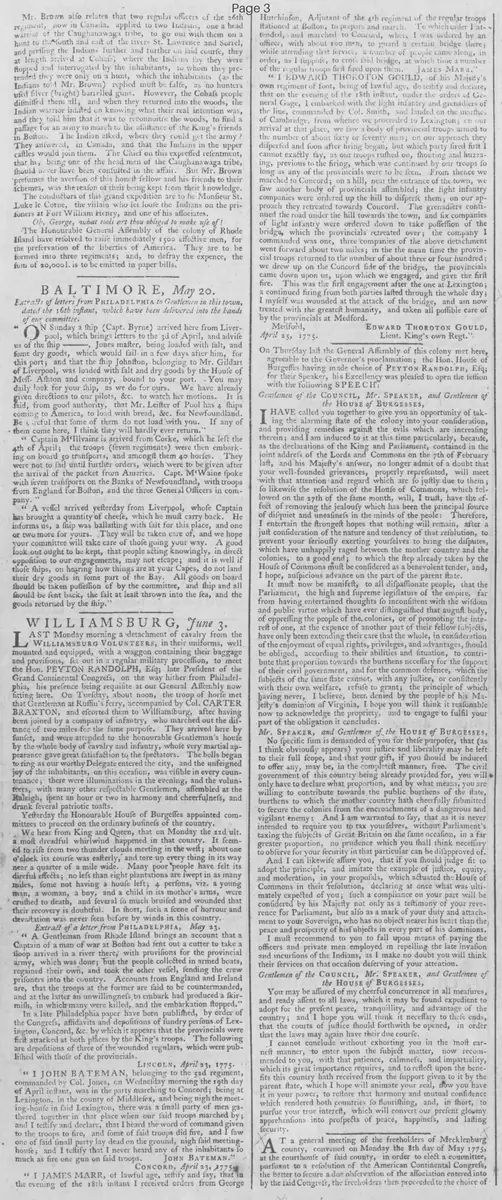
LINCOLN, April 23, 1775.
"I JOHN BATEMAN, belonging to the 52d regiment, commanded by Col. Jones, on Wednesday morning the 19th day of April instant, was in the party marching to Concord; being at Lexington, in the county of Middlesex, and being nigh the meeting-house in said Lexington, there was a small party of men gathered together in that place when our said troops marched by; and I testify and declare, that I heard the word of command given to the troops to fire, and some of said troops did fire, and I saw one of said small party lay dead on the ground, nigh said meeting-house; and I testify that I never heard any of the inhabitants so much as fire one gun on said troops."
JOHN BATEMAN.
CONCORD, April 23, 1775.
"I JAMES MARR, of lawful age, testify and say, that in the evening of the 18th instant I received orders from George Hutchinson, Adjutant of the 4th regiment of the regular troops stationed at Boston, to prepare and march. To which order I attended, and marched to Concord, where I was ordered by an officer, with about 100 men, to guard a certain bridge there; while attending that service, a number of people came along, in order, as I suppose, to cross said bridge, at which time a number of the regular troops first fired upon them."
James Marr.
"I EDWARD THOROTON GOULD, of his Majesty's own regiment of foot, being of lawful age, do testify and declare, that on the evening of the 18th instant, under the orders of General Gage, I embarked with the light infantry and grenadiers of the line, commanded by Col. Smith, and landed on the marshes of Cambridge, from whence we proceeded to Lexington; on our arrival at that place, we saw a body of provincial troops armed to the number of about sixty or seventy men; on our approach they dispersed and soon after firing began, but which party fired first I cannot exactly say, as our troops rushed on, shouting and huzzaing, previous to the firing, which was continued by our troops so long as any of the provincials were to be seen. From thence we marched to Concord; on a hill, near the entrance of the town, we saw another body of provincials assembled; the light infantry companies were ordered up the hill to disperse them; on our approach they retreated towards Concord. The grenadiers continued the road under the hill towards the town, and six companies of light infantry were ordered down to take possession of the bridge, which the provincials retreated over; the company I commanded was one, three companies of the above detachment went forward about two miles; in the mean time the provincial troops returned to the number of about three or four hundred; we drew up on the Concord side of the bridge, the provincials came down upon us, upon which we engaged, and gave the first fire. This was the first engagement after the one at Lexington; a continued firing from both parties lasted through the whole day; I myself was wounded at the attack of the bridge, and am now treated with the greatest humanity, and taken all possible care of by the provincials at Medford."
Medford,
Edward Thoroton Gould,
April 25, 1775.
Lieut. King's own Regt.
What sub-type of article is it?
What keywords are associated?
What entities or persons were involved?
Where did it happen?
Domestic News Details
Primary Location
Lexington, Concord, Middlesex
Event Date
April 19, 1775
Key Persons
Outcome
one provincial killed at lexington meeting-house; lt. edward thoroton gould wounded at concord bridge; continued firing from both parties through the day.
Event Details
Depositions from British soldiers John Bateman, James Marr, and Edward Thoroton Gould describe King's troops marching to Concord, firing first on provincials at Lexington and the bridge at Concord on April 19, 1775.