Thank you for visiting SNEWPapers!
Sign up free
Editorial
February 8, 1812
The Enquirer
Richmond, Henrico County, Virginia
What is this article about?
Editorial in Richmond Enquirer, February 8, 1812, defends Secretary Gallatin's budget proposing taxes to finance impending war with Britain. Argues for mixed taxes and loans over loans alone, citing Jefferson and Madison's principles, to avoid compound interest and higher borrowing costs. Compares financial outcomes over five years.
Merged-components note: Table of taxes and loans is embedded within the editorial on finances, spatial overlap.
Clipping
OCR Quality
75%
Good
Full Text
RICHMOND. FEBRUARY 8, 1812.
FINANCES.
This theme appears at this time to be 'the bow of Ulysses.' Every Editor that can wield a pen, is trying his hand at it.--We also dare to approach it---for, in the language of the Artist 'We too are painters.'
We shall not flinch from our share of responsibility,--We are the friends of opposition to G. Britain; we are for war; we are willing to incur those expences and disbursements which war will carry in its train. And now, that every exertion is using to intimidate the people by the sound of taxes, we are willing to share in the storm. The cry of taxes shall not scare us from our post.--We are embarked in the same bottom with the friends of the rights of the country; and if they should sink, we consent to sink with them. If the majority of the people of this country should hereafter determine to condemn them & drive them from their confidence, we are willing to partake of their exile. We shall never wish to whine out, with the miserable Macbeth, 'Thou can'st not say that I had it.'
There is another reason why we would express our sentiments on this subject. Much error has sprung from the manner in which it has been discussed.--The Report has been too little considered; and the Author too much. The opponents of Mr. Gallatin have abused it with too much severity, because it is the work of his hands. They have treated it with comparatively too much feeling & very little judgment.
No honest man will charge us with an idolatry for Mr. Gallatin. We have expressed our sentiments of him more than once--'without fear, favor or affection.' We know him as a Statesman only: and not as a Man. He has never excited in our bosoms either personal resentment or gratitude. We can look at him as we can at one of the dead; with the calmness and impartiality of distant historians--the more we see, the more we are satisfied; that personal feelings are the bane of the politician. He who forms his views of measures or of men, not so much from their own intrinsic light, as through the mist which his own feelings cast around them, must always be deceived. He who is pushed on by ambition or revenge, must sooner or later trip and fall. At some evil hour or other, his evil genius will surround him with temptation, & pour into his ear the seductive councils that will conduct him to his ruin.
The Budget has been the subject of much general and indiscriminate abuse. Some have completely damned it in gross---because some of its suggestions are improper. Mr. G. has been charged as a jesuit; in the profession one thing and in the practice of another, slyly attempting to defeat a war which he dislikes, by the unpopularity of the means which he has proposed--The error has not stopped there. Some have even gone so far as to say, that no taxes ought to be laid, and that the war ought only to be waged by loans.
We shall not hesitate, therefore, to speak our sentiments, both of the Budget and its Author.
The first presents to us these two very interesting points: 1st. Whether we shall or shall not raise any new taxes? and 2d. Are the taxes proposed the best which can be devised?
On the first point, we are disposed to move, heart and hand, with the Secretary of the Treasury.--We are most clearly of opinion, that taxes ought to be imposed for at least the purposes which he points out. The very politicians who advocated the repeal of the internal taxes in 1801, had anticipated such a crisis as the present, when our internal resources might be resorted to--This view did not escape Mr. Jefferson, in his first Message to Congress, on Dec. 8, 1801, for, in recommending their repeal, he uses the following emphatic & prophetic language:
'Other circumstances, combined with the increase of numbers, have produced an augmentation of revenue arising from consumption, in a ratio far beyond that of population alone; and though the changes in foreign relations, now taking place so desirably for the whole world, may for a season affect this branch of revenue, yet, weighing all probabilities of expence, as well as of income, there is reasonable ground of confidence that we may now safely dispense with all the internal taxes, comprehending excises, stamps, auctions, licenses, carriages, & refined segars: to which the postage on news-papers may be added to facilitate the progress of information: and that the remaining sources of revenue will be sufficient to provide for the support of government, to pay the interest of the public debt and to discharge the principals in shorter periods than the laws, or the general expectation had contemplated. War, indeed, and untoward events, may change this prospect of things, and call for expences which the imposts could not meet.'--But sound principles will not justify our taxing the industry of our fellow citizens to accumulate treasure for wars to happen we know not when, and which might not, perhaps happen, but from the temptations offered by that treasure.
At the present crisis, what do we see?-- 'War and untoward events,' HAVE 'changed this prospect of things;' they 'call for expences which the impost cannot meet.' Were Mr. Jefferson at the helm of affairs, he must, consistent with his own principles, ask for the use of our internal resources to meet the new expences of the times.
What Mr. Jefferson would have done, has been substantially done by his successor. The suggestion came from Mr. Madison in his Message of November, to raise a revenue 'sufficient at least to defray the ordinary expenses of government and to pay the interest on the public debt, including that on new loans which may be authorised.'--Mr. Gallatin has conformed to the idea of Mr. Madison in the general principle of the budget before us.
But this is not the suggestion of Mr. Madison only; it is that of reason.--If we do not have taxes to this amount, we must have loans--and the only question is, which is best, all loans, or part loans, part taxes?
In the 1st. way, we shall have to borrow as much as will not only supply our wants, but pay the interest on that loan--in other words the interest will be continually melting into the principal, and thus we shall have to pay interest upon interest, for each succeeding year. This is by way of compound interest; the other mode is in the operation of simple interest. This is one distinguished advantage which the latter, has over the former--and to form some rude conjecture of the amount let us take the following comparative view of the workings of each system.
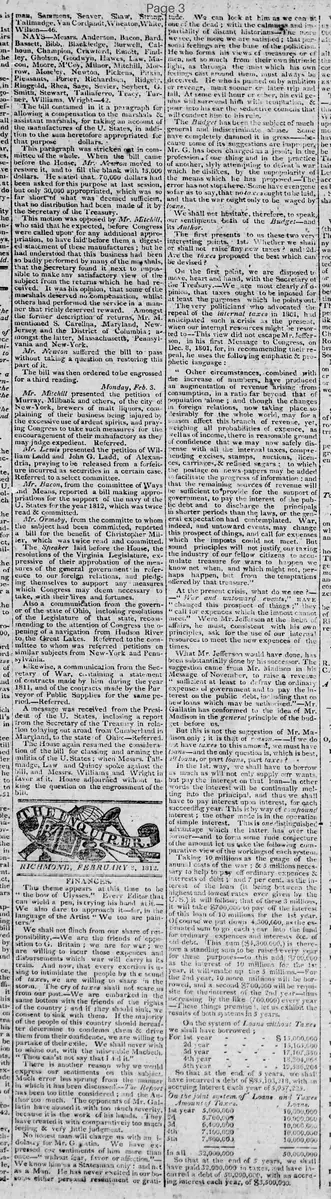
Taking 10 millions as the gauge of the annual costs of the war; & 5 millions necessary to help to pay off ordinary expences & interests of debt; and 7 per cent. as the interest of the loan (it being between the highest and lowest rates ever given by the U. S.) it will follow; that of these 15 millions, it will take 700,000 to pay off the interest of this loan of 10 millions for the 1st year. Of course we put down 4,300,000, as the estimated sum to go each year into the fund for ordinary expences and interests &c. of old debt. This sum (4,300,000,) is therefore a standing sum to be raised every year for these purposes--to this add, 700,000 as the interest of 10 millions for the 1st year, it will make up the 5 millions.--For the 2nd year, 10 more millions will be borrowed, and a second 700,000 will be requisite for the interest of the 2nd year--thus increasing by the like (700,000) every year--These things premise, let us exhibit the results of both systems in 5 years.
On the system of Loans without Taxes we shall have borrowed;
For 1st year $11,000,000
2d year 13,105,600
3d year 17,107,350
4th year 18,304,864
5th year 19,586,204
So that at the end, of 5 years. we shall have incurred a debt of $78,103,218, with an accruing interest each year of 5,457,225.
On the joint system of Loans and Taxes $50,000,000
So that at the end of 5 years, we shall have paid 25,000,000 in taxes, and have incurred a debt of 50,000,000, with an accruing interest each year, of 3,500,000.
Whereas the former system would leave us in debt at the end of 5 years, only $56,000,000, -with an accruing interest thereafter of 3,920,000; being 1,437,225 less.
Thus in a word--by paying no taxes at all, we shall get in debt $28,000,000 more than the whole amount of taxes would have come to, if we had paid taxes--and besides we shall have incurred an accruing Interest of $1,957,225 each year, more than if we had paid taxes, as we went along.
This is one advantage of the last system -A second, and perhaps greater one is this; that the rate of interest will be, much less. Who will think, that if we give 7 per cent. upon a loan of 10 millions, we shall not give more for 15? Or. at least; that we shall have to give no more for the $19,850,000 to be raised the 5th year than for $10,000,000 to be uniformly raised. under the tax system? The more money we have to borrow, certainly the more we shall have to give for it Let then this circumstance be taken into account, and the advantage in favor of taxes becomes in fact incalculable.
So much for the main principle.--We shall resume this subject, in Our next.
FINANCES.
This theme appears at this time to be 'the bow of Ulysses.' Every Editor that can wield a pen, is trying his hand at it.--We also dare to approach it---for, in the language of the Artist 'We too are painters.'
We shall not flinch from our share of responsibility,--We are the friends of opposition to G. Britain; we are for war; we are willing to incur those expences and disbursements which war will carry in its train. And now, that every exertion is using to intimidate the people by the sound of taxes, we are willing to share in the storm. The cry of taxes shall not scare us from our post.--We are embarked in the same bottom with the friends of the rights of the country; and if they should sink, we consent to sink with them. If the majority of the people of this country should hereafter determine to condemn them & drive them from their confidence, we are willing to partake of their exile. We shall never wish to whine out, with the miserable Macbeth, 'Thou can'st not say that I had it.'
There is another reason why we would express our sentiments on this subject. Much error has sprung from the manner in which it has been discussed.--The Report has been too little considered; and the Author too much. The opponents of Mr. Gallatin have abused it with too much severity, because it is the work of his hands. They have treated it with comparatively too much feeling & very little judgment.
No honest man will charge us with an idolatry for Mr. Gallatin. We have expressed our sentiments of him more than once--'without fear, favor or affection.' We know him as a Statesman only: and not as a Man. He has never excited in our bosoms either personal resentment or gratitude. We can look at him as we can at one of the dead; with the calmness and impartiality of distant historians--the more we see, the more we are satisfied; that personal feelings are the bane of the politician. He who forms his views of measures or of men, not so much from their own intrinsic light, as through the mist which his own feelings cast around them, must always be deceived. He who is pushed on by ambition or revenge, must sooner or later trip and fall. At some evil hour or other, his evil genius will surround him with temptation, & pour into his ear the seductive councils that will conduct him to his ruin.
The Budget has been the subject of much general and indiscriminate abuse. Some have completely damned it in gross---because some of its suggestions are improper. Mr. G. has been charged as a jesuit; in the profession one thing and in the practice of another, slyly attempting to defeat a war which he dislikes, by the unpopularity of the means which he has proposed--The error has not stopped there. Some have even gone so far as to say, that no taxes ought to be laid, and that the war ought only to be waged by loans.
We shall not hesitate, therefore, to speak our sentiments, both of the Budget and its Author.
The first presents to us these two very interesting points: 1st. Whether we shall or shall not raise any new taxes? and 2d. Are the taxes proposed the best which can be devised?
On the first point, we are disposed to move, heart and hand, with the Secretary of the Treasury.--We are most clearly of opinion, that taxes ought to be imposed for at least the purposes which he points out. The very politicians who advocated the repeal of the internal taxes in 1801, had anticipated such a crisis as the present, when our internal resources might be resorted to--This view did not escape Mr. Jefferson, in his first Message to Congress, on Dec. 8, 1801, for, in recommending their repeal, he uses the following emphatic & prophetic language:
'Other circumstances, combined with the increase of numbers, have produced an augmentation of revenue arising from consumption, in a ratio far beyond that of population alone; and though the changes in foreign relations, now taking place so desirably for the whole world, may for a season affect this branch of revenue, yet, weighing all probabilities of expence, as well as of income, there is reasonable ground of confidence that we may now safely dispense with all the internal taxes, comprehending excises, stamps, auctions, licenses, carriages, & refined segars: to which the postage on news-papers may be added to facilitate the progress of information: and that the remaining sources of revenue will be sufficient to provide for the support of government, to pay the interest of the public debt and to discharge the principals in shorter periods than the laws, or the general expectation had contemplated. War, indeed, and untoward events, may change this prospect of things, and call for expences which the imposts could not meet.'--But sound principles will not justify our taxing the industry of our fellow citizens to accumulate treasure for wars to happen we know not when, and which might not, perhaps happen, but from the temptations offered by that treasure.
At the present crisis, what do we see?-- 'War and untoward events,' HAVE 'changed this prospect of things;' they 'call for expences which the impost cannot meet.' Were Mr. Jefferson at the helm of affairs, he must, consistent with his own principles, ask for the use of our internal resources to meet the new expences of the times.
What Mr. Jefferson would have done, has been substantially done by his successor. The suggestion came from Mr. Madison in his Message of November, to raise a revenue 'sufficient at least to defray the ordinary expenses of government and to pay the interest on the public debt, including that on new loans which may be authorised.'--Mr. Gallatin has conformed to the idea of Mr. Madison in the general principle of the budget before us.
But this is not the suggestion of Mr. Madison only; it is that of reason.--If we do not have taxes to this amount, we must have loans--and the only question is, which is best, all loans, or part loans, part taxes?
In the 1st. way, we shall have to borrow as much as will not only supply our wants, but pay the interest on that loan--in other words the interest will be continually melting into the principal, and thus we shall have to pay interest upon interest, for each succeeding year. This is by way of compound interest; the other mode is in the operation of simple interest. This is one distinguished advantage which the latter, has over the former--and to form some rude conjecture of the amount let us take the following comparative view of the workings of each system.
Taking 10 millions as the gauge of the annual costs of the war; & 5 millions necessary to help to pay off ordinary expences & interests of debt; and 7 per cent. as the interest of the loan (it being between the highest and lowest rates ever given by the U. S.) it will follow; that of these 15 millions, it will take 700,000 to pay off the interest of this loan of 10 millions for the 1st year. Of course we put down 4,300,000, as the estimated sum to go each year into the fund for ordinary expences and interests &c. of old debt. This sum (4,300,000,) is therefore a standing sum to be raised every year for these purposes--to this add, 700,000 as the interest of 10 millions for the 1st year, it will make up the 5 millions.--For the 2nd year, 10 more millions will be borrowed, and a second 700,000 will be requisite for the interest of the 2nd year--thus increasing by the like (700,000) every year--These things premise, let us exhibit the results of both systems in 5 years.
On the system of Loans without Taxes we shall have borrowed;
For 1st year $11,000,000
2d year 13,105,600
3d year 17,107,350
4th year 18,304,864
5th year 19,586,204
So that at the end, of 5 years. we shall have incurred a debt of $78,103,218, with an accruing interest each year of 5,457,225.
On the joint system of Loans and Taxes $50,000,000
So that at the end of 5 years, we shall have paid 25,000,000 in taxes, and have incurred a debt of 50,000,000, with an accruing interest each year, of 3,500,000.
Whereas the former system would leave us in debt at the end of 5 years, only $56,000,000, -with an accruing interest thereafter of 3,920,000; being 1,437,225 less.
Thus in a word--by paying no taxes at all, we shall get in debt $28,000,000 more than the whole amount of taxes would have come to, if we had paid taxes--and besides we shall have incurred an accruing Interest of $1,957,225 each year, more than if we had paid taxes, as we went along.
This is one advantage of the last system -A second, and perhaps greater one is this; that the rate of interest will be, much less. Who will think, that if we give 7 per cent. upon a loan of 10 millions, we shall not give more for 15? Or. at least; that we shall have to give no more for the $19,850,000 to be raised the 5th year than for $10,000,000 to be uniformly raised. under the tax system? The more money we have to borrow, certainly the more we shall have to give for it Let then this circumstance be taken into account, and the advantage in favor of taxes becomes in fact incalculable.
So much for the main principle.--We shall resume this subject, in Our next.
| Amount of Taxes. | Loans. |
| 1st year | 5,000,000 |
| 2nd | 5,700,000 |
| 3rd | 6,400,000 |
| 4th | 7,100,000 |
| 5th | 7,800,000 |
| Total | 33,000,000 |
What sub-type of article is it?
Economic Policy
Taxation
War Or Peace
What keywords are associated?
War Finances
Taxes Vs Loans
Gallatin Budget
Jefferson Message
Madison Revenue
Compound Interest
British Opposition
What entities or persons were involved?
Mr. Gallatin
Mr. Jefferson
Mr. Madison
G. Britain
Editorial Details
Primary Topic
Support For Taxes To Finance War With Britain
Stance / Tone
Pro War And Supportive Of Gallatin's Mixed Taxes And Loans Budget
Key Figures
Mr. Gallatin
Mr. Jefferson
Mr. Madison
G. Britain
Key Arguments
Taxes Necessary To Meet War Expenses Beyond Imposts
Mixed Taxes And Loans Prevent Compound Interest On Debt
Loans Alone Lead To Higher Debt And Interest Rates Over Time
Gallatin's Budget Aligns With Jefferson And Madison's Principles
Critics Abuse Budget Due To Personal Bias Against Gallatin